Chapter 2Frequency Distributions and Graphs
A frequency distribution is the organization of raw data in table from, using classes and frequency.
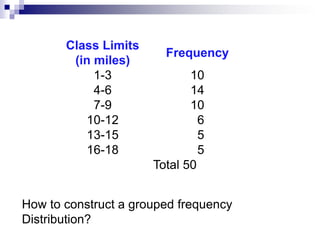
The number of miles that the employees of a large department store traveled to work each day
How to construct a grouped frequency Distribution?
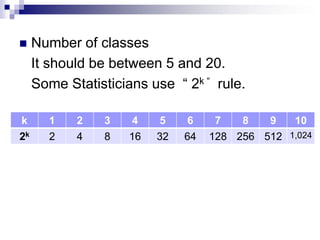
Number of classes It should be between 5 and 20.Some Statisticians use  “ 2k “  rule.
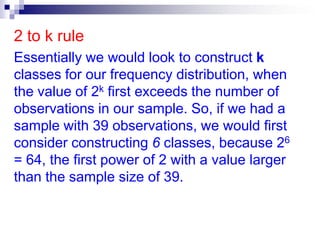
2 to k ruleEssentially we would look to construct k classes for our frequency distribution, when the value of 2k first exceeds the number of observations in our sample. So, if we had a sample with 39 observations, we would first consider constructing 6 classes, because 26 = 64, the first power of 2 with a value larger than the sample size of 39.
A guide, not a dictator.Strictly speaking the 2k rule is a guide, not a rule. If the 2k rule suggests you need 6 classes, also consider using 5 or 7 classes ... but certainly not 3 or 9.
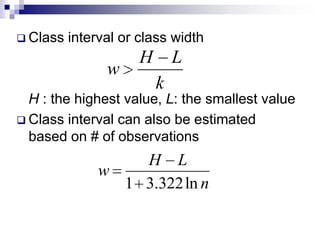
Class interval or class width	H : the highest value, L: the smallest valueClass interval can also be estimated based on # of observationsSelect the lower limit of the first class and set the limits of each classIt could be L  or any value smaller than L. It should be an even multiple of the class interval.
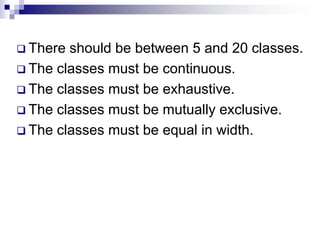
There should be between 5 and 20 classes.
The classes must be continuous.
The classes must be exhaustive.
The classes must be mutually exclusive.
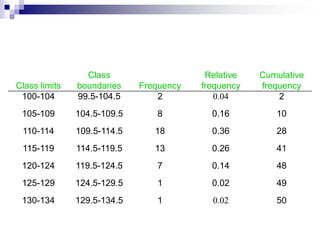
The classes must be equal in width.Relative frequencyRelative frequency of a class is the frequency of that class divided by to total number of frequency.ExampleThese data represent the record high temperatures for each of the 50 states. Construct a grouped frequency distribution for the data using 7 classes.
HistogramA histogram is a graph that displays the data by using contiguous vertical bars (unless the frequency of a class is 0) of various heights to represent the frequencies of the classes.
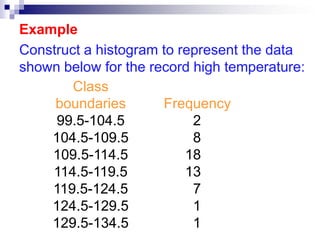
ExampleConstruct a histogram to represent the data shown below for the record high temperature:
18Histogram151296399.5109.5104.5124.5119.5114.5129.5The largest concentration is in the class 	109.5 – 114.5.
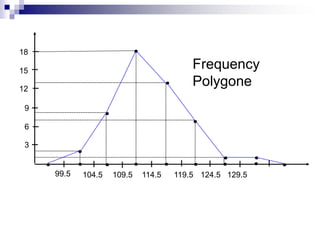
18Frequency Polygone151296399.5109.5104.5124.5119.5114.5129.5
The Ogive is a graph that represents the cumulative frequencies for the classes in a frequency distribution.
Cumulative Frequency Polygone504030201099.5109.5104.5124.5119.5114.5129.5
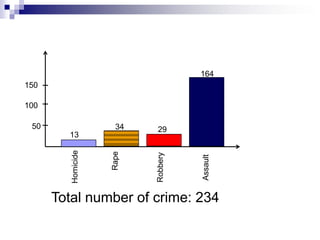
Other types of GraphsBar ChartBar Chart is use to represent a frequency distribution for a categorical variable, and the frequencies are displayed by the heights of vertical bars.
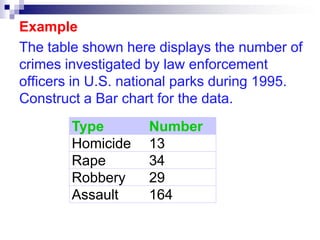
ExampleThe table shown here displays the number of crimes investigated by law enforcement officers in U.S. national parks during 1995. Construct a Bar chart for the data.
16415010050342913HomicideAssaultRapeRobberyTotal number of crime: 234
Pie Graph A pie graph is a circle that is divided into sections or wedges according to the percentage of frequencies in each category of the distribution.
ExampleThis frequency distribution shows the number of pounds of each snack food eaten during the 1998 Super Bowl. Construct a pie graph for the data.
We need to find percentages for each category and then compute the corresponding sectors so that we divide the circle proportionally.
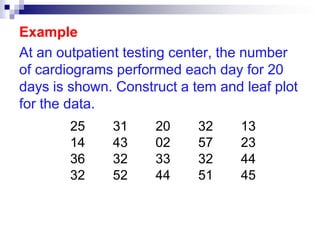
Stem and Leaf PlotsA stem and leaf plot is a data plot that uses part of the data value as the stem and part of the data value as the leaf to form groups or classes.
ExampleAt an outpatient testing center, the number of cardiograms performed each day for 20 days is shown. Construct a tem and leaf plot for the data.
It is helpful to arrange the data in order but it is not required.02, 13, 14, 20, 23, 25, 31, 32, 32, 32, 32, 33, 36, 43, 44, 44, 45, 51, 52, 57
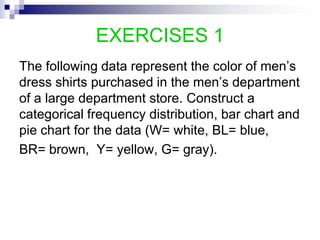
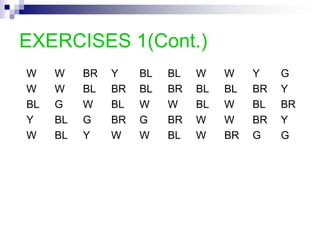
EXERCISES 1The following data represent the color of men’s dress shirts purchased in the men’s department of a large department store. Construct a categorical frequency distribution, bar chart and pie chart for the data (W= white, BL= blue, BR= brown,  Y= yellow, G= gray).
EXERCISES 1(Cont.)
EXERCISES 2The ages of the signers of the Declaration of Independence of the US are shown below.
EXERCISES 2 (Cont.)Construct a frequency distribution using seven classes. Include relative frequency, percentage and Cumulative frequency.Construct a histogram, frequency poly-gone, and Ogive.Develop a stem-and-leaf plot for the data.

Chapter 2: Frequency Distribution and Graphs

  • 1.
  • 2.
    A frequency distributionis the organization of raw data in table from, using classes and frequency.
  • 3.
    The number ofmiles that the employees of a large department store traveled to work each day
  • 4.
    How to constructa grouped frequency Distribution?
  • 5.
    Number of classesIt should be between 5 and 20.Some Statisticians use “ 2k “ rule.
  • 6.
    2 to kruleEssentially we would look to construct k classes for our frequency distribution, when the value of 2k first exceeds the number of observations in our sample. So, if we had a sample with 39 observations, we would first consider constructing 6 classes, because 26 = 64, the first power of 2 with a value larger than the sample size of 39.
  • 7.
    A guide, nota dictator.Strictly speaking the 2k rule is a guide, not a rule. If the 2k rule suggests you need 6 classes, also consider using 5 or 7 classes ... but certainly not 3 or 9.
  • 8.
    Class interval orclass width H : the highest value, L: the smallest valueClass interval can also be estimated based on # of observationsSelect the lower limit of the first class and set the limits of each classIt could be L or any value smaller than L. It should be an even multiple of the class interval.
  • 9.
    There should bebetween 5 and 20 classes.
  • 10.
    The classes mustbe continuous.
  • 11.
    The classes mustbe exhaustive.
  • 12.
    The classes mustbe mutually exclusive.
  • 13.
    The classes mustbe equal in width.Relative frequencyRelative frequency of a class is the frequency of that class divided by to total number of frequency.ExampleThese data represent the record high temperatures for each of the 50 states. Construct a grouped frequency distribution for the data using 7 classes.
  • 15.
    HistogramA histogram isa graph that displays the data by using contiguous vertical bars (unless the frequency of a class is 0) of various heights to represent the frequencies of the classes.
  • 16.
    ExampleConstruct a histogramto represent the data shown below for the record high temperature:
  • 17.
  • 18.
  • 19.
    The Ogive isa graph that represents the cumulative frequencies for the classes in a frequency distribution.
  • 21.
  • 22.
    Other types ofGraphsBar ChartBar Chart is use to represent a frequency distribution for a categorical variable, and the frequencies are displayed by the heights of vertical bars.
  • 23.
    ExampleThe table shownhere displays the number of crimes investigated by law enforcement officers in U.S. national parks during 1995. Construct a Bar chart for the data.
  • 24.
  • 25.
    Pie Graph Apie graph is a circle that is divided into sections or wedges according to the percentage of frequencies in each category of the distribution.
  • 26.
    ExampleThis frequency distributionshows the number of pounds of each snack food eaten during the 1998 Super Bowl. Construct a pie graph for the data.
  • 27.
    We need tofind percentages for each category and then compute the corresponding sectors so that we divide the circle proportionally.
  • 29.
    Stem and LeafPlotsA stem and leaf plot is a data plot that uses part of the data value as the stem and part of the data value as the leaf to form groups or classes.
  • 30.
    ExampleAt an outpatienttesting center, the number of cardiograms performed each day for 20 days is shown. Construct a tem and leaf plot for the data.
  • 31.
    It is helpfulto arrange the data in order but it is not required.02, 13, 14, 20, 23, 25, 31, 32, 32, 32, 32, 33, 36, 43, 44, 44, 45, 51, 52, 57
  • 32.
    EXERCISES 1The followingdata represent the color of men’s dress shirts purchased in the men’s department of a large department store. Construct a categorical frequency distribution, bar chart and pie chart for the data (W= white, BL= blue, BR= brown, Y= yellow, G= gray).
  • 33.
  • 34.
    EXERCISES 2The agesof the signers of the Declaration of Independence of the US are shown below.
  • 35.
    EXERCISES 2 (Cont.)Constructa frequency distribution using seven classes. Include relative frequency, percentage and Cumulative frequency.Construct a histogram, frequency poly-gone, and Ogive.Develop a stem-and-leaf plot for the data.