FDT
  Relative Freq. &
Cumulative Frequency

   Shut Down


Start
Frequency Distribution Table (FDT)


• It is a grouping of all the (numerical) observations into
  intervals or classes together with a count of the number
      of observations that fall in each interval or class.


End                                                      Next
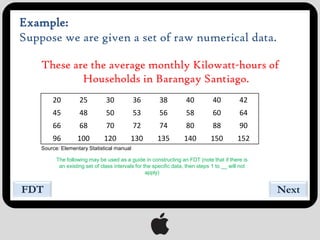
Example:
Suppose we are given a set of raw numerical data.

    These are the average monthly Kilowatt-hours of
            Households in Barangay Santiago.
        20          25          30          36          38          40          40          42
        45          48          50          53          56          58          60          64
        66          68          70          72          74          80          88          90
        96         100         120         130         135         140         150         152
    Source: Elementary Statistical manual

          The following may be used as a guide in constructing an FDT (note that if there is
           an existing set of class intervals for the specific data, then steps 1 to __ will not
                                                   apply)


FDT                                                                                                Next
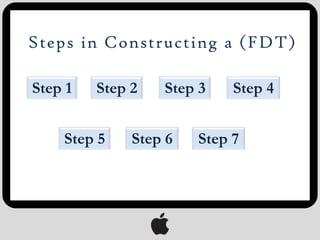
Steps in Constructing a (FDT)

Step 1   Step 2   Step 3    Step 4


    Step 5    Step 6   Step 7
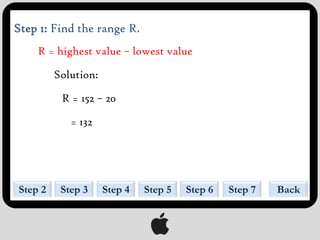
Step 1: Find the range R.
    R = highest value – lowest value

         Solution:

          R = 152 – 20

            = 132


Step 2    Step 3     Step 4   Step 5   Step 6   Step 7   Back
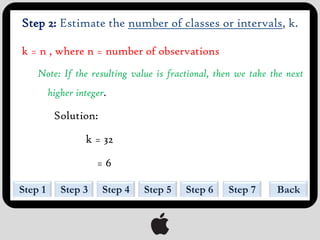
Step 2: Estimate the number of classes or intervals, k.

k = n , where n = number of observations
    Note: If the resulting value is fractional, then we take the next
         higher integer.

          Solution:

                  k = 32

                     =6

Step 1      Step 3    Step 4   Step 5   Step 6    Step 7      Back
Step 3: Estimate the class width c of each interval.

c = R/k
   Note: Round off the answer to the same number of decimal places
     that the observations have.

         Solution:
               c = 132/6
                   = 22
Step 1    Step 2     Step 4   Step 5   Step 6    Step 7      Back
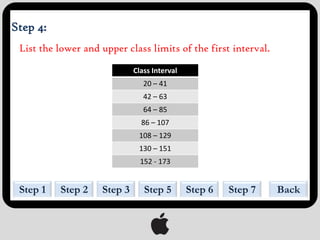
Step 4:
 List the lower and upper class limits of the first interval.

                             Class Interval
                                20 – 41
                                42 – 63
                                64 – 85
                               86 – 107
                              108 – 129
                              130 – 151
                               152 - 173


 Step 1   Step 2    Step 3      Step 5        Step 6   Step 7   Back
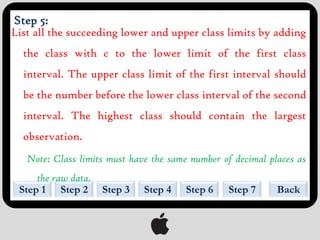
Step 5:
List all the succeeding lower and upper class limits by adding
  the class with c to the lower limit of the first class
  interval. The upper class limit of the first interval should
  be the number before the lower class interval of the second
  interval. The highest class should contain the largest
  observation.
   Note: Class limits must have the same number of decimal places as
     the raw data.
 Step 1 Step 2       Step 3   Step 4   Step 6    Step 7      Back
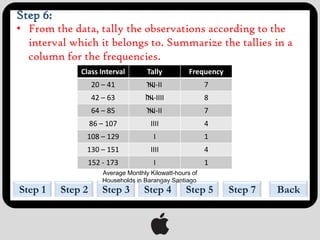
Step 6:
• From the data, tally the observations according to the
  interval which it belongs to. Summarize the tallies in a
  column for the frequencies.
              Class Interval          Tally          Frequency
                   20 – 41            IIII-II              7
                   42 – 63           IIII-IIII             8
                   64 – 85            IIII-II              7
                   86 – 107            IIII                4
               108 – 129                 I                 1
               130 – 151               IIII                4
                   152 - 173             I                 1
                       Average Monthly Kilowatt-hours of
                       Households in Barangay Santiago
Step 1    Step 2       Step 3        Step 4         Step 5       Step 7   Back
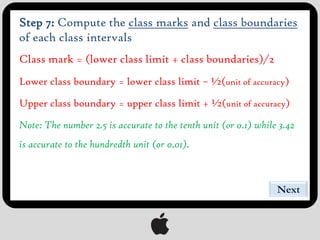
Step 7: Compute the class marks and class boundaries
of each class intervals
Class mark = (lower class limit + class boundaries)/2
Lower class boundary = lower class limit – ½(unit of accuracy)

Upper class boundary = upper class limit + ½(unit of accuracy)

Note: The number 2.5 is accurate to the tenth unit (or 0.1) while 3.42
is accurate to the hundredth unit (or 0.01).


                                                                 Next
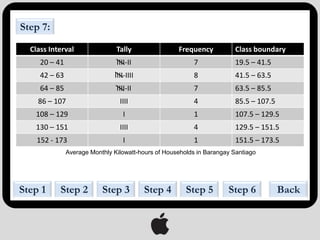
Step 7:

  Class Interval                Tally                Frequency          Class boundary
     20 – 41                    IIII-II                   7             19.5 – 41.5
     42 – 63                   IIII-IIII                  8             41.5 – 63.5
     64 – 85                    IIII-II                   7             63.5 – 85.5
    86 – 107                     IIII                     4             85.5 – 107.5
   108 – 129                       I                      1             107.5 – 129.5
   130 – 151                     IIII                     4             129.5 – 151.5
    152 - 173                      I                      1             151.5 – 173.5
               Average Monthly Kilowatt-hours of Households in Barangay Santiago


Step 1     Step 2          Step 3          Step 4       Step 5        Step 6           Back
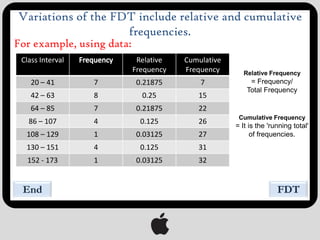
Variations of the FDT include relative and cumulative
                    frequencies.
For example, using data:
 Class Interval             Relative   Cumulative
                           Frequency   Frequency       Relative Frequency
    20 – 41       7         0.21875        7             = Frequency/
                                                        Total Frequency
    42 – 63       8          0.25         15
    64 – 85       7         0.21875       22
                                                     Cumulative Frequency
   86 – 107       4          0.125        26
                                                    = It is the 'running total'
  108 – 129       1         0.03125       27              of frequencies.
  130 – 151       4          0.125        31
   152 - 173      1         0.03125       32


 End                                                               FDT

frequency distribution table

  • 2.
    FDT RelativeFreq. & Cumulative Frequency Shut Down Start
  • 3.
    Frequency Distribution Table(FDT) • It is a grouping of all the (numerical) observations into intervals or classes together with a count of the number of observations that fall in each interval or class. End Next
  • 4.
    Example: Suppose we aregiven a set of raw numerical data. These are the average monthly Kilowatt-hours of Households in Barangay Santiago. 20 25 30 36 38 40 40 42 45 48 50 53 56 58 60 64 66 68 70 72 74 80 88 90 96 100 120 130 135 140 150 152 Source: Elementary Statistical manual The following may be used as a guide in constructing an FDT (note that if there is an existing set of class intervals for the specific data, then steps 1 to __ will not apply) FDT Next
  • 5.
    Steps in Constructinga (FDT) Step 1 Step 2 Step 3 Step 4 Step 5 Step 6 Step 7
  • 6.
    Step 1: Findthe range R. R = highest value – lowest value Solution: R = 152 – 20 = 132 Step 2 Step 3 Step 4 Step 5 Step 6 Step 7 Back
  • 7.
    Step 2: Estimatethe number of classes or intervals, k. k = n , where n = number of observations Note: If the resulting value is fractional, then we take the next higher integer. Solution: k = 32 =6 Step 1 Step 3 Step 4 Step 5 Step 6 Step 7 Back
  • 8.
    Step 3: Estimatethe class width c of each interval. c = R/k Note: Round off the answer to the same number of decimal places that the observations have. Solution: c = 132/6 = 22 Step 1 Step 2 Step 4 Step 5 Step 6 Step 7 Back
  • 9.
    Step 4: Listthe lower and upper class limits of the first interval. Class Interval 20 – 41 42 – 63 64 – 85 86 – 107 108 – 129 130 – 151 152 - 173 Step 1 Step 2 Step 3 Step 5 Step 6 Step 7 Back
  • 10.
    Step 5: List allthe succeeding lower and upper class limits by adding the class with c to the lower limit of the first class interval. The upper class limit of the first interval should be the number before the lower class interval of the second interval. The highest class should contain the largest observation. Note: Class limits must have the same number of decimal places as the raw data. Step 1 Step 2 Step 3 Step 4 Step 6 Step 7 Back
  • 11.
    Step 6: • Fromthe data, tally the observations according to the interval which it belongs to. Summarize the tallies in a column for the frequencies. Class Interval Tally Frequency 20 – 41 IIII-II 7 42 – 63 IIII-IIII 8 64 – 85 IIII-II 7 86 – 107 IIII 4 108 – 129 I 1 130 – 151 IIII 4 152 - 173 I 1 Average Monthly Kilowatt-hours of Households in Barangay Santiago Step 1 Step 2 Step 3 Step 4 Step 5 Step 7 Back
  • 12.
    Step 7: Computethe class marks and class boundaries of each class intervals Class mark = (lower class limit + class boundaries)/2 Lower class boundary = lower class limit – ½(unit of accuracy) Upper class boundary = upper class limit + ½(unit of accuracy) Note: The number 2.5 is accurate to the tenth unit (or 0.1) while 3.42 is accurate to the hundredth unit (or 0.01). Next
  • 13.
    Step 7: Class Interval Tally Frequency Class boundary 20 – 41 IIII-II 7 19.5 – 41.5 42 – 63 IIII-IIII 8 41.5 – 63.5 64 – 85 IIII-II 7 63.5 – 85.5 86 – 107 IIII 4 85.5 – 107.5 108 – 129 I 1 107.5 – 129.5 130 – 151 IIII 4 129.5 – 151.5 152 - 173 I 1 151.5 – 173.5 Average Monthly Kilowatt-hours of Households in Barangay Santiago Step 1 Step 2 Step 3 Step 4 Step 5 Step 6 Back
  • 14.
    Variations of theFDT include relative and cumulative frequencies. For example, using data: Class Interval Relative Cumulative Frequency Frequency Relative Frequency 20 – 41 7 0.21875 7 = Frequency/ Total Frequency 42 – 63 8 0.25 15 64 – 85 7 0.21875 22 Cumulative Frequency 86 – 107 4 0.125 26 = It is the 'running total' 108 – 129 1 0.03125 27 of frequencies. 130 – 151 4 0.125 31 152 - 173 1 0.03125 32 End FDT