OBJECTIV
E:
Illustrates a probability
distribution for a discrete
random variable and its
properties.
RANDOM
VARIABLE
It is a numeric
variable from a
random experiment
that can take on
Discrete
Probability
Distribution
A discrete probability
distribution lists each
possible value the random
variable can assume,
along with the probability
for that value.
Toss two fair coin and let X
be the number of heads
observed. Find the
probability distribution of
X.
Example 1
Coin 1 Coin 2
H H
H T
T H
T T
x
2
1
1
0
P(X=x)
1/4
1/4
1/4
1/4
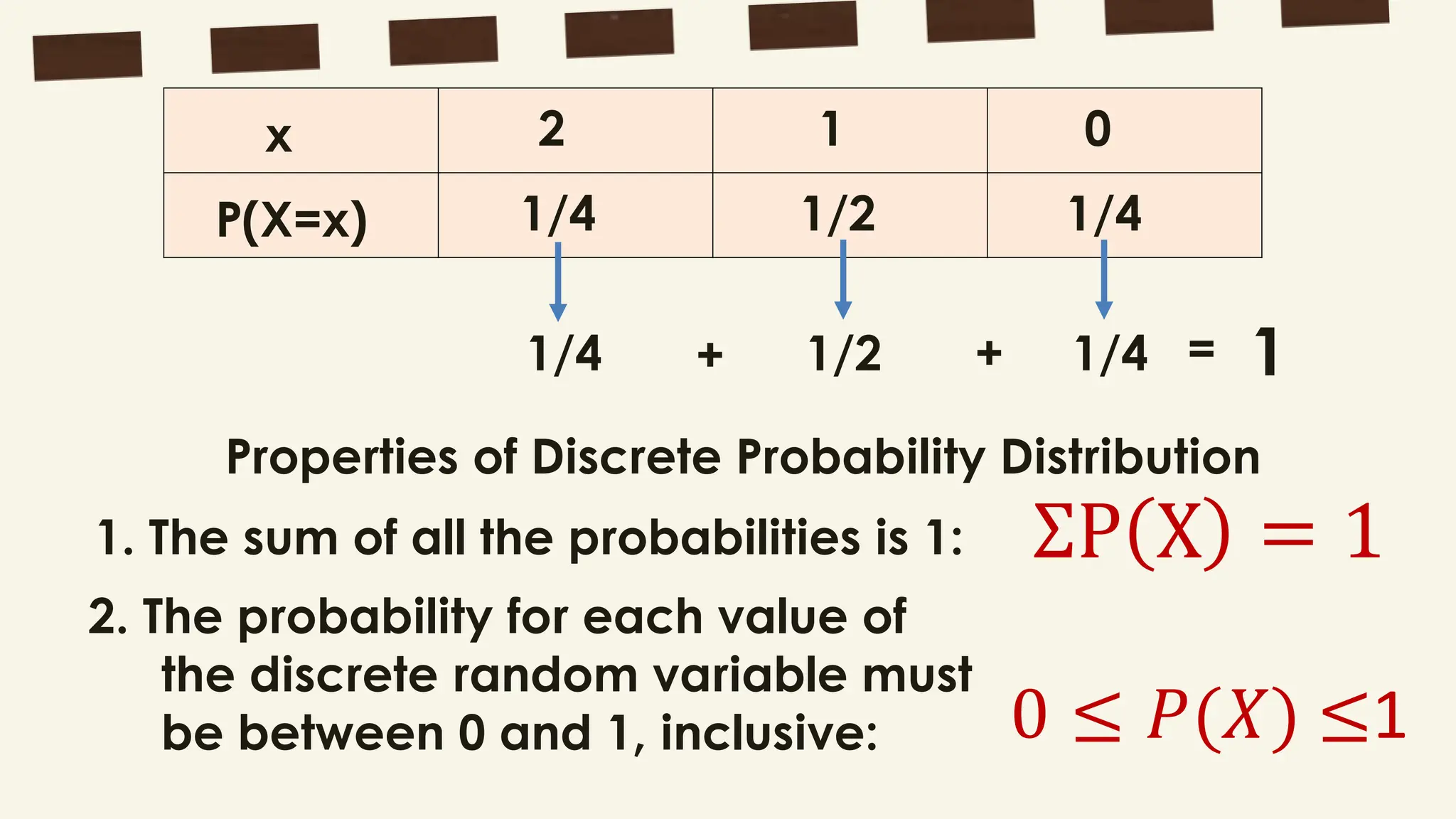
x
P(X=x)
2
1/4
1
1/2
0
1/4
x
P(X=x)
2
1/4
1
1/2
0
1/4
1/4 1/2 1/4
+ + = 1
Properties of Discrete Probability Distribution
1. The sum of all the probabilities is 1:
2. The probability for each value of
the discrete random variable must
be between 0 and 1, inclusive:
ΣP X = 1
0 ≤ 𝑃(𝑋) ≤1
Flip 3 coins at the same
time. Let random
variable X be the heads
showing.
Example 2
DISCRETE PROBABILITY DISTRIBUTION
HHH
HHT
HTH
THH
HTT
THT
TTH
TTT
3 heads
2 heads
2 heads
2 heads
1 head
1 head
1 head
0 head
x
P(X=x)
0
1/8
1
3/8
3
1/8
DISCRETE PROBABILITY DISTRIBUTION
HHH
HHT
HTH
THH
HTT
THT
TTH
TTT
3 heads
2 heads
2 heads
2 heads
1 head
1 head
1 head
0 head
2
3/8
heads
Probability distribution
for X, sum of 2 rolled
dice.
Example 3
DISCRETE PROBABILITY DISTRIBUTION
x
P(X=x)
2 3 4 5 6 7 8 9 10 11 12
1/36 2/36 3/36 4/36 5/36 6/36 5/36 4/36 3/36 2/36 1/36
The discrete random variable Y has
probability distribution as shown
Example 4
Y
P(Y)
-3 -2 -1 0 1
0.1 0.25 0.3 0.15 c
Find:
a. The value of c
b. P(-3≤ 𝑌 < 0)
c. P(𝑌 > −3)
d. P(-3< 𝑌 < 1)
e. The mode
The probability distribution of a
random variable X, is given by
𝑃 𝑋 = 𝑥 = 𝑐𝑥2
, 𝑓𝑜𝑟 𝑥 = 0, 1, 2, 3, 4.
Given that c is a constant, find the
value of c.
Example 5
The probability distribution of a random variable X,
is given by 𝑃 𝑋 = 𝑥 = 𝑐𝑥2
, 𝑓𝑜𝑟 𝑥 = 0, 1, 2, 3, 4.
Given that c is a constant, find the value of c.
Example 5
X
P(X=x)
0 1 2 3 4
0 c 4c 9c 16c
A. Construct a probability distribution in tabular form
for the random variable described in
each situation.
1. A shipment five computers contains two
that are slightly defective. A retailer
receives three of these computers at
random. Let Z represent the number of
computers purchased by the retailer
which are slightly defective.
2. Make a probability distribution table for
the numbers on the spinning wheel. Let
X be the number on the wheel.
B. Determine whether the distribution represents a
probability distribution for a discrete
random variable.
1. A shipment five computers contains two that are slightly
defective. A retailer receives three of these computers at
random. Let Z represent the number of computers purchased
by the retailer which are slightly defective.
2. Make a probability distribution table for the numbers
on the spinning wheel. Let X be the number on the
wheel.
B. Determine whether the distribution represents a
probability distribution for a discrete
random variable.
NO
YES
YES
NO
NO

2 DISCRETE PROBABILITY DISTRIBUTION.pptx

Editor's Notes

  • #4 In algebra – variable ( values that can change) In statistics – random variable is a variable whose value is determined by random experiment.
  • #5 Emphasize – both discrete and continuous random variables have distribution. Discrete probability distribution – table, graph, formulas or equation
  • #7 x - represent the possible values of outcomes (heads) it can take P(X = x) notation – the probability of the variable X takes small letter x or
  • #8 x - represent the possible values of outcomes (heads) it can take P(X = x) notation – the probability of the variable X takes small letter x or
  • #10 x - represent the possible values of outcomes (heads) it can take P(X = x) notation – the probability of the variable X takes small letter x or
  • #11 x - represent the possible values of outcomes (heads) it can take P(X = x) notation – the probability of the variable X takes small letter x or
  • #13 x - represent the possible values of outcomes (heads) it can take P(X = x) notation – the probability of the variable X takes small letter x or
  • #19 x - represent the possible values of outcomes (heads) it can take P(X = x) notation – the probability of the variable X takes small letter x or
  • #20 x - represent the possible values of outcomes (heads) it can take P(X = x) notation – the probability of the variable X takes small letter x or
  • #21 x - represent the possible values of outcomes (heads) it can take P(X = x) notation – the probability of the variable X takes small letter x or
  • #22 x - represent the possible values of outcomes (heads) it can take P(X = x) notation – the probability of the variable X takes small letter x or
  • #23 x - represent the possible values of outcomes (heads) it can take P(X = x) notation – the probability of the variable X takes small letter x or
  • #24 x - represent the possible values of outcomes (heads) it can take P(X = x) notation – the probability of the variable X takes small letter x or
  • #25 x - represent the possible values of outcomes (heads) it can take P(X = x) notation – the probability of the variable X takes small letter x or
  • #26 x - represent the possible values of outcomes (heads) it can take P(X = x) notation – the probability of the variable X takes small letter x or