Sorensen’s pH scale,
pH determination
by electrometric
and calorimetric
Presented by-
Prof. Mirza Salman Baig
Assistant Professor in Pharmaceutics
Dissociation constant (Kw)
• In any aqueous solution at a given temperature (Dissociation
constant = Kw)
• [H+] = [OH-] = 1.0 x 10⁻⁷ M
• [1.0 x 10⁻⁷][1.0 x 10⁻⁷] = 1.0 x 10⁻¹⁴
• Kw = [H+] [OH-]
• Acids
• [H+] increases and [OH-] decreases
• Bases
• [OH-] increases and [H+] decreases
Sorensen’s pH scale
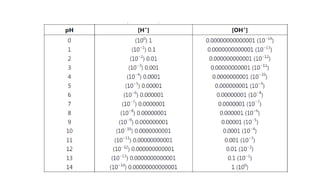
• pH = − log [H+]
• where, log is a base −10 logarithm and [H+] is the
concentration of hydrogen ions in moles per litre of solution.
• pOH = − log [OH-]
Sorensen’s pH scale
• Danish biochemist Soren Sorensen in 1909 developed the pH scale and
introduced pH definition as minus (−) logarithm of [H+] to the base 10.
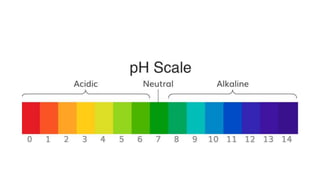
• A pH of 7 is considered as “neutral”, because the concentration of
hydrogen ions is exactly equal to the concentration of hydroxide (OH−)
ions produced by dissociation of the water.
• The hydrogen ion concentration in pure water at room temperature is
about 1 × 10⁻⁷ M .
• Increasing the concentration of hydrogen ions above 1 × 10⁻⁷ M produces
a solution with a pH of less than 7, and the solution is considered as
“acidic”.
• On other hand decreasing the concentration of hydrogen ions below 1 ×
10−7 M produces a solution with a pH above 7, and the solution is
considered “alkaline” or “basic”.
Methods of pH
determination
Electrometric method
Colorimetric method
Electrometric method
(glass electrode for pH)
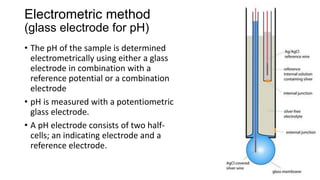
• The pH of the sample is determined
electrometrically using either a glass
electrode in combination with a
reference potential or a combination
electrode
• pH is measured with a potentiometric
glass electrode.
• A pH electrode consists of two half-
cells; an indicating electrode and a
reference electrode.
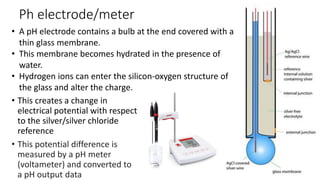
Ph electrode/meter
• This creates a change in
electrical potential with respect
to the silver/silver chloride
reference
• This potential difference is
measured by a pH meter
(voltameter) and converted to
a pH output data
• A pH electrode contains a bulb at the end covered with a
thin glass membrane.
• This membrane becomes hydrated in the presence of
water.
• Hydrogen ions can enter the silicon-oxygen structure of
the glass and alter the charge.
Colorimetric method
• The basis of colorimetric analysis is the variation in the intensity of the color of a
solution with changes in ion concentration (or pH).
• ​The color may be due to an inherent property of the constituent itself (e.g. is
purple) or it may be due to the formation of a coloured compound as the result
of the addition of a suitable reagent which is called as an indicator.
• ​By comparing the intensity of the color of a solution of unknown pH with the
intensities of solutions of known pH, the pH of an unknown solution may be
determined.
• Certain organic substances change color in dilute solution when the hydrogen ion
concentration reaches a particular value.
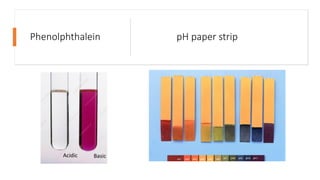
• For example, phenolphthalein is a colorless substance in any aqueous solution
with a hydrogen ion concentration while it become pink at pH more than 7
(alkaline)
Phenolphthalein pH paper strip
Acidic Basic
Thank you

Sorensen's pH scale SB

  • 1.
    Sorensen’s pH scale, pHdetermination by electrometric and calorimetric Presented by- Prof. Mirza Salman Baig Assistant Professor in Pharmaceutics
  • 2.
    Dissociation constant (Kw) •In any aqueous solution at a given temperature (Dissociation constant = Kw) • [H+] = [OH-] = 1.0 x 10⁻⁷ M • [1.0 x 10⁻⁷][1.0 x 10⁻⁷] = 1.0 x 10⁻¹⁴ • Kw = [H+] [OH-] • Acids • [H+] increases and [OH-] decreases • Bases • [OH-] increases and [H+] decreases
  • 4.
    Sorensen’s pH scale •pH = − log [H+] • where, log is a base −10 logarithm and [H+] is the concentration of hydrogen ions in moles per litre of solution. • pOH = − log [OH-]
  • 5.
    Sorensen’s pH scale •Danish biochemist Soren Sorensen in 1909 developed the pH scale and introduced pH definition as minus (−) logarithm of [H+] to the base 10. • A pH of 7 is considered as “neutral”, because the concentration of hydrogen ions is exactly equal to the concentration of hydroxide (OH−) ions produced by dissociation of the water. • The hydrogen ion concentration in pure water at room temperature is about 1 × 10⁻⁷ M . • Increasing the concentration of hydrogen ions above 1 × 10⁻⁷ M produces a solution with a pH of less than 7, and the solution is considered as “acidic”. • On other hand decreasing the concentration of hydrogen ions below 1 × 10⁻⁷ M produces a solution with a pH above 7, and the solution is considered “alkaline” or “basic”.
  • 7.
  • 8.
    Electrometric method (glass electrodefor pH) • The pH of the sample is determined electrometrically using either a glass electrode in combination with a reference potential or a combination electrode • pH is measured with a potentiometric glass electrode. • A pH electrode consists of two half- cells; an indicating electrode and a reference electrode.
  • 9.
    Ph electrode/meter • Thiscreates a change in electrical potential with respect to the silver/silver chloride reference • This potential difference is measured by a pH meter (voltameter) and converted to a pH output data • A pH electrode contains a bulb at the end covered with a thin glass membrane. • This membrane becomes hydrated in the presence of water. • Hydrogen ions can enter the silicon-oxygen structure of the glass and alter the charge.
  • 10.
    Colorimetric method • Thebasis of colorimetric analysis is the variation in the intensity of the color of a solution with changes in ion concentration (or pH). • ​The color may be due to an inherent property of the constituent itself (e.g. is purple) or it may be due to the formation of a coloured compound as the result of the addition of a suitable reagent which is called as an indicator. • ​By comparing the intensity of the color of a solution of unknown pH with the intensities of solutions of known pH, the pH of an unknown solution may be determined. • Certain organic substances change color in dilute solution when the hydrogen ion concentration reaches a particular value. • For example, phenolphthalein is a colorless substance in any aqueous solution with a hydrogen ion concentration while it become pink at pH more than 7 (alkaline)
  • 11.
    Phenolphthalein pH paperstrip Acidic Basic
  • 12.