• DISSOCIATION CONSTANT
• Definition: tendency of a particular substance in solution is to
reversibly dissociate into ions.
• Also know as ionization constant.
• It is equal to the product of respective ion concentration non ionic
molecule.
• The greater the dissociation constant of the acid, the stronger is the is
the acid
• Ka or acid dissociation constant is a quantitative measurement
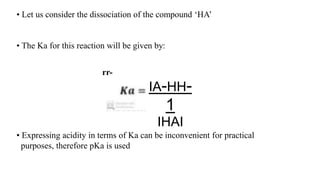
• Let us consider the dissociation of the compound ‘HA’
• The Ka for this reaction will be given by:
rr-
IA-HH-
1
IHAI
• Expressing acidity in terms of Ka can be inconvenient for practical
purposes, therefore pKa is used
• Degree of ionization depends on pH
• Henderson-Hasselbalch equation:
• For basic compounds:
pH = pKa +
[Ionized]
un-ionized]
• For acidic compounds:
pH = pKa +
[un-ionized]
[ionizeds]
□
Determination
1. Conductivity method.
2. Solubility method.
3. Potentiometric method.
1. Conductivity method
• The law is based on the fact that only a portion of electrolyte is
dissociated into ions at ordinary dilution and completely at infinite
dilution.
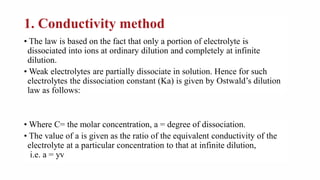
• Weak electrolytes are partially dissociate in solution. Hence for such
electrolytes the dissociation constant (Ka) is given by Ostwald’s dilution
law as follows:
• Where C= the molar concentration, a = degree of dissociation.
• The value of a is given as the ratio of the equivalent conductivity of the
electrolyte at a particular concentration to that at infinite dilution,
i.e. a = yv
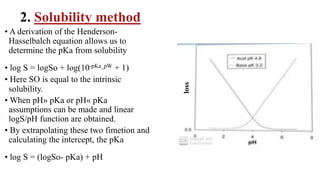
2. Solubility method
• A derivation of the Henderson-
Hasselbalch equation allows us to
determine the pKa from solubility
• log S = logSo + log(10-pKa_pW + 1)
• Here SO is equal to the intrinsic
solubility.
• When pH» pKa or pH« pKa
assumptions can be made and linear
logS/pH function are obtained.
• By extrapolating these two fimetion and
calculating the intercept, the pKa
• log S = (logSo- pKa) + pH
loss
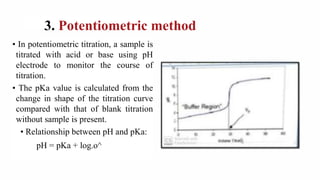
3. Potentiometric method
• In potentiometric titration, a sample is
titrated with acid or base using pH
electrode to monitor the course of
titration.
• The pKa value is calculated from the
change in shape of the titration curve
compared with that of blank titration
without sample is present.
• Relationship between pH and pKa:
pH = pKa + log.o^
□ Application
1. Dissociation constant is incorporated in Henderson-Hasselbalch
equation to calculate the extent of ionization (or dissociation), i.e per cent
unionized and ionized fonns of drug.
2. The absorption of drugs in gastrointestinal tract can be predicted using
dissociation constant of the drug and pH at different sites of GIT.
3. The concentration of preservatives such as benzoic acid required to preserve
solution and emulsion can be prcdictcs.
REFERENCES
Physical Pharmaceutics
Author - Edword Showtton
Publisher - Oxford University Press(oup)
Edition - 2008
•https:"staticscience.com
• http://www.researchgate.net
THANKYOU

Dissociation Constant.

  • 2.
    • DISSOCIATION CONSTANT •Definition: tendency of a particular substance in solution is to reversibly dissociate into ions. • Also know as ionization constant. • It is equal to the product of respective ion concentration non ionic molecule. • The greater the dissociation constant of the acid, the stronger is the is the acid • Ka or acid dissociation constant is a quantitative measurement
  • 3.
    • Let usconsider the dissociation of the compound ‘HA’ • The Ka for this reaction will be given by: rr- IA-HH- 1 IHAI • Expressing acidity in terms of Ka can be inconvenient for practical purposes, therefore pKa is used
  • 4.
    • Degree ofionization depends on pH • Henderson-Hasselbalch equation: • For basic compounds: pH = pKa + [Ionized] un-ionized] • For acidic compounds: pH = pKa + [un-ionized] [ionizeds]
  • 5.
    □ Determination 1. Conductivity method. 2.Solubility method. 3. Potentiometric method.
  • 6.
    1. Conductivity method •The law is based on the fact that only a portion of electrolyte is dissociated into ions at ordinary dilution and completely at infinite dilution. • Weak electrolytes are partially dissociate in solution. Hence for such electrolytes the dissociation constant (Ka) is given by Ostwald’s dilution law as follows: • Where C= the molar concentration, a = degree of dissociation. • The value of a is given as the ratio of the equivalent conductivity of the electrolyte at a particular concentration to that at infinite dilution, i.e. a = yv
  • 7.
    2. Solubility method •A derivation of the Henderson- Hasselbalch equation allows us to determine the pKa from solubility • log S = logSo + log(10-pKa_pW + 1) • Here SO is equal to the intrinsic solubility. • When pH» pKa or pH« pKa assumptions can be made and linear logS/pH function are obtained. • By extrapolating these two fimetion and calculating the intercept, the pKa • log S = (logSo- pKa) + pH loss
  • 8.
    3. Potentiometric method •In potentiometric titration, a sample is titrated with acid or base using pH electrode to monitor the course of titration. • The pKa value is calculated from the change in shape of the titration curve compared with that of blank titration without sample is present. • Relationship between pH and pKa: pH = pKa + log.o^
  • 9.
    □ Application 1. Dissociationconstant is incorporated in Henderson-Hasselbalch equation to calculate the extent of ionization (or dissociation), i.e per cent unionized and ionized fonns of drug. 2. The absorption of drugs in gastrointestinal tract can be predicted using dissociation constant of the drug and pH at different sites of GIT. 3. The concentration of preservatives such as benzoic acid required to preserve solution and emulsion can be prcdictcs.
  • 10.
    REFERENCES Physical Pharmaceutics Author -Edword Showtton Publisher - Oxford University Press(oup) Edition - 2008 •https:"staticscience.com • http://www.researchgate.net THANKYOU