Suspension
Mr. Mirza Salman Baig
Assistant Professor (Pharmaceutics)
AIKTC, School of Pharmacy, New Panvel
Affiliated to University of Mumbai (INDIA)
Physical Pharmaceutics
Sem-4 PCI syllabus
Content
• Introduction
• Definition
• Features desired in pharmaceutical suspension
• Advantage/Disadvantages of pharmaceutical suspension
• Flocculated and deflocculated suspension
• Interfacial properties of suspending particles
• Settling in suspensions
• Effect of Brownian movement,
• Sedimentation of flocculated particles,
• Sedimentation parameters
• Formulation of suspensions
• Wetting of Particles,
• Controlled flocculation,
• Flocculation in structured vehicle
Introduction
Definition
Advantage/disadvantage
Desirable features
Flocculated / Deflocculated suspension
Definition
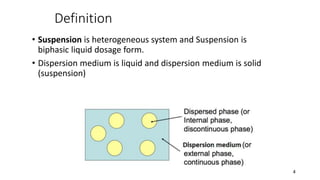
• Suspension is heterogeneous system and Suspension is
biphasic liquid dosage form.
• Dispersion medium is liquid and dispersion medium is solid
(suspension)
4
Features desired in Pharmaceutical Suspension
• Particles should settle slowly and should be readily
re-dispersed upon shaking of the container.
• The particle size of the suspensoid should remain
fairly constant throughout long periods of
undisturbed standing.
• The suspension should pour readily and evenly
from its container.
5
Applications of suspensions
• Drugs which degrade in aqueous solution may be suspended in a
non-aqueous phase. eg. Tetracycline hydrochloride is suspended
in a fractionated coconut oil for ophthalmic use.
• Lotions containing insoluble solids are formulated to leave a thin
coating of medicament on the skin. As the vehicle evaporates, it
gives a cooling effect and leaves the solid behind.eg calamine
lotion and sulphur lotion compound.
• Bulky, insoluble powders can be formulated as a suspension so
that they are easier to take eg Kaolin or chalk.
6
Advantages of suspensions
• Suspension can improve chemical stability of certain drug. E.g.
Procaine penicillin G
• Drug in suspension exhibits higher rate of bioavailability than
other dosage forms. bioavailability is in following order,
•
Solution > Suspension > Capsule > Compressed Tablet > Coated
tablet
• Duration and onset of action can be controlled. E.g. Protamine
Zinc-Insulin suspension
• Suspension can mask the unpleasant/ bitter taste of drug. E.g.
Chloramphenicol palmitate
7
Disadvantages of suspension
• Physical stability, sedimentation and compaction can causes
problems.
• It is bulky, therefore sufficient care must be taken during
handling and transport.
• It is difficult to formulate
• Uniform and accurate dose can not be achieved unless
suspension are packed in unit dosage form
8
Diffusible / in diffusible solid
1.DIFFUSIBLE SOLIDS– these sediment sufficiently slowly to enable
satisfactory dose removal after redispersion. eg. Light kaoline,
magnesium tricilicate
2.INDIFFUSIBLE SOLIDS- eg. sulphadimidine and chalk. These sediment
too rapidly and require the addition of other materials to reduce
sedimentation rate to an acceptable level.
9
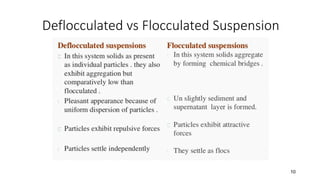
Deflocculated vs Flocculated Suspension
10
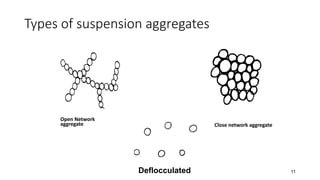
Types of suspension aggregates
Open Network
aggregate Close network aggregate
Deflocculated 11
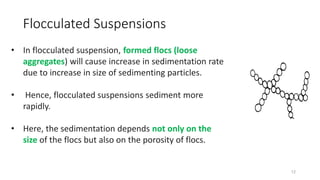
12
• In flocculated suspension, formed flocs (loose
aggregates) will cause increase in sedimentation rate
due to increase in size of sedimenting particles.
• Hence, flocculated suspensions sediment more
rapidly.
• Here, the sedimentation depends not only on the
size of the flocs but also on the porosity of flocs.
Flocculated Suspensions
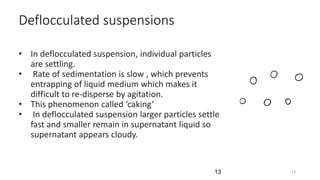
Deflocculated suspensions
• In deflocculated suspension, individual particles
are settling.
• Rate of sedimentation is slow , which prevents
entrapping of liquid medium which makes it
difficult to re-disperse by agitation.
• This phenomenon called ‘caking’
• In deflocculated suspension larger particles settle
fast and smaller remain in supernatant liquid so
supernatant appears cloudy.
13
13
Interfacial properties of
suspending particles
Surface free energy
Attractive force
Repulsive force & Zeta potential
DLVO theory
Interfacial properties of suspending particles
Surface free energy
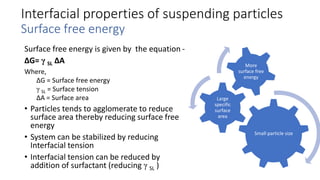
Surface free energy is given by the equation -
∆G= γ SL ∆A
Where,
∆G = Surface free energy
γ SL = Surface tension
∆A = Surface area
• Particles tends to agglomerate to reduce
surface area thereby reducing surface free
energy
• System can be stabilized by reducing
Interfacial tension
• Interfacial tension can be reduced by
addition of surfactant (reducing γ SL )
Small particle size
Large
specific
surface
area
More
surface free
energy
Interfacial properties of suspending particles
Attractive force
Keesom
force
• Permanent dipole –
Permanent dipole
Debye
force
• Permanent dipole -
induced dipole
London
force
• Induced dipole –
induced dipole
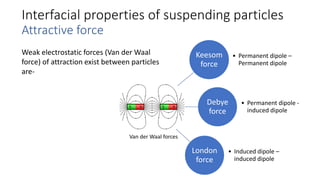
Van der Waal forces
Weak electrostatic forces (Van der Waal
force) of attraction exist between particles
are-
Interfacial properties of suspending particles
Repulsive force
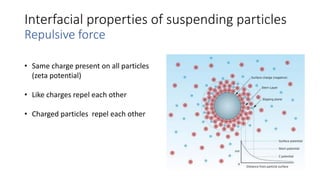
• Same charge present on all particles
(zeta potential)
• Like charges repel each other
• Charged particles repel each other
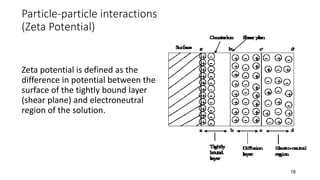
Particle-particle interactions
(Zeta Potential)
Zeta potential is defined as the
difference in potential between the
surface of the tightly bound layer
(shear plane) and electroneutral
region of the solution.
18
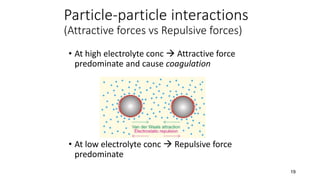
• At high electrolyte conc → Attractive force
predominate and cause coagulation
• At low electrolyte conc → Repulsive force
predominate
Particle-particle interactions
(Attractive forces vs Repulsive forces)
19
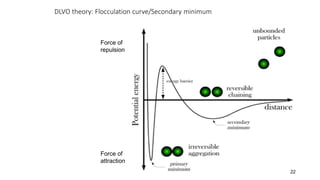
DLVO Theory
• It proposed that an energy barrier resulting from the electrostatic
repulsive force prevents two particles approaching one another and
adhering together.
• If the particles collide with sufficient energy to overcome the barrier,
the Van der Waals attractive force will attract them strongly and
cause them adhere together irreversibly.
• If the particles repel each other strongly, the dispersion will resist
coagulation and the dispersed system will be stable.
• If the repulsion is not sufficient then coagulation will take place.
DLVO theory
• DLVO theory was developed in the 1940s and named after the
• Russian scientists
• B. Derjaguin
• L. Landau,
• Dutch scientists
• E. Verwey
• J. Overbeek
DLVO theory: Flocculation curve/Secondary minimum
Force of
repulsion
Force of
attraction
22
Interparticle forces
• Van der Waals attractive forces
• Electrostatic repulsive force → Overlapping of diffusion layer.
• Repulsive forces due to hydration → Structuring of water at interface
(Physical barrier)
• Steric repulsive force → Because of adsorbent (Physical barrier)
23
Settling in suspension
Effect of Brownian movement,
Sedimentation of flocculated particles,
Sedimentation parameters
Sedimentation
• This is a phenomenon which occurs in dispersed system where the
dispersed particles settle to the bottom of the container because of
gravitational force.
• This occurs because the particles are too large to remain
permanently suspended in the vehicle.
• Therefore suitable suspending agents are added to retard this
process.
25
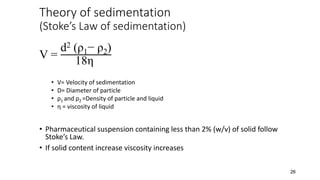
Theory of sedimentation
(Stoke’s Law of sedimentation)
V =
d2 (ρ1− ρ2)
18η
• V= Velocity of sedimentation
• D= Diameter of particle
• ρ1 and ρ2 =Density of particle and liquid
• η = viscosity of liquid
• Pharmaceutical suspension containing less than 2% (w/v) of solid follow
Stoke’s Law.
• If solid content increase viscosity increases
26
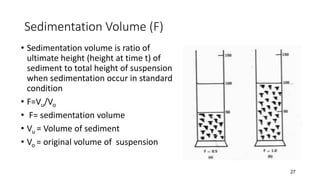
Sedimentation Volume (F)
• Sedimentation volume is ratio of
ultimate height (height at time t) of
sediment to total height of suspension
when sedimentation occur in standard
condition
• F=Vu/Vo
• F= sedimentation volume
• Vu = Volume of sediment
• Vo = original volume of suspension
27
28
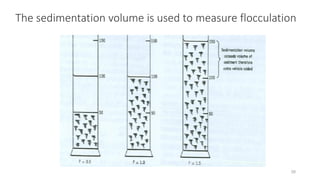
The sedimentation volume is used to measure flocculation
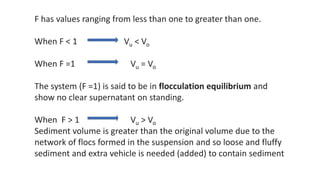
F has values ranging from less than one to greater than one.
When F < 1 Vu < Vo
When F =1 Vu = Vo
The system (F =1) is said to be in flocculation equilibrium and
show no clear supernatant on standing.
When F > 1 Vu > Vo
Sediment volume is greater than the original volume due to the
network of flocs formed in the suspension and so loose and fluffy
sediment and extra vehicle is needed (added) to contain sediment
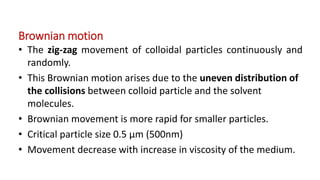
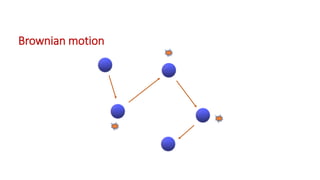
Brownian motion
• The zig-zag movement of colloidal particles continuously and
randomly.
• This Brownian motion arises due to the uneven distribution of
the collisions between colloid particle and the solvent
molecules.
• Brownian movement is more rapid for smaller particles.
• Critical particle size 0.5 µm (500nm)
• Movement decrease with increase in viscosity of the medium.
Brownian motion
Formulation of Suspension
Wetting of Particles, Controlled flocculation, Flocculation in structured
vehicle
Wetting phenomenon
• Force of attraction between solid and liquid play important role
• Angle of contact range (0° to 180 °)
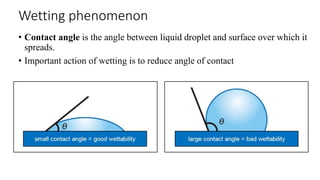
Wetting phenomenon
• Contact angle is the angle between liquid droplet and surface over which it
spreads.
• Important action of wetting is to reduce angle of contact
Wetting phenomenon
Two types of solids
Lyophilic (wetting)
• Not sensitive to electrolytes in
medium
• Readily wettable
Lyophobic (non-wetting)
• Sensitive to electrolytes in
medium
• No aggregation
35
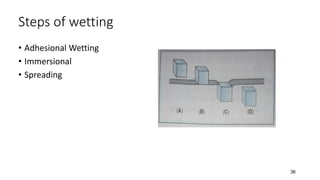
Steps of wetting
• Adhesional Wetting
• Immersional
• Spreading
36
Strategies for wetting of hydrophobic solids
• Surfactant
• Hydrophilic polymers
• Water insoluble hydrophilic material (bentonite)
37
Methods to evaluate wetting property of
wetting agent
• Wet point method
• Amount of vehicle needed to just wet given amount of solid
powder
• Flow point method
• Amount of liquid needed to produce pourability
• Unit (mL/100gm)
38
Methods to evaluate wetting property of
wetting agent
• Low wet point and low flow point
• Also, small difference between wet point and flow point
• This indicate good dispersion of solid particles in liquid medium.
39
Need of Controlled Flocculation
• Assume powder is properly wetted and dispersed
• In order to prevent compact sediment (hard cake) we need
controlled flocculation
Controlled Flocculation
Controlled Flocculation can be achieved through following methods
• Effect of Electrolytes (ionic substance): It act as flocculating agents by
reducing electrical barrier between particles... by decresing zeta
potential and forming bridge between adjacent particles
• Effect of Surfactant
• Effect of Polymer
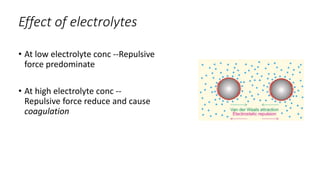
• At low electrolyte conc --Repulsive
force predominate
• At high electrolyte conc --
Repulsive force reduce and cause
coagulation
Effect of electrolytes
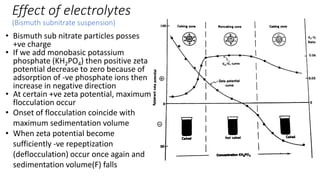
(Bismuth subnitrate suspension)
• Bismuth sub nitrate particles posses
+ve charge
• If we add monobasic potassium
phosphate (KH2PO4) then positive zeta
potential decrease to zero because of
adsorption of -ve phosphate ions then
increase in negative direction
• At certain +ve zeta potential, maximum
flocculation occur
• Onset of flocculation coincide with
maximum sedimentation volume
• When zeta potential become
sufficiently -ve repeptization
(deflocculation) occur once again and
sedimentation volume(F) falls
Effect of Surfactant
• Concentration of (cationic/anionic) surfactant as flocculating agent is
critical because--
• Act as wetting and deflocculating agent
• Surfactant improve dispersion by reducing surface tension
• Ionic surfactant (SLS) sometime cause flocculation
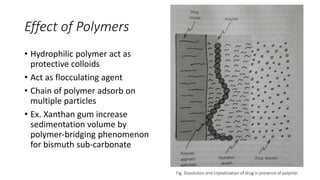
Effect of Polymers
• Hydrophilic polymer act as
protective colloids
• Act as flocculating agent
• Chain of polymer adsorb on
multiple particles
• Ex. Xanthan gum increase
sedimentation volume by
polymer-bridging phenomenon
for bismuth sub-carbonate
Fig. Dissolution and crystallization of drug in presence of polymer
Flocculation in structured vehicle
• Flocculation provide stability to suspension
• But F, sedimentation volume is less than 1 which makes the
suspension unsightly
• Hence there is need of structured vehicle beside controlled
flocculation.
• Structured vehicle is the dispersion medium in which suspending
medium has been added like gum acacia / gum tragacanth/ CMC etc.
Flocculation in structured vehicle
+ve charge particles
• If the suspension of +ve charge particles produced then it can be
flocculated using anionic salt like monobasic potassium phosphate
• In this case if we use hydrocolloids which are generally negatively
charged then there is no incompatibility
Flocculation in structured vehicle
-ve charge particles
• If the suspension of -ve charge particles produced then it can be
flocculated using anionic salt like aluminum chloride
• In such case if we use hydrocolloids which are generally negatively
charged then there is incompatibility of stringy mass and rapid
settling.
• Remedy: Protective colloid
Flocculation in
structured vehicle
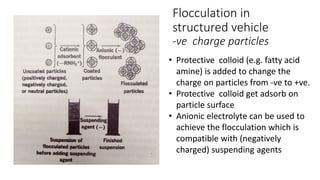
-ve charge particles
• Protective colloid (e.g. fatty acid
amine) is added to change the
charge on particles from -ve to +ve.
• Protective colloid get adsorb on
particle surface
• Anionic electrolyte can be used to
achieve the flocculation which is
compatible with (negatively
charged) suspending agents
Rheology in suspension
• Thixotrophy is a phenomenon or property exhibited by highly
floculated preparation in which a preparation is sem-solid at rest
(in the absence of shearing forces) but becomes fluid when
tapped or shaken and resumes its original structure after only a
few minutes of rest.
• A thixotropic suspension is the one which is viscous during
storage but loses consistency and become fluid upon shaking.
• A well-formulated thixotropic suspension would remain fluid long
enough for the easy dispense of a dose but would slowly regain
its original viscosity within a short time.
50
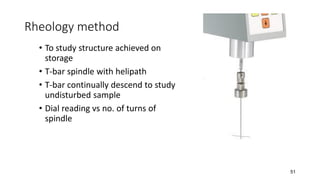
Rheology method
• To study structure achieved on
storage
• T-bar spindle with helipath
• T-bar continually descend to study
undisturbed sample
• Dial reading vs no. of turns of
spindle
51
Physical stability of suspensions
• Raising temperature leads to flocculation of sterically stabilized (by
non-ionic surfactant) suspension
• Repulsion force depend upon amount of surfactant adsorbed on
particles
• On heating, energy of repulsion reduces because of dehydration of
surfactant, attraction increases and particles flocculate
Physical stability of suspensions
• During freezing processes particle overcome repulsive barrier due to
ice formation.
• Particles come close enough and experience attractive force like in
primary minimum and form aggregates as per DLVO theory
• When ice melts, particles remain as aggregates unless work is applied
to overcome the primary energy peak
• Aggregate size is directly proportional to rate of freezing
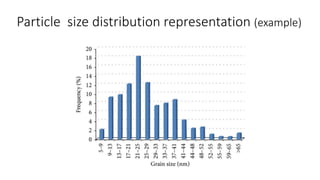
Particle size distribution representation (example)
Oswald Ripening
• Solubility of large crystal is less than that of smaller crystals
• It is because of more surface energy per unit mass on smaller
crystals.
• Smaller crystals are in a state of unstable equilibrium in a
supersaturated solution.
• As a result larger crystals grow on expense of the small crystals
55
What is Ostwald ripening?
• This is a spontaneous process that occurs because larger crystals are
more energetically (thermodynamically) favored than smaller
crystals.
• Large crystals, have lower energy state.
• While the formation of many small crystals is kinetically favored.
• Small crystals have a larger specific surface area (surface area to
volume ratio)
• Thus, many small crystals will attain a lower energy state by getting
transformed into large crystals and this is Ostwald ripening.
56
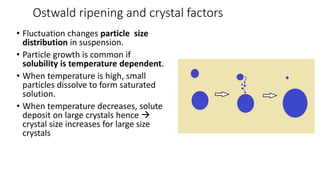
Ostwald ripening and crystal factors
• Fluctuation changes particle size
distribution in suspension.
• Particle growth is common if
solubility is temperature dependent.
• When temperature is high, small
particles dissolve to form saturated
solution.
• When temperature decreases, solute
deposit on large crystals hence →
crystal size increases for large size
crystals
Reference
• Martin’s Physical Pharmacy

Suspension sb pci

  • 1.
    Suspension Mr. Mirza SalmanBaig Assistant Professor (Pharmaceutics) AIKTC, School of Pharmacy, New Panvel Affiliated to University of Mumbai (INDIA) Physical Pharmaceutics Sem-4 PCI syllabus
  • 2.
    Content • Introduction • Definition •Features desired in pharmaceutical suspension • Advantage/Disadvantages of pharmaceutical suspension • Flocculated and deflocculated suspension • Interfacial properties of suspending particles • Settling in suspensions • Effect of Brownian movement, • Sedimentation of flocculated particles, • Sedimentation parameters • Formulation of suspensions • Wetting of Particles, • Controlled flocculation, • Flocculation in structured vehicle
  • 3.
  • 4.
    Definition • Suspension isheterogeneous system and Suspension is biphasic liquid dosage form. • Dispersion medium is liquid and dispersion medium is solid (suspension) 4
  • 5.
    Features desired inPharmaceutical Suspension • Particles should settle slowly and should be readily re-dispersed upon shaking of the container. • The particle size of the suspensoid should remain fairly constant throughout long periods of undisturbed standing. • The suspension should pour readily and evenly from its container. 5
  • 6.
    Applications of suspensions •Drugs which degrade in aqueous solution may be suspended in a non-aqueous phase. eg. Tetracycline hydrochloride is suspended in a fractionated coconut oil for ophthalmic use. • Lotions containing insoluble solids are formulated to leave a thin coating of medicament on the skin. As the vehicle evaporates, it gives a cooling effect and leaves the solid behind.eg calamine lotion and sulphur lotion compound. • Bulky, insoluble powders can be formulated as a suspension so that they are easier to take eg Kaolin or chalk. 6
  • 7.
    Advantages of suspensions •Suspension can improve chemical stability of certain drug. E.g. Procaine penicillin G • Drug in suspension exhibits higher rate of bioavailability than other dosage forms. bioavailability is in following order, • Solution > Suspension > Capsule > Compressed Tablet > Coated tablet • Duration and onset of action can be controlled. E.g. Protamine Zinc-Insulin suspension • Suspension can mask the unpleasant/ bitter taste of drug. E.g. Chloramphenicol palmitate 7
  • 8.
    Disadvantages of suspension •Physical stability, sedimentation and compaction can causes problems. • It is bulky, therefore sufficient care must be taken during handling and transport. • It is difficult to formulate • Uniform and accurate dose can not be achieved unless suspension are packed in unit dosage form 8
  • 9.
    Diffusible / indiffusible solid 1.DIFFUSIBLE SOLIDS– these sediment sufficiently slowly to enable satisfactory dose removal after redispersion. eg. Light kaoline, magnesium tricilicate 2.INDIFFUSIBLE SOLIDS- eg. sulphadimidine and chalk. These sediment too rapidly and require the addition of other materials to reduce sedimentation rate to an acceptable level. 9
  • 10.
  • 11.
    Types of suspensionaggregates Open Network aggregate Close network aggregate Deflocculated 11
  • 12.
    12 • In flocculatedsuspension, formed flocs (loose aggregates) will cause increase in sedimentation rate due to increase in size of sedimenting particles. • Hence, flocculated suspensions sediment more rapidly. • Here, the sedimentation depends not only on the size of the flocs but also on the porosity of flocs. Flocculated Suspensions
  • 13.
    Deflocculated suspensions • Indeflocculated suspension, individual particles are settling. • Rate of sedimentation is slow , which prevents entrapping of liquid medium which makes it difficult to re-disperse by agitation. • This phenomenon called ‘caking’ • In deflocculated suspension larger particles settle fast and smaller remain in supernatant liquid so supernatant appears cloudy. 13 13
  • 14.
    Interfacial properties of suspendingparticles Surface free energy Attractive force Repulsive force & Zeta potential DLVO theory
  • 15.
    Interfacial properties ofsuspending particles Surface free energy Surface free energy is given by the equation - ∆G= γ SL ∆A Where, ∆G = Surface free energy γ SL = Surface tension ∆A = Surface area • Particles tends to agglomerate to reduce surface area thereby reducing surface free energy • System can be stabilized by reducing Interfacial tension • Interfacial tension can be reduced by addition of surfactant (reducing γ SL ) Small particle size Large specific surface area More surface free energy
  • 16.
    Interfacial properties ofsuspending particles Attractive force Keesom force • Permanent dipole – Permanent dipole Debye force • Permanent dipole - induced dipole London force • Induced dipole – induced dipole Van der Waal forces Weak electrostatic forces (Van der Waal force) of attraction exist between particles are-
  • 17.
    Interfacial properties ofsuspending particles Repulsive force • Same charge present on all particles (zeta potential) • Like charges repel each other • Charged particles repel each other
  • 18.
    Particle-particle interactions (Zeta Potential) Zetapotential is defined as the difference in potential between the surface of the tightly bound layer (shear plane) and electroneutral region of the solution. 18
  • 19.
    • At highelectrolyte conc → Attractive force predominate and cause coagulation • At low electrolyte conc → Repulsive force predominate Particle-particle interactions (Attractive forces vs Repulsive forces) 19
  • 20.
    DLVO Theory • Itproposed that an energy barrier resulting from the electrostatic repulsive force prevents two particles approaching one another and adhering together. • If the particles collide with sufficient energy to overcome the barrier, the Van der Waals attractive force will attract them strongly and cause them adhere together irreversibly. • If the particles repel each other strongly, the dispersion will resist coagulation and the dispersed system will be stable. • If the repulsion is not sufficient then coagulation will take place.
  • 21.
    DLVO theory • DLVOtheory was developed in the 1940s and named after the • Russian scientists • B. Derjaguin • L. Landau, • Dutch scientists • E. Verwey • J. Overbeek
  • 22.
    DLVO theory: Flocculationcurve/Secondary minimum Force of repulsion Force of attraction 22
  • 23.
    Interparticle forces • Vander Waals attractive forces • Electrostatic repulsive force → Overlapping of diffusion layer. • Repulsive forces due to hydration → Structuring of water at interface (Physical barrier) • Steric repulsive force → Because of adsorbent (Physical barrier) 23
  • 24.
    Settling in suspension Effectof Brownian movement, Sedimentation of flocculated particles, Sedimentation parameters
  • 25.
    Sedimentation • This isa phenomenon which occurs in dispersed system where the dispersed particles settle to the bottom of the container because of gravitational force. • This occurs because the particles are too large to remain permanently suspended in the vehicle. • Therefore suitable suspending agents are added to retard this process. 25
  • 26.
    Theory of sedimentation (Stoke’sLaw of sedimentation) V = d2 (ρ1− ρ2) 18η • V= Velocity of sedimentation • D= Diameter of particle • ρ1 and ρ2 =Density of particle and liquid • η = viscosity of liquid • Pharmaceutical suspension containing less than 2% (w/v) of solid follow Stoke’s Law. • If solid content increase viscosity increases 26
  • 27.
    Sedimentation Volume (F) •Sedimentation volume is ratio of ultimate height (height at time t) of sediment to total height of suspension when sedimentation occur in standard condition • F=Vu/Vo • F= sedimentation volume • Vu = Volume of sediment • Vo = original volume of suspension 27
  • 28.
    28 The sedimentation volumeis used to measure flocculation
  • 29.
    F has valuesranging from less than one to greater than one. When F < 1 Vu < Vo When F =1 Vu = Vo The system (F =1) is said to be in flocculation equilibrium and show no clear supernatant on standing. When F > 1 Vu > Vo Sediment volume is greater than the original volume due to the network of flocs formed in the suspension and so loose and fluffy sediment and extra vehicle is needed (added) to contain sediment
  • 30.
    Brownian motion • Thezig-zag movement of colloidal particles continuously and randomly. • This Brownian motion arises due to the uneven distribution of the collisions between colloid particle and the solvent molecules. • Brownian movement is more rapid for smaller particles. • Critical particle size 0.5 µm (500nm) • Movement decrease with increase in viscosity of the medium.
  • 31.
  • 32.
    Formulation of Suspension Wettingof Particles, Controlled flocculation, Flocculation in structured vehicle
  • 33.
    Wetting phenomenon • Forceof attraction between solid and liquid play important role • Angle of contact range (0° to 180 °)
  • 34.
    Wetting phenomenon • Contactangle is the angle between liquid droplet and surface over which it spreads. • Important action of wetting is to reduce angle of contact
  • 35.
    Wetting phenomenon Two typesof solids Lyophilic (wetting) • Not sensitive to electrolytes in medium • Readily wettable Lyophobic (non-wetting) • Sensitive to electrolytes in medium • No aggregation 35
  • 36.
    Steps of wetting •Adhesional Wetting • Immersional • Spreading 36
  • 37.
    Strategies for wettingof hydrophobic solids • Surfactant • Hydrophilic polymers • Water insoluble hydrophilic material (bentonite) 37
  • 38.
    Methods to evaluatewetting property of wetting agent • Wet point method • Amount of vehicle needed to just wet given amount of solid powder • Flow point method • Amount of liquid needed to produce pourability • Unit (mL/100gm) 38
  • 39.
    Methods to evaluatewetting property of wetting agent • Low wet point and low flow point • Also, small difference between wet point and flow point • This indicate good dispersion of solid particles in liquid medium. 39
  • 40.
    Need of ControlledFlocculation • Assume powder is properly wetted and dispersed • In order to prevent compact sediment (hard cake) we need controlled flocculation
  • 41.
    Controlled Flocculation Controlled Flocculationcan be achieved through following methods • Effect of Electrolytes (ionic substance): It act as flocculating agents by reducing electrical barrier between particles... by decresing zeta potential and forming bridge between adjacent particles • Effect of Surfactant • Effect of Polymer
  • 42.
    • At lowelectrolyte conc --Repulsive force predominate • At high electrolyte conc -- Repulsive force reduce and cause coagulation Effect of electrolytes
  • 43.
    Effect of electrolytes (Bismuthsubnitrate suspension) • Bismuth sub nitrate particles posses +ve charge • If we add monobasic potassium phosphate (KH2PO4) then positive zeta potential decrease to zero because of adsorption of -ve phosphate ions then increase in negative direction • At certain +ve zeta potential, maximum flocculation occur • Onset of flocculation coincide with maximum sedimentation volume • When zeta potential become sufficiently -ve repeptization (deflocculation) occur once again and sedimentation volume(F) falls
  • 44.
    Effect of Surfactant •Concentration of (cationic/anionic) surfactant as flocculating agent is critical because-- • Act as wetting and deflocculating agent • Surfactant improve dispersion by reducing surface tension • Ionic surfactant (SLS) sometime cause flocculation
  • 45.
    Effect of Polymers •Hydrophilic polymer act as protective colloids • Act as flocculating agent • Chain of polymer adsorb on multiple particles • Ex. Xanthan gum increase sedimentation volume by polymer-bridging phenomenon for bismuth sub-carbonate Fig. Dissolution and crystallization of drug in presence of polymer
  • 46.
    Flocculation in structuredvehicle • Flocculation provide stability to suspension • But F, sedimentation volume is less than 1 which makes the suspension unsightly • Hence there is need of structured vehicle beside controlled flocculation. • Structured vehicle is the dispersion medium in which suspending medium has been added like gum acacia / gum tragacanth/ CMC etc.
  • 47.
    Flocculation in structuredvehicle +ve charge particles • If the suspension of +ve charge particles produced then it can be flocculated using anionic salt like monobasic potassium phosphate • In this case if we use hydrocolloids which are generally negatively charged then there is no incompatibility
  • 48.
    Flocculation in structuredvehicle -ve charge particles • If the suspension of -ve charge particles produced then it can be flocculated using anionic salt like aluminum chloride • In such case if we use hydrocolloids which are generally negatively charged then there is incompatibility of stringy mass and rapid settling. • Remedy: Protective colloid
  • 49.
    Flocculation in structured vehicle -vecharge particles • Protective colloid (e.g. fatty acid amine) is added to change the charge on particles from -ve to +ve. • Protective colloid get adsorb on particle surface • Anionic electrolyte can be used to achieve the flocculation which is compatible with (negatively charged) suspending agents
  • 50.
    Rheology in suspension •Thixotrophy is a phenomenon or property exhibited by highly floculated preparation in which a preparation is sem-solid at rest (in the absence of shearing forces) but becomes fluid when tapped or shaken and resumes its original structure after only a few minutes of rest. • A thixotropic suspension is the one which is viscous during storage but loses consistency and become fluid upon shaking. • A well-formulated thixotropic suspension would remain fluid long enough for the easy dispense of a dose but would slowly regain its original viscosity within a short time. 50
  • 51.
    Rheology method • Tostudy structure achieved on storage • T-bar spindle with helipath • T-bar continually descend to study undisturbed sample • Dial reading vs no. of turns of spindle 51
  • 52.
    Physical stability ofsuspensions • Raising temperature leads to flocculation of sterically stabilized (by non-ionic surfactant) suspension • Repulsion force depend upon amount of surfactant adsorbed on particles • On heating, energy of repulsion reduces because of dehydration of surfactant, attraction increases and particles flocculate
  • 53.
    Physical stability ofsuspensions • During freezing processes particle overcome repulsive barrier due to ice formation. • Particles come close enough and experience attractive force like in primary minimum and form aggregates as per DLVO theory • When ice melts, particles remain as aggregates unless work is applied to overcome the primary energy peak • Aggregate size is directly proportional to rate of freezing
  • 54.
    Particle size distributionrepresentation (example)
  • 55.
    Oswald Ripening • Solubilityof large crystal is less than that of smaller crystals • It is because of more surface energy per unit mass on smaller crystals. • Smaller crystals are in a state of unstable equilibrium in a supersaturated solution. • As a result larger crystals grow on expense of the small crystals 55
  • 56.
    What is Ostwaldripening? • This is a spontaneous process that occurs because larger crystals are more energetically (thermodynamically) favored than smaller crystals. • Large crystals, have lower energy state. • While the formation of many small crystals is kinetically favored. • Small crystals have a larger specific surface area (surface area to volume ratio) • Thus, many small crystals will attain a lower energy state by getting transformed into large crystals and this is Ostwald ripening. 56
  • 57.
    Ostwald ripening andcrystal factors • Fluctuation changes particle size distribution in suspension. • Particle growth is common if solubility is temperature dependent. • When temperature is high, small particles dissolve to form saturated solution. • When temperature decreases, solute deposit on large crystals hence → crystal size increases for large size crystals
  • 58.