pH
METER
PH
 pH is a unit of measure which describes the degree of
acidity or basicity of a solution.
 It is measured on a scale of 0 to 14.
 The formal definition of pH is the negative logarithm of
the hydrogen ion activity.
 pH = -log[H+]
PH VALUE
 The pH value of a substance is directly related to the
ratio of the hydrogen ion and hydroxyl ion
concentrations.
 If the H+ concentration is higher than OH- the material
is acidic.
 If the OH- concentration is higher than H+ the material
is basic.
 7 is neutral, < is acidic, >7 is basic
PH METER
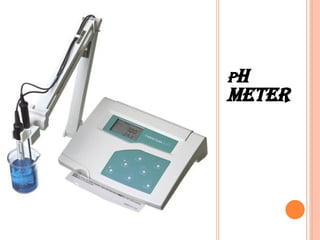
 pH meter has two basic components: the digital
meter (with a numeric display), and either one or
two probes that we insert into the test solution.
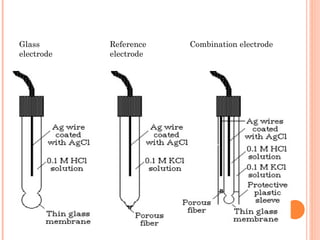
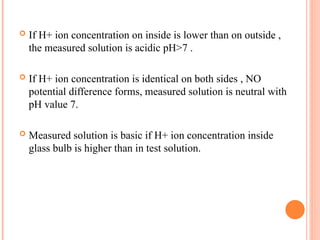
 The electrode that does the most important job,
is the glass electrode, having a silver based
electrical wire suspended in a solution of hydrogen
chloride, contained inside a thin bulb made from a
special glass containing metal salts (typically
compounds of sodium and calcium).
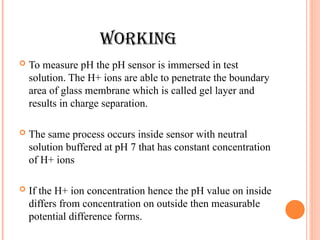
 The other electrode is called the reference
electrode and has a silver chloride wire
suspended in a solution of potassium chloride.
 A pH meter is essentially a voltmeter which
measures the voltage of an electrode sensitive to
the hydrogen ion concentration, relative to
another electrode which exhibits a constant
voltage.
 The key feature of the pH-sensitive electrode is a
thin glass membrane whose outside surface
contacts the solution to be tested. The inside
surface of the glass membrane is exposed to a
constant concentration of hydrogen ions
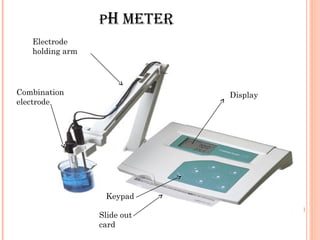
PH METER
Combination
electrode
Electrode
holding arm
Display
Keypad
Slide out
card
GLASS ELECTRODE
 Inside the glass electrode assembly, a silver wire,
coated with silver chloride and immersed in the
HCl solution, is called an Ag/AgCl electrode. This
electrode carries current through the half-cell
reaction. The potential between the electrode and
the solution depends on the chloride ion
concentration, but, since this is constant (0.1 M),
the electrode potential is also constant.
REFERENCE ELECTRODE
 A reference electrode is needed to complete the
electrical circuit. A common choice is to use
another Ag/AgCl electrode as the reference. The
Ag/AgCl electrode is immersed in an 0.1 M KCl
solution which makes contact with the test
solution through a porous fiber which allows a
small flow of ions back and forth to conduct the
current.
Glass
electrode
Reference
electrode
Combination electrode
WORKING
 To measure pH the pH sensor is immersed in test
solution. The H+ ions are able to penetrate the boundary
area of glass membrane which is called gel layer and
results in charge separation.
 The same process occurs inside sensor with neutral
solution buffered at pH 7 that has constant concentration
of H+ ions
 If the H+ ion concentration hence the pH value on inside
differs from concentration on outside then measurable
potential difference forms.
 If H+ ion concentration on inside is lower than on outside ,
the measured solution is acidic pH>7 .
 If H+ ion concentration is identical on both sides , NO
potential difference forms, measured solution is neutral with
pH value 7.
 Measured solution is basic if H+ ion concentration inside
glass bulb is higher than in test solution.
ACCURACY
 For pH meters to be accurate, they have to be
properly calibrated, so they usually need testing and
adjusting before we start to use them.
 To calibrate a pH meter we dip it into buffers (test
solutions of known pH) and adjust the meter accordingly.
 Another important consideration is that pH
measurements made this way depend on temperature.
Some meters have built-in thermometers and
automatically correct their own pH measurements as the
temperature changes; those are best if fluctuations in
temperature are likely to occur while making a number
of different measurements.
pH measurement.ppt sums university of iran