Presented by:
Mahewash Sana A. Pathan
DIFFUSION
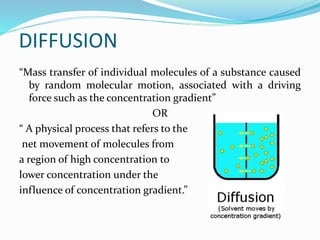
“Mass transfer of individual molecules of a substance caused
by random molecular motion, associated with a driving
force such as the concentration gradient”
OR
“ A physical process that refers to the
net movement of molecules from
a region of high concentration to
lower concentration under the
influence of concentration gradient.”
Diffusion phenomena applied in pharmaceutical sciences
include:
 Release of drug from dosage form
 Ultrafiltration, microfiltration, dialysis, hemodailysis.
 Permeation & distribution of drug in living tissues
 Estimation of molecular weight of polymers
 Prediction of absorption & elimination of drug.
TYPES OF DIFFUSION
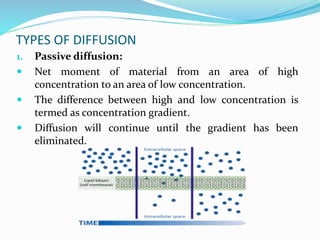
1. Passive diffusion:
 Net moment of material from an area of high
concentration to an area of low concentration.
 The difference between high and low concentration is
termed as concentration gradient.
 Diffusion will continue until the gradient has been
eliminated.
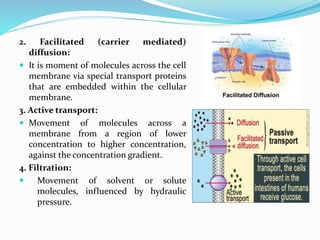
2. Facilitated (carrier mediated)
diffusion:
 It is moment of molecules across the cell
membrane via special transport proteins
that are embedded within the cellular
membrane.
3. Active transport:
 Movement of molecules across a
membrane from a region of lower
concentration to higher concentration,
against the concentration gradient.
4. Filtration:
 Movement of solvent or solute
molecules, influenced by hydraulic
pressure.
LAWS OF DIFFUSION
 Derived by Adolf Fick in 1856.
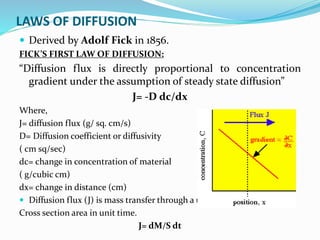
FICK’S FIRST LAW OF DIFFUSION:
“Diffusion flux is directly proportional to concentration
gradient under the assumption of steady state diffusion”
J= -D dc/dx
Where,
J= diffusion flux (g/ sq. cm/s)
D= Diffusion coefficient or diffusivity
( cm sq/sec)
dc= change in concentration of material
( g/cubic cm)
dx= change in distance (cm)
 Diffusion flux (J) is mass transfer through a unit
Cross section area in unit time.
J= dM/S dt
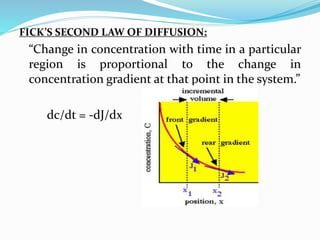
FICK’S SECOND LAW OF DIFFUSION:
“Change in concentration with time in a particular
region is proportional to the change in
concentration gradient at that point in the system.”
dc/dt = -dJ/dx
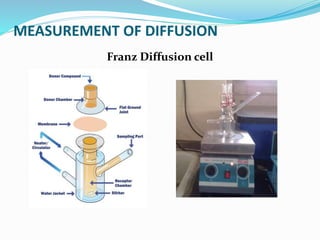
MEASUREMENT OF DIFFUSION
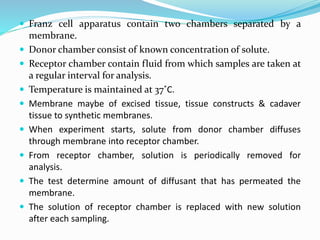
Franz Diffusion cell
 Franz cell apparatus contain two chambers separated by a
membrane.
 Donor chamber consist of known concentration of solute.
 Receptor chamber contain fluid from which samples are taken at
a regular interval for analysis.
 Temperature is maintained at 37˚C.
 Membrane maybe of excised tissue, tissue constructs & cadaver
tissue to synthetic membranes.
 When experiment starts, solute from donor chamber diffuses
through membrane into receptor chamber.
 From receptor chamber, solution is periodically removed for
analysis.
 The test determine amount of diffusant that has permeated the
membrane.
 The solution of receptor chamber is replaced with new solution
after each sampling.
DIFFUSION CONTROLLED RELEASE SYSTEM
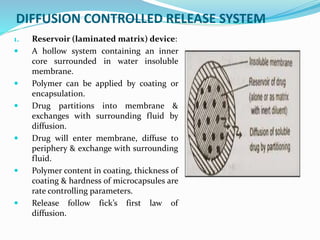
1. Reservoir (laminated matrix) device:
 A hollow system containing an inner
core surrounded in water insoluble
membrane.
 Polymer can be applied by coating or
encapsulation.
 Drug partitions into membrane &
exchanges with surrounding fluid by
diffusion.
 Drug will enter membrane, diffuse to
periphery & exchange with surrounding
fluid.
 Polymer content in coating, thickness of
coating & hardness of microcapsules are
rate controlling parameters.
 Release follow fick’s first law of
diffusion.
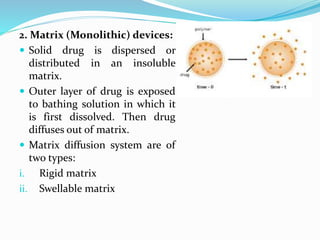
2. Matrix (Monolithic) devices:
 Solid drug is dispersed or
distributed in an insoluble
matrix.
 Outer layer of drug is exposed
to bathing solution in which it
is first dissolved. Then drug
diffuses out of matrix.
 Matrix diffusion system are of
two types:
i. Rigid matrix
ii. Swellable matrix
Diffusion principles in biological systems