Diffusion
(Dr.) Mirza Salman Baig
Assistant Professor
(Pharmaceutics)
AIKTC, School of Pharmacy,New
Panvel
Affiliated to University of Mumbai
(INDIA)
Defination
• Diffusion is the processes of mass
transfer of molecules of a substance
because of random molecular motion
(Brownian motion) and associated with
driving force such as concentration
gradient.
Diffusion
• Diffusion is spontaneous movement of
molecules from higher concentration region to
lower concentration region till equilibrium is
established
Application
• Release of drug from dosageform in
diffusion controlled system...SR
• Molecular wt of polymer can be estimated
• Transport of drug (absorption) from GIT
• Diffusion of drug in tissues (distribution)
and excretion through kidnies
• Dialysis/ Microfiltration/ultrafiltration
Application
Dissolution of drug from
• Tablet
• Powder
• Granules
• Ointment
• Suppositories
Diffusion through biological
membranes
• Dissolution of drug in polymeric membrane
then simple molecular diffusion
• Drug + Solvent transport across skin
• Steriodal molecule with hydrophilic group
pass through hair follicles
• Diffusant may pass through pores
• Diffusion play important role in transport of
drug in kidney, brain and liver
• Diffusion through lipoidal membrane (BBB)
is known as transcellular diffusion
• Paracellular diffusion occurs through the
space between cells
• In addition to drugs, nutrients also pass
through biological membranes
Diffusion through biological
membranes
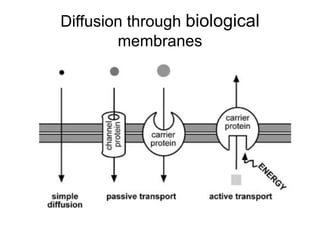
• Energy dependent carrier mediated
diffusion through biological membrane
(Active transport)
• Energy independent carrier mediated
diffusion through biological membrane
(Facilitated diffusion)
Diffusion through biological
membranes
• Membrane transporters are specialized
proteins that facilitate drug transport
• Active transport
• Facilitated diffusion
Diffusion through biological
membranes
Diffusion through biological
membranes
• Concentration gradient
• Osmotic pressure
• Temperature
• Electrical potential
Driving force for Diffusion
Measurement of Diffusion
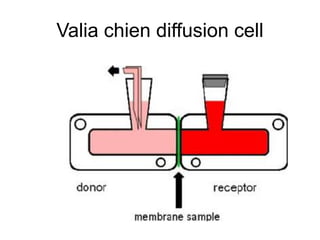
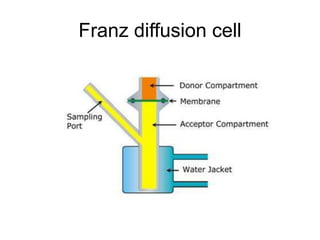
• Diffusion of molecules is estimated using
diffusion cell
• Solute is dissolved in solvent is placed in
donor compartment
• Solvent is placed in receptor
compartment
Valia chien diffusion cell
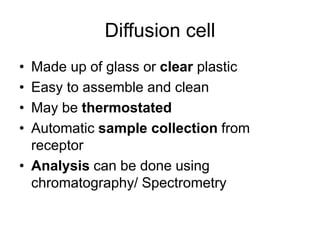
Diffusion cell
• Made up of glass or clear plastic
• Easy to assemble and clean
• May be thermostated
• Automatic sample collection from
receptor
• Analysis can be done using
chromatography/ Spectrometry
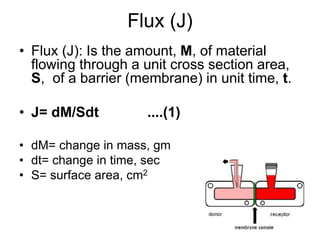
Flux (J)
• Flux (J): Is the amount, M, of material
flowing through a unit cross section area,
S, of a barrier (membrane) in unit time, t.
• J= dM/Sdt ....(1)
• dM= change in mass, gm
• dt= change in time, sec
• S= surface area, cm2
Fick`s First Law
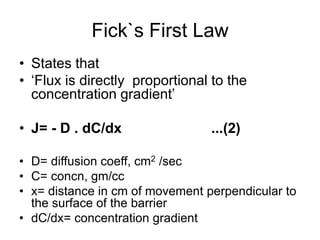
• States that
• ‘Flux is directly proportional to the
concentration gradient’
• J= - D . dC/dx ...(2)
• D= diffusion coeff, cm2 /sec
• C= concn, gm/cc
• x= distance in cm of movement perpendicular to
the surface of the barrier
• dC/dx= concentration gradient
Fick`s First Law
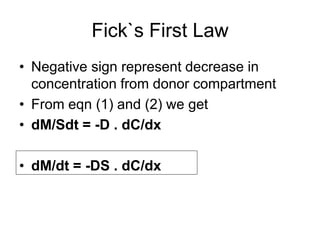
• Negative sign represent decrease in
concentration from donor compartment
• From eqn (1) and (2) we get
• dM/Sdt = -D . dC/dx
• dM/dt = -DS . dC/dx
Fick`s Second Law
• Emphasize on change in concentration
with time at definite location
Fick`s Second Law
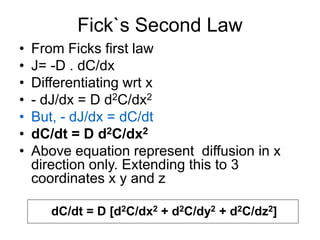
• From Ficks first law
• J= -D . dC/dx
• Differentiating wrt x
• - dJ/dx = D d2C/dx2
• But, - dJ/dx = dC/dt
• dC/dt = D d2C/dx2
• Above equation represent diffusion in x
direction only. Extending this to 3
coordinates x y and z
dC/dt = D [d2C/dx2 + d2C/dy2 + d2C/dz2]
Franz diffusion cell
Steady state diffusion
• System is said to be steady state if conditions
(concentration in donor and receptor
compartment) do not vary with time
• Mass transfer remain constant with time
• To achieve this both the compartments are
connected to reservoirs of solute/diffusant
(maintained at respective concentration) and
recirculated.
• Concentration gradient remain constant.
Steady state (Sink condition)
• Concentration in receptor compartment
is maintained at lower level compare to
concentration in the donor compartment.
• Donor compartment act as source and
receptor compartment act as sink.
• Receptor compartment is connected to
large reservoirs and solution is
recirculated.
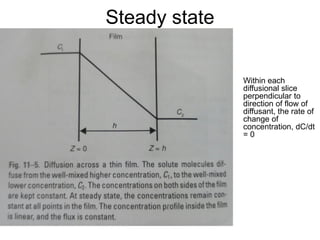
Steady state
Within each
diffusional slice
perpendicular to
direction of flow of
diffusant, the rate of
change of
concentration, dC/dt
= 0
Steady state
• Within each diffusional slice perpendicular
to direction of flow of diffusant, the rate of
change of concentration, dC/dt = 0
• dC/dt = D d2C/dx2 =0
• But D ≠ 0,
• Hence, d2C/dx2 =0
• dC/dx is constant indicating a linear
relation between concentration,C, and
distance, x
Driving forces for diffusion in pharmaceutical systems
Driving Force Example Description
Concentration
Passive
diffusion
Mass transfer due to random motion of
molecule , across concn gradient
Drug
dissolution
Disintegration --> Deaggregation --> Fine
particles--> Diffusion of drug from small
particles--> Dissolution --> Absorption
Pressure
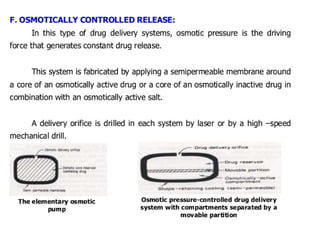
Osmotic
pressure
Osmotic pressure cause controlled
release of drug, osmotic core coated
with semipermiable membrane, orifice
for drug release
Pressure
driven jets
High velocity jet (>100m/s) penetrate
skin and deliver drug subcutaneously or
intramuscularly without needle
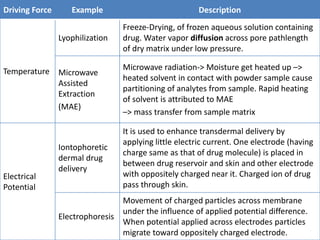
Driving Force Example Description
Temperature
Lyophilization
Freeze-Drying, of frozen aqueous solution containing
drug. Water vapor diffusion across pore pathlength
of dry matrix under low pressure.
Microwave
Assisted
Extraction
(MAE)
Microwave radiation-> Moisture get heated up –>
heated solvent in contact with powder sample cause
partitioning of analytes from sample. Rapid heating
of solvent is attributed to MAE
–> mass transfer from sample matrix
Electrical
Potential
Iontophoretic
dermal drug
delivery
It is used to enhance transdermal delivery by
applying little electric current. One electrode (having
charge same as that of drug molecule) is placed in
between drug reservoir and skin and other electrode
with oppositely charged near it. Charged ion of drug
pass through skin.
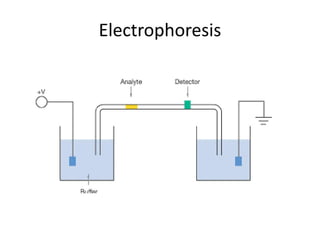
Electrophoresis
Movement of charged particles across membrane
under the influence of applied potential difference.
When potential applied across electrodes particles
migrate toward oppositely charged electrode.
Electrophoresis
Diffusion through film
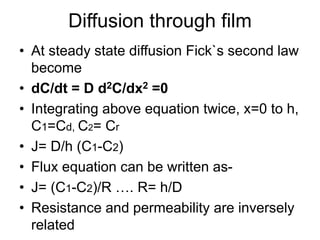
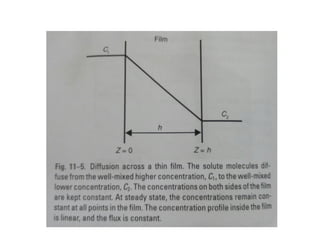
• At steady state diffusion Fick`s second law
become
• dC/dt = D d2C/dx2 =0
• Integrating above equation twice, x=0 to h,
C1=Cd, C2= Cr
• J= D/h (C1-C2)
• Flux equation can be written as-
• J= (C1-C2)/R …. R= h/D
• Resistance and permeability are inversely
related
Permeability
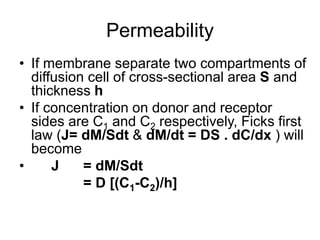
• If membrane separate two compartments of
diffusion cell of cross-sectional area S and
thickness h
• If concentration on donor and receptor
sides are C1 and C2 respectively, Ficks first
law (J= dM/Sdt & dM/dt = DS . dC/dx ) will
become
• J = dM/Sdt
= D [(C1-C2)/h]
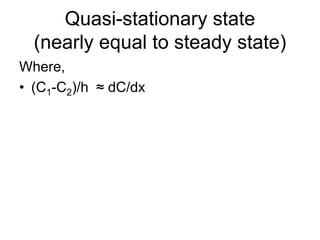
Quasi-stationary state
(nearly equal to steady state)
Where,
• (C1-C2)/h ≈ dC/dx
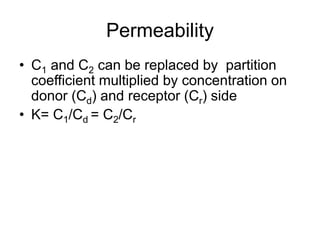
Permeability
• C1 and C2 can be replaced by partition
coefficient multiplied by concentration on
donor (Cd) and receptor (Cr) side
• K= C1/Cd = C2/Cr
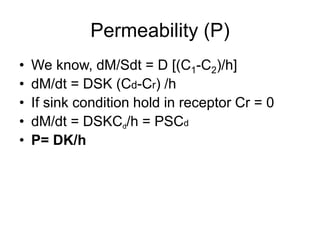
Permeability (P)
• We know, dM/Sdt = D [(C1-C2)/h]
• dM/dt = DSK (Cd-Cr) /h
• If sink condition hold in receptor Cr = 0
• dM/dt = DSKCd/h = PSCd
• P= DK/h
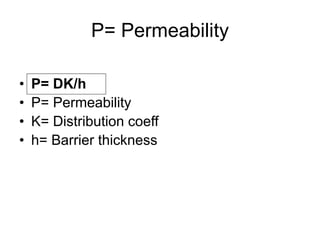
P= Permeability
• P= DK/h
• P= Permeability
• K= Distribution coeff
• h= Barrier thickness