






Presented By – Ajay Gautam
Click to edit Master title style
2
WHAT ARE BUFFER SOLUTION ?????
•A buffer solution is one which maintains
its pH fairly constant even upon the
addition of small amounts of acid or
base.
Types of solution…
 ISOTONIC
An isotonic solution is one that has the same osmolarity, or solute
concentration, as another solution. If these two solutions are separated by
a semipermeable membrane, water will flow in equal parts out of
each solution and into the other.
 HYPOTONIC
Having a lower osmotic pressure than a surrounding medium or a fluid
under comparison hypotonic organisms.
 HYPERTONIC
A solution that contains more dissolved particles (such as salt and other
electrolytes).
PRACTICALLY SAYING……..
• Illustrated by mixing a small quantity of blood with aqueous sodium
chloride solutions of varying tonicity.
• Isotonic : 0.9 g of NaCl per 100 mL
• Hypotonic : 0.2% NaCl
• Hypertonic : 2.0% NaCl solution
GENERAL PRINCIPLES FOR
ADJUSTMENT OF ISOTONICITY
1. Parenteral preparations should be isotonic with blood plasma
(depending on the route of administration).
i. Intravenous injection- isotonicity is always desirable.
ii. Subcutaneous injection- not essential.
iii. Intramuscular- hypertonic.
iv. Intrathecal injection- isotonic
2. Nasal drops- should be isotonic.
3. Ophthalmic preparations- should be isotonic.
Click to edit Master title style
6
Measurement of Tonicity
The tonicity of solutions may be determined by one of the following
two methods:
• Haemolytic Method
• Colligative Method
Haemolytic Method
 The acting principle of this method is the observation of the
effect of various solutions of drugs on the appearance of
RBCs when suspended in those solutions. If, there is no
change in size and shape of RBCs when immersed in test
solution on observing with microscope, then this solution is
isotonic to the blood.
COLLIGATIVE METHOD
 It has been determined that solutions having same tonicity
exhibit similar behavior with respect to their colligative
properties such as lowering of vapour pressure,
depression in freezing point, etc. Hence, tonicity of a
solution may be determined by determining its colligative
properties. For making isotonic solutions, the quantities of
substances to be added may be calculated by following
methods:
 Based on molecular concentration
 Based on freezing point data
 Based on sodium chloride equivalent (E) value
 White-Vincent method
Colligative Method
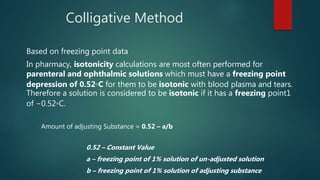
Based on freezing point data
In pharmacy, isotonicity calculations are most often performed for
parenteral and ophthalmic solutions which must have a freezing point
depression of 0.52◦C for them to be isotonic with blood plasma and tears.
Therefore a solution is considered to be isotonic if it has a freezing point1
of −0.52◦C.
Amount of adjusting Substance = 0.52 – a/b
0.52 – Constant Value
a – freezing point of 1% solution of un-adjusted solution
b – freezing point of 1% solution of adjusting substance
Click to edit Master title style
10
APPLICATIONS OF ISOTONICITY
• All the parentals preparations.
• Intravenous solutions , Irrigating solutions , lotions for wounds and
subcutaneous injections.
• Solutions meant for intrathecal injections
• Aqueous solution used for nasal applications
• Opthalmic preparations.
FABRIKAM
Buffered isotonic solutions

Buffered isotonic solutions

  • 1.
    Presented By –Ajay Gautam
  • 2.
    Click to editMaster title style 2 WHAT ARE BUFFER SOLUTION ????? •A buffer solution is one which maintains its pH fairly constant even upon the addition of small amounts of acid or base.
  • 3.
    Types of solution… ISOTONIC An isotonic solution is one that has the same osmolarity, or solute concentration, as another solution. If these two solutions are separated by a semipermeable membrane, water will flow in equal parts out of each solution and into the other.  HYPOTONIC Having a lower osmotic pressure than a surrounding medium or a fluid under comparison hypotonic organisms.  HYPERTONIC A solution that contains more dissolved particles (such as salt and other electrolytes).
  • 4.
    PRACTICALLY SAYING…….. • Illustratedby mixing a small quantity of blood with aqueous sodium chloride solutions of varying tonicity. • Isotonic : 0.9 g of NaCl per 100 mL • Hypotonic : 0.2% NaCl • Hypertonic : 2.0% NaCl solution
  • 5.
    GENERAL PRINCIPLES FOR ADJUSTMENTOF ISOTONICITY 1. Parenteral preparations should be isotonic with blood plasma (depending on the route of administration). i. Intravenous injection- isotonicity is always desirable. ii. Subcutaneous injection- not essential. iii. Intramuscular- hypertonic. iv. Intrathecal injection- isotonic 2. Nasal drops- should be isotonic. 3. Ophthalmic preparations- should be isotonic.
  • 6.
    Click to editMaster title style 6 Measurement of Tonicity The tonicity of solutions may be determined by one of the following two methods: • Haemolytic Method • Colligative Method
  • 7.
    Haemolytic Method  Theacting principle of this method is the observation of the effect of various solutions of drugs on the appearance of RBCs when suspended in those solutions. If, there is no change in size and shape of RBCs when immersed in test solution on observing with microscope, then this solution is isotonic to the blood.
  • 8.
    COLLIGATIVE METHOD  Ithas been determined that solutions having same tonicity exhibit similar behavior with respect to their colligative properties such as lowering of vapour pressure, depression in freezing point, etc. Hence, tonicity of a solution may be determined by determining its colligative properties. For making isotonic solutions, the quantities of substances to be added may be calculated by following methods:  Based on molecular concentration  Based on freezing point data  Based on sodium chloride equivalent (E) value  White-Vincent method
  • 9.
    Colligative Method Based onfreezing point data In pharmacy, isotonicity calculations are most often performed for parenteral and ophthalmic solutions which must have a freezing point depression of 0.52◦C for them to be isotonic with blood plasma and tears. Therefore a solution is considered to be isotonic if it has a freezing point1 of −0.52◦C. Amount of adjusting Substance = 0.52 – a/b 0.52 – Constant Value a – freezing point of 1% solution of un-adjusted solution b – freezing point of 1% solution of adjusting substance
  • 10.
    Click to editMaster title style 10 APPLICATIONS OF ISOTONICITY • All the parentals preparations. • Intravenous solutions , Irrigating solutions , lotions for wounds and subcutaneous injections. • Solutions meant for intrathecal injections • Aqueous solution used for nasal applications • Opthalmic preparations.
  • 11.