BUFFER
BUFFER
Buffer are the mixture of compounds that, by their presence in solution, resist change
in pH upon addition of small quantities of acid or base
Resistance to change in pH is known as buffer action
Buffer is the combination of weak acid and its conjugate base
BUFFER EQUATION (HENDERSON-HESSELBALCH EQUATION)
When salt and weak acid have common ion
E.g. Sodium acetate + Acetic acid
For acid
pH = pKa + Log [Salt]/[Acid]
For base
pH = pKw - pKb + Log [Salt]/[Acid]
FACTORS AFFECTING BUFFER SOLUTION
Addition of neutral salts…. changes pH by altering ionic strength
Dilution … as it changes ionic strength
Temperature… pH increases with increase in pH for acetate buffers
PROBLEM 1
What is the pH of 0.1 M acetic acid solution, pKa =4.76? What is the pH after
enough sodium acetate has been added to make the solution 0.1 M with respect to
this salt.
PROBLEM
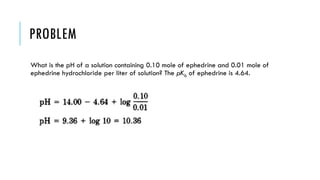
What is the pH of a solution containing 0.10 mole of ephedrine and 0.01 mole of
ephedrine hydrochloride per liter of solution? The pKb of ephedrine is 4.64.
PROBLEM
What is the pH of a solution containing 0.10 mole of ephedrine and 0.01 mole of
ephedrine hydrochloride per liter of solution? The pKb of ephedrine is 4.64.
BUFFER CAPACITY (Β)
The buffer capacity of a buffer solution is “a measure of its magnitude of its resistance to
change in the pH on an addition of an acid or a base.”
Buffer capacity is also referred as buffer index, buffer value, buffer efficiency or buffer
coefficient.
The buffer capacity represented by ‘β’ may also be defined as:
“The ratio of the increment (amount added) of strong acid or base to the change in pH
(ΔpH) occured”.
β = ΔA or ΔB / ΔpH
Where, ΔA or ΔB represents the small increment (in gram equivalents / litre of strong acid or
base added)and ΔpH is the (small) pH change of ΔpH.
PHARMACEUTICAL (APPLICATIONS OF) BUFFER
Buffers are widely used in the field of pharmacy as ingredients in most of the pharmaceutical
formulations in order to adjust the pH of the product to that required for maximum stability.
In parenteral preparations (i.e. injections):In case of parenteral preparations, pH should be
considered carefully as large deviations of pH may lead to serious consequences. The ideal pH of a
parenteral product is 7.4, which is pH of blood; The most commonly used buffers in parenteral
products (injections) are acetate, phosphate, citrate and glutamate.
Prevent tissue irritation (ophthalmic formulations); The lacrimal fluid has a pH in rang 7 – 8. The
buffering agents most commonly used in ophthalmic preparations include borate, carbonate and
phosphates
For stability of formulations
To enhance solubility of drug
For optimum therapeutic effect
THANK YOU

Buffer and Buffer capacity

  • 1.
  • 2.
    BUFFER Buffer are themixture of compounds that, by their presence in solution, resist change in pH upon addition of small quantities of acid or base Resistance to change in pH is known as buffer action Buffer is the combination of weak acid and its conjugate base
  • 3.
    BUFFER EQUATION (HENDERSON-HESSELBALCHEQUATION) When salt and weak acid have common ion E.g. Sodium acetate + Acetic acid For acid pH = pKa + Log [Salt]/[Acid] For base pH = pKw - pKb + Log [Salt]/[Acid]
  • 4.
    FACTORS AFFECTING BUFFERSOLUTION Addition of neutral salts…. changes pH by altering ionic strength Dilution … as it changes ionic strength Temperature… pH increases with increase in pH for acetate buffers
  • 5.
    PROBLEM 1 What isthe pH of 0.1 M acetic acid solution, pKa =4.76? What is the pH after enough sodium acetate has been added to make the solution 0.1 M with respect to this salt.
  • 6.
    PROBLEM What is thepH of a solution containing 0.10 mole of ephedrine and 0.01 mole of ephedrine hydrochloride per liter of solution? The pKb of ephedrine is 4.64.
  • 7.
    PROBLEM What is thepH of a solution containing 0.10 mole of ephedrine and 0.01 mole of ephedrine hydrochloride per liter of solution? The pKb of ephedrine is 4.64.
  • 8.
    BUFFER CAPACITY (Β) Thebuffer capacity of a buffer solution is “a measure of its magnitude of its resistance to change in the pH on an addition of an acid or a base.” Buffer capacity is also referred as buffer index, buffer value, buffer efficiency or buffer coefficient. The buffer capacity represented by ‘β’ may also be defined as: “The ratio of the increment (amount added) of strong acid or base to the change in pH (ΔpH) occured”. β = ΔA or ΔB / ΔpH Where, ΔA or ΔB represents the small increment (in gram equivalents / litre of strong acid or base added)and ΔpH is the (small) pH change of ΔpH.
  • 9.
    PHARMACEUTICAL (APPLICATIONS OF)BUFFER Buffers are widely used in the field of pharmacy as ingredients in most of the pharmaceutical formulations in order to adjust the pH of the product to that required for maximum stability. In parenteral preparations (i.e. injections):In case of parenteral preparations, pH should be considered carefully as large deviations of pH may lead to serious consequences. The ideal pH of a parenteral product is 7.4, which is pH of blood; The most commonly used buffers in parenteral products (injections) are acetate, phosphate, citrate and glutamate. Prevent tissue irritation (ophthalmic formulations); The lacrimal fluid has a pH in rang 7 – 8. The buffering agents most commonly used in ophthalmic preparations include borate, carbonate and phosphates For stability of formulations To enhance solubility of drug For optimum therapeutic effect
  • 10.