



Biphasic
Systems
(Large scale manufacture of
emulsions & suspensions)
Mr. Mirza Salman Baig
Assistant Professor (Pharmaceutics)
AIKTC, School of Pharmacy, New Panvel
Affiliated to University of Mumbai (INDIA)
Large scale manufacture of
emulsions & suspensions
Layout
Equipments
Collidal mill
QC for suspension /emulsion
Equipments for Suspension
• Ball mill
• Fluid energy mill
• Cutter mill
• Hammer mill
• End runner mill
• Collidal mill
QC Suspension
• Sedimentation volume (Hu/H0)
• Rheological test (Brookfield)
• Electrokinetic test (Electrophoresis)
• Zeta potential
• Particle Size distrubution
• Photo microscopy (Coulter counter)
• Sp Gravity
• Drug content uniformity (assay)
• Redispersibility (simulated human arm shaker)
Equipments for emulsion
• Agitators
• Mechanical mixers
• Collidal mill
• Homogenizer
• Ultrasonic Devices
QC Suspension/emulsion
Stress conditions
• Ageing and Temperature (40-450C)
• Centrifugation (3500 rpm)
• Agitation
Physical Parameters
• Phase Seperation
• Viscosity
General Layout
Colloidal mill
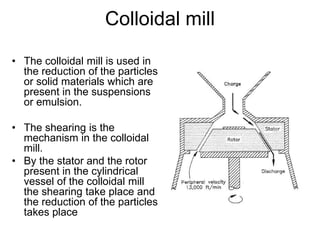
• The colloidal mill is used in
the reduction of the particles
or solid materials which are
present in the suspensions
or emulsion.
• The shearing is the
mechanism in the colloidal
mill.
• By the stator and the rotor
present in the cylindrical
vessel of the colloidal mill
the shearing take place and
the reduction of the particles
takes place
Basic parts
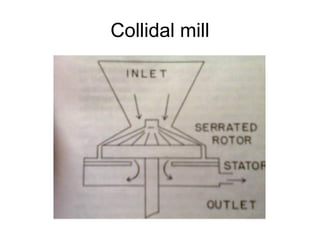
• It consists of an inlet hopper which is used to
feed the material into the mill.
• It consists of a rotor and stator which are used
to reduce the particles size by applying the
shearing force.
• It consists of an outlet which is used to
discharge the reduced particles.
Construction
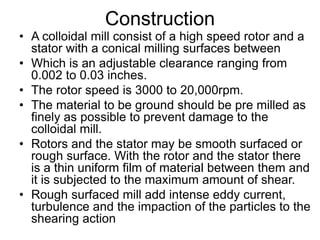
• A colloidal mill consist of a high speed rotor and a
stator with a conical milling surfaces between
• Which is an adjustable clearance ranging from
0.002 to 0.03 inches.
• The rotor speed is 3000 to 20,000rpm.
• The material to be ground should be pre milled as
finely as possible to prevent damage to the
colloidal mill.
• Rotors and the stator may be smooth surfaced or
rough surface. With the rotor and the stator there
is a thin uniform film of material between them and
it is subjected to the maximum amount of shear.
• Rough surfaced mill add intense eddy current,
turbulence and the impaction of the particles to the
shearing action
Principle
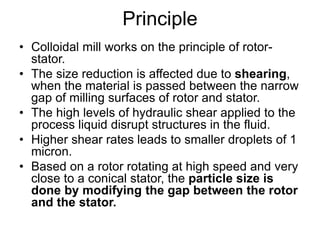
• Colloidal mill works on the principle of rotor-
stator.
• The size reduction is affected due to shearing,
when the material is passed between the narrow
gap of milling surfaces of rotor and stator.
• The high levels of hydraulic shear applied to the
process liquid disrupt structures in the fluid.
• Higher shear rates leads to smaller droplets of 1
micron.
• Based on a rotor rotating at high speed and very
close to a conical stator, the particle size is
done by modifying the gap between the rotor
and the stator.
Working
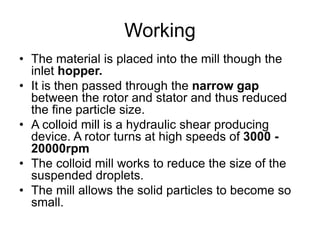
• The material is placed into the mill though the
inlet hopper.
• It is then passed through the narrow gap
between the rotor and stator and thus reduced
the fine particle size.
• A colloid mill is a hydraulic shear producing
device. A rotor turns at high speeds of 3000 -
20000rpm
• The colloid mill works to reduce the size of the
suspended droplets.
• The mill allows the solid particles to become so
small.
Collidal mill
Colloidal mill
The main use of a colloid mill is the dispersion of solid particles within a
liquid.
• It is used to reduce the particle size in suspension in a liquid or to reduce
the droplet size of a liquid suspended in another liquid.
• By applying high levels of hydraulic shear to the process liquid the
reduction is done.
• It is frequently used to increase the stability of suspensions and emulsions.
• It is used for the formation of the efficient emulsification, homogenization,
dispersion and mixing during the course of cutting, milling and shocking
with high frequency.
• Colloidal mill is utilized in a number of industries including, food and
beverage, pharmaceuticals and chemicals.
• Colloidal mill is ideal for small, medium and large scale tablet batching
systems. The colloid mill is the most efficient system for dispersion and
homogenization of raw material.
• It is mainly used in pharmaceutical purpose for the preparations colloidal
dispersions, suspensions, emulsions and ointments.
• Particles size of as small as 3 microns can be obtained by the colloidal mill.
• Fibrous materials can be milled using rough surfaced rotor and stator.
• Colloidal mill can be sterilized hence, it can be mainly used in the
production of the sterile products.
Filling and packaging of pharmaceutical
suspension
• The common packaging presentations for commercial oral
liquid pediatric drug products are glass bottle, plastic bottle,
sachet, and stick pack configurations.
• Oral liquid pediatric formulations are typically prepared from
a powder that is constituted at the time of use as a
suspension or a solution for single or multiple use depending
on the stability of the constituted formulation
• Active ingredients with low aqueous solubility can be
developed as a powder for oral suspension and presented in a
bottle for multiple use product and a stick pack or sachet for
single‐use product.
• A secondary package may be used in cases where the primary
pack failed to provide adequate protection against light
degradation.