
Accelerated stability testing
& ICH
(Dr.) Mirza Salman Baig
Assistant Professor (Pharmaceutics)
AIKTC, School of Pharmacy,New Panvel
Affiliated to University of Mumbai (INDIA)
• Federal food, drug and cosmetic act ask
manufacturer to control processes to
ensure safety, quality etc
• This is GMP
• FDA regulate this
Stability
• Stability of pharmaceutical product may be
defined as the capability of a formulation (in a
specific container/closure system) to remain
within its physical, chemical, microbiological,
therapeutic and toxicological specification.
Stability testing
• A method by which a product is exposed
to elevated temperature, simulating what
would happen over longer periods on the
shelf life
• Shelf life:- Time by which product remain
stable and retain 90% of its initial potency.
(10% degradation)
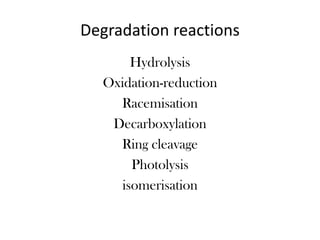
Hydrolysis
Oxidation-reduction
Racemisation
Decarboxylation
Ring cleavage
Photolysis
isomerisation
Degradation reactions
Why?
• The stability of pharmaceutical
preparations should be evaluated by
exposing the product to normal shelf
conditions for a year or extended periods.
• The rate of decomposition is slow at room
temperature .Such a method is time
consuming and uneconomical.
Objective of accelerated stability
study
• To predict the shelf life of a pharmaceutical
product by accelerating the rate of
decomposition ,preferably by increasing the
temperature.
• Stability study to predict the shelf life of the
product, by accelerating the rate of
decomposition, preferably by increasing the
temperature of reaction conditions.
Advantage
• With the advancement in branch of
kinetics, shelf life of a dosage form can be
predicted within months based on
accelerated stability reports
• Preparations are subjected to high
stresses during stability testing.
• Common high stresses include :
– Temperature
– Humidity
– Light
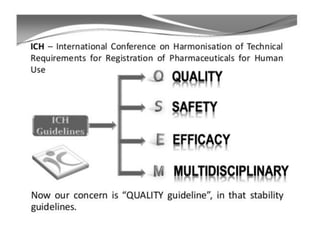
ICH Guidelines
• These guidelines provide definitions of key
terms & principles used in the stability testing of
drug substances & drug products.
• Q 1A (R2) :Stability testing of new drug
substances & products.
• Q 1B :Photo stability testing of new drug
substances &products.
• Q 1C :Stability testing for new dosage forms.
ICH
• ICH outlined a combination of temperature
& humidities for stability studies for most of
the drug products. These include.....
❖ -15O C ±5 C
❖ 05O C±3 C /Ambient humidity
❖ 25O C±2 C/60%RH±5%,
❖ 30O C±2 C/60% RH±5%,
❖ 40O C±2 C/75%RH±5%.
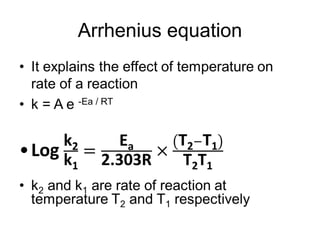
Arrhenius equation
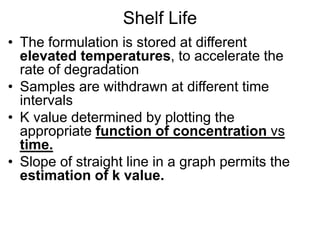
Shelf Life
• The formulation is stored at different
elevated temperatures, to accelerate the
rate of degradation
• Samples are withdrawn at different time
intervals
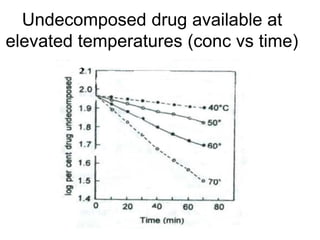
• K value determined by plotting the
appropriate function of concentration vs
time.
• Slope of straight line in a graph permits the
estimation of k value.
Undecomposed drug available at
elevated temperatures (conc vs time)
Shelf Life
• Log k values are plotted against
reciprocal of absolute temperature
• Resulting the straight line extrapolated to
room temperature (k 25O C ) read the
corresponding log k value on y-axis.
• Substitute the k value in the appropriate
equation to get the shelf life of the
product.
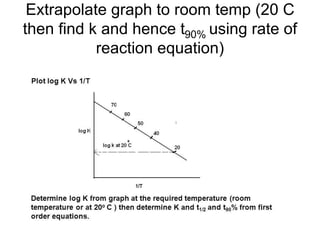
Extrapolate graph to room temp (20 C
then find k and hence t90% using rate of
reaction equation)
Shelf life can be determined if we know
k and order of reaction
Order of
reactiont
Equation t1/2 (Half life) t90%
0 k0= x/t OR x=k0t t1/2= a/2k0 t0.9= 0.9a/k
1
k= 2.303/t . log
a/(a-x)
t1/2= 0.693/k t0.9=2.303/k
2 k = 1/t . x/a(a-x) t1/2= 1/ak t0.9= 9/ak