
IIIrd Semesester B. pharmacy
Physical Pharmaceutics-I
Unit-III
Surface and Interfacial tension (Part-1)
(Liquid interface, surface and interfacial tension )
Miss. Pooja D. Bhandare
(Assistant professor)
Kandhar college of pharmacy
 LIQUID INTERFACE
• When phases are in contact with each other, the boundary between them is
know as interface.
• If one of two phases is a gas or vapour, the term ‘surface’ is generally used
instead of interface.
• No interface can be observed between two gas phases because they are
mutually miscible in all proportions.
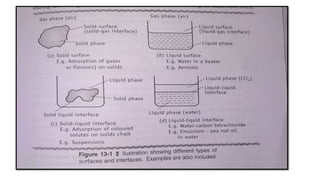
• The pharmacist encounter several types of interface, while handling dosage
form.
• Solid- solid interface are important in pharmacy in the area of adhesion
of granules to form a tablet, flow of granules through hopper during
tableting.
• In the liquid state, the cohesive forces between adjacent molecule are
well developed.
• Molecules in the bulk liquid are surrounded in all directions by other
molecule for which they have an equal attraction.
• But molecules at the surface (i.e., at the liquid-air interface) can only
develop attractive cohesive forces with other liquid molecules that are
situated below and adjacent to them.
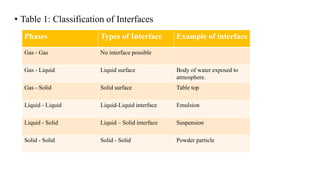
• Table 1: Classification of Interfaces
Phases Types of Interface Example of interface
Gas - Gas No interface possible
Gas - Liquid Liquid surface Body of water exposed to
atmosphere.
Gas - Solid Solid surface Table top
Liquid - Liquid Liquid-Liquid interface Emulsion
Liquid - Solid Liquid – Solid interface Suspension
Solid - Solid Solid - Solid Powder particle
 SURFACE AND INTERFACIAL TENSION
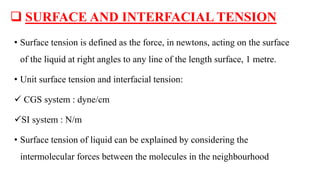
• Surface tension is defined as the force, in newtons, acting on the surface
of the liquid at right angles to any line of the length surface, 1 metre.
• Unit surface tension and interfacial tension:
 CGS system : dyne/cm
SI system : N/m
• Surface tension of liquid can be explained by considering the
intermolecular forces between the molecules in the neighbourhood
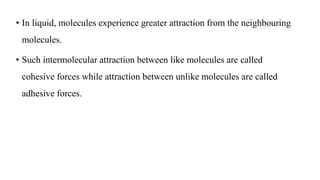
• In liquid, molecules experience greater attraction from the neighbouring
molecules.
• Such intermolecular attraction between like molecules are called
cohesive forces while attraction between unlike molecules are called
adhesive forces.
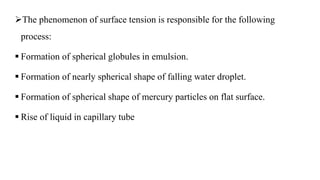
The phenomenon of surface tension is responsible for the following
process:
 Formation of spherical globules in emulsion.
 Formation of nearly spherical shape of falling water droplet.
 Formation of spherical shape of mercury particles on flat surface.
 Rise of liquid in capillary tube
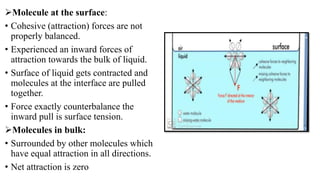
Molecule at the surface:
• Cohesive (attraction) forces are not
properly balanced.
• Experienced an inward forces of
attraction towards the bulk of liquid.
• Surface of liquid gets contracted and
molecules at the interface are pulled
together.
• Force exactly counterbalance the
inward pull is surface tension.
Molecules in bulk:
• Surrounded by other molecules which
have equal attraction in all directions.
• Net attraction is zero
Interfacial tension is between two immiscible liquids arises as a result of
imbalance forces.
It is the per unit length existing at the interface between two immiscible
liquid phases.
Although, in the general sense, all tension may be referred to as interfacial
tension, this term is most often used for the attractive forces between
immiscible liquids.
Generally interfacial tension are less than surface tension because the
adhesive forces between two liquid phases forming an interface are greater
than when a liquid and a gas phase exist together
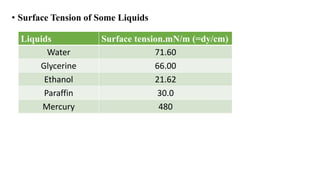
• Surface Tension of Some Liquids
Liquids Surface tension.mN/m (=dy/cm)
Water 71.60
Glycerine 66.00
Ethanol 21.62
Paraffin 30.0
Mercury 480
Thank You!