Biphasic
Systems
(Introduction)
Mr. Mirza Salman Baig
Assistant Professor (Pharmaceutics)
AIKTC, School of Pharmacy, New Panvel
Affiliated to University of Mumbai (INDIA)
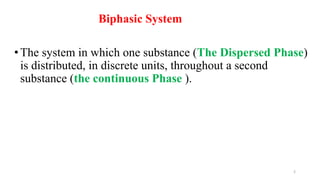
•The system in which one substance (The Dispersed Phase)
is distributed, in discrete units, throughout a second
substance (the continuous Phase ).
2
Biphasic System
3
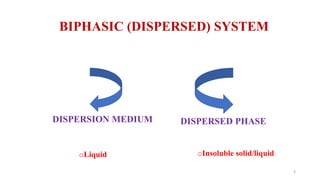
BIPHASIC (DISPERSED) SYSTEM
DISPERSION MEDIUM DISPERSED PHASE
oLiquid oInsoluble solid/liquid
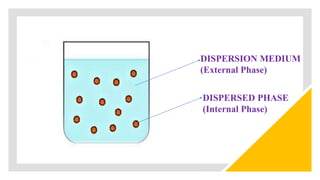
DISPERSION MEDIUM
(External Phase)
DISPERSED PHASE
(Internal Phase)
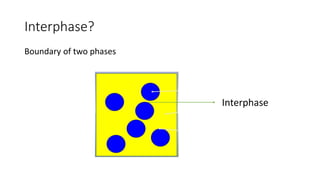
Interphase?
Interphase
Boundary of two phases
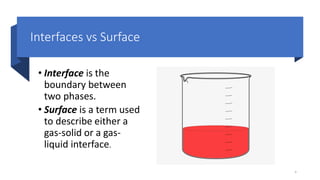
Interfaces vs Surface
• Interface is the
boundary between
two phases.
• Surface is a term used
to describe either a
gas-solid or a gas-
liquid interface.
6
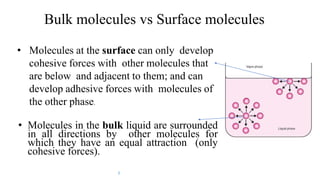
Bulk molecules vs Surface molecules
• Molecules in the bulk liquid are surrounded
in all directions by other molecules for
which they have an equal attraction (only
cohesive forces).
7
• Molecules at the surface can only develop
cohesive forces with other molecules that
are below and adjacent to them; and can
develop adhesive forces with molecules of
the other phase.
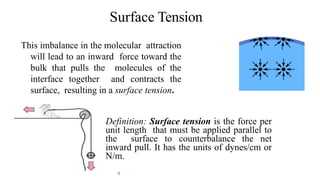
Surface Tension
This imbalance in the molecular attraction
will lead to an inward force toward the
bulk that pulls the molecules of the
interface together and contracts the
surface, resulting in a surface tension.
Definition: Surface tension is the force per
unit length that must be applied parallel to
the surface to counterbalance the net
inward pull. It has the units of dynes/cm or
N/m.
8
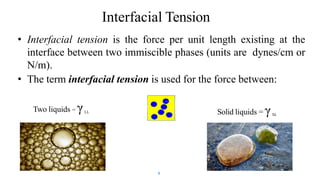
Interfacial Tension
• Interfacial tension is the force per unit length existing at the
interface between two immiscible phases (units are dynes/cm or
N/m).
• The term interfacial tension is used for the force between:
9
Two liquids = γLL Solid liquids = γSL
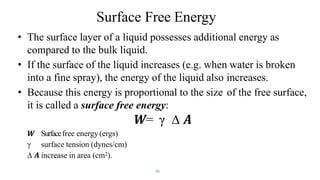
Surface Free Energy
10
• The surface layer of a liquid possesses additional energy as
compared to the bulk liquid.
• If the surface of the liquid increases (e.g. when water is broken
into a fine spray), the energy of the liquid also increases.
• Because this energy is proportional to the size of the free surface,
it is called a surface free energy:
𝑾= γ ∆ 𝑨
𝑾 Surfacefree energy (ergs)
γ surface tension (dynes/cm)
∆ 𝑨 increase in area (cm2).
Surface Free Energy
• Each molecule of the liquid has a
tendency to move inside the
liquid from the surface;
• To increase surface area of liquid ,
molecules must be moved from
bulk to surface, this needs energy
which is stored in surface of liquid
• This energy is known as surface
free energy
11
Gibbs free energy G,
•G = [Difference in bond energies or attractive
energies between products and reactants, H]-
[Change in probability during the process, T S]
•G=H-TS
• Where,
• H= Enthalpy
• S= Entropy
• T= Temperature
Stable dispersed system
• Suspension → No permanent coagulation of particles
• Emulsion → No phase separation
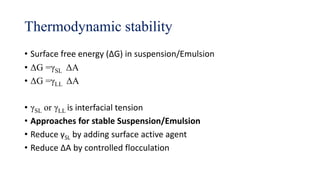
Thermodynamic stability
• Surface free energy (ΔG) in suspension/Emulsion
• ΔG =γSL ΔA
• ΔG =γLL ΔA
• γSL or γLL is interfacial tension
• Approaches for stable Suspension/Emulsion
• Reduce γSL by adding surface active agent
• Reduce ΔA by controlled flocculation
Kinetic stability
• Sedimentation
• Brownian motion
Where,
• vsed. = sedimentation velocity in cm / sec
• d = diameter of particle
• ρ s= density of disperse phase
• ρ o= density of disperse media
• g = acceleration due to gravity
• η= viscosity of disperse medium in
poise
Stokes Equation
16
All the factors which reduce sedimentation velocity[vsed], provide kinetic
stability
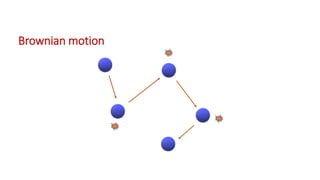
Brownian motion
Kinetic stability
Brownian Movement
• Brownian movement of particle prevents sedimentation by keeping the
dispersed material in random motion.
• Brownian movement depends on the density of dispersed phase and
the density and viscosity of the disperse medium.
• The kinetic bombardment of the particles by the molecules of the
suspending medium will keep the particles suspending,
• Particle size is below critical radius (r) for Brownian movement.
19
➢ Suspension/Emulsion can improve chemical stability of certain
drug. E.g. Procaine penicillin G.
➢Drug in suspension exhibits higher rate of bioavailability than
other dosage forms.
Solution > Suspension > Capsule > Compressed Tablet >
Coated tablet
➢Duration and onset of action can be controlled.
E.g. Protamine Zinc-Insulin suspension.
➢Suspension can mask the unpleasant/ bitter taste of drug.
E.g. Chloramphenicol
Advantages
20
➢Physical stability , sedimentation and compaction can cause
problems.
➢ It is bulky sufficient care must be taken during handling and
transport.
➢ It is difficult to formulate.
➢ Uniform and accurate dose can not be achieved unless
suspension are packed in unit dosage form.
Disadvantages
21
➢The suspended particles/globules should not settle/cream rapidly
and sediment produced, must be easily re-disperse by means of
moderate amount of shaking.
➢ It should be easy to pour yet not watery and no grittiness.
➢ It should have pleasing odor , color and palatability.
➢ Good syringeability
➢ It should be physically,chemically and microbiologically
stable.
➢ Parenteral /Ophthalmic suspension should be sterilizable.
Features Desired In Dispersed System

Introduction biphasic system suspension emulsion

  • 1.
    Biphasic Systems (Introduction) Mr. Mirza SalmanBaig Assistant Professor (Pharmaceutics) AIKTC, School of Pharmacy, New Panvel Affiliated to University of Mumbai (INDIA)
  • 2.
    •The system inwhich one substance (The Dispersed Phase) is distributed, in discrete units, throughout a second substance (the continuous Phase ). 2 Biphasic System
  • 3.
    3 BIPHASIC (DISPERSED) SYSTEM DISPERSIONMEDIUM DISPERSED PHASE oLiquid oInsoluble solid/liquid
  • 4.
  • 5.
  • 6.
    Interfaces vs Surface •Interface is the boundary between two phases. • Surface is a term used to describe either a gas-solid or a gas- liquid interface. 6
  • 7.
    Bulk molecules vsSurface molecules • Molecules in the bulk liquid are surrounded in all directions by other molecules for which they have an equal attraction (only cohesive forces). 7 • Molecules at the surface can only develop cohesive forces with other molecules that are below and adjacent to them; and can develop adhesive forces with molecules of the other phase.
  • 8.
    Surface Tension This imbalancein the molecular attraction will lead to an inward force toward the bulk that pulls the molecules of the interface together and contracts the surface, resulting in a surface tension. Definition: Surface tension is the force per unit length that must be applied parallel to the surface to counterbalance the net inward pull. It has the units of dynes/cm or N/m. 8
  • 9.
    Interfacial Tension • Interfacialtension is the force per unit length existing at the interface between two immiscible phases (units are dynes/cm or N/m). • The term interfacial tension is used for the force between: 9 Two liquids = γLL Solid liquids = γSL
  • 10.
    Surface Free Energy 10 •The surface layer of a liquid possesses additional energy as compared to the bulk liquid. • If the surface of the liquid increases (e.g. when water is broken into a fine spray), the energy of the liquid also increases. • Because this energy is proportional to the size of the free surface, it is called a surface free energy: 𝑾= γ ∆ 𝑨 𝑾 Surfacefree energy (ergs) γ surface tension (dynes/cm) ∆ 𝑨 increase in area (cm2).
  • 11.
    Surface Free Energy •Each molecule of the liquid has a tendency to move inside the liquid from the surface; • To increase surface area of liquid , molecules must be moved from bulk to surface, this needs energy which is stored in surface of liquid • This energy is known as surface free energy 11
  • 12.
    Gibbs free energyG, •G = [Difference in bond energies or attractive energies between products and reactants, H]- [Change in probability during the process, T S] •G=H-TS • Where, • H= Enthalpy • S= Entropy • T= Temperature
  • 13.
    Stable dispersed system •Suspension → No permanent coagulation of particles • Emulsion → No phase separation
  • 14.
    Thermodynamic stability • Surfacefree energy (ΔG) in suspension/Emulsion • ΔG =γSL ΔA • ΔG =γLL ΔA • γSL or γLL is interfacial tension • Approaches for stable Suspension/Emulsion • Reduce γSL by adding surface active agent • Reduce ΔA by controlled flocculation
  • 15.
  • 16.
    Where, • vsed. =sedimentation velocity in cm / sec • d = diameter of particle • ρ s= density of disperse phase • ρ o= density of disperse media • g = acceleration due to gravity • η= viscosity of disperse medium in poise Stokes Equation 16 All the factors which reduce sedimentation velocity[vsed], provide kinetic stability
  • 17.
  • 18.
    Kinetic stability Brownian Movement •Brownian movement of particle prevents sedimentation by keeping the dispersed material in random motion. • Brownian movement depends on the density of dispersed phase and the density and viscosity of the disperse medium. • The kinetic bombardment of the particles by the molecules of the suspending medium will keep the particles suspending, • Particle size is below critical radius (r) for Brownian movement.
  • 19.
    19 ➢ Suspension/Emulsion canimprove chemical stability of certain drug. E.g. Procaine penicillin G. ➢Drug in suspension exhibits higher rate of bioavailability than other dosage forms. Solution > Suspension > Capsule > Compressed Tablet > Coated tablet ➢Duration and onset of action can be controlled. E.g. Protamine Zinc-Insulin suspension. ➢Suspension can mask the unpleasant/ bitter taste of drug. E.g. Chloramphenicol Advantages
  • 20.
    20 ➢Physical stability ,sedimentation and compaction can cause problems. ➢ It is bulky sufficient care must be taken during handling and transport. ➢ It is difficult to formulate. ➢ Uniform and accurate dose can not be achieved unless suspension are packed in unit dosage form. Disadvantages
  • 21.
    21 ➢The suspended particles/globulesshould not settle/cream rapidly and sediment produced, must be easily re-disperse by means of moderate amount of shaking. ➢ It should be easy to pour yet not watery and no grittiness. ➢ It should have pleasing odor , color and palatability. ➢ Good syringeability ➢ It should be physically,chemically and microbiologically stable. ➢ Parenteral /Ophthalmic suspension should be sterilizable. Features Desired In Dispersed System