pH Buffer and Isotonic Solution
Mr. Rakesh Tiwle
Asst. professor
Shri Rawatpura Sarkar Institute of Pharmacy ,
Kumhari, Durg, C.G
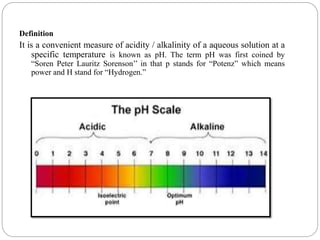
Definition
It is a convenient measure of acidity / alkalinity of a aqueous solution at a
specific temperature is known as pH. The term pH was first coined by
“Soren Peter Lauritz Sorenson’’ in that p stands for “Potenz” which means
power and H stand for “Hydrogen.”
WHY IS pH MEASURED?
 To test a sample against a legal requirement
 To test a chemical against a specification
 As a part of analytical method
 Process control in chemical industry
 Environmental monitoring of waste and effluents
 Monitoring and controlling biochemical reactions, many of which
only take place in a particular and sometimes narrow pH range.
Limitation of pH Scale
pH is confined only to dilute aqueous solution
It does not cover very high concentration or pH value and very low pH value.
It is measured on a continuous scale from 0 to 14
Method to measurement of pH
There are three method for measuring the pH
1. Electrometric method
2. pH paper method
3. Colorimetric method
1.Electrometric method
 The pH measurement is possible because emf of certain chemical cell varies
with the hydrogen ion concentration of the solution on the cell.
 pH electrode/test solution to be measured// reference electrode
symbol//signifies the presence of a liquid junction between test solution and
reference electrode
 If other variables in the cells are controlled, emf of the cell can be correlated
with pH
 Pt, H2 (p) H+ (a)  reference electrode.
 left hand electrode is the hydrogen electrode
 right hand electrode whose potential is not affected by pH
The basic principle of pH of the electrometric method is to determine the activity of the
hydrogen ions.
Electrometric measurement are of two type.
1. Measuring system
2. Reference electrode.
1. Measuring system
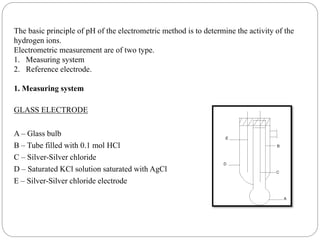
GLASS ELECTRODE
A – Glass bulb
B – Tube filled with 0.1 mol HCl
C – Silver-Silver chloride
D – Saturated KCl solution saturated with AgCl
E – Silver-Silver chloride electrode
It consist of glass envelop having a pH sentive glass membrane at the bottom which
contain constant pH buffer solution. A glass electrode is made of a thin glass membrane of
special composition. This elecrode is dipped in the measuring solution so that the potential
is to developed at the platinium elctrode is dipped in the measuring solution.
CAR E OF pH ELECTRODES
 On exposure to air and allowing to dry out, glass membrane becomes dehydrated and
liquid junction may also deteriorate
 pH electrode should be stored in an appropriate storage solution, when not in use
 Mixture of different salts of similar composition to the reference electrode filling
solution, a buffer to provide suitable pH(e.g.4 to7) and mild cleansing agent
 Electrode to be immersed to a sufficient depth to cover both the glass membrane and
the liquid junction
 A pH electrode should not be stored in water
 Periodically the level of the filling solution in reference electrode should be checked
and topped-up as necessary
 When not in use, the filling hole of the reference electrode should be covered with
the plug provided for this
 If pH electrode has been left in air and dried out, it should be re-hydrated by
immersion in the storage solution for at least 12 hours
 A pH electrode should be regularly examined for salt crystal build up and
membrane and liquid junction deposits
 For additional cleaning soak the pH electrode in either 0.1 molar HCl or 0.1 molar
Nitric acid
ACCURACY
 Electrodes available that are capable of measuring pH to typically 0.01, 0.02, 0.02
and 0.1 pH unit
 Possible to record pH to 0.001 pH unit, only done to study small differences or
changes in pH
Reference electrode.
The calomel electrode can be used as a reference electrode having glass envelop
containing glass tube having a calomel along with the platinum wire submerged in
which the tube is surrounded by a saturated solution KCL. Solution that diffuses
slowly in to the process liquid through the liquid junction provided by the asbestos
fiber. Due to this reference electrode developed the pH.
2. pH paper method
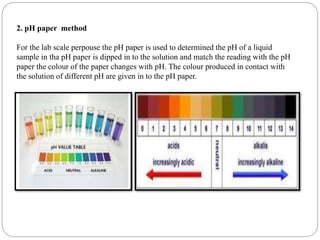
For the lab scale perpouse the pH paper is used to determined the pH of a liquid
sample in tha pH paper is dipped in to the solution and match the reading with the pH
paper the colour of the paper changes with pH. The colour produced in contact with
the solution of different pH are given in to the pH paper.
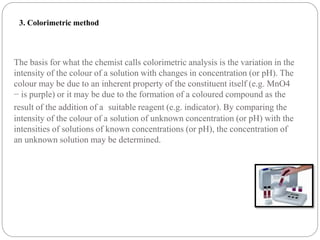
The basis for what the chemist calls colorimetric analysis is the variation in the
intensity of the colour of a solution with changes in concentration (or pH). The
colour may be due to an inherent property of the constituent itself (e.g. MnO4
− is purple) or it may be due to the formation of a coloured compound as the
result of the addition of a suitable reagent (e.g. indicator). By comparing the
intensity of the colour of a solution of unknown concentration (or pH) with the
intensities of solutions of known concentrations (or pH), the concentration of
an unknown solution may be determined.
3. Colorimetric method
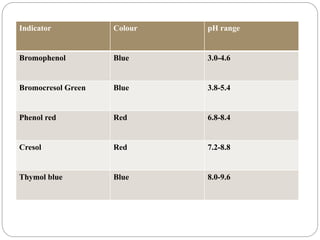
Indicator Colour pH range
Bromophenol Blue 3.0-4.6
Bromocresol Green Blue 3.8-5.4
Phenol red Red 6.8-8.4
Cresol Red 7.2-8.8
Thymol blue Blue 8.0-9.6
Buffers
A buffer solution (more precisely, pH buffer or hydrogen ion buffer) is an aqueous
solution consisting of a mixture of a weak acid and its conjugate base, or vice versa.
Its pH changes very little when a small amount of strong acid or base is added to it.
Buffer solutions are used as a means of keeping pH at a nearly constant value in a
wide variety of chemical applications. In nature, there are many systems that use
buffering for pH regulation. For example, the bicarbonate buffering system is used to
regulate the pH of blood.
Buffer equation
It can be reffered from book only. It is written in easy language.
Buffer capacity
Buffer capacity is a measure of the efficiency of a buffer in resisting changes in pH.
Conventionally, the buffer capacity (ß) is expressed as the amount of strong acid or
base, in gram-equivalents, that must be added to 1 liter of the solution to change its pH
by one unit. Calculate the buffer capacity as:
Parenteral Products:
Use of buffers is common in the parenteral products. Since the PH of blood is 7.4,these
products are required to be adjusted to this PH. Change in PH to higher side (more than 10)
may cause tissue necrosis while on lower side (below 3) it may cause pain at the site of
action. Commonly used buffers include citrate, glutamate, phthalate and acetate. The PH
optimization is generally carried out to have better solubility, stability and reduced irritancy
of the product.
Ophthalmic Products:
The purpose of buffering some ophthalmic solution is to prevent an increase in PH can
affect both the solubility and the stability of the drug. The decision whether or not buffering
agents should be added in preparing on ophthalmic solution must be based on
several considerations. Normal tears have PH of about 7.4 and posses some buffer capacity
Buffer in Pharmaceutical and biological system
BUFFERS IN BIOLOGICAL SYSTEMS
Buffers for biological systems should satisfy the following requirements-
A PKa value between 6.0to 8.0
High water solubility and minimal organic solvent solubility-
Exclusion by cellular membranes-
Minimal interaction between buffer and critical reaction compounds-
Should not absorbs light in the visible and Uv spectrum-
Stable and resistant to enzymatic degradation-
Minimal changes on dissociation from changes In Concentration and temperature-
Easy to manufacture and purify-
Cost effective-
Ionic strength-
Permeability Buffers are important to biological systems becausee they enable the organism to
maintain homeostasis with the little physiological cost
Blood:
Blood consist of primary and secondary buffer systems contributing the PH 7.4. When PH of the
blood goes below7.0 or above 7.8, life is in danger .The PH of the blood in diabetic coma is reported
to drop as low as 6.8.Primary buffers present in plasma are
–
Carbonic acid-bicarbonate system and acid alkali salts of phosphoric acid systems Secondary buffers
that are present in erythrocytes are
–
hemoglobin/ oxyhemoglobin system and acid saltsof phosphoric acid system Lacrimal Fluids:
Lacrimal fluids (tears) have been found to have a great degree of buffer capacity, allowing dilution
of1:15 with neutral distilled water. The PH of tears is about 7.4 , with range of 7.0 to 8.0. Normally,
pure conjunctiva fluid is more acidic than the tear fluids commonly employed in pharmacy. The PH
increase rapidly when the sample is removed for analysis because of loss of carbon dioxide from the
tear fluid
www.uobabylon.edu.iq/eprints/publication
Visit the link for the buffer equation
What is buffer isotonic solution
The isotonic solution does not causes contraction or swelling of the tissues and do not
produce discomfort when it si injected in to the eye.
Osmotic pressure
Movement of water molecule across the semi permeable from lower to higher
concentration is known as osmosis.
Hypertonic solution
The solution having the an osmotic pressure greater than 0.9% w/v is known as isotonoic
solution.
Hypotonic solution
The solution having the an osmotic pressure less than 0.9% w/v is known as isotonoic
solution.
Osmolality
It is the measurement of solute concentration per unit mass of solvent.
Osmolarity
It is th econcentration ofosmotic solution is can be measured of solute con. Per unit
volume of the solvent.
THANKs for watching

P h buffer and isotonic solution

  • 1.
    pH Buffer andIsotonic Solution Mr. Rakesh Tiwle Asst. professor Shri Rawatpura Sarkar Institute of Pharmacy , Kumhari, Durg, C.G
  • 2.
    Definition It is aconvenient measure of acidity / alkalinity of a aqueous solution at a specific temperature is known as pH. The term pH was first coined by “Soren Peter Lauritz Sorenson’’ in that p stands for “Potenz” which means power and H stand for “Hydrogen.”
  • 3.
    WHY IS pHMEASURED?  To test a sample against a legal requirement  To test a chemical against a specification  As a part of analytical method  Process control in chemical industry  Environmental monitoring of waste and effluents  Monitoring and controlling biochemical reactions, many of which only take place in a particular and sometimes narrow pH range.
  • 4.
    Limitation of pHScale pH is confined only to dilute aqueous solution It does not cover very high concentration or pH value and very low pH value. It is measured on a continuous scale from 0 to 14 Method to measurement of pH There are three method for measuring the pH 1. Electrometric method 2. pH paper method 3. Colorimetric method
  • 5.
    1.Electrometric method  ThepH measurement is possible because emf of certain chemical cell varies with the hydrogen ion concentration of the solution on the cell.  pH electrode/test solution to be measured// reference electrode symbol//signifies the presence of a liquid junction between test solution and reference electrode  If other variables in the cells are controlled, emf of the cell can be correlated with pH  Pt, H2 (p) H+ (a) reference electrode.  left hand electrode is the hydrogen electrode  right hand electrode whose potential is not affected by pH
  • 6.
    The basic principleof pH of the electrometric method is to determine the activity of the hydrogen ions. Electrometric measurement are of two type. 1. Measuring system 2. Reference electrode. 1. Measuring system GLASS ELECTRODE A – Glass bulb B – Tube filled with 0.1 mol HCl C – Silver-Silver chloride D – Saturated KCl solution saturated with AgCl E – Silver-Silver chloride electrode
  • 7.
    It consist ofglass envelop having a pH sentive glass membrane at the bottom which contain constant pH buffer solution. A glass electrode is made of a thin glass membrane of special composition. This elecrode is dipped in the measuring solution so that the potential is to developed at the platinium elctrode is dipped in the measuring solution. CAR E OF pH ELECTRODES  On exposure to air and allowing to dry out, glass membrane becomes dehydrated and liquid junction may also deteriorate  pH electrode should be stored in an appropriate storage solution, when not in use  Mixture of different salts of similar composition to the reference electrode filling solution, a buffer to provide suitable pH(e.g.4 to7) and mild cleansing agent  Electrode to be immersed to a sufficient depth to cover both the glass membrane and the liquid junction  A pH electrode should not be stored in water  Periodically the level of the filling solution in reference electrode should be checked and topped-up as necessary
  • 8.
     When notin use, the filling hole of the reference electrode should be covered with the plug provided for this  If pH electrode has been left in air and dried out, it should be re-hydrated by immersion in the storage solution for at least 12 hours  A pH electrode should be regularly examined for salt crystal build up and membrane and liquid junction deposits  For additional cleaning soak the pH electrode in either 0.1 molar HCl or 0.1 molar Nitric acid ACCURACY  Electrodes available that are capable of measuring pH to typically 0.01, 0.02, 0.02 and 0.1 pH unit  Possible to record pH to 0.001 pH unit, only done to study small differences or changes in pH
  • 9.
    Reference electrode. The calomelelectrode can be used as a reference electrode having glass envelop containing glass tube having a calomel along with the platinum wire submerged in which the tube is surrounded by a saturated solution KCL. Solution that diffuses slowly in to the process liquid through the liquid junction provided by the asbestos fiber. Due to this reference electrode developed the pH.
  • 10.
    2. pH papermethod For the lab scale perpouse the pH paper is used to determined the pH of a liquid sample in tha pH paper is dipped in to the solution and match the reading with the pH paper the colour of the paper changes with pH. The colour produced in contact with the solution of different pH are given in to the pH paper.
  • 11.
    The basis forwhat the chemist calls colorimetric analysis is the variation in the intensity of the colour of a solution with changes in concentration (or pH). The colour may be due to an inherent property of the constituent itself (e.g. MnO4 − is purple) or it may be due to the formation of a coloured compound as the result of the addition of a suitable reagent (e.g. indicator). By comparing the intensity of the colour of a solution of unknown concentration (or pH) with the intensities of solutions of known concentrations (or pH), the concentration of an unknown solution may be determined. 3. Colorimetric method
  • 12.
    Indicator Colour pHrange Bromophenol Blue 3.0-4.6 Bromocresol Green Blue 3.8-5.4 Phenol red Red 6.8-8.4 Cresol Red 7.2-8.8 Thymol blue Blue 8.0-9.6
  • 13.
    Buffers A buffer solution(more precisely, pH buffer or hydrogen ion buffer) is an aqueous solution consisting of a mixture of a weak acid and its conjugate base, or vice versa. Its pH changes very little when a small amount of strong acid or base is added to it. Buffer solutions are used as a means of keeping pH at a nearly constant value in a wide variety of chemical applications. In nature, there are many systems that use buffering for pH regulation. For example, the bicarbonate buffering system is used to regulate the pH of blood.
  • 14.
    Buffer equation It canbe reffered from book only. It is written in easy language.
  • 15.
    Buffer capacity Buffer capacityis a measure of the efficiency of a buffer in resisting changes in pH. Conventionally, the buffer capacity (ß) is expressed as the amount of strong acid or base, in gram-equivalents, that must be added to 1 liter of the solution to change its pH by one unit. Calculate the buffer capacity as:
  • 16.
    Parenteral Products: Use ofbuffers is common in the parenteral products. Since the PH of blood is 7.4,these products are required to be adjusted to this PH. Change in PH to higher side (more than 10) may cause tissue necrosis while on lower side (below 3) it may cause pain at the site of action. Commonly used buffers include citrate, glutamate, phthalate and acetate. The PH optimization is generally carried out to have better solubility, stability and reduced irritancy of the product. Ophthalmic Products: The purpose of buffering some ophthalmic solution is to prevent an increase in PH can affect both the solubility and the stability of the drug. The decision whether or not buffering agents should be added in preparing on ophthalmic solution must be based on several considerations. Normal tears have PH of about 7.4 and posses some buffer capacity Buffer in Pharmaceutical and biological system
  • 17.
    BUFFERS IN BIOLOGICALSYSTEMS Buffers for biological systems should satisfy the following requirements- A PKa value between 6.0to 8.0 High water solubility and minimal organic solvent solubility- Exclusion by cellular membranes- Minimal interaction between buffer and critical reaction compounds- Should not absorbs light in the visible and Uv spectrum- Stable and resistant to enzymatic degradation- Minimal changes on dissociation from changes In Concentration and temperature- Easy to manufacture and purify- Cost effective- Ionic strength- Permeability Buffers are important to biological systems becausee they enable the organism to maintain homeostasis with the little physiological cost
  • 18.
    Blood: Blood consist ofprimary and secondary buffer systems contributing the PH 7.4. When PH of the blood goes below7.0 or above 7.8, life is in danger .The PH of the blood in diabetic coma is reported to drop as low as 6.8.Primary buffers present in plasma are – Carbonic acid-bicarbonate system and acid alkali salts of phosphoric acid systems Secondary buffers that are present in erythrocytes are – hemoglobin/ oxyhemoglobin system and acid saltsof phosphoric acid system Lacrimal Fluids: Lacrimal fluids (tears) have been found to have a great degree of buffer capacity, allowing dilution of1:15 with neutral distilled water. The PH of tears is about 7.4 , with range of 7.0 to 8.0. Normally, pure conjunctiva fluid is more acidic than the tear fluids commonly employed in pharmacy. The PH increase rapidly when the sample is removed for analysis because of loss of carbon dioxide from the tear fluid
  • 19.
  • 20.
    What is bufferisotonic solution The isotonic solution does not causes contraction or swelling of the tissues and do not produce discomfort when it si injected in to the eye. Osmotic pressure Movement of water molecule across the semi permeable from lower to higher concentration is known as osmosis. Hypertonic solution The solution having the an osmotic pressure greater than 0.9% w/v is known as isotonoic solution. Hypotonic solution The solution having the an osmotic pressure less than 0.9% w/v is known as isotonoic solution. Osmolality It is the measurement of solute concentration per unit mass of solvent. Osmolarity It is th econcentration ofosmotic solution is can be measured of solute con. Per unit volume of the solvent.
  • 21.