The Solids State
General properties
Crystalline Solids
Amorphous Solids
Melting point
General properties
Solids are much denser than both gases and liquids due to
the presence of very strong intermolecular forces.
Solids are essentially incompressible (small empty spaces)
Solids have definite volume and shape (rigid, not fluid)
Solids have no
translational
motion (only
vibration)
Crystalline Solids
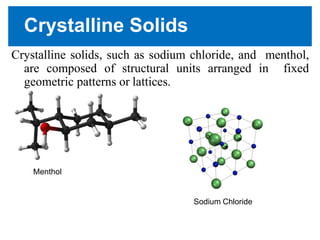
Crystalline solids, such as sodium chloride, and menthol,
are composed of structural units arranged in fixed
geometric patterns or lattices.
Menthol
Sodium Chloride
Crystalline Solids
Crystalline solids show definite melting points, passing
rather sharply from the solid to the liquid state.
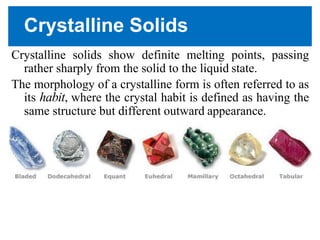
The morphology of a crystalline form is often referred to as
its habit, where the crystal habit is defined as having the
same structure but different outward appearance.
Crystalline Solids
Types of crystalline solids
The units that constitute the crystal structure can be atoms,
molecules, or ions
.
Ionic Solid
Lattice units consist of
ions held together by
ionic bonds e.g. NaCl
Atomic Solid
Lattice units consist of
atoms held together by
covalent bonds e.g.
diamond
Molecular Solid
Lattice units consists of
molecules held together
by van der Waals forces
e.g. Solid CO2
Ionic and atomic crystals in general are hard and brittle and have high melting
points, while molecular crystals are soft and have relatively low melting points.
Crystalline Solids
Types of crystalline solids
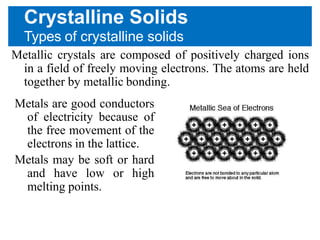
Metallic crystals are composed of positively charged ions
in a field of freely moving electrons. The atoms are held
together by metallic bonding.
Metals are good conductors
of electricity because of
the free movement of the
electrons in the lattice.
Metals may be soft or hard
and have low or high
melting points.
Amorphous Solids
Amorphous solids may be considered as supercooled
liquids in which the molecules are arranged in a
somewhat random manner as in the liquid state.
Amorphous Crystalline
They differ from crystalline solids in that they tend to flow
when subjected to sufficient pressure over a period of
time, and they do not have definite melting points.
Amorphous Solids
The amorphous state is unstable compared to the
crystalline solid (it has higher energy than crystalline
solid).
The pharmaceutical advantages of amorphous solid is its
higher solubility and bioavailability.
Its pharmaceutical disadvantages is its low stability (over
time, amorphous solid may transform to the more stable
crystalline state).
Melting point
Heat of fusion
The temperature at which a solid passes into liquid state is
known as the melting point. It is also the freezing point
of the liquid state of that solid.
The melting point of a pure crystalline solid (or freezing
point of a liquid) is the temperature at which the pure
liquid and solid exist in equilibrium.
Normal melting or freezing point is the temperature of the
equilibrium mixture at an external pressure of 1 atm.
Unlike the boiling point, the melting point is relatively
insensitive to pressure because the solid/liquid transition
represents only a small change in volume.
Melting point
Heat of fusion
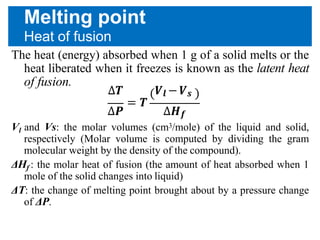
The heat (energy) absorbed when 1 g of a solid melts or the
heat liberated when it freezes is known as the latent heat
of fusion.
∆𝑻 𝑽𝒍 − 𝑽 𝒔
= 𝑻
∆𝑷 ∆𝑯 𝒇
Vl and Vs: the molar volumes (cm3/mole) of the liquid and solid,
respectively (Molar volume is computed by dividing the gram
molecular weight by the density of the compound).
ΔHf : the molar heat of fusion (the amount of heat absorbed when 1
mole of the solid changes into liquid)
ΔT: the change of melting point brought about by a pressure change
of ΔP.
Melting point
Intermolecular forces
• The heat of fusion may be considered as the heat
required to increase the interatomic or intermolecular
distances in crystals, thus allowing melting (increased
molecular motion) to occur.
• A crystal that is bound together by weak forces
generally has a low heat of fusion and a low melting
point, whereas one bound together by strong forces has
a high heat of fusion and a high melting point.
Thermal analysis
Applications
Thermal analysis has many applications in pharmaceutical
industry and quality control such as:
Melting points for organic and inorganic compounds are
often used for thermal analysis for-
Characterization and identification of compounds.
Determination of purity, polymorphism, and stability.
Investigation of drug compatibility with excipient(s).
Thermal analysis
Definition
Thermal analysis is a number of methods for observing
physical and chemical changes (e.g melting point) of a
material upon heating or cooling.
The most common types of thermal analysis are:
Differntail scanning calorimetry (DSC)
Differential thermal analysis (DTA),
Thermogravimetric analysis (TGA)
Thermomechanical analysis (TMA).
Polymorphism
• Some elements like carbon (Dimond, graphite) and
sulphur exist in more than one crystalline form which is
known as polymorphism
• Diamond is metastable (less stable) form of carbon
• Polymorphs exhibit different-
• Melting points
• Solubility
• Formation of different polymorphs depend upon
crystallization conditions (Level of supersaturation,
temperature)
Pharmaceutical significance of
polymorphs
• Nearly all long chain organic compounds exhibit polymorphism
• Eg: Triglyceride tristearin shows
• Low melting point metastable (α)
• Beta prime (β’)
• High melting point Stable beta (β)
• Theobroma (coca butter) shows 4 forms γ, α, β’ and β. For
making suppositories Theobroma should be melted at lowest
possible temperature (33C) so that stable polymorph (β MP
34.5C)) should not destroy.
• Because of difference in solubilities of polymorphs, one may be
more active therapeutically than other. E.g. Sulfameter
antimicrobial form II is more active than Form III.
• Cortisone acetate suspension … out of 5 forms only one is stable
in presence of water. During preparation of suspension stable form
should be available to avoid caking.
References
Sinko, P. J. Martin's physical pharmacy and pharmaceutical sciences:
physical chemical and biopharmaceutical principles in the
pharmaceutical sciences, Philadelphia, Lippincott Williams &
Wilkins.