

Development of Hard Intellectual
Property core for Convolution Encoder
Guide:
Prof. Usha Mehta Prepared By:-
Archit (09bec101)
Aalay (09bec025)
Steps
Selection of IP-Core and its theory and
study of IP-core
VHDL and Verilog coding
Implementing code on FPGA kit
Layout MICROWIND software tool
Comparison and readings
Review 1
Selection of IP-Core and its theory and
study of IP-core
VHDL and verilog code for state
machine apprach
About convolution codes
Error Correcting Code
Sequential Codes
Constraint length (k) (trade-off)
Rate of Coder (r) (trade-off)
Why so named ?
Applications (wireless communication)
Popular Codes (k=7; r=1/2)
Applications
Wireless Standards : W-LAN, Wi-Max etc.
Satellite communication
Cellular Standards : GSM, CDMA, 3G etc.
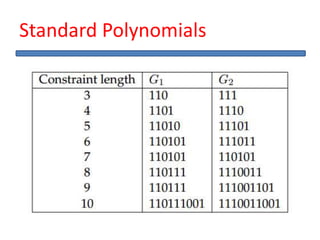
Standard Polynomials
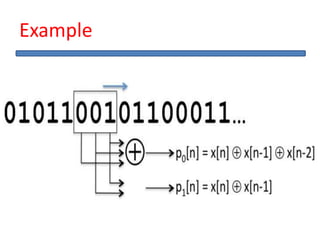
Example
Block Diagram View
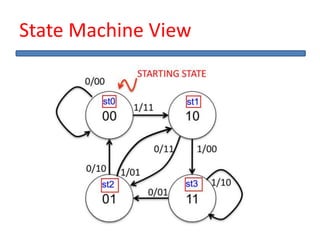
State Machine View
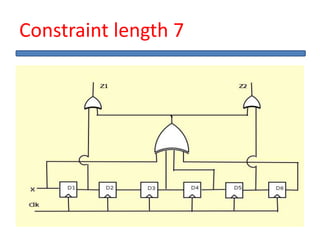
Constraint length 7
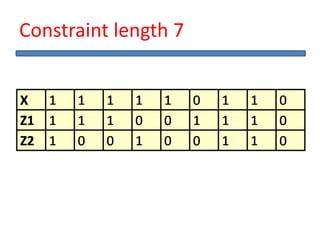
Constraint length 7
Review 2
Both VHDL and Verilog codes are ready with
block diagram approach
Constraint Length 7; Rate ½
Results showing comparison with Coregen(Core
Generation)
Each component is made in microwind
Dimension of Each Component made
Also a C code for convolution coder is made to
easy testing
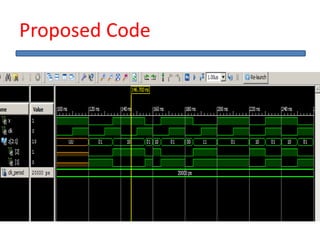
Proposed Code
VHDL
Verilog
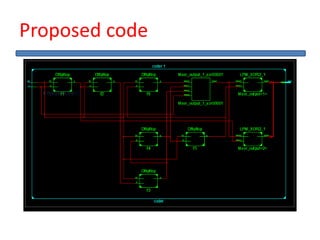
RTL view
Proposed code
Proposed Code
Proposed Code
Coregen
Coregen
Comparison with Coregen
Components required
No of
components
No of
Transistors
DFF 6 16
XOR2 4 4
XOR_regular 1 6
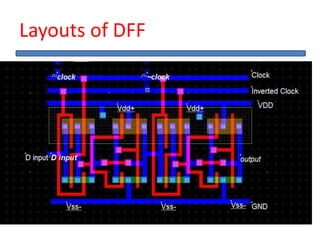
Layouts of each component
Layouts of DFF
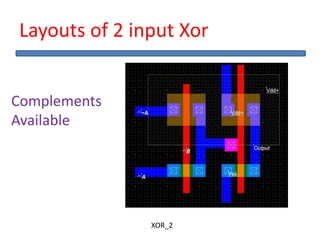
Layouts of 2 input Xor
XOR_2
Complements
Available
Layouts of 2 input Xor
XOR Regular
Complements
Not Available
Design schematic
Comparison with Verilog Compilation
Using Verilog coding
 63 NMOS
 51 PMOS
 114 Total
 Buffers not provided
 Metalization 3 levels
 Area = 575.28 µm
 Highly rectangular
Proposed Hard IP
 60 NMOS
 60 PMOS
 120 total
 Bufferes provided
 Metalization 2 layers
 Area 186.3 square µm
 Almost square
Review 3
Floor Planning
Complete Layout
SPICE simulation
Floor Planning
Floor Planning
Floor Planning
Pinout
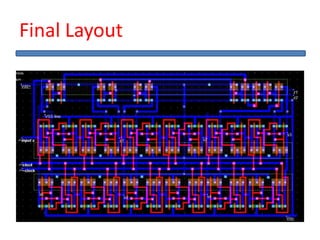
Final Layout
Simulation
Spice Netlist
Exported from Microwind
Got introduced to Tanner, Mentor Graphics
and SPICE syntax
Readings are taken from Mentor Graphics
Readings
Maximum Average
Power dissipation 0.622 mW 0.130 mW
Idd 0.519 mA 0.109 mA
X to Z1 48.706 ps 38.347 ps
X to Z2 66.721 ps 40.2042 ps
Clk to Z1 49.974 ps 36.343 ps
Clk to Z2 57.999 ps 38.493 ps
Core Size : 186.3 sq. um
Supply : 1.2 V
Summary
Xilinx ISE:
– Verilog, RTL, Spartan 3 kit
DSCH:
– Gate level, Transistor level
Microwind:
– Floor planning, Layout
Mentor Graphics:
– SPICE Simulation
Conclusion
Great learnings
– VLSI Industry
– Coregen Implementation
– Verilog Coding
Better than Xilinx Coregen
Better than direct Verilog Implementation
References
Basics Of CMOS Cell Design
– Etienne Sicard, Sonia Delmas Bendhia
CMOS VLSI DESIGN : A Circuit and System
Perspective
– Neil H. E. Weste, David Harris, Ayan Banerjee
CMOS Digital Integrated Circuit,3/E
– Sung-Mo-Kang, Yusuf Leblebici
References
Spice User Manual Draft 10
T-Spice 12 user guide
– Tanner EDA tools
Open Source Semiconductor Core Licesing
– Harvard Journal of Law and Technology
Digital Design 4th Edition
– Morris Mano
Questions ??
Thank you !
Prof. Usha Mehta
Mr. Dharmesh Patel
Mr. Prasann Shukla
Nirma University and All Professors
– 4 years of great learning
Hard IP Core design | Convolution Encoder

Hard IP Core design | Convolution Encoder