Coding Style for Good
Synthesis
VinChip Systems
Agenda
 Basic Concepts of Logic Synthesis
 Synthesizable Verilog constructs
 Coding for Synthesis
 Conclusion
Basic Concepts of Logic Synthesis
 Converting a high-level description of design into an optimized gate-level representation.
 It uses Standard Cell Library
 Basic logic elements
 and
 or
 inverter (not),
 Nand, nor …
 Macro Cells like
 adder, multiplexers,
 memory, and special flip-flops.
Logic Synthesis
Synthesis = Translation + Optimization +Mapping
Limitation on Manual Design
 Error-Prone:
 For Large Designs, We can not determine the missed gates
 Hard to Verify:
 Designer would never sure about the conversion until gate level circuit implemented
and tested
 Time-Consuming:
 Time Consuming process to convert High level design into gate level design
 Hard to reuse:
 design reuse was not possible
 Impossible to optimize globally :
 Not Possible in global optimization – Each designed might designed in different
method.
Logic Synthesis
 There are two parts
 Translation
 Performs architectural optimizations and then creates an internal representation of the
design.
 Usually this is automatically done while design is imported to the synthesis tool.
 Optimization
 The resulting netlist to fit constraints on speed (timing constraint) and area (area
constraint)
 Most critical part of the process
 Logic optimization + Gate optimization
Synthesis Flow
RTL Source :
Logic Implemented in RTL
No Timing Information
HDL – Verilog or VHDL
Constraints
Timing Specification
Maximum Fan-Out
Maximum Capacitance
Port delays ..
Technology Library
Target Library – Target components
Link Library – Resolve references
Synthetic Library –Adders ..
GTECH Library – Tech Independent
Coding Guidelines for Synthesis
 Goals of coding guidelines
 Testability
 Performance
 Simplification of static timing analysis
 Matching gate-level behavior with that of the original RTL codes
Synthesizable Verilog constructs
 All the Verilog constructs are not synthesizable
 Only a subset of Verilog constructs can be synthesized
HDL Compiler Unsupported
 delay
 initial
 Repeat , wait
 fork … join
 event
 Assign, deassign – reg data type
 Force - release
 time
 triand, trior, tri1, tri0, trireg
 nmos, pmos, cmos, rnmos,
 rpmos, rcmos
 pullup, pulldown
 rtran, tranif0, tranif1, rtranif0,
 case identity and not identity
operators
Synthesizable Verilog Constructs
 Ports - Input , output , inouts
 Parameters - parameter
 Module definitions
 Signals and Variables
 Instantiations .
 Procedural block ,
 Data flow
Language Structure Translations
 Synthesizable operators
 Synthesizable constructs
 assignment statement
 if .. else statement
 case statement
 loop structures
 always statement
 memory synthesis approaches
Blocking and Nonblocking Assignments
 Two types of assignments
 Blocking assignments execute in sequential order.
 Nonblocking assignments execute Concurrently.
 Always use non blocking assignments in Sequential blocks
 Otherwise, the simulation behavior of the RTL and gate-level designs may
differ.
 Specifically, blocking assignments can lead to race conditions and
unpredictable behavior in simulations.
Blocking and Nonblocking Assignments
 Use non-blocking assignments to model sequential logic
 Use blocking assignments to model combinational logic
 Do not mix blocking and non-blocking assignments in the same always block.
 Do not make assignments to the same variable from more than one always block.
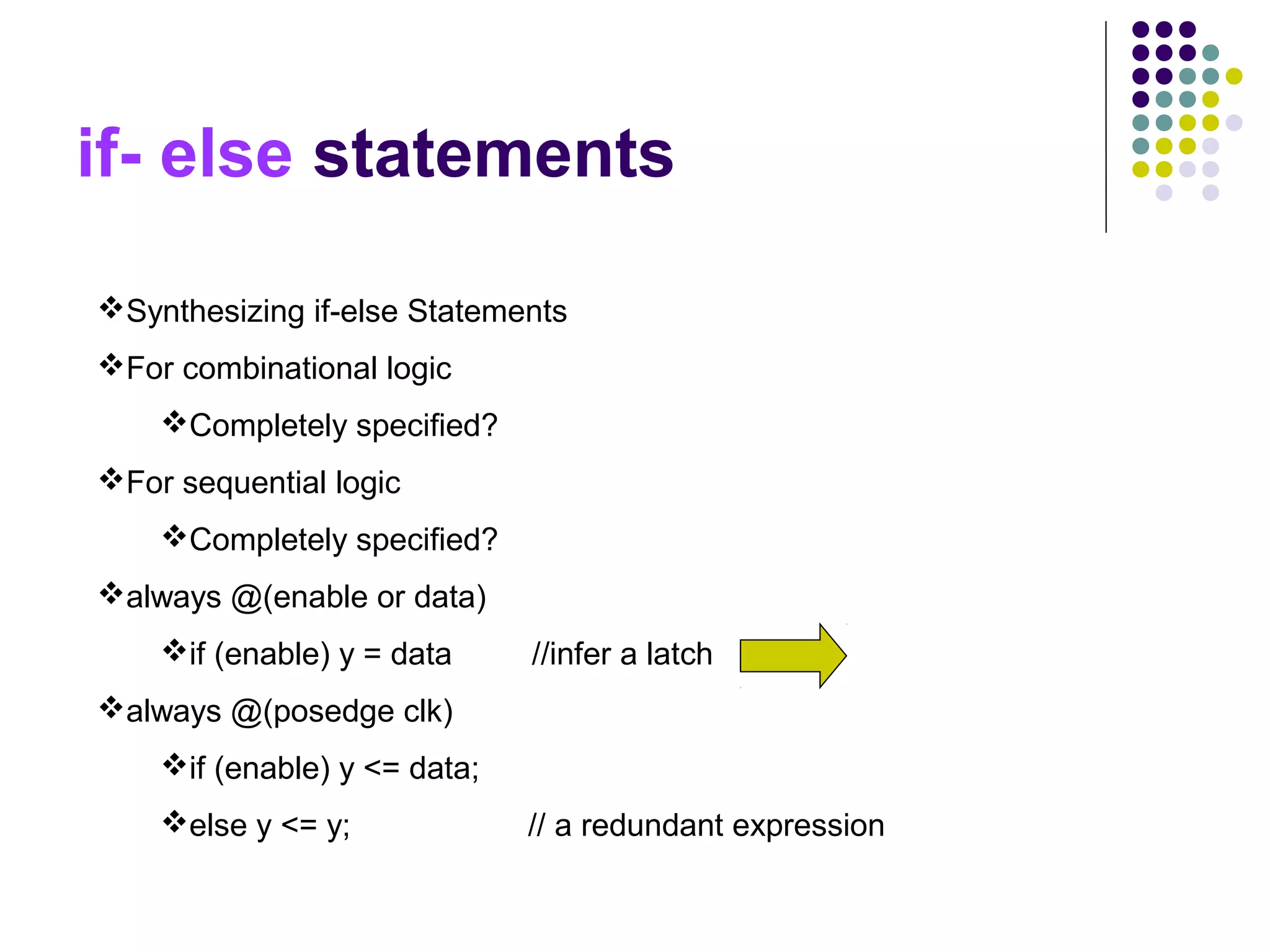
if- else statements
Synthesizing if-else Statements
For combinational logic
Completely specified?
For sequential logic
Completely specified?
always @(enable or data)
if (enable) y = data //infer a latch
always @(posedge clk)
if (enable) y <= data;
else y <= y; // a redundant expression
Synthesizing case Statements
 A case statement
 Infers a multiplexer
 Completely specified?
Latch Inference - Incomplete case Statements
 // Creating a latch
module latch_infer_case(select, data, y);
input select;
output y;
reg y;
always @(select or data)
case (select)
2'b00: y = data[select];
2'b01: y = data[select];
2'b10: y = data[select];
// default: y = 2'b11;
endcase
 No Default Statement – Infers a latch
 // Correct code
module latch_infer_case(select, data, y);
input select;
output y;
reg y;
always @(select or data)
case (select)
2'b00: y = data[select];
2'b01: y = data[select];
2'b10: y = data[select];
default: y = 2'b11;
endcase
Mixed Use of posedge/level Signals
 // the mixed usage of posedge/negedge
signal
//The result cannot be synthesized
module DFF (clk, reset, d, q);
…
// the body of DFF
always @(posedge clk or reset)
begin
if (reset) q <= 1'b0;
else q <= d;
end
 // the mixed usage of posedge/negedge
signal
//The result can be synthesized
module DFF (clk, reset, d, q);
…
// the body of DFF
always @(posedge clk or negedge reset)
begin
if (reset) q <= 1'b0;
else q <= d;
end
Sensitivity List
 For combinational blocks
 The sensitivity list must include every signal that is read by the process.
 Signals that appear on the right side of an assign statement
 Signals that appear in a conditional expression
Sensitivity List
 For sequential blocks
 The sensitive list must include the clock signal.
 If an asynchronous reset signal is used, include reset in the sensitivity list.
 Use only necessary signals in the sensitivity lists
 Unnecessary signals in the sensitivity list slow down simulation
for Loop
 Provide a shorter way to express a series of statements.
 Loop index variables must be integer type.
 Step, start & end value must be constant.
 In synthesis, for loops are “unrolled”, and then synthesized.
Memory Synthesis Approaches
 A flip-flop
 10 to 20 times the area of a 6-transistor static RAM cell
 Inefficient in terms of area
 Register files in datapaths
 use a synthesis directive
 hand instantiation
Memory Synthesis Approaches
 RAM standard components
 supplied by an ASIC vendor
 depend on the technology
 RAM compilers
 The most area-efficient approach
Guidelines for Clocks
 Using single global clock
 Avoiding using gated clocks
 Avoiding mixed use of both positive and negative edge-triggered flip-flops
 Avoiding using internally generated clock signals
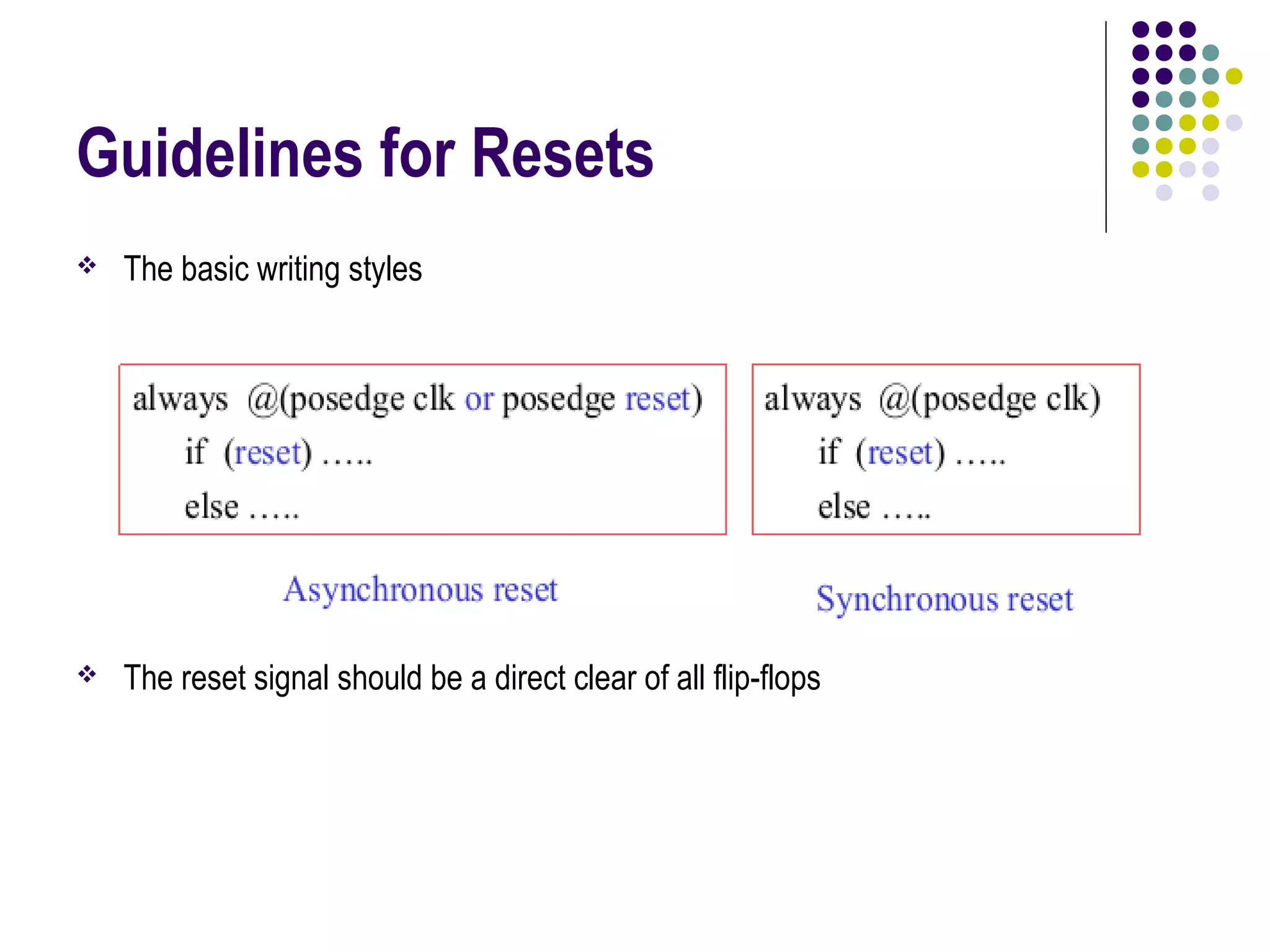
Guidelines for Resets
 The basic design issues of resets are
 Asynchronous or synchronous?
 An internal or external power-on reset?
 More than one reset, hard vs. soft reset?
 Asynchronous reset
 Hard to implement and Does not require a free-running clock
 Makes STA more difficult
 Makes the automatic insertion of test structure more difficult
 Synchronous reset
 easy to implement
 Requires a free-running clock
Guidelines for Resets
 The basic writing styles
 The reset signal should be a direct clear of all flip-flops
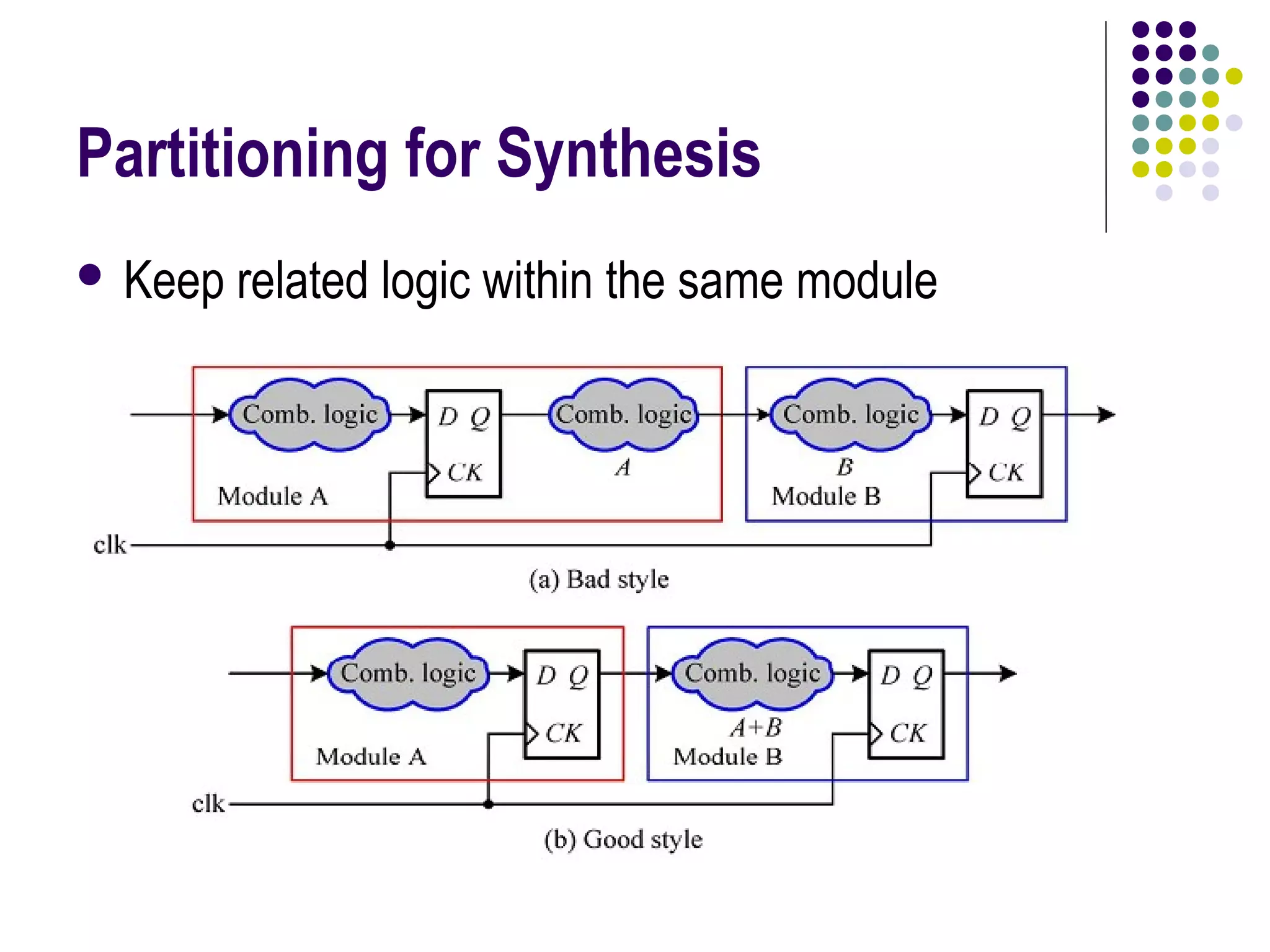
Partitioning for Synthesis
 Keep related logic within the same module
Cntd..
 For good synthesis
 Register all outputs
 Locate related combinational logic in same module
 Do not use Glue logic in top module
 Separate module that have different design goals
Coding style for good synthesis

Coding style for good synthesis

  • 1.
    Coding Style forGood Synthesis VinChip Systems
  • 2.
    Agenda  Basic Conceptsof Logic Synthesis  Synthesizable Verilog constructs  Coding for Synthesis  Conclusion
  • 3.
    Basic Concepts ofLogic Synthesis  Converting a high-level description of design into an optimized gate-level representation.  It uses Standard Cell Library  Basic logic elements  and  or  inverter (not),  Nand, nor …  Macro Cells like  adder, multiplexers,  memory, and special flip-flops.
  • 4.
    Logic Synthesis Synthesis =Translation + Optimization +Mapping
  • 5.
    Limitation on ManualDesign  Error-Prone:  For Large Designs, We can not determine the missed gates  Hard to Verify:  Designer would never sure about the conversion until gate level circuit implemented and tested  Time-Consuming:  Time Consuming process to convert High level design into gate level design  Hard to reuse:  design reuse was not possible  Impossible to optimize globally :  Not Possible in global optimization – Each designed might designed in different method.
  • 6.
    Logic Synthesis  Thereare two parts  Translation  Performs architectural optimizations and then creates an internal representation of the design.  Usually this is automatically done while design is imported to the synthesis tool.  Optimization  The resulting netlist to fit constraints on speed (timing constraint) and area (area constraint)  Most critical part of the process  Logic optimization + Gate optimization
  • 7.
    Synthesis Flow RTL Source: Logic Implemented in RTL No Timing Information HDL – Verilog or VHDL Constraints Timing Specification Maximum Fan-Out Maximum Capacitance Port delays .. Technology Library Target Library – Target components Link Library – Resolve references Synthetic Library –Adders .. GTECH Library – Tech Independent
  • 8.
    Coding Guidelines forSynthesis  Goals of coding guidelines  Testability  Performance  Simplification of static timing analysis  Matching gate-level behavior with that of the original RTL codes
  • 9.
    Synthesizable Verilog constructs All the Verilog constructs are not synthesizable  Only a subset of Verilog constructs can be synthesized
  • 10.
    HDL Compiler Unsupported delay  initial  Repeat , wait  fork … join  event  Assign, deassign – reg data type  Force - release  time  triand, trior, tri1, tri0, trireg  nmos, pmos, cmos, rnmos,  rpmos, rcmos  pullup, pulldown  rtran, tranif0, tranif1, rtranif0,  case identity and not identity operators
  • 11.
    Synthesizable Verilog Constructs Ports - Input , output , inouts  Parameters - parameter  Module definitions  Signals and Variables  Instantiations .  Procedural block ,  Data flow
  • 12.
    Language Structure Translations Synthesizable operators  Synthesizable constructs  assignment statement  if .. else statement  case statement  loop structures  always statement  memory synthesis approaches
  • 13.
    Blocking and NonblockingAssignments  Two types of assignments  Blocking assignments execute in sequential order.  Nonblocking assignments execute Concurrently.  Always use non blocking assignments in Sequential blocks  Otherwise, the simulation behavior of the RTL and gate-level designs may differ.  Specifically, blocking assignments can lead to race conditions and unpredictable behavior in simulations.
  • 14.
    Blocking and NonblockingAssignments  Use non-blocking assignments to model sequential logic  Use blocking assignments to model combinational logic  Do not mix blocking and non-blocking assignments in the same always block.  Do not make assignments to the same variable from more than one always block.
  • 15.
    if- else statements Synthesizingif-else Statements For combinational logic Completely specified? For sequential logic Completely specified? always @(enable or data) if (enable) y = data //infer a latch always @(posedge clk) if (enable) y <= data; else y <= y; // a redundant expression
  • 16.
    Synthesizing case Statements A case statement  Infers a multiplexer  Completely specified?
  • 17.
    Latch Inference -Incomplete case Statements  // Creating a latch module latch_infer_case(select, data, y); input select; output y; reg y; always @(select or data) case (select) 2'b00: y = data[select]; 2'b01: y = data[select]; 2'b10: y = data[select]; // default: y = 2'b11; endcase  No Default Statement – Infers a latch  // Correct code module latch_infer_case(select, data, y); input select; output y; reg y; always @(select or data) case (select) 2'b00: y = data[select]; 2'b01: y = data[select]; 2'b10: y = data[select]; default: y = 2'b11; endcase
  • 18.
    Mixed Use ofposedge/level Signals  // the mixed usage of posedge/negedge signal //The result cannot be synthesized module DFF (clk, reset, d, q); … // the body of DFF always @(posedge clk or reset) begin if (reset) q <= 1'b0; else q <= d; end  // the mixed usage of posedge/negedge signal //The result can be synthesized module DFF (clk, reset, d, q); … // the body of DFF always @(posedge clk or negedge reset) begin if (reset) q <= 1'b0; else q <= d; end
  • 19.
    Sensitivity List  Forcombinational blocks  The sensitivity list must include every signal that is read by the process.  Signals that appear on the right side of an assign statement  Signals that appear in a conditional expression
  • 20.
    Sensitivity List  Forsequential blocks  The sensitive list must include the clock signal.  If an asynchronous reset signal is used, include reset in the sensitivity list.  Use only necessary signals in the sensitivity lists  Unnecessary signals in the sensitivity list slow down simulation
  • 21.
    for Loop  Providea shorter way to express a series of statements.  Loop index variables must be integer type.  Step, start & end value must be constant.  In synthesis, for loops are “unrolled”, and then synthesized.
  • 22.
    Memory Synthesis Approaches A flip-flop  10 to 20 times the area of a 6-transistor static RAM cell  Inefficient in terms of area  Register files in datapaths  use a synthesis directive  hand instantiation
  • 23.
    Memory Synthesis Approaches RAM standard components  supplied by an ASIC vendor  depend on the technology  RAM compilers  The most area-efficient approach
  • 24.
    Guidelines for Clocks Using single global clock  Avoiding using gated clocks  Avoiding mixed use of both positive and negative edge-triggered flip-flops  Avoiding using internally generated clock signals
  • 25.
    Guidelines for Resets The basic design issues of resets are  Asynchronous or synchronous?  An internal or external power-on reset?  More than one reset, hard vs. soft reset?  Asynchronous reset  Hard to implement and Does not require a free-running clock  Makes STA more difficult  Makes the automatic insertion of test structure more difficult  Synchronous reset  easy to implement  Requires a free-running clock
  • 26.
    Guidelines for Resets The basic writing styles  The reset signal should be a direct clear of all flip-flops
  • 27.
    Partitioning for Synthesis Keep related logic within the same module
  • 28.
    Cntd..  For goodsynthesis  Register all outputs  Locate related combinational logic in same module  Do not use Glue logic in top module  Separate module that have different design goals