ASIC
(APPLICATION SPECIFIC INTEGRATED CIRCUITS)
Submitted by:
Rajeev Kumar
Ashok Kumar
ECE 3rd year
ROORKEE INSTITUTE OF TECHNOLOGY,
ROORKEE
4th April, 2016
What Is ASIC ?
 A microchip designed for a special application, such as a particular kind of
transmission protocol or a hand-held computer.
 Might contrast it with general integrated circuits, such as the microprocessor
and the random access memory chips in your PC.
 An ASIC can be pre-manufactured for a special application or
it can be custom manufactured for a particular customer
application.
CONTENTS
 ASIC vs Standard ICs
 Structured ASIC
 Types of ASIC
Generalized ASIC Design Flow
 Advantages
 Disadvantages
 ASIC vs FPGA
Stages of The ASIC Design Project
 Applications
Standard ICs – ICs sold as Standard Parts
 SSI/LSI/ MSI IC such as MUX, Encoder, Memory Chips, or Microprocessor IC
 Application Specific Integrated Circuits (ASIC) – A Chip for Toy Bear, Auto-
Mobile Control Chip, Different Communication Chips.
 Concept Started in 1980s
 An IC Customized to a Particular System or Application – Custom ICs
 Digital Designs Became a Matter of Placing of Fewer CICs or ASICs plus Some Glue Logic
 Reduced Cost and Improved Reliability
 Application Specific Standard Parts (ASSP) – Controller Chip for PC or a Modem
main
Structured ASICs
 Structured ASICs have the bottom metal layers fixed and only the top layers can be designed by
the customer.
 Structured ASICs are custom devices that approach the performance of today's Standard Cell
ASIC while dramatically simplifying the design complexity.
 Structured ASICs offer designers a set of devices with specific, customizable metal layers along
with predefined metal layers, which can contain the underlying pattern of logic cells, memory,
and I/O.
main
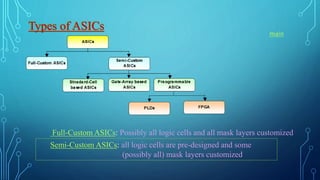
Types of ASICs
Full-Custom ASICs: Possibly all logic cells and all mask layers customized
Semi-Custom ASICs: all logic cells are pre-designed and some
(possibly all) mask layers customized
main
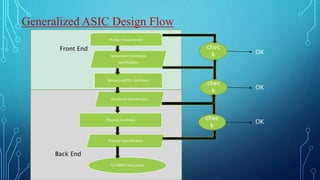
Generalized ASIC Design Flow
Product Requirement
Behavioral/Functional
specification
Behavioral(RTL) Synthesis
Structural Specification
Physical Synthesis
Physical Specification
To CMOS Fabrication
chec
k
chec
k
chec
k
OK
OK
OK
Back End
Front End
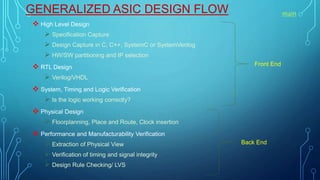
GENERALIZED ASIC DESIGN FLOW
 High Level Design
 Specification Capture
 Design Capture in C, C++, SystemC or SystemVerilog
 HW/SW partitioning and IP selection
 RTL Design
 Verilog/VHDL
 System, Timing and Logic Verification
 Is the logic working correctly?
 Physical Design
 Floorplanning, Place and Route, Clock insertion
 Performance and Manufacturability Verification
 Extraction of Physical View
 Verification of timing and signal integrity
 Design Rule Checking/ LVS
Front End
Back End
main
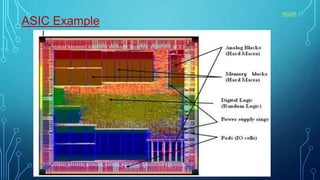
ASIC Example
main
Advantages Of ASIC Design
 Lower unit costs: For very high volume designs costs comes out to be very less.
 ASICs are faster: ASIC gives design flexibility. This gives enoromous opportunity for speed
optimizations.
 Low power: ASIC can be optimized for required low power. There are several low power
techniques such as power gating, clock gating, multi vt cell libraries, pipelining etc are
available to achieve the power target.
 In ASIC you can implement analog circuit, mixed signal designs.
 In ASIC DFT (Design For Test) is inserted.
main
Disadvantages Of ASIC Design
 Time-to-market: Some large ASICs can take a year or more to design.
 Design Issues: In ASIC you should take care of DFM issues, Signal Integrity issues and many
more.
 Expensive Tools: ASIC design tools are very much expensive. You spend a huge amount of
NRE.
main
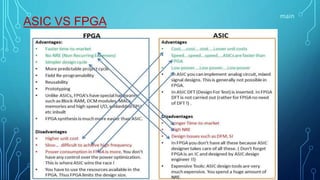
ASIC VS FPGA
main
MAIN STAGES OF THE ASIC DESIGN PROJECT
 Marketing Requirements Specification (MRS)
 Project Initialization Stage
 Specification stage
 Logic Design Stage
 FPGA Implementation and Validation Stage (optional)
 ASIC Implementation Stage
 Tape-Out -Transfer to FAB (Transfer to Production)
main
APPLICATIONS
Aerospace applications. Because they are not field
programmable they are more radiation tolerant.
An ASIC might also be the only possible solution when your
system needs to reach a high energy efficiency (eg. lowest
joule/operation) or very high performance (eg. lowest latency,
or highest operation/second).
A6 processor on the new Apple iPhone
main
Asic

Asic

  • 1.
    ASIC (APPLICATION SPECIFIC INTEGRATEDCIRCUITS) Submitted by: Rajeev Kumar Ashok Kumar ECE 3rd year ROORKEE INSTITUTE OF TECHNOLOGY, ROORKEE 4th April, 2016
  • 2.
    What Is ASIC?  A microchip designed for a special application, such as a particular kind of transmission protocol or a hand-held computer.  Might contrast it with general integrated circuits, such as the microprocessor and the random access memory chips in your PC.  An ASIC can be pre-manufactured for a special application or it can be custom manufactured for a particular customer application.
  • 3.
    CONTENTS  ASIC vsStandard ICs  Structured ASIC  Types of ASIC Generalized ASIC Design Flow  Advantages  Disadvantages  ASIC vs FPGA Stages of The ASIC Design Project  Applications
  • 4.
    Standard ICs –ICs sold as Standard Parts  SSI/LSI/ MSI IC such as MUX, Encoder, Memory Chips, or Microprocessor IC  Application Specific Integrated Circuits (ASIC) – A Chip for Toy Bear, Auto- Mobile Control Chip, Different Communication Chips.  Concept Started in 1980s  An IC Customized to a Particular System or Application – Custom ICs  Digital Designs Became a Matter of Placing of Fewer CICs or ASICs plus Some Glue Logic  Reduced Cost and Improved Reliability  Application Specific Standard Parts (ASSP) – Controller Chip for PC or a Modem main
  • 5.
    Structured ASICs  StructuredASICs have the bottom metal layers fixed and only the top layers can be designed by the customer.  Structured ASICs are custom devices that approach the performance of today's Standard Cell ASIC while dramatically simplifying the design complexity.  Structured ASICs offer designers a set of devices with specific, customizable metal layers along with predefined metal layers, which can contain the underlying pattern of logic cells, memory, and I/O. main
  • 6.
    Types of ASICs Full-CustomASICs: Possibly all logic cells and all mask layers customized Semi-Custom ASICs: all logic cells are pre-designed and some (possibly all) mask layers customized main
  • 7.
    Generalized ASIC DesignFlow Product Requirement Behavioral/Functional specification Behavioral(RTL) Synthesis Structural Specification Physical Synthesis Physical Specification To CMOS Fabrication chec k chec k chec k OK OK OK Back End Front End
  • 8.
    GENERALIZED ASIC DESIGNFLOW  High Level Design  Specification Capture  Design Capture in C, C++, SystemC or SystemVerilog  HW/SW partitioning and IP selection  RTL Design  Verilog/VHDL  System, Timing and Logic Verification  Is the logic working correctly?  Physical Design  Floorplanning, Place and Route, Clock insertion  Performance and Manufacturability Verification  Extraction of Physical View  Verification of timing and signal integrity  Design Rule Checking/ LVS Front End Back End main
  • 9.
  • 10.
    Advantages Of ASICDesign  Lower unit costs: For very high volume designs costs comes out to be very less.  ASICs are faster: ASIC gives design flexibility. This gives enoromous opportunity for speed optimizations.  Low power: ASIC can be optimized for required low power. There are several low power techniques such as power gating, clock gating, multi vt cell libraries, pipelining etc are available to achieve the power target.  In ASIC you can implement analog circuit, mixed signal designs.  In ASIC DFT (Design For Test) is inserted. main
  • 11.
    Disadvantages Of ASICDesign  Time-to-market: Some large ASICs can take a year or more to design.  Design Issues: In ASIC you should take care of DFM issues, Signal Integrity issues and many more.  Expensive Tools: ASIC design tools are very much expensive. You spend a huge amount of NRE. main
  • 12.
  • 13.
    MAIN STAGES OFTHE ASIC DESIGN PROJECT  Marketing Requirements Specification (MRS)  Project Initialization Stage  Specification stage  Logic Design Stage  FPGA Implementation and Validation Stage (optional)  ASIC Implementation Stage  Tape-Out -Transfer to FAB (Transfer to Production) main
  • 14.
    APPLICATIONS Aerospace applications. Becausethey are not field programmable they are more radiation tolerant. An ASIC might also be the only possible solution when your system needs to reach a high energy efficiency (eg. lowest joule/operation) or very high performance (eg. lowest latency, or highest operation/second). A6 processor on the new Apple iPhone main