SYSTEMS ON CHIP (SOC)
FOR EMBEDDED
APPLICATIONS
Victor P. Nelson
“Leap Day”, 2012
2/29/2012 VLSI D&T Seminar - Victor P. Nelson
This is not a “defense”
So – please enjoy these photos of food.
2/29/2012 VLSI D&T Seminar - Victor P. Nelson
Outline
• What is an embedded SoC?
• SoC Intellectual Property (IP)
• ARM processors
• ARM support modules
• SoC Design Flow
• Modeling and simulation
• Physical design
2/29/2012 VLSI D&T Seminar - Victor P. Nelson
Embedded System
• “System”
• Set of components needed to perform a function
• Hardware + software + ….
• “Embedded”
• Main function not computing
• Usually not autonomous
• Usually a computer inside a system
• Application specific
• Subject to constraints
2/29/2012 VLSI D&T Seminar - Victor P. Nelson
System on chip
• Definition
• (nearly) complete embedded system on a single chip
• Usually includes
• Programmable processor(s)
• Memory
• Accelerating function units
• Input/output interfaces
• Software
• Re-usable intellectual property blocks (HW + SW)
2/29/2012 VLSI D&T Seminar - Victor P. Nelson
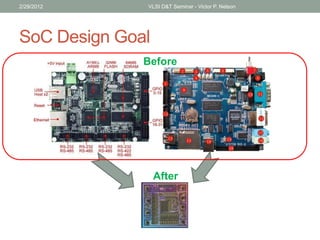
SoC Design Goal
2/29/2012 VLSI D&T Seminar - Victor P. Nelson
After
Before
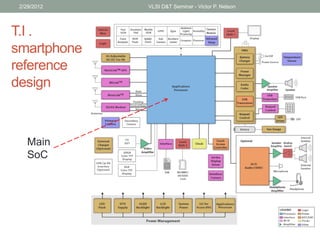
T.I .
smartphone
reference
design
2/29/2012 VLSI D&T Seminar - Victor P. Nelson
Main
SoC
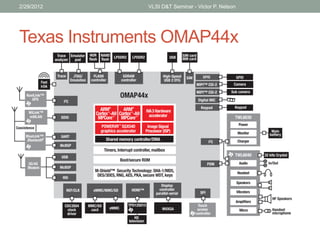
Texas Instruments OMAP44x
2/29/2012 VLSI D&T Seminar - Victor P. Nelson
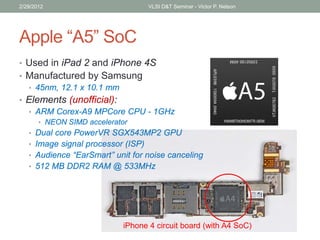
Apple “A5” SoC
• Used in iPad 2 and iPhone 4S
• Manufactured by Samsung
• 45nm, 12.1 x 10.1 mm
• Elements (unofficial):
• ARM Corex-A9 MPCore CPU - 1GHz
• NEON SIMD accelerator
• Dual core PowerVR SGX543MP2 GPU
• Image signal processor (ISP)
• Audience “EarSmart” unit for noise canceling
• 512 MB DDR2 RAM @ 533MHz
2/29/2012 VLSI D&T Seminar - Victor P. Nelson
iPhone 4 circuit board (with A4 SoC)
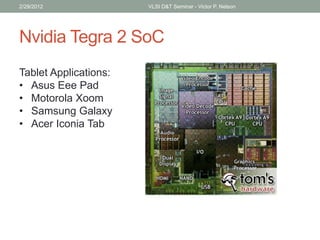
Nvidia Tegra 2 SoC
2/29/2012 VLSI D&T Seminar - Victor P. Nelson
Tablet Applications:
• Asus Eee Pad
• Motorola Xoom
• Samsung Galaxy
• Acer Iconia Tab
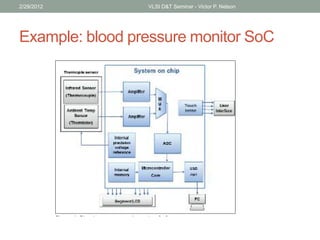
Example: blood pressure monitor SoC
2/29/2012 VLSI D&T Seminar - Victor P. Nelson
SoC Challenges
• SoC Designs
• More complex, more functions, higher gate counts
• Faster, cheaper, smaller
• More reliable
• How to handle complexity?
• System design at multiple abstraction levels
• Integration of heterogeneous technologies & tools
• Signal integrity & timing
• Power management
• SoC test methodology
2/29/2012 VLSI D&T Seminar - Victor P. Nelson
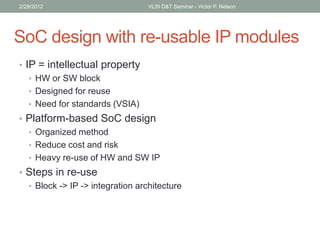
SoC design with re-usable IP modules
• IP = intellectual property
• HW or SW block
• Designed for reuse
• Need for standards (VSIA)
• Platform-based SoC design
• Organized method
• Reduce cost and risk
• Heavy re-use of HW and SW IP
• Steps in re-use
• Block -> IP -> integration architecture
2/29/2012 VLSI D&T Seminar - Victor P. Nelson
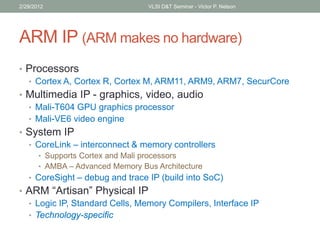
ARM IP (ARM makes no hardware)
• Processors
• Cortex A, Cortex R, Cortex M, ARM11, ARM9, ARM7, SecurCore
• Multimedia IP - graphics, video, audio
• Mali-T604 GPU graphics processor
• Mali-VE6 video engine
• System IP
• CoreLink – interconnect & memory controllers
• Supports Cortex and Mali processors
• AMBA – Advanced Memory Bus Architecture
• CoreSight – debug and trace IP (build into SoC)
• ARM “Artisan” Physical IP
• Logic IP, Standard Cells, Memory Compilers, Interface IP
• Technology-specific
2/29/2012 VLSI D&T Seminar - Victor P. Nelson
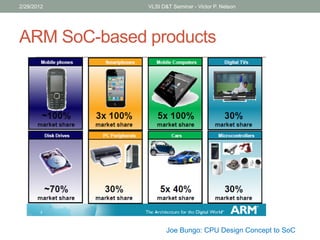
ARM SoC-based products
2/29/2012 VLSI D&T Seminar - Victor P. Nelson
Joe Bungo: CPU Design Concept to SoC
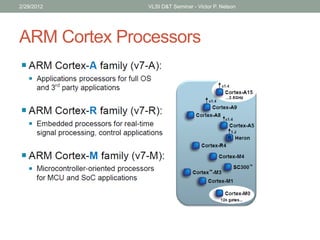
ARM Cortex Processors
2/29/2012 VLSI D&T Seminar - Victor P. Nelson
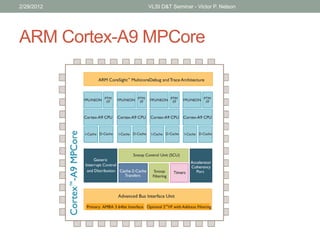
ARM Cortex-A9 MPCore
2/29/2012 VLSI D&T Seminar - Victor P. Nelson
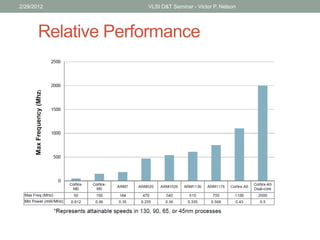
Relative Performance
2/29/2012 VLSI D&T Seminar - Victor P. Nelson
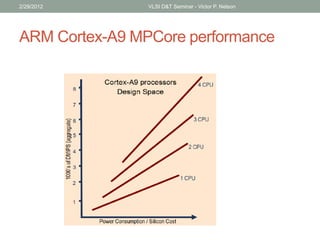
ARM Cortex-A9 MPCore performance
2/29/2012 VLSI D&T Seminar - Victor P. Nelson
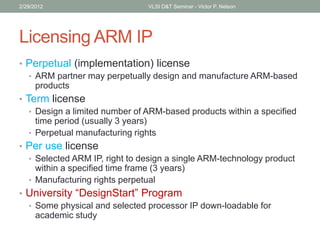
Licensing ARM IP
• Perpetual (implementation) license
• ARM partner may perpetually design and manufacture ARM-based
products
• Term license
• Design a limited number of ARM-based products within a specified
time period (usually 3 years)
• Perpetual manufacturing rights
• Per use license
• Selected ARM IP, right to design a single ARM-technology product
within a specified time frame (3 years)
• Manufacturing rights perpetual
• University “DesignStart” Program
• Some physical and selected processor IP down-loadable for
academic study
2/29/2012 VLSI D&T Seminar - Victor P. Nelson
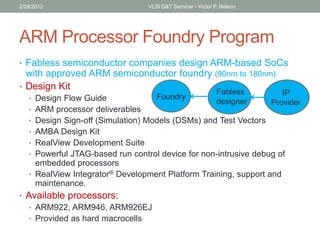
ARM Processor Foundry Program
• Fabless semiconductor companies design ARM-based SoCs
with approved ARM semiconductor foundry (90nm to 180nm)
• Design Kit
• Design Flow Guide
• ARM processor deliverables
• Design Sign-off (Simulation) Models (DSMs) and Test Vectors
• AMBA Design Kit
• RealView Development Suite
• Powerful JTAG-based run control device for non-intrusive debug of
embedded processors
• RealView Integrator® Development Platform Training, support and
maintenance.
• Available processors:
• ARM922, ARM946, ARM926EJ
• Provided as hard macrocells
2/29/2012 VLSI D&T Seminar - Victor P. Nelson
Foundry
Fabless
designer
IP
Provider
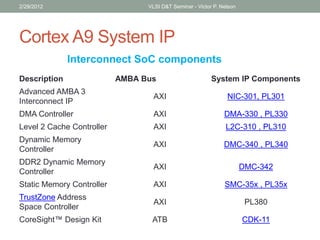
Cortex A9 System IP
Description AMBA Bus System IP Components
Advanced AMBA 3
Interconnect IP
AXI NIC-301, PL301
DMA Controller AXI DMA-330 , PL330
Level 2 Cache Controller AXI L2C-310 , PL310
Dynamic Memory
Controller
AXI DMC-340 , PL340
DDR2 Dynamic Memory
Controller
AXI DMC-342
Static Memory Controller AXI SMC-35x , PL35x
TrustZone Address
Space Controller
AXI PL380
CoreSight™ Design Kit ATB CDK-11
2/29/2012 VLSI D&T Seminar - Victor P. Nelson
Interconnect SoC components
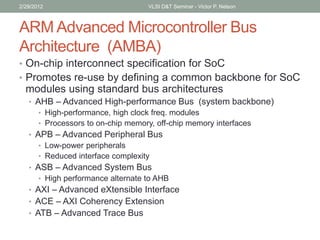
ARM Advanced Microcontroller Bus
Architecture (AMBA)
• On-chip interconnect specification for SoC
• Promotes re-use by defining a common backbone for SoC
modules using standard bus architectures
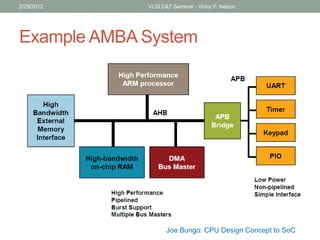
• AHB – Advanced High-performance Bus (system backbone)
• High-performance, high clock freq. modules
• Processors to on-chip memory, off-chip memory interfaces
• APB – Advanced Peripheral Bus
• Low-power peripherals
• Reduced interface complexity
• ASB – Advanced System Bus
• High performance alternate to AHB
• AXI – Advanced eXtensible Interface
• ACE – AXI Coherency Extension
• ATB – Advanced Trace Bus
2/29/2012 VLSI D&T Seminar - Victor P. Nelson
Example AMBA System
2/29/2012 VLSI D&T Seminar - Victor P. Nelson
Joe Bungo: CPU Design Concept to SoC
2/29/2012 VLSI D&T Seminar - Victor P. Nelson
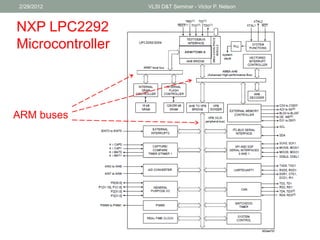
NXP LPC2292
Microcontroller
ARM buses
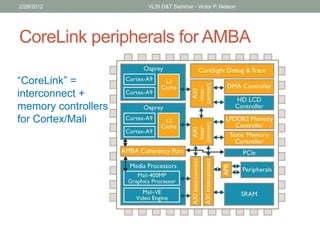
CoreLink peripherals for AMBA
2/29/2012 VLSI D&T Seminar - Victor P. Nelson
“CoreLink” =
interconnect +
memory controllers
for Cortex/Mali
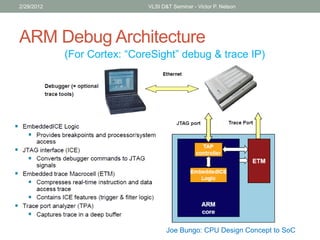
ARM Debug Architecture
2/29/2012 VLSI D&T Seminar - Victor P. Nelson
(For Cortex: “CoreSight” debug & trace IP)
Joe Bungo: CPU Design Concept to SoC
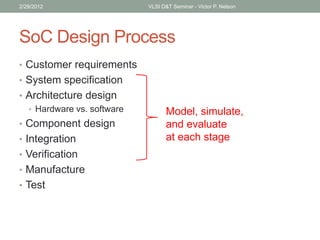
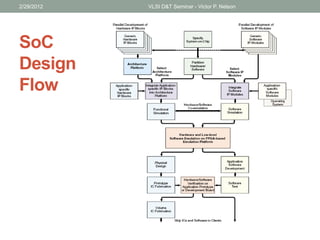
SoC Design Process
• Customer requirements
• System specification
• Architecture design
• Hardware vs. software
• Component design
• Integration
• Verification
• Manufacture
• Test
2/29/2012 VLSI D&T Seminar - Victor P. Nelson
Model, simulate,
and evaluate
at each stage
SoC
Design
Flow
2/29/2012 VLSI D&T Seminar - Victor P. Nelson
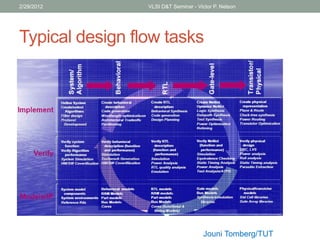
Typical design flow tasks
2/29/2012 VLSI D&T Seminar - Victor P. Nelson
Jouni Tomberg/TUT
High-Level Performance Modeling
• Identify Workloads
• Based on target market
• Standard benchmarks (spec, EEMBC)
• O/S based “real” benchmarks – browser, real apps
• Performance Models
• C-based, highly configurable
• Internally developed (no EDA vendor)
• Fast Instruction-Set Based Model
• No timing information, but very fast
• Used for statistics collection and coarse algorithm development
(i.e. branch prediction scheme, load/store address patterns)
• Abstracted Pipeline
• Reasonably accurate, longer development time
• More specific to microarchitecture
2/29/2012 VLSI D&T Seminar - Victor P. Nelson
Joe Bungo: CPU Design Concept to SoC
Higher levels of abstraction for SoC
• ESL (Electronic system level)
• RTL (register transfer level) to TLM (transaction-level modeling)
• VHDL to SystemC to UML
• HW/SW co-design
• Simulation models/emulators of hardware to develop software
while hardware is being developed
• Need new tools
• Consider the whole system
• Large optimization potential
• Combination of formal, semi-formal and non formal techniques
2/29/2012 VLSI D&T Seminar - Victor P. Nelson
Joe Bungo: CPU Design Concept to SoC
Unit RTL
• Synthesizable HDL models
• Split work into units based on functionality
• Verilog language of choice
• Write low-level constructs only (assign, case)
• Why?
• Portability; we target multiple partners and have to target
• ‘lowest-common denominator’ design tools
• Know your RTL! Easier to count gates “on-the-fly”
• Orderly bring-up; integration as soon as possible
2/29/2012 VLSI D&T Seminar - Victor P. Nelson
Joe Bungo: CPU Design Concept to SoC
Unit Validation vs. Top Level Validation
• Validation is done at both the unit- and top-level. Both are
important and doing one isn’t a substitute for doing the other!
• Unit Level Pro’S
• Faster runtimes (more cycles -> more throughput)
• Easier to generate “strange” corner case stimulus
• Top Level Pro’S
• Interfaces between units are tested
• Stimulus re-use; often top level tests are assembly and can be ported
from other projects
• This is what is being delivered!
• Performance validation
2/29/2012 VLSI D&T Seminar - Victor P. Nelson
Joe Bungo: CPU Design Concept to SoC
Validation
• Stimulus
• random – RIS, traffic generators for system
• directed – assembly language tests to check specific features
• Irritators
• artificial constraints to stress certain features
• i.e. 1 entry TLB to test table walk logic, forced stalls to test queues
• Assertions
• constantly check that logic cannot do things specified as “illegal”
• i.e. bus protocol checkers
• Formal
• uses properties to check that system can’t get into certain state via
sequence (lots of constraints required)
• lots of research ongoing about formal
2/29/2012 VLSI D&T Seminar - Victor P. Nelson
Joe Bungo: CPU Design Concept to SoC
Validation - Coverage
• How do I know that I’ve tested everything?
• Coverage provides validation metrics
• Line Coverage
• hit all RTL lines (easy to run)
• Condition Coverage
• hit all RTL terms (easy to run)
• Functional Coverage
• Only way to determine sequences hit
• Require coverage points to be written
• For example, test pipeline flush under other stall conditions (Cache
miss, TLB miss…)
• RTL unit designer and validation person collaborate to determine
“points” or “matrices”
2/29/2012 VLSI D&T Seminar - Victor P. Nelson
Joe Bungo: CPU Design Concept to SoC
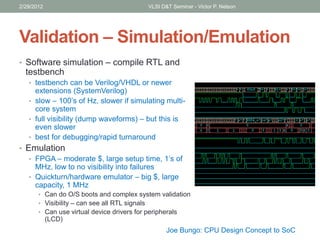
Validation – Simulation/Emulation
• Software simulation – compile RTL and
testbench
• testbench can be Verilog/VHDL or newer
extensions (SystemVerilog)
• slow – 100’s of Hz, slower if simulating multi-
core system
• full visibility (dump waveforms) – but this is
even slower
• best for debugging/rapid turnaround
• Emulation
• FPGA – moderate $, large setup time, 1’s of
MHz, low to no visibility into failures
• Quickturn/hardware emulator – big $, large
capacity, 1 MHz
• Can do O/S boots and complex system validation
• Visibility – can see all RTL signals
• Can use virtual device drivers for peripherals
(LCD)
2/29/2012 VLSI D&T Seminar - Victor P. Nelson
Joe Bungo: CPU Design Concept to SoC
ARM Design Simulation Models (DSM)
• HDL behavioral models of ARM cores
• for functional and “in some cases, timing” simulation
• derived from ARM core RTL code
• full device functionality
• register visibility
• configure cache and memory sizes
• compatible with VHDL/Verilog simulators (ex. ModelSim)
• Back-annotation capable, timing accurate
• accept timing through SDF files
• min/typ/max pin-to-pin delays
• setup/hold/pulse checks
• Also called “Design Sign-Off Models”
• generated from technology-specific netlist of a core
2/29/2012 VLSI D&T Seminar - Victor P. Nelson
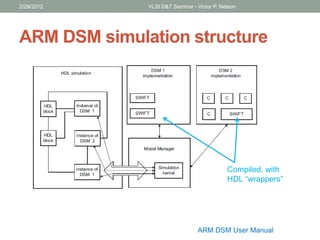
ARM DSM simulation structure
2/29/2012 VLSI D&T Seminar - Victor P. Nelson
Compiled, with
HDL “wrappers”
ARM DSM User Manual
Implementation Style
• Custom
• Squeeze last % of performance from design
• Larger teams required
• Best suited to datapath elements:
• adders
• memories
• search [CAM] structures; reservation stations
• Automated Flow
• Synthesis, place and route
• Time to market
• Tools have gotten pretty good
• Dependent on good libraries (standard cell)
• Initial RTL is portable between processes
These are not mutually exclusive; even teams that use “custom” design
will use automated flow for non-critical or control blocks.
2/29/2012 VLSI D&T Seminar - Victor P. Nelson
Joe Bungo: CPU Design Concept to SoC
Standard Cells
• Important to have rich set of standard cells for synthesis tool
• drive strengths
• complex gates (for area)
• biased threshold (faster P, faster N)
• Static Power (leakage) minimization
• This power is burned when doing NOTHING!
• Multi-Vt
• Incremental cost; 4-5 more masks out of 45 (implant)
• higher Vt – slower, but less leakage
• lower Vt – faster, but MUCH more leakage (use sparingly if at all)
• Long channel
• Characterization
• Synthesis – function, pins, timing, power
• Place and route – pin location, blockages, power rails (abstracts)
2/29/2012 VLSI D&T Seminar - Victor P. Nelson
Joe Bungo: CPU Design Concept to SoC
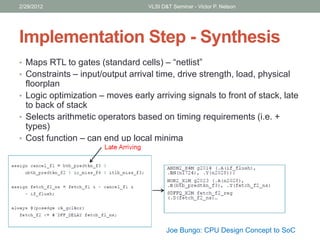
Implementation Step - Synthesis
• Maps RTL to gates (standard cells) – “netlist”
• Constraints – input/output arrival time, drive strength, load, physical
floorplan
• Logic optimization – moves early arriving signals to front of stack, late
to back of stack
• Selects arithmetic operators based on timing requirements (i.e. +
types)
• Cost function – can end up local minima
2/29/2012 VLSI D&T Seminar - Victor P. Nelson
Joe Bungo: CPU Design Concept to SoC
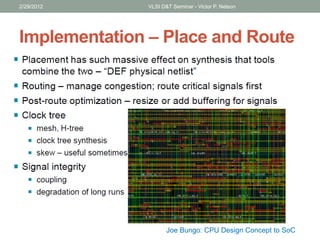
Implementation – Place and Route
2/29/2012 VLSI D&T Seminar - Victor P. Nelson
Joe Bungo: CPU Design Concept to SoC
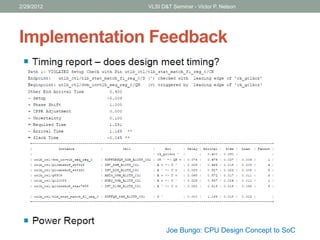
Implementation Feedback
2/29/2012 VLSI D&T Seminar - Victor P. Nelson
Joe Bungo: CPU Design Concept to SoC
SoC integration
• Once core is built, integrated with other cores into chip
• Many millions of gates; can we abstract this out?
• System Design
• SystemC model – transaction level, no timing
• Can chain processor/peripheral models together to test OS
• Cycle-level system simulation
• compiled model
• no internal visibility
• faster runtimes
• smaller, simulator won’t run out of memory!
2/29/2012 VLSI D&T Seminar - Victor P. Nelson
Joe Bungo: CPU Design Concept to SoC
ARM Development Tools
• Software development
• ARM Development Studio 5 (DS-5)
• For ASICs and ASSPs
• Compilers, debugger, system performance analyzer, real-time system
simulator
• Keil Microcontroller Development Kit (MDK)
• For embedded microcontrollers
• Cortex M, Cortex-R4, ARM7, ARM 9 devices
• Compilers, debugger, simulators
• Models
• ARM Fast Models – virtual platforms for software development
before silicon
2/29/2012 VLSI D&T Seminar - Victor P. Nelson
Conclusions
• SoC design requires different design approach than
traditional ASICs
• More modeling & simulation at higher abstraction levels
• Heavy use of IP, re-usable modules, platform-based
design
• SoC design team must work with IP vendor and foundry
• Use platform design & standard interfaces between IP
• Hardware/software co-design
• Many design challenges
2/29/2012 VLSI D&T Seminar - Victor P. Nelson

Systems on chip (so c)

  • 1.
    SYSTEMS ON CHIP(SOC) FOR EMBEDDED APPLICATIONS Victor P. Nelson “Leap Day”, 2012 2/29/2012 VLSI D&T Seminar - Victor P. Nelson
  • 2.
    This is nota “defense” So – please enjoy these photos of food. 2/29/2012 VLSI D&T Seminar - Victor P. Nelson
  • 3.
    Outline • What isan embedded SoC? • SoC Intellectual Property (IP) • ARM processors • ARM support modules • SoC Design Flow • Modeling and simulation • Physical design 2/29/2012 VLSI D&T Seminar - Victor P. Nelson
  • 4.
    Embedded System • “System” •Set of components needed to perform a function • Hardware + software + …. • “Embedded” • Main function not computing • Usually not autonomous • Usually a computer inside a system • Application specific • Subject to constraints 2/29/2012 VLSI D&T Seminar - Victor P. Nelson
  • 5.
    System on chip •Definition • (nearly) complete embedded system on a single chip • Usually includes • Programmable processor(s) • Memory • Accelerating function units • Input/output interfaces • Software • Re-usable intellectual property blocks (HW + SW) 2/29/2012 VLSI D&T Seminar - Victor P. Nelson
  • 6.
    SoC Design Goal 2/29/2012VLSI D&T Seminar - Victor P. Nelson After Before
  • 7.
    T.I . smartphone reference design 2/29/2012 VLSID&T Seminar - Victor P. Nelson Main SoC
  • 8.
    Texas Instruments OMAP44x 2/29/2012VLSI D&T Seminar - Victor P. Nelson
  • 9.
    Apple “A5” SoC •Used in iPad 2 and iPhone 4S • Manufactured by Samsung • 45nm, 12.1 x 10.1 mm • Elements (unofficial): • ARM Corex-A9 MPCore CPU - 1GHz • NEON SIMD accelerator • Dual core PowerVR SGX543MP2 GPU • Image signal processor (ISP) • Audience “EarSmart” unit for noise canceling • 512 MB DDR2 RAM @ 533MHz 2/29/2012 VLSI D&T Seminar - Victor P. Nelson iPhone 4 circuit board (with A4 SoC)
  • 10.
    Nvidia Tegra 2SoC 2/29/2012 VLSI D&T Seminar - Victor P. Nelson Tablet Applications: • Asus Eee Pad • Motorola Xoom • Samsung Galaxy • Acer Iconia Tab
  • 11.
    Example: blood pressuremonitor SoC 2/29/2012 VLSI D&T Seminar - Victor P. Nelson
  • 12.
    SoC Challenges • SoCDesigns • More complex, more functions, higher gate counts • Faster, cheaper, smaller • More reliable • How to handle complexity? • System design at multiple abstraction levels • Integration of heterogeneous technologies & tools • Signal integrity & timing • Power management • SoC test methodology 2/29/2012 VLSI D&T Seminar - Victor P. Nelson
  • 13.
    SoC design withre-usable IP modules • IP = intellectual property • HW or SW block • Designed for reuse • Need for standards (VSIA) • Platform-based SoC design • Organized method • Reduce cost and risk • Heavy re-use of HW and SW IP • Steps in re-use • Block -> IP -> integration architecture 2/29/2012 VLSI D&T Seminar - Victor P. Nelson
  • 14.
    ARM IP (ARMmakes no hardware) • Processors • Cortex A, Cortex R, Cortex M, ARM11, ARM9, ARM7, SecurCore • Multimedia IP - graphics, video, audio • Mali-T604 GPU graphics processor • Mali-VE6 video engine • System IP • CoreLink – interconnect & memory controllers • Supports Cortex and Mali processors • AMBA – Advanced Memory Bus Architecture • CoreSight – debug and trace IP (build into SoC) • ARM “Artisan” Physical IP • Logic IP, Standard Cells, Memory Compilers, Interface IP • Technology-specific 2/29/2012 VLSI D&T Seminar - Victor P. Nelson
  • 15.
    ARM SoC-based products 2/29/2012VLSI D&T Seminar - Victor P. Nelson Joe Bungo: CPU Design Concept to SoC
  • 16.
    ARM Cortex Processors 2/29/2012VLSI D&T Seminar - Victor P. Nelson
  • 17.
    ARM Cortex-A9 MPCore 2/29/2012VLSI D&T Seminar - Victor P. Nelson
  • 18.
    Relative Performance 2/29/2012 VLSID&T Seminar - Victor P. Nelson
  • 19.
    ARM Cortex-A9 MPCoreperformance 2/29/2012 VLSI D&T Seminar - Victor P. Nelson
  • 20.
    Licensing ARM IP •Perpetual (implementation) license • ARM partner may perpetually design and manufacture ARM-based products • Term license • Design a limited number of ARM-based products within a specified time period (usually 3 years) • Perpetual manufacturing rights • Per use license • Selected ARM IP, right to design a single ARM-technology product within a specified time frame (3 years) • Manufacturing rights perpetual • University “DesignStart” Program • Some physical and selected processor IP down-loadable for academic study 2/29/2012 VLSI D&T Seminar - Victor P. Nelson
  • 21.
    ARM Processor FoundryProgram • Fabless semiconductor companies design ARM-based SoCs with approved ARM semiconductor foundry (90nm to 180nm) • Design Kit • Design Flow Guide • ARM processor deliverables • Design Sign-off (Simulation) Models (DSMs) and Test Vectors • AMBA Design Kit • RealView Development Suite • Powerful JTAG-based run control device for non-intrusive debug of embedded processors • RealView Integrator® Development Platform Training, support and maintenance. • Available processors: • ARM922, ARM946, ARM926EJ • Provided as hard macrocells 2/29/2012 VLSI D&T Seminar - Victor P. Nelson Foundry Fabless designer IP Provider
  • 22.
    Cortex A9 SystemIP Description AMBA Bus System IP Components Advanced AMBA 3 Interconnect IP AXI NIC-301, PL301 DMA Controller AXI DMA-330 , PL330 Level 2 Cache Controller AXI L2C-310 , PL310 Dynamic Memory Controller AXI DMC-340 , PL340 DDR2 Dynamic Memory Controller AXI DMC-342 Static Memory Controller AXI SMC-35x , PL35x TrustZone Address Space Controller AXI PL380 CoreSight™ Design Kit ATB CDK-11 2/29/2012 VLSI D&T Seminar - Victor P. Nelson Interconnect SoC components
  • 23.
    ARM Advanced MicrocontrollerBus Architecture (AMBA) • On-chip interconnect specification for SoC • Promotes re-use by defining a common backbone for SoC modules using standard bus architectures • AHB – Advanced High-performance Bus (system backbone) • High-performance, high clock freq. modules • Processors to on-chip memory, off-chip memory interfaces • APB – Advanced Peripheral Bus • Low-power peripherals • Reduced interface complexity • ASB – Advanced System Bus • High performance alternate to AHB • AXI – Advanced eXtensible Interface • ACE – AXI Coherency Extension • ATB – Advanced Trace Bus 2/29/2012 VLSI D&T Seminar - Victor P. Nelson
  • 24.
    Example AMBA System 2/29/2012VLSI D&T Seminar - Victor P. Nelson Joe Bungo: CPU Design Concept to SoC
  • 25.
    2/29/2012 VLSI D&TSeminar - Victor P. Nelson NXP LPC2292 Microcontroller ARM buses
  • 26.
    CoreLink peripherals forAMBA 2/29/2012 VLSI D&T Seminar - Victor P. Nelson “CoreLink” = interconnect + memory controllers for Cortex/Mali
  • 27.
    ARM Debug Architecture 2/29/2012VLSI D&T Seminar - Victor P. Nelson (For Cortex: “CoreSight” debug & trace IP) Joe Bungo: CPU Design Concept to SoC
  • 28.
    SoC Design Process •Customer requirements • System specification • Architecture design • Hardware vs. software • Component design • Integration • Verification • Manufacture • Test 2/29/2012 VLSI D&T Seminar - Victor P. Nelson Model, simulate, and evaluate at each stage
  • 29.
    SoC Design Flow 2/29/2012 VLSI D&TSeminar - Victor P. Nelson
  • 30.
    Typical design flowtasks 2/29/2012 VLSI D&T Seminar - Victor P. Nelson Jouni Tomberg/TUT
  • 31.
    High-Level Performance Modeling •Identify Workloads • Based on target market • Standard benchmarks (spec, EEMBC) • O/S based “real” benchmarks – browser, real apps • Performance Models • C-based, highly configurable • Internally developed (no EDA vendor) • Fast Instruction-Set Based Model • No timing information, but very fast • Used for statistics collection and coarse algorithm development (i.e. branch prediction scheme, load/store address patterns) • Abstracted Pipeline • Reasonably accurate, longer development time • More specific to microarchitecture 2/29/2012 VLSI D&T Seminar - Victor P. Nelson Joe Bungo: CPU Design Concept to SoC
  • 32.
    Higher levels ofabstraction for SoC • ESL (Electronic system level) • RTL (register transfer level) to TLM (transaction-level modeling) • VHDL to SystemC to UML • HW/SW co-design • Simulation models/emulators of hardware to develop software while hardware is being developed • Need new tools • Consider the whole system • Large optimization potential • Combination of formal, semi-formal and non formal techniques 2/29/2012 VLSI D&T Seminar - Victor P. Nelson Joe Bungo: CPU Design Concept to SoC
  • 33.
    Unit RTL • SynthesizableHDL models • Split work into units based on functionality • Verilog language of choice • Write low-level constructs only (assign, case) • Why? • Portability; we target multiple partners and have to target • ‘lowest-common denominator’ design tools • Know your RTL! Easier to count gates “on-the-fly” • Orderly bring-up; integration as soon as possible 2/29/2012 VLSI D&T Seminar - Victor P. Nelson Joe Bungo: CPU Design Concept to SoC
  • 34.
    Unit Validation vs.Top Level Validation • Validation is done at both the unit- and top-level. Both are important and doing one isn’t a substitute for doing the other! • Unit Level Pro’S • Faster runtimes (more cycles -> more throughput) • Easier to generate “strange” corner case stimulus • Top Level Pro’S • Interfaces between units are tested • Stimulus re-use; often top level tests are assembly and can be ported from other projects • This is what is being delivered! • Performance validation 2/29/2012 VLSI D&T Seminar - Victor P. Nelson Joe Bungo: CPU Design Concept to SoC
  • 35.
    Validation • Stimulus • random– RIS, traffic generators for system • directed – assembly language tests to check specific features • Irritators • artificial constraints to stress certain features • i.e. 1 entry TLB to test table walk logic, forced stalls to test queues • Assertions • constantly check that logic cannot do things specified as “illegal” • i.e. bus protocol checkers • Formal • uses properties to check that system can’t get into certain state via sequence (lots of constraints required) • lots of research ongoing about formal 2/29/2012 VLSI D&T Seminar - Victor P. Nelson Joe Bungo: CPU Design Concept to SoC
  • 36.
    Validation - Coverage •How do I know that I’ve tested everything? • Coverage provides validation metrics • Line Coverage • hit all RTL lines (easy to run) • Condition Coverage • hit all RTL terms (easy to run) • Functional Coverage • Only way to determine sequences hit • Require coverage points to be written • For example, test pipeline flush under other stall conditions (Cache miss, TLB miss…) • RTL unit designer and validation person collaborate to determine “points” or “matrices” 2/29/2012 VLSI D&T Seminar - Victor P. Nelson Joe Bungo: CPU Design Concept to SoC
  • 37.
    Validation – Simulation/Emulation •Software simulation – compile RTL and testbench • testbench can be Verilog/VHDL or newer extensions (SystemVerilog) • slow – 100’s of Hz, slower if simulating multi- core system • full visibility (dump waveforms) – but this is even slower • best for debugging/rapid turnaround • Emulation • FPGA – moderate $, large setup time, 1’s of MHz, low to no visibility into failures • Quickturn/hardware emulator – big $, large capacity, 1 MHz • Can do O/S boots and complex system validation • Visibility – can see all RTL signals • Can use virtual device drivers for peripherals (LCD) 2/29/2012 VLSI D&T Seminar - Victor P. Nelson Joe Bungo: CPU Design Concept to SoC
  • 38.
    ARM Design SimulationModels (DSM) • HDL behavioral models of ARM cores • for functional and “in some cases, timing” simulation • derived from ARM core RTL code • full device functionality • register visibility • configure cache and memory sizes • compatible with VHDL/Verilog simulators (ex. ModelSim) • Back-annotation capable, timing accurate • accept timing through SDF files • min/typ/max pin-to-pin delays • setup/hold/pulse checks • Also called “Design Sign-Off Models” • generated from technology-specific netlist of a core 2/29/2012 VLSI D&T Seminar - Victor P. Nelson
  • 39.
    ARM DSM simulationstructure 2/29/2012 VLSI D&T Seminar - Victor P. Nelson Compiled, with HDL “wrappers” ARM DSM User Manual
  • 40.
    Implementation Style • Custom •Squeeze last % of performance from design • Larger teams required • Best suited to datapath elements: • adders • memories • search [CAM] structures; reservation stations • Automated Flow • Synthesis, place and route • Time to market • Tools have gotten pretty good • Dependent on good libraries (standard cell) • Initial RTL is portable between processes These are not mutually exclusive; even teams that use “custom” design will use automated flow for non-critical or control blocks. 2/29/2012 VLSI D&T Seminar - Victor P. Nelson Joe Bungo: CPU Design Concept to SoC
  • 41.
    Standard Cells • Importantto have rich set of standard cells for synthesis tool • drive strengths • complex gates (for area) • biased threshold (faster P, faster N) • Static Power (leakage) minimization • This power is burned when doing NOTHING! • Multi-Vt • Incremental cost; 4-5 more masks out of 45 (implant) • higher Vt – slower, but less leakage • lower Vt – faster, but MUCH more leakage (use sparingly if at all) • Long channel • Characterization • Synthesis – function, pins, timing, power • Place and route – pin location, blockages, power rails (abstracts) 2/29/2012 VLSI D&T Seminar - Victor P. Nelson Joe Bungo: CPU Design Concept to SoC
  • 42.
    Implementation Step -Synthesis • Maps RTL to gates (standard cells) – “netlist” • Constraints – input/output arrival time, drive strength, load, physical floorplan • Logic optimization – moves early arriving signals to front of stack, late to back of stack • Selects arithmetic operators based on timing requirements (i.e. + types) • Cost function – can end up local minima 2/29/2012 VLSI D&T Seminar - Victor P. Nelson Joe Bungo: CPU Design Concept to SoC
  • 43.
    Implementation – Placeand Route 2/29/2012 VLSI D&T Seminar - Victor P. Nelson Joe Bungo: CPU Design Concept to SoC
  • 44.
    Implementation Feedback 2/29/2012 VLSID&T Seminar - Victor P. Nelson Joe Bungo: CPU Design Concept to SoC
  • 45.
    SoC integration • Oncecore is built, integrated with other cores into chip • Many millions of gates; can we abstract this out? • System Design • SystemC model – transaction level, no timing • Can chain processor/peripheral models together to test OS • Cycle-level system simulation • compiled model • no internal visibility • faster runtimes • smaller, simulator won’t run out of memory! 2/29/2012 VLSI D&T Seminar - Victor P. Nelson Joe Bungo: CPU Design Concept to SoC
  • 46.
    ARM Development Tools •Software development • ARM Development Studio 5 (DS-5) • For ASICs and ASSPs • Compilers, debugger, system performance analyzer, real-time system simulator • Keil Microcontroller Development Kit (MDK) • For embedded microcontrollers • Cortex M, Cortex-R4, ARM7, ARM 9 devices • Compilers, debugger, simulators • Models • ARM Fast Models – virtual platforms for software development before silicon 2/29/2012 VLSI D&T Seminar - Victor P. Nelson
  • 47.
    Conclusions • SoC designrequires different design approach than traditional ASICs • More modeling & simulation at higher abstraction levels • Heavy use of IP, re-usable modules, platform-based design • SoC design team must work with IP vendor and foundry • Use platform design & standard interfaces between IP • Hardware/software co-design • Many design challenges 2/29/2012 VLSI D&T Seminar - Victor P. Nelson