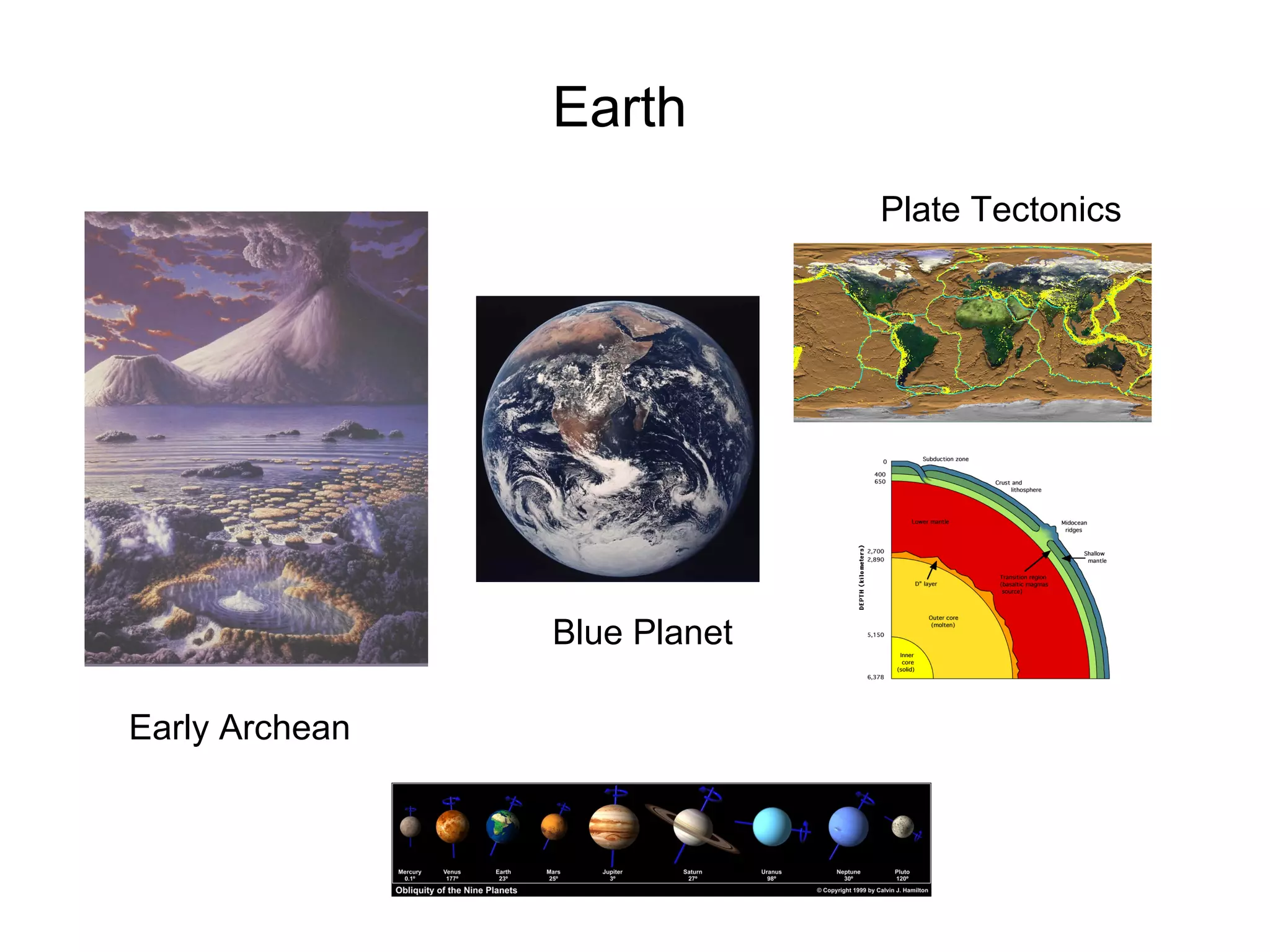
Earth
Early Archean
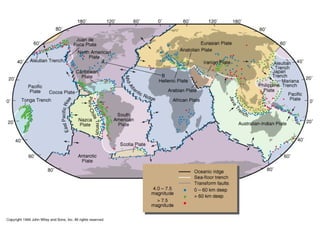
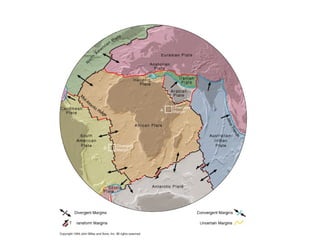
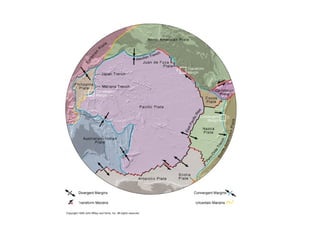
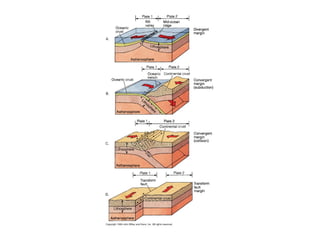
Plate Tectonics
Blue Planet
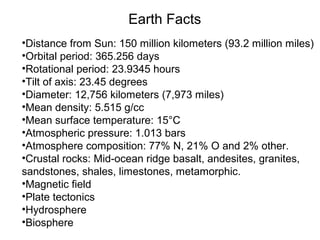
•Distance from Sun: 150 million kilometers (93.2 million miles)
•Orbital period: 365.256 days
•Rotational period: 23.9345 hours
•Tilt of axis: 23.45 degrees
•Diameter: 12,756 kilometers (7,973 miles)
•Mean density: 5.515 g/cc
•Mean surface temperature: 15°C
•Atmospheric pressure: 1.013 bars
•Atmosphere composition: 77% N, 21% O and 2% other.
•Crustal rocks: Mid-ocean ridge basalt, andesites, granites,
sandstones, shales, limestones, metamorphic.
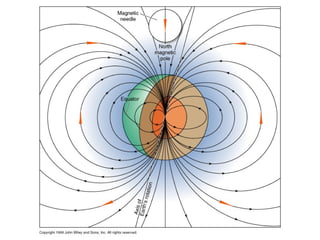
•Magnetic field
•Plate tectonics
•Hydrosphere
•Biosphere
Earth Facts
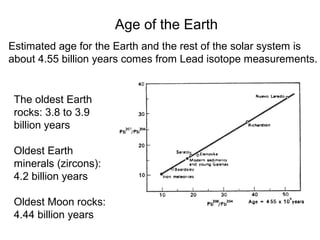
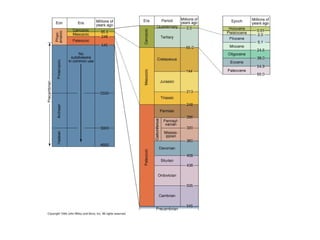
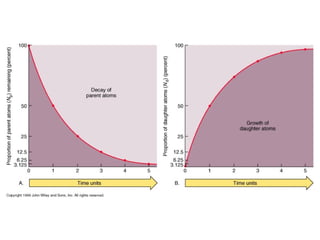
Age of the Earth
Estimated age for the Earth and the rest of the solar system is
about 4.55 billion years comes from Lead isotope measurements.
The oldest Earth
rocks: 3.8 to 3.9
billion years
Oldest Earth
minerals (zircons):
4.2 billion years
Oldest Moon rocks:
4.44 billion years
•About 5.5-6 billion years ago (BYA), the solar nebula
begins to collapse
•About 4.6 BYA, Sun begins fusion
•About 4.5-4.56 BYA, Proto-Earth formed from
planetesimals.
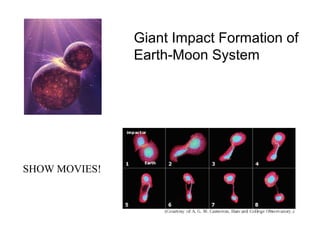
•4.44+ BYA, Earth-Moon formed by giant impact. Earth
melts, magma ocean.
•4.2 BYA, Earth was completely differentiated.
•4 BYA, earliest oceans formed, thick atmosphere exists
•3.8 BYA, life develops
•2.5-3 BYA, photosynthesis leads to O2 in ocean
•2 BYA, O2 hits atmosphere
Early Earth Timeline
Giant Impact Formation of
Earth-Moon System
SHOW MOVIES!
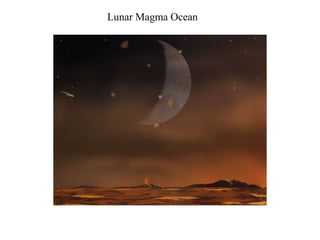
Lunar Magma Ocean
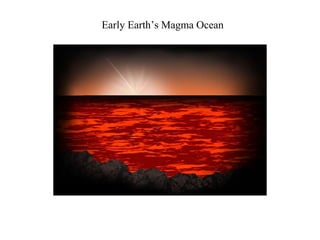
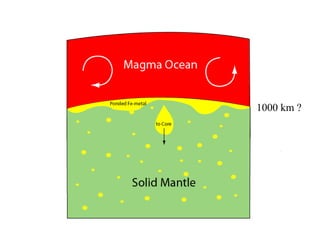
Early Earth’s Magma Ocean
1000 km ?
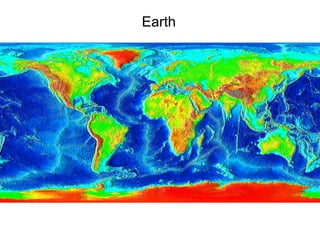
Earth
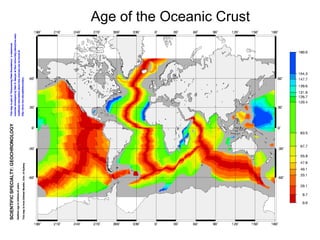
Age of the Oceanic Crust
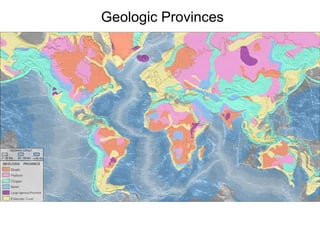
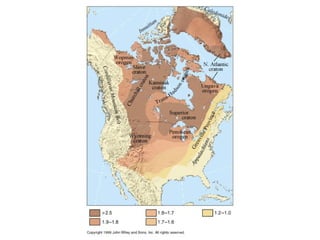
Geologic Provinces
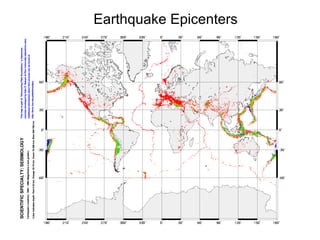
Earthquake Epicenters
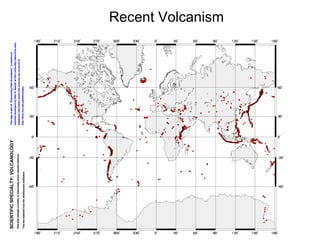
Recent Volcanism
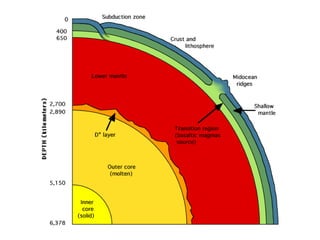
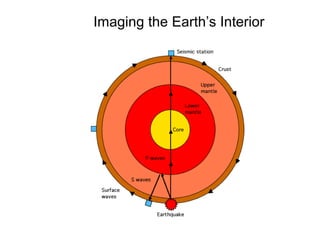
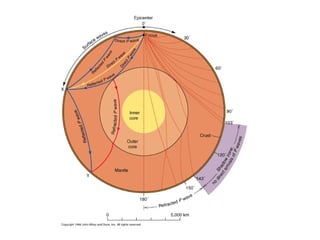
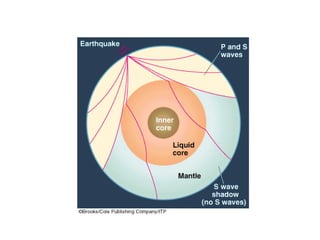
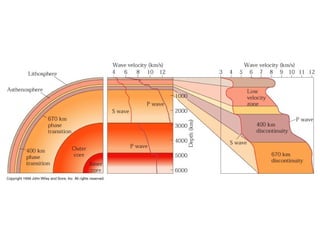
Imaging the Earth’s Interior
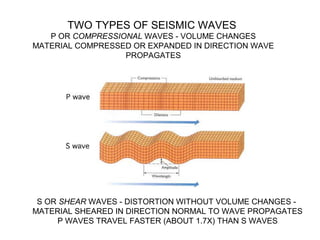
TWO TYPES OF SEISMIC WAVES
P OR COMPRESSIONAL WAVES - VOLUME CHANGES
MATERIAL COMPRESSED OR EXPANDED IN DIRECTION WAVE
PROPAGATES
S OR SHEAR WAVES - DISTORTION WITHOUT VOLUME CHANGES -
MATERIAL SHEARED IN DIRECTION NORMAL TO WAVE PROPAGATES
P WAVES TRAVEL FASTER (ABOUT 1.7X) THAN S WAVES
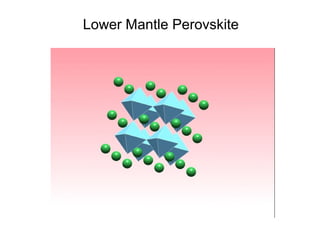
Lower Mantle Perovskite
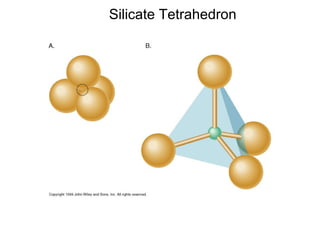
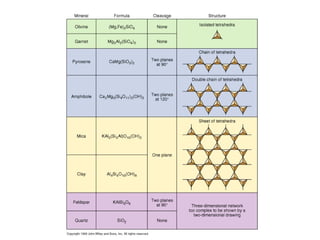
Silicate Tetrahedron
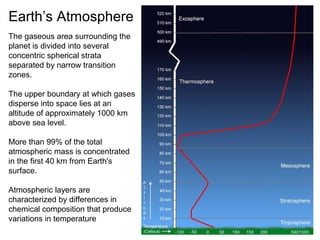
Earth’s Atmosphere
The gaseous area surrounding the
planet is divided into several
concentric spherical strata
separated by narrow transition
zones.
The upper boundary at which gases
disperse into space lies at an
altitude of approximately 1000 km
above sea level.
More than 99% of the total
atmospheric mass is concentrated
in the first 40 km from Earth's
surface.
Atmospheric layers are
characterized by differences in
chemical composition that produce
variations in temperature
Studies of the chemical abundance in the solar system points to the fact
that our atmosphere is not a primordial atmosphere but rather a secondary
atmosphere.
When the Earth (and other planets) formed, it must have been surrounded
by a primordial atmosphere (mainly H2, He).
The primordial atmospheres of the inner planets were probably wiped out
completely during the stage when the sun evolved to the stage of a T-Tauri
star.
This was probably caused by the sun ejecting substantial mass from its
surface in form of violent solar winds. These winds were effective in eroding
the primordial atmospheres of the terrestrial planets.
This atmosphere erosion may have been enhanced by the lack of a strong
magnetic in the early Earth.
Also, Earth’s gravity (compared to Jovian planets) is not strong enough to
prevent escape of H2 & He.
Primordial Atmosphere
Secondary Atmosphere
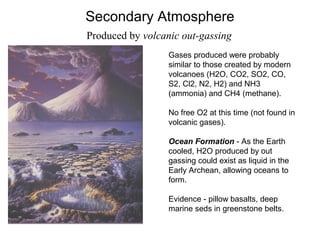
Gases produced were probably
similar to those created by modern
volcanoes (H2O, CO2, SO2, CO,
S2, Cl2, N2, H2) and NH3
(ammonia) and CH4 (methane).
No free O2 at this time (not found in
volcanic gases).
Ocean Formation - As the Earth
cooled, H2O produced by out
gassing could exist as liquid in the
Early Archean, allowing oceans to
form.
Evidence - pillow basalts, deep
marine seds in greenstone belts.
Produced by volcanic out-gassing
Oxygen Production
Photochemical dissociation
Breakup of water molecules by ultraviolet radiation
Produced O2 levels approx. 1-2% current levels
At these levels O3 (Ozone) can form to shield Earth surface
from UV
Photosynthesis
CO2 + H2O + sunlight = organic compounds + O2 – first produced
by Archean cyanobacteria, and eventually higher plants - supplied
the rest of O2 to atmosphere.
Addition of O2 to Atmosphere
CO2 is removed from the atmosphere during silicate
weathering and buried as limestone (CaCO3) where it is
sequested for a long time (millions of years) until
subduction and metamorphism release it.
Silicate Weathering – Carbonate Precipitation
CO2 + CaSiO3 CaCO3 + SiO2
Carbon dioxide Silicate minerals Limestone Chert
Removal of CO2 from Atmosphere
(In the presence of water)
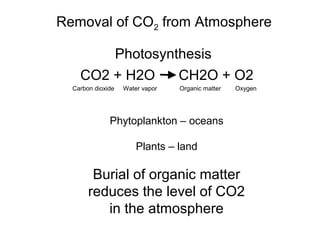
Photosynthesis
CO2 + H2O CH2O + O2
Phytoplankton – oceans
Plants – land
Burial of organic matter
reduces the level of CO2
in the atmosphere
Carbon dioxide Water vapor Organic matter Oxygen
Removal of CO2 from Atmosphere
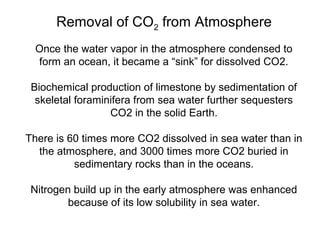
Once the water vapor in the atmosphere condensed to
form an ocean, it became a “sink” for dissolved CO2.
Biochemical production of limestone by sedimentation of
skeletal foraminifera from sea water further sequesters
CO2 in the solid Earth.
There is 60 times more CO2 dissolved in sea water than in
the atmosphere, and 3000 times more CO2 buried in
sedimentary rocks than in the oceans.
Nitrogen build up in the early atmosphere was enhanced
because of its low solubility in sea water.
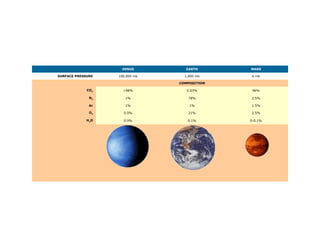
  VENUS EARTH MARS
SURFACE PRESSURE 100,000 mb 1,000 mb 6 mb
  COMPOSITION
CO2 >98% 0.03% 96%
N2 1% 78% 2.5%
Ar 1% 1% 1.5%
O2 0.0% 21% 2.5%
H2
O 0.0% 0.1% 0-0.1%


Climatology-Climatology Chapter

  • 1.
  • 2.
    •Distance from Sun:150 million kilometers (93.2 million miles) •Orbital period: 365.256 days •Rotational period: 23.9345 hours •Tilt of axis: 23.45 degrees •Diameter: 12,756 kilometers (7,973 miles) •Mean density: 5.515 g/cc •Mean surface temperature: 15°C •Atmospheric pressure: 1.013 bars •Atmosphere composition: 77% N, 21% O and 2% other. •Crustal rocks: Mid-ocean ridge basalt, andesites, granites, sandstones, shales, limestones, metamorphic. •Magnetic field •Plate tectonics •Hydrosphere •Biosphere Earth Facts
  • 3.
    Age of theEarth Estimated age for the Earth and the rest of the solar system is about 4.55 billion years comes from Lead isotope measurements. The oldest Earth rocks: 3.8 to 3.9 billion years Oldest Earth minerals (zircons): 4.2 billion years Oldest Moon rocks: 4.44 billion years
  • 4.
    •About 5.5-6 billionyears ago (BYA), the solar nebula begins to collapse •About 4.6 BYA, Sun begins fusion •About 4.5-4.56 BYA, Proto-Earth formed from planetesimals. •4.44+ BYA, Earth-Moon formed by giant impact. Earth melts, magma ocean. •4.2 BYA, Earth was completely differentiated. •4 BYA, earliest oceans formed, thick atmosphere exists •3.8 BYA, life develops •2.5-3 BYA, photosynthesis leads to O2 in ocean •2 BYA, O2 hits atmosphere Early Earth Timeline
  • 7.
    Giant Impact Formationof Earth-Moon System SHOW MOVIES!
  • 8.
  • 9.
  • 10.
  • 13.
  • 14.
    Age of theOceanic Crust
  • 15.
  • 18.
  • 19.
  • 24.
  • 25.
    TWO TYPES OFSEISMIC WAVES P OR COMPRESSIONAL WAVES - VOLUME CHANGES MATERIAL COMPRESSED OR EXPANDED IN DIRECTION WAVE PROPAGATES S OR SHEAR WAVES - DISTORTION WITHOUT VOLUME CHANGES - MATERIAL SHEARED IN DIRECTION NORMAL TO WAVE PROPAGATES P WAVES TRAVEL FASTER (ABOUT 1.7X) THAN S WAVES
  • 32.
  • 37.
  • 44.
    Earth’s Atmosphere The gaseousarea surrounding the planet is divided into several concentric spherical strata separated by narrow transition zones. The upper boundary at which gases disperse into space lies at an altitude of approximately 1000 km above sea level. More than 99% of the total atmospheric mass is concentrated in the first 40 km from Earth's surface. Atmospheric layers are characterized by differences in chemical composition that produce variations in temperature
  • 45.
    Studies of thechemical abundance in the solar system points to the fact that our atmosphere is not a primordial atmosphere but rather a secondary atmosphere. When the Earth (and other planets) formed, it must have been surrounded by a primordial atmosphere (mainly H2, He). The primordial atmospheres of the inner planets were probably wiped out completely during the stage when the sun evolved to the stage of a T-Tauri star. This was probably caused by the sun ejecting substantial mass from its surface in form of violent solar winds. These winds were effective in eroding the primordial atmospheres of the terrestrial planets. This atmosphere erosion may have been enhanced by the lack of a strong magnetic in the early Earth. Also, Earth’s gravity (compared to Jovian planets) is not strong enough to prevent escape of H2 & He. Primordial Atmosphere
  • 46.
    Secondary Atmosphere Gases producedwere probably similar to those created by modern volcanoes (H2O, CO2, SO2, CO, S2, Cl2, N2, H2) and NH3 (ammonia) and CH4 (methane). No free O2 at this time (not found in volcanic gases). Ocean Formation - As the Earth cooled, H2O produced by out gassing could exist as liquid in the Early Archean, allowing oceans to form. Evidence - pillow basalts, deep marine seds in greenstone belts. Produced by volcanic out-gassing
  • 47.
    Oxygen Production Photochemical dissociation Breakupof water molecules by ultraviolet radiation Produced O2 levels approx. 1-2% current levels At these levels O3 (Ozone) can form to shield Earth surface from UV Photosynthesis CO2 + H2O + sunlight = organic compounds + O2 – first produced by Archean cyanobacteria, and eventually higher plants - supplied the rest of O2 to atmosphere. Addition of O2 to Atmosphere
  • 48.
    CO2 is removedfrom the atmosphere during silicate weathering and buried as limestone (CaCO3) where it is sequested for a long time (millions of years) until subduction and metamorphism release it. Silicate Weathering – Carbonate Precipitation CO2 + CaSiO3 CaCO3 + SiO2 Carbon dioxide Silicate minerals Limestone Chert Removal of CO2 from Atmosphere (In the presence of water)
  • 49.
    Photosynthesis CO2 + H2OCH2O + O2 Phytoplankton – oceans Plants – land Burial of organic matter reduces the level of CO2 in the atmosphere Carbon dioxide Water vapor Organic matter Oxygen Removal of CO2 from Atmosphere
  • 50.
    Removal of CO2from Atmosphere Once the water vapor in the atmosphere condensed to form an ocean, it became a “sink” for dissolved CO2. Biochemical production of limestone by sedimentation of skeletal foraminifera from sea water further sequesters CO2 in the solid Earth. There is 60 times more CO2 dissolved in sea water than in the atmosphere, and 3000 times more CO2 buried in sedimentary rocks than in the oceans. Nitrogen build up in the early atmosphere was enhanced because of its low solubility in sea water.
  • 51.
      VENUS EARTHMARS SURFACE PRESSURE 100,000 mb 1,000 mb 6 mb   COMPOSITION CO2 >98% 0.03% 96% N2 1% 78% 2.5% Ar 1% 1% 1.5% O2 0.0% 21% 2.5% H2 O 0.0% 0.1% 0-0.1%