Development and Degradation
● Development
-The term ‘development’ can be used to
describe a process towards modernization that
can be measured in terms of the growth of
economy.
-Sustained efforts to improve the social and
economic well-being of the people and
communities.
Environmental Degradation
-When any of the components of the ecosystem
(wetland, forest, land etc.) reach to such a
situation due to natural disturbances or
anthropogenic activities, the part of the
ecosystem can not get back to its original state,
this situation leads to degradation.
-is damage to a local or global ecosystem or
the biosphere as a whole due to human
activities. It occurs when human resources
(such as, plants, habitat) are consumed
faster than nature can replenish them.
•Environmental Degradation
-The reduction of the ecosystem to provide
social and economic services (ISDR)
URBANIZATION
-Urbanization refers to a process in which an
increasing proportion of an entire population lives in
cities and the suburbs of cities.
-Urban population growth, migration and expansion
of the area are important in urbanization.
•There is a close relationship between
Environment, Development and degradation
Development: Urbanization (manipulation of
environmental parameters and transformation
of lands) and Industrialization (transformation
of lands for production, waste disposal,
emission of GHG gases)
World Conservation Strategy (WCS) and UNEP
publications drew the attention of Sustainable
Development.
Objectives of WCS
- to maintain essential ecological processes
-preservation of species and
-sustainable use of natural resources.
WCED
-19 December 1983, the General assembly
welcomed the establishment of a special commission
that should make available a report on environment.
Chairman- Gro Harlem Brundtland (Norway)
Members (21) from Sudan, Canada, USA etc.
WCED Report is divided into three parts
Part I- A threatened future towards sustainable
development
Part II- Common challenges
. Population and human resource
. Food and ecosystem
. Energy
. Industry
. Urban
Part III- Common endeavors, managing the
commons, peace, security, environment, towards
common action
WCED- World Conference on Environment
and Development (1987) -Our Common
Future (WCED, 1987)
Statement- many development activities are
leaving growing number of people poor and
vulnerable and at the same time are
degrading for the environment.
Objectives of WCED
-to meet basic needs
-to encourage consumption within the bounds
of ecosystem
-to ensure natural system that supports life on
earth (atmosphere, water, land and living
organisms are not threatened)
-to ensure equitable access to constrained
resources
-to maintain biodiversity through conservation
of plants and animal species
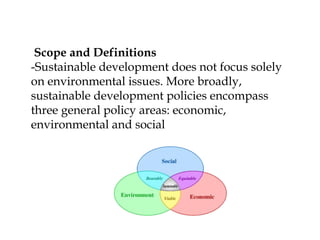
Scope and Definitions
-Sustainable development does not focus solely
on environmental issues. More broadly,
sustainable development policies encompass
three general policy areas: economic,
environmental and social
Sustainable Development (WCED, 1987)
-development that meets the needs of the present
without compromising the ability of future
generations to meet their own needs.
-Sustainable development is defined as
balancing the fulfillment of human needs with
the protection of the natural environment so that
these needs can be met not only in the present,
but in the indefinite future.
United Nations Conference on Environment
and Development (UNCED)
UNCED promotes Sustainable Development
Popularly known as–
EARTH SUMMIT, June 1992, Rio De Janeiro
of Brazil
-178 representatives including 117 heads of
the States were present
Agenda 21- is an agreement that highlights
many of the issues of SD—
1. Poverty eradication
2. Population control to save scarce
resources
3. Primary health care and control of
communicable diseases, and reduction of
health risk from environmental pollution
Agenda 21 outlines the global strategies for
protecting earth’s environment, conserving
natural resources and saving its population
and therefore provides the framework for
SD.
SD Efforts of Bangladesh
-BD is a signatory to Agenda 21 and it is
committed to pursuance of SD
-The Dhaka Declaration of the D-8 Summit held
in Dhaka on March 1999, where the goal of
SD is clearly stated as the pursuance of the
Sustainable Development.
-The Fifth Five Year Plan of Bangladesh 1997-
2002 (Planning Commission 1998) refers
several objectives of linking development
activities with environment.
Environmental Impact Assessment
-Nothing like EIA existed before 1967
-The first true EIA was probably in 1967 where EIA
was applied in investigating copper mining in
Puerto Rico.
-EIA evolved from landuse planning established by
the NEPA (National Env. Policy Act 1969, USA)
-EIA spread after 1970s for the systematic assessment
and presentation of predicted impacts, available
alternatives and mitigation possibilities.
-EIA evolved in an era dominated by a technocratic
perspective on problem solving and with an
emphasis on biophysical impacts.
-By 1995 about half of the world’s govts required EIA
in some form in any development projects.
Global and Transboundary Impact Assessment
-in 1991 the UN Economic Commission for Europe
(UNECE) initiated the Convention on
Environmental Impact Assessment in a
transboundary context in Espoo, Finland
Stages of EIA
-Pre-project assessment
-During project phase
-Post-project assessment and monitoring
Therefore the objectives of EIA are to evaluate the
potential threats of any development project to
environmental components & to plan accordingly
so that the impacts might be mitigated to a
sustainable level
-As methods of EIA, identification of probable threats
by a multidisciplinary expert group (Participatory
approach)
-Scaling of the problems and to compromise with
everyone’s objectives
Social Impact Assessment
-SIA Seeks to assess whether a proposed
development alters quality of life and sense of
well-being, and how well individuals, groups and
communities adapt change caused by
development
-scientists also recognize cultural impact assessment
concerned with effects on archaeological remains,
holy places, traditions etc.

Environmental degradation

  • 1.
    Development and Degradation ●Development -The term ‘development’ can be used to describe a process towards modernization that can be measured in terms of the growth of economy. -Sustained efforts to improve the social and economic well-being of the people and communities.
  • 2.
    Environmental Degradation -When anyof the components of the ecosystem (wetland, forest, land etc.) reach to such a situation due to natural disturbances or anthropogenic activities, the part of the ecosystem can not get back to its original state, this situation leads to degradation.
  • 3.
    -is damage toa local or global ecosystem or the biosphere as a whole due to human activities. It occurs when human resources (such as, plants, habitat) are consumed faster than nature can replenish them.
  • 4.
    •Environmental Degradation -The reductionof the ecosystem to provide social and economic services (ISDR) URBANIZATION -Urbanization refers to a process in which an increasing proportion of an entire population lives in cities and the suburbs of cities. -Urban population growth, migration and expansion of the area are important in urbanization.
  • 5.
    •There is aclose relationship between Environment, Development and degradation Development: Urbanization (manipulation of environmental parameters and transformation of lands) and Industrialization (transformation of lands for production, waste disposal, emission of GHG gases)
  • 6.
    World Conservation Strategy(WCS) and UNEP publications drew the attention of Sustainable Development. Objectives of WCS - to maintain essential ecological processes -preservation of species and -sustainable use of natural resources.
  • 7.
    WCED -19 December 1983,the General assembly welcomed the establishment of a special commission that should make available a report on environment. Chairman- Gro Harlem Brundtland (Norway) Members (21) from Sudan, Canada, USA etc.
  • 8.
    WCED Report isdivided into three parts Part I- A threatened future towards sustainable development Part II- Common challenges . Population and human resource . Food and ecosystem . Energy . Industry . Urban Part III- Common endeavors, managing the commons, peace, security, environment, towards common action
  • 9.
    WCED- World Conferenceon Environment and Development (1987) -Our Common Future (WCED, 1987) Statement- many development activities are leaving growing number of people poor and vulnerable and at the same time are degrading for the environment.
  • 10.
    Objectives of WCED -tomeet basic needs -to encourage consumption within the bounds of ecosystem -to ensure natural system that supports life on earth (atmosphere, water, land and living organisms are not threatened) -to ensure equitable access to constrained resources -to maintain biodiversity through conservation of plants and animal species
  • 11.
    Scope and Definitions -Sustainabledevelopment does not focus solely on environmental issues. More broadly, sustainable development policies encompass three general policy areas: economic, environmental and social
  • 12.
    Sustainable Development (WCED,1987) -development that meets the needs of the present without compromising the ability of future generations to meet their own needs. -Sustainable development is defined as balancing the fulfillment of human needs with the protection of the natural environment so that these needs can be met not only in the present, but in the indefinite future.
  • 13.
    United Nations Conferenceon Environment and Development (UNCED) UNCED promotes Sustainable Development Popularly known as– EARTH SUMMIT, June 1992, Rio De Janeiro of Brazil -178 representatives including 117 heads of the States were present
  • 14.
    Agenda 21- isan agreement that highlights many of the issues of SD— 1. Poverty eradication 2. Population control to save scarce resources 3. Primary health care and control of communicable diseases, and reduction of health risk from environmental pollution
  • 15.
    Agenda 21 outlinesthe global strategies for protecting earth’s environment, conserving natural resources and saving its population and therefore provides the framework for SD. SD Efforts of Bangladesh -BD is a signatory to Agenda 21 and it is committed to pursuance of SD
  • 16.
    -The Dhaka Declarationof the D-8 Summit held in Dhaka on March 1999, where the goal of SD is clearly stated as the pursuance of the Sustainable Development. -The Fifth Five Year Plan of Bangladesh 1997- 2002 (Planning Commission 1998) refers several objectives of linking development activities with environment.
  • 17.
    Environmental Impact Assessment -Nothinglike EIA existed before 1967 -The first true EIA was probably in 1967 where EIA was applied in investigating copper mining in Puerto Rico. -EIA evolved from landuse planning established by the NEPA (National Env. Policy Act 1969, USA)
  • 18.
    -EIA spread after1970s for the systematic assessment and presentation of predicted impacts, available alternatives and mitigation possibilities. -EIA evolved in an era dominated by a technocratic perspective on problem solving and with an emphasis on biophysical impacts. -By 1995 about half of the world’s govts required EIA in some form in any development projects. Global and Transboundary Impact Assessment -in 1991 the UN Economic Commission for Europe (UNECE) initiated the Convention on Environmental Impact Assessment in a transboundary context in Espoo, Finland
  • 19.
    Stages of EIA -Pre-projectassessment -During project phase -Post-project assessment and monitoring Therefore the objectives of EIA are to evaluate the potential threats of any development project to environmental components & to plan accordingly so that the impacts might be mitigated to a sustainable level -As methods of EIA, identification of probable threats by a multidisciplinary expert group (Participatory approach) -Scaling of the problems and to compromise with everyone’s objectives
  • 20.
    Social Impact Assessment -SIASeeks to assess whether a proposed development alters quality of life and sense of well-being, and how well individuals, groups and communities adapt change caused by development -scientists also recognize cultural impact assessment concerned with effects on archaeological remains, holy places, traditions etc.