Introduction to Remote
Sensing
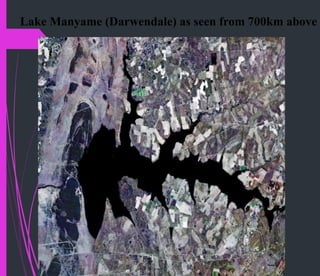
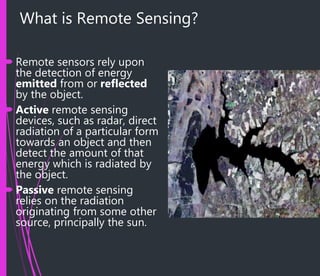
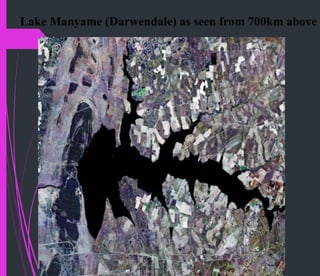
Lake Manyame (Darwendale) as seen from 700km above
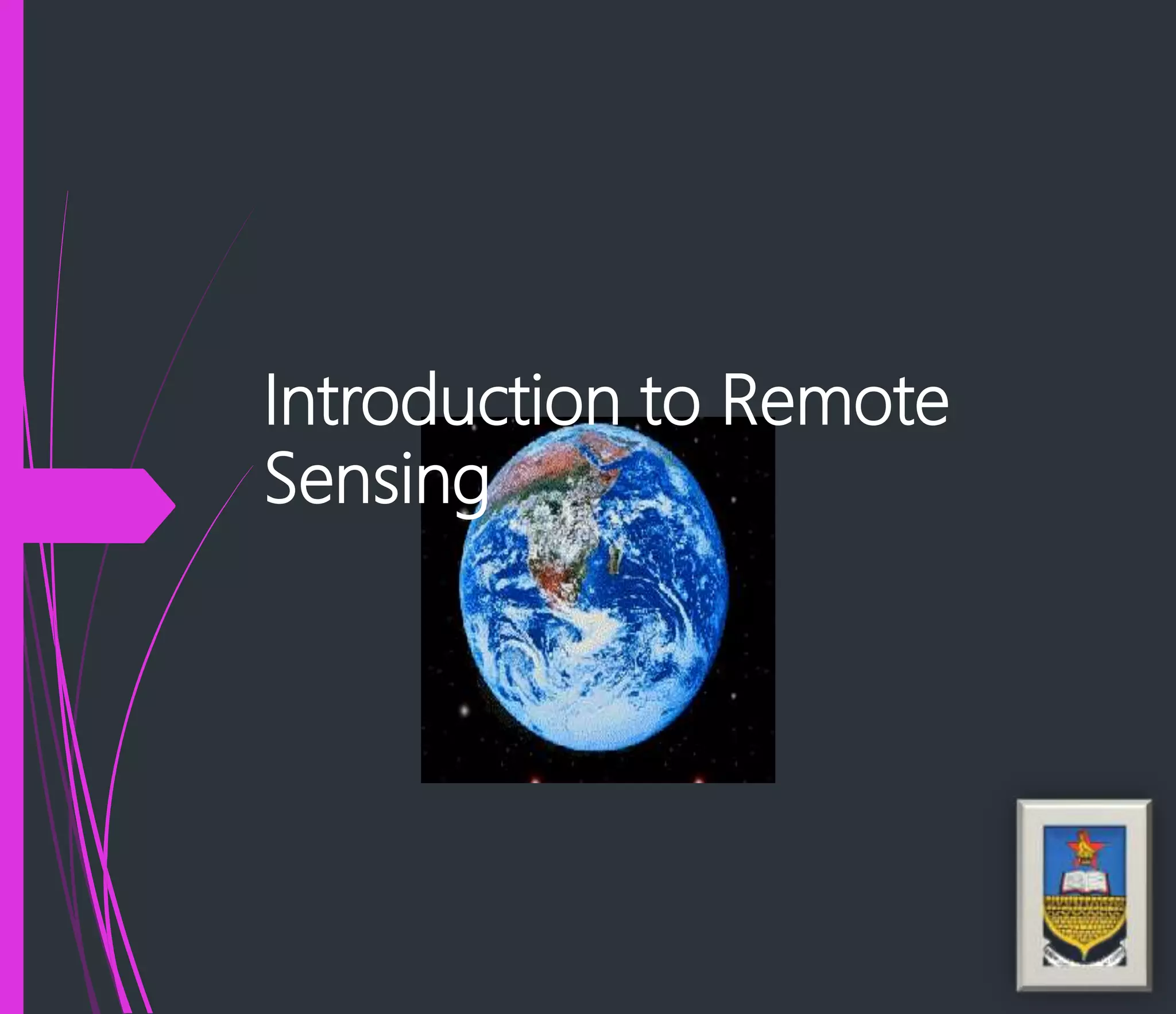
Southern Africa
Remote Sensing to derive spatial information
 Remote Sensing is the practice of deriving information about the earth’s surface
using data obtained by an instrument which is not in contact with the Earth surface,
 RS normally images acquired from an overhead perspective,
 The image is a result of detecting electromagnetic radiation reflected or emitted
from the earth’s surface.
What is Remote Sensing?
 Remote sensors rely upon
the detection of energy
emitted from or reflected
by the object.
 Active remote sensing
devices, such as radar, direct
radiation of a particular form
towards an object and then
detect the amount of that
energy which is radiated by
the object.
 Passive remote sensing
relies on the radiation
originating from some other
source, principally the sun.
What is Remote Sensing?
Remote sensing devices may be carried on a variety
of platforms. Characteristics of both the platform
and sensing device determine the type of the
remotely sensed data: spectral, spatial, radiometric
and temporal aspects of data resolution and extent.
What is Remote Sensing?
The number of satellite missions dedicated to Earth
Observation has increased significantly, and will further
increase, with in particular the increasing popularity of
very high resolution imagery.
Remote Sensing and GIS
Remotely sensed images have a number
of features which make them ideal GIS
data sources.
Remote sensing provides a regional
view.
Remote sensing provides repetitive
looks at the same area.
Remote sensors "see" over a broader
portion of the spectrum than the human
eye.
Remote Sensing and GIS
Sensors can focus in on a very specific
bandwidth in an image.
They can also look at a number of
bandwidths simultaneously.
Remote sensors often record signals
electronically and provide geo-
referenced, digital data.
Some remote sensors operate in all
seasons, at night, and in bad weather.
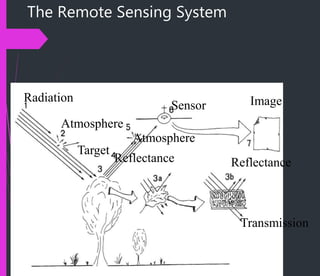
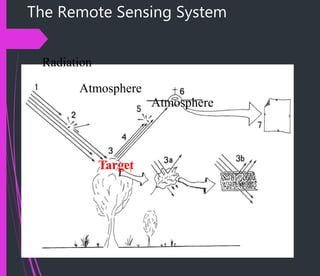
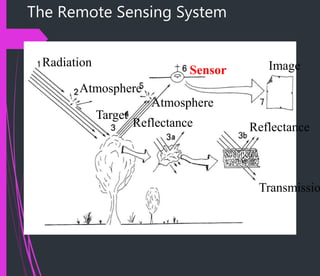
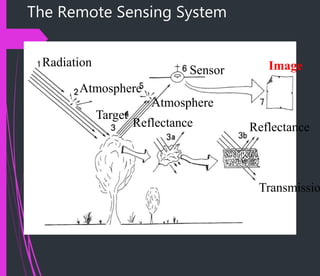
The Remote Sensing System
Radiation
Atmosphere
Target
Reflectance
Atmosphere
Sensor
Transmission
Reflectance
Image
What is electromagnetic radiation?
 The sun is the energy source used to detect reflective energy of ground surfaces
in the visible and near infrared regions.
What is electromagnetic radiation?
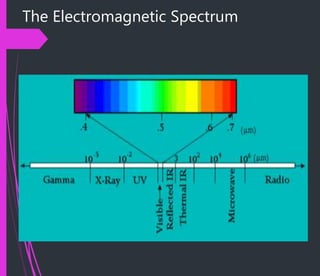
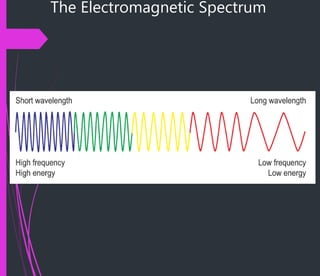
The Electromagnetic Spectrum
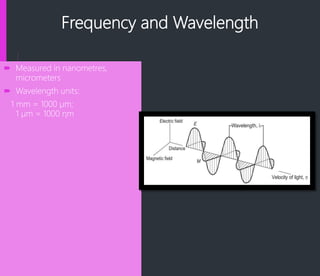
Frequency and Wavelength
 Measured in nanometres,
micrometers
 Wavelength units:
1 mm = 1000 µm;
1 µm = 1000 ηm
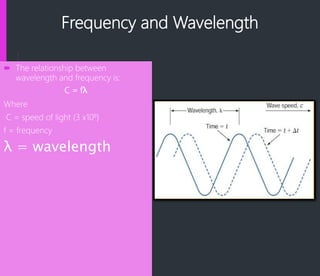
Frequency and Wavelength
 The relationship between
wavelength and frequency is:
C = fλ
Where
C = speed of light (3 x10⁸)
f = frequency
λ = wavelength
Particle Model of EM Energy
 Another theory offers useful insights into how
EM interacts with matter besides wave theory-
Quantum or particle theory
 Quantum theory of electromagnetic radiation:
energy is transferred in discrete packets called
quanta or photons
 The energy of a quantum is given as a function
of the frequency of radiation:
Q = hf
 where Q is the energy of a quantum measured
in Joules (J), h is the Planck constant (6.626 x
10-34 J s-1), and f is
the frequency of the radiation
Particle Model of EM Energy
 We can relate the wave and quantum models
of EM behaviour by solving for f and
substituting to obtain:
Q = hc/λ
 Thus, we see that energy of a quantum is
inversely proportional to wavelength.
 The longer the wavelength involved, the lower
its energy content.
 This is important since naturally emitted
radiation from terrain features such as
microwave is difficult to sense than radiation
and shorter wavelengths
 Thus sensors working at long wavelengths
The Electromagnetic Spectrum
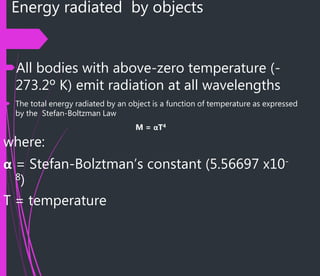
Energy radiated by objects
All bodies with above-zero temperature (-
273.2º K) emit radiation at all wavelengths
 The total energy radiated by an object is a function of temperature as expressed
by the Stefan-Boltzman Law
M = αT4
where:
α = Stefan-Bolztman’s constant (5.56697 x10-
8)
T = temperature
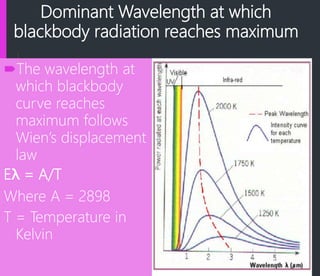
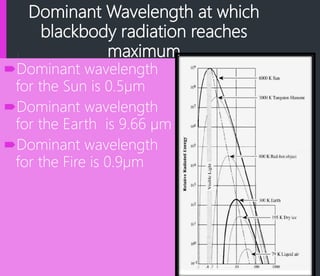
Dominant Wavelength at which
blackbody radiation reaches maximum
The wavelength at
which blackbody
curve reaches
maximum follows
Wien’s displacement
law
Eλ = A/T
Where A = 2898
T = Temperature in
Kelvin
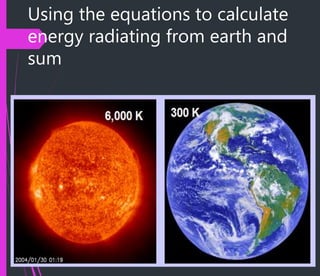
Using the equations to calculate
energy radiating from earth and
sum
Dominant Wavelength at which
blackbody radiation reaches
maximum
Dominant wavelength
for the Sun is 0.5µm
Dominant wavelength
for the Earth is 9.66 µm
Dominant wavelength
for the Fire is 0.9µm
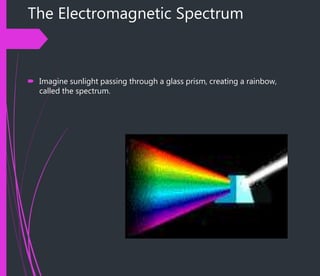
The Electromagnetic Spectrum
 Imagine sunlight passing through a glass prism, creating a rainbow,
called the spectrum.
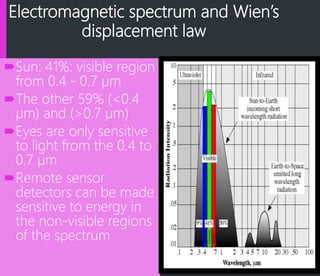
Electromagnetic spectrum and Wien’s
displacement law
Sun: 41%: visible region
from 0.4 - 0.7 µm
The other 59% (<0.4
µm) and (>0.7 µm)
Eyes are only sensitive
to light from the 0.4 to
0.7 µm
Remote sensor
detectors can be made
sensitive to energy in
the non-visible regions
of the spectrum
Understanding The EM
Spectrum
 the electromagnetic spectrum describes all the wavelengths
of light – both seen and unseen.
 The electromagnetic spectrum is the term used by
scientists to describe the entire range of light that exists.
 From radio waves to gamma rays, most of the light in the
universe is, in fact, invisible to us!
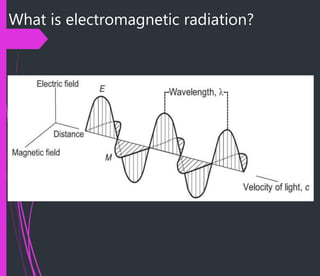
 Light is a wave of alternating electric and magnetic fields.
Measuring EM radiation
 Like any other wave, light has a few fundamental properties that describe it.
 One is its frequency, measured in Hertz, which counts the number of waves
that pass by a point in one second.
 Another property is wavelength: the distance from the peak of one wave to
the peak of the next.
 These two attributes are inversely related. The larger the frequency, the
smaller the wavelength – and vice versa.
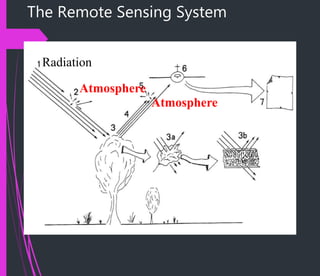
The Remote Sensing System
Radiation
Atmosphere
Atmosphere
Effects of the Atmosphere
Before radiation used for remote sensing
reaches the Earth's surface it has to travel
through some distance of the Earth's
atmosphere.
Particles and gases in the atmosphere can
affect the incoming light and radiation.
These effects are caused by the mechanisms
of scattering and absorption.
Effects of the Atmosphere
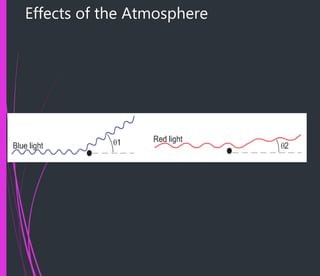
Scattering occurs when particles or large gas
molecules present in the atmosphere interact
with and cause the electromagnetic radiation
to be redirected from its original path.
How much scattering takes place depends on
several factors including the wavelength of the
radiation, the abundance of particles or gases,
and the distance the radiation travels through
the atmosphere.
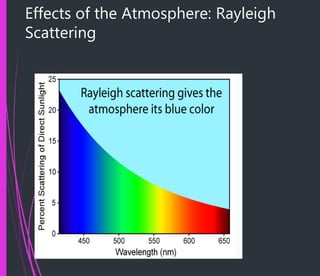
Rayleigh Scattering: Blue Sky
Mie Scattering larger (sky is grey)
Effects of the Atmosphere: Rayleigh
Scattering
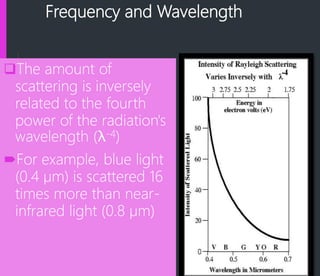
Frequency and Wavelength
The amount of
scattering is inversely
related to the fourth
power of the radiation's
wavelength (λ-4)
For example, blue light
(0.4 µm) is scattered 16
times more than near-
infrared light (0.8 µm)
Effects of the Atmosphere
Absorption is the other main mechanism at
work when electromagnetic radiation
interacts with the atmosphere.
In contrast to scattering, this phenomenon
causes molecules in the atmosphere to
absorb energy at various wavelengths.
Ozone, carbon dioxide, and water vapour
are the three main atmospheric
constituents which absorb radiation.
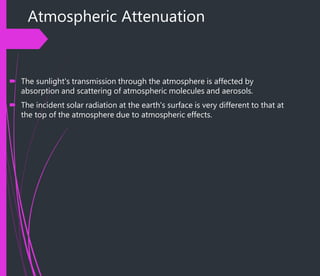
Atmospheric Attenuation
 The sunlight's transmission through the atmosphere is affected by
absorption and scattering of atmospheric molecules and aerosols.
 The incident solar radiation at the earth's surface is very different to that at
the top of the atmosphere due to atmospheric effects.
The Remote Sensing System
Radiation
Atmosphere
Target
Atmosphere
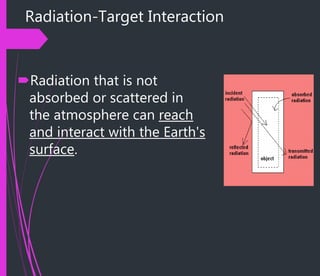
Radiation-Target Interaction
Radiation that is not
absorbed or scattered in
the atmosphere can reach
and interact with the Earth's
surface.
Radiation-Target Interaction
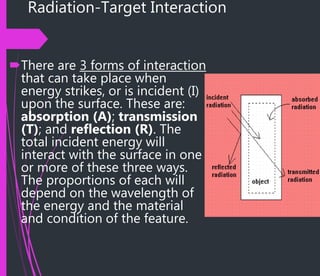
There are 3 forms of interaction
that can take place when
energy strikes, or is incident (I)
upon the surface. These are:
absorption (A); transmission
(T); and reflection (R). The
total incident energy will
interact with the surface in one
or more of these three ways.
The proportions of each will
depend on the wavelength of
the energy and the material
and condition of the feature.
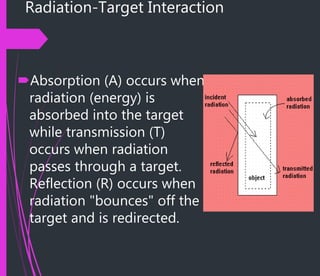
Radiation-Target Interaction
Absorption (A) occurs when
radiation (energy) is
absorbed into the target
while transmission (T)
occurs when radiation
passes through a target.
Reflection (R) occurs when
radiation "bounces" off the
target and is redirected.
The Remote Sensing System
Radiation
Atmosphere
Target
Reflectance
Atmosphere
Sensor
Transmissio
Reflectance
Image
Sensors
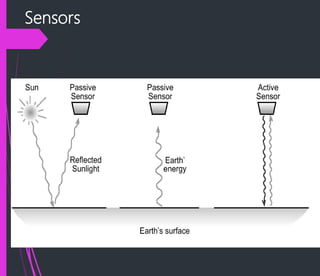
Sensors
PASSIVE remote sensing
relies on the radiation originating from
some other source, principally the sun.
Landsat TM, SPOT, NOAA AVHRR, etc.
ACTIVE remote sensing devices,
such as RADAR and LASAR, direct
radiation of a particular form towards an
object and then detect the amount of that
energy which is radiated by the object.
Sensors
The number of satellite missions
dedicated to Earth Observation has
increased significantly, and will further
increase, with in particular the increasing
popularity of very high resolution
imagery,
such as hyperspectral (MERIS) and
high spatial resolution such as IKONOS
(< 1m pixel size).
Sensors
List of Current and Future Sensor Systems:
http://geo.arc.nasa.gov/sge/health/sensor/c
fsensor.html
In 1995, the Committee on Earth Observation
Satellites (CEOS http://www.ceos.org/)
estimated that international space agencies
were planning to launch more than 80
missions by the year 2010. These missions will
be carrying over 200 different instruments,
providing measurements of many
environmental change parameters, some for
the first time.
The Remote Sensing System
Radiation
Atmosphere
Target
Reflectance
Atmosphere
Sensor
Transmissio
Reflectance
Image
Lake Manyame (Darwendale) as seen from 700km above

Introduction to remote sensing pt 1

  • 1.
  • 2.
    Lake Manyame (Darwendale)as seen from 700km above
  • 3.
  • 4.
    Remote Sensing toderive spatial information  Remote Sensing is the practice of deriving information about the earth’s surface using data obtained by an instrument which is not in contact with the Earth surface,  RS normally images acquired from an overhead perspective,  The image is a result of detecting electromagnetic radiation reflected or emitted from the earth’s surface.
  • 5.
    What is RemoteSensing?  Remote sensors rely upon the detection of energy emitted from or reflected by the object.  Active remote sensing devices, such as radar, direct radiation of a particular form towards an object and then detect the amount of that energy which is radiated by the object.  Passive remote sensing relies on the radiation originating from some other source, principally the sun.
  • 6.
    What is RemoteSensing? Remote sensing devices may be carried on a variety of platforms. Characteristics of both the platform and sensing device determine the type of the remotely sensed data: spectral, spatial, radiometric and temporal aspects of data resolution and extent.
  • 7.
    What is RemoteSensing? The number of satellite missions dedicated to Earth Observation has increased significantly, and will further increase, with in particular the increasing popularity of very high resolution imagery.
  • 8.
    Remote Sensing andGIS Remotely sensed images have a number of features which make them ideal GIS data sources. Remote sensing provides a regional view. Remote sensing provides repetitive looks at the same area. Remote sensors "see" over a broader portion of the spectrum than the human eye.
  • 9.
    Remote Sensing andGIS Sensors can focus in on a very specific bandwidth in an image. They can also look at a number of bandwidths simultaneously. Remote sensors often record signals electronically and provide geo- referenced, digital data. Some remote sensors operate in all seasons, at night, and in bad weather.
  • 10.
    The Remote SensingSystem Radiation Atmosphere Target Reflectance Atmosphere Sensor Transmission Reflectance Image
  • 11.
    What is electromagneticradiation?  The sun is the energy source used to detect reflective energy of ground surfaces in the visible and near infrared regions.
  • 12.
  • 13.
  • 14.
    Frequency and Wavelength Measured in nanometres, micrometers  Wavelength units: 1 mm = 1000 µm; 1 µm = 1000 ηm
  • 15.
    Frequency and Wavelength The relationship between wavelength and frequency is: C = fλ Where C = speed of light (3 x10⁸) f = frequency λ = wavelength
  • 16.
    Particle Model ofEM Energy  Another theory offers useful insights into how EM interacts with matter besides wave theory- Quantum or particle theory  Quantum theory of electromagnetic radiation: energy is transferred in discrete packets called quanta or photons  The energy of a quantum is given as a function of the frequency of radiation: Q = hf  where Q is the energy of a quantum measured in Joules (J), h is the Planck constant (6.626 x 10⁻³⁴ J s-1), and f is the frequency of the radiation
  • 17.
    Particle Model ofEM Energy  We can relate the wave and quantum models of EM behaviour by solving for f and substituting to obtain: Q = hc/λ  Thus, we see that energy of a quantum is inversely proportional to wavelength.  The longer the wavelength involved, the lower its energy content.  This is important since naturally emitted radiation from terrain features such as microwave is difficult to sense than radiation and shorter wavelengths  Thus sensors working at long wavelengths
  • 18.
  • 19.
    Energy radiated byobjects All bodies with above-zero temperature (- 273.2º K) emit radiation at all wavelengths  The total energy radiated by an object is a function of temperature as expressed by the Stefan-Boltzman Law M = αT4 where: α = Stefan-Bolztman’s constant (5.56697 x10- 8) T = temperature
  • 20.
    Dominant Wavelength atwhich blackbody radiation reaches maximum The wavelength at which blackbody curve reaches maximum follows Wien’s displacement law Eλ = A/T Where A = 2898 T = Temperature in Kelvin
  • 21.
    Using the equationsto calculate energy radiating from earth and sum
  • 22.
    Dominant Wavelength atwhich blackbody radiation reaches maximum Dominant wavelength for the Sun is 0.5µm Dominant wavelength for the Earth is 9.66 µm Dominant wavelength for the Fire is 0.9µm
  • 23.
    The Electromagnetic Spectrum Imagine sunlight passing through a glass prism, creating a rainbow, called the spectrum.
  • 24.
    Electromagnetic spectrum andWien’s displacement law Sun: 41%: visible region from 0.4 - 0.7 µm The other 59% (<0.4 µm) and (>0.7 µm) Eyes are only sensitive to light from the 0.4 to 0.7 µm Remote sensor detectors can be made sensitive to energy in the non-visible regions of the spectrum
  • 25.
    Understanding The EM Spectrum the electromagnetic spectrum describes all the wavelengths of light – both seen and unseen.  The electromagnetic spectrum is the term used by scientists to describe the entire range of light that exists.  From radio waves to gamma rays, most of the light in the universe is, in fact, invisible to us!  Light is a wave of alternating electric and magnetic fields.
  • 26.
    Measuring EM radiation Like any other wave, light has a few fundamental properties that describe it.  One is its frequency, measured in Hertz, which counts the number of waves that pass by a point in one second.  Another property is wavelength: the distance from the peak of one wave to the peak of the next.  These two attributes are inversely related. The larger the frequency, the smaller the wavelength – and vice versa.
  • 27.
    The Remote SensingSystem Radiation Atmosphere Atmosphere
  • 28.
    Effects of theAtmosphere Before radiation used for remote sensing reaches the Earth's surface it has to travel through some distance of the Earth's atmosphere. Particles and gases in the atmosphere can affect the incoming light and radiation. These effects are caused by the mechanisms of scattering and absorption.
  • 29.
    Effects of theAtmosphere Scattering occurs when particles or large gas molecules present in the atmosphere interact with and cause the electromagnetic radiation to be redirected from its original path. How much scattering takes place depends on several factors including the wavelength of the radiation, the abundance of particles or gases, and the distance the radiation travels through the atmosphere. Rayleigh Scattering: Blue Sky Mie Scattering larger (sky is grey)
  • 30.
    Effects of theAtmosphere: Rayleigh Scattering
  • 31.
    Frequency and Wavelength Theamount of scattering is inversely related to the fourth power of the radiation's wavelength (λ-4) For example, blue light (0.4 µm) is scattered 16 times more than near- infrared light (0.8 µm)
  • 32.
    Effects of theAtmosphere
  • 33.
    Effects of theAtmosphere Absorption is the other main mechanism at work when electromagnetic radiation interacts with the atmosphere. In contrast to scattering, this phenomenon causes molecules in the atmosphere to absorb energy at various wavelengths. Ozone, carbon dioxide, and water vapour are the three main atmospheric constituents which absorb radiation.
  • 34.
    Atmospheric Attenuation  Thesunlight's transmission through the atmosphere is affected by absorption and scattering of atmospheric molecules and aerosols.  The incident solar radiation at the earth's surface is very different to that at the top of the atmosphere due to atmospheric effects.
  • 35.
    The Remote SensingSystem Radiation Atmosphere Target Atmosphere
  • 36.
    Radiation-Target Interaction Radiation thatis not absorbed or scattered in the atmosphere can reach and interact with the Earth's surface.
  • 37.
    Radiation-Target Interaction There are3 forms of interaction that can take place when energy strikes, or is incident (I) upon the surface. These are: absorption (A); transmission (T); and reflection (R). The total incident energy will interact with the surface in one or more of these three ways. The proportions of each will depend on the wavelength of the energy and the material and condition of the feature.
  • 38.
    Radiation-Target Interaction Absorption (A)occurs when radiation (energy) is absorbed into the target while transmission (T) occurs when radiation passes through a target. Reflection (R) occurs when radiation "bounces" off the target and is redirected.
  • 39.
    The Remote SensingSystem Radiation Atmosphere Target Reflectance Atmosphere Sensor Transmissio Reflectance Image
  • 40.
  • 41.
    Sensors PASSIVE remote sensing relieson the radiation originating from some other source, principally the sun. Landsat TM, SPOT, NOAA AVHRR, etc. ACTIVE remote sensing devices, such as RADAR and LASAR, direct radiation of a particular form towards an object and then detect the amount of that energy which is radiated by the object.
  • 42.
    Sensors The number ofsatellite missions dedicated to Earth Observation has increased significantly, and will further increase, with in particular the increasing popularity of very high resolution imagery, such as hyperspectral (MERIS) and high spatial resolution such as IKONOS (< 1m pixel size).
  • 43.
    Sensors List of Currentand Future Sensor Systems: http://geo.arc.nasa.gov/sge/health/sensor/c fsensor.html In 1995, the Committee on Earth Observation Satellites (CEOS http://www.ceos.org/) estimated that international space agencies were planning to launch more than 80 missions by the year 2010. These missions will be carrying over 200 different instruments, providing measurements of many environmental change parameters, some for the first time.
  • 44.
    The Remote SensingSystem Radiation Atmosphere Target Reflectance Atmosphere Sensor Transmissio Reflectance Image
  • 45.
    Lake Manyame (Darwendale)as seen from 700km above

Editor's Notes

  • #17 Niels Bohr (1885-1962) and Max Planck recognized the discrete nature of exchanges of radiant energy and proposed the quantum theory of electromagnetic radiation. This theory states that energy is transferred in discrete packets called quanta or photons as discussed. The relationship between the frequency of radiation expressed by wave theory and the quantum is: Q = h  where Q is the energy of a quantum measured in Joules (J), h is the Planck constant (6.626 x 10⁻³⁴ J s-1), and  is the frequency of the radiation.
  • #18 Niels Bohr (1885-1962) and Max Planck recognized the discrete nature of exchanges of radiant energy and proposed the quantum theory of electromagnetic radiation. This theory states that energy is transferred in discrete packets called quanta or photons as discussed. The relationship between the frequency of radiation expressed by wave theory and the quantum is: Q = h  where Q is the energy of a quantum measured in Joules (J), h is the Planck constant (6.626 x 10⁻³⁴ J s-1), and  is the frequency of the radiation.
  • #22 Suppose instead of green all you find is a dark "line" where green should be. You might assume something had absorbed all the "green" wavelengths out of the incoming light. This can happen. By studying the brightness of individual wavelengths from a natural source, and comparing them to the results of laboratory experiments, many substances can be identified that lie in the path from the light source to the observer, each absorbing particular wavelengths, in a characteristic manner. Spectroscopy is not limited to the band of visible light, but is commonly applied to infrared, ultraviolet, and many other parts of the whole spectrum of electromagnetic energy.
  • #24 Suppose instead of green all you find is a dark "line" where green should be. You might assume something had absorbed all the "green" wavelengths out of the incoming light. This can happen. By studying the brightness of individual wavelengths from a natural source, and comparing them to the results of laboratory experiments, many substances can be identified that lie in the path from the light source to the observer, each absorbing particular wavelengths, in a characteristic manner. Spectroscopy is not limited to the band of visible light, but is commonly applied to infrared, ultraviolet, and many other parts of the whole spectrum of electromagnetic energy.
  • #40  The vehicle or carrier for remote sensors are borne is called the platform. Typical platforms are satellite and aircraft Platforms with the highest altitude are geosynchronous satellites such as the Geosynchronous Meteorological Satellite (GMS), which has an altitude of 36,000 km at the Equator. Most of the earth observation satellites, such as Landsat, SPOT, MOS etc. are at about 900 km altitude with a sun synchronous orbit.