1
Advantages of Remote Sensing
• Major advantages of remote sensing are
 Provides data for large areas
 Provide data of very remote and inaccessible regions
 Able to obtain imagery of any area over a continuous period of time
– Possible to monitor any anthropogenic or natural changes in the landscape
 Relatively inexpensive when compared to employing a team of surveyors
 Easy and rapid collection of data
 Rapid production of maps for interpretation
2
Limitations of Remote Sensing
• Some of the drawbacks of remote sensing are
 The interpretation of imagery requires a certain skill level
 Needs cross verification with ground (field) survey data
 Data from multiple sources may create confusion
 Objects can be misclassified or confused
 Distortions may occur in an image due to the relative motion of sensor and source
3
Energy Interactions in the
Atmosphere
4
Objectives
• Composition of the atmosphere
• Interactions of the electromagnetic radiation with the atmospheric particles
– Scattering
5
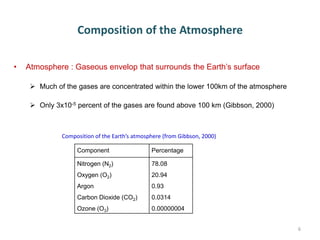
Composition of the Atmosphere
• Atmosphere : Gaseous envelop that surrounds the Earth’s surface
 Much of the gases are concentrated within the lower 100km of the atmosphere
 Only 3x10⁻⁵ percent of the gases are found above 100 km (Gibbson, 2000)
6
Composition of the Earth’s atmosphere (from Gibbson, 2000)
Component Percentage
Nitrogen (N2) 78.08
Oxygen (O2) 20.94
Argon 0.93
Carbon Dioxide (CO2) 0.0314
Ozone (O3) 0.00000004
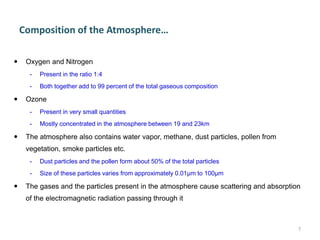
Composition of the Atmosphere…
 Oxygen and Nitrogen
- Present in the ratio 1:4
- Both together add to 99 percent of the total gaseous composition
 Ozone
- Present in very small quantities
- Mostly concentrated in the atmosphere between 19 and 23km
 The atmosphere also contains water vapor, methane, dust particles, pollen from
vegetation, smoke particles etc.
- Dust particles and the pollen form about 50% of the total particles
- Size of these particles varies from approximately 0.01μm to 100μm
 The gases and the particles present in the atmosphere cause scattering and absorption
of the electromagnetic radiation passing through it
7
Energy Interactions
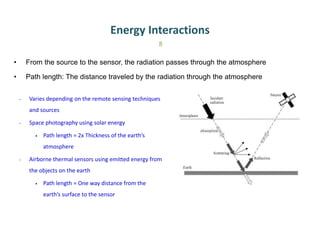
• From the source to the sensor, the radiation passes through the atmosphere
• Path length: The distance traveled by the radiation through the atmosphere
8
- Varies depending on the remote sensing techniques
and sources
- Space photography using solar energy
• Path length = 2x Thickness of the earth’s
atmosphere
- Airborne thermal sensors using emitted energy from
the objects on the earth
• Path length = One way distance from the
earth’s surface to the sensor
Energy Interactions…
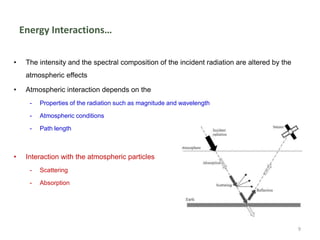
• The intensity and the spectral composition of the incident radiation are altered by the
atmospheric effects
• Atmospheric interaction depends on the
- Properties of the radiation such as magnitude and wavelength
- Atmospheric conditions
- Path length
• Interaction with the atmospheric particles
- Scattering
- Absorption
9
Scattering
-Rayleigh Scattering
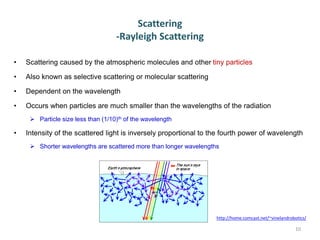
• Scattering caused by the atmospheric molecules and other tiny particles
• Also known as selective scattering or molecular scattering
• Dependent on the wavelength
• Occurs when particles are much smaller than the wavelengths of the radiation
 Particle size less than (1/10)th of the wavelength
• Intensity of the scattered light is inversely proportional to the fourth power of wavelength
 Shorter wavelengths are scattered more than longer wavelengths
10
http://home.comcast.net/~vinelandrobotics/
Rayleigh Scattering of the Visible Part of the EM Energy
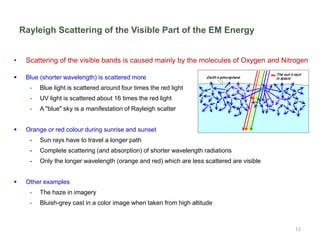
• Scattering of the visible bands is caused mainly by the molecules of Oxygen and Nitrogen
 Blue (shorter wavelength) is scattered more
- Blue light is scattered around four times the red light
- UV light is scattered about 16 times the red light
- A "blue" sky is a manifestation of Rayleigh scatter
 Orange or red colour during sunrise and sunset
- Sun rays have to travel a longer path
- Complete scattering (and absorption) of shorter wavelength radiations
- Only the longer wavelength (orange and red) which are less scattered are visible
 Other examples
- The haze in imagery
- Bluish-grey cast in a color image when taken from high altitude
11
Scattering
-Mie Scattering
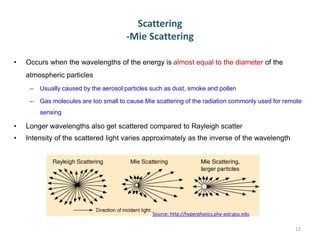
• Occurs when the wavelengths of the energy is almost equal to the diameter of the
atmospheric particles
– Usually caused by the aerosol particles such as dust, smoke and pollen
– Gas molecules are too small to cause Mie scattering of the radiation commonly used for remote
sensing
• Longer wavelengths also get scattered compared to Rayleigh scatter
• Intensity of the scattered light varies approximately as the inverse of the wavelength
12
Source: http://hyperphysics.phy-astr.gsu.edu
Scattering
-Non-selective Scattering
• When the diameters of the atmospheric particles are much larger
– Diameter is greater than10 times the wavelengths being sensed
– Particles such as pollen, cloud droplets, ice crystals and raindrops can cause non-selective
scattering of the visible light.
• Non-selective scattering of visible light (of wavelength 0.4-0.7μ)
– Generally caused by water droplets (5 to 100 μm diameter)
– All visible and IR wavelengths get scattered equally
– Gives white or grey color to the clouds
Remote Sensing: M1L3 13
Absorption
• Absorption : Process in which the incident energy is retained by particles in the
atmosphere
• Energy is transformed into other forms
• Unlike scattering, atmospheric absorption causes an effective loss of energy
• Absorption depends on
– Wavelength of the energy
– Atmospheric composition
– Arrangement of the gaseous molecules and their energy level
• The absorbing medium will not only absorb a portion of the total energy, but will also
reflect, refract or scatter the energy. The absorbed energy may also be transmitted back
to the atmosphere.
D. Nagesh Kumar, IISc Remote Sensing: M1L3 14
Absorption…
• The most efficient absorbers of solar radiation are
 Water vapour, carbon dioxide, and ozone
• Gaseous components are selective absorbers of the electromagnetic radiation
 Absorb electromagnetic energy in specific wavelength bands
 Depends on the arrangement of the gaseous molecules and their energy levels
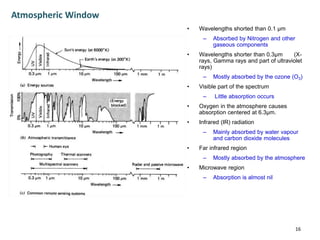
Atmospheric window
• The ranges of wavelength that are partially or wholly transmitted through the atmosphere
• Remote sensing data acquisition is limited through these atmospheric windows
D. Nagesh Kumar, IISc
Remote Sensing: M1L3
15
16
Atmospheric Window
• Wavelengths shorted than 0.1 μm
– Absorbed by Nitrogen and other
gaseous components
• Wavelengths shorter than 0.3μm (X-
rays, Gamma rays and part of ultraviolet
rays)
– Mostly absorbed by the ozone (O3)
• Visible part of the spectrum
– Little absorption occurs
• Oxygen in the atmosphere causes
absorption centered at 6.3μm.
• Infrared (IR) radiation
– Mainly absorbed by water vapour
and carbon dioxide molecules
• Far infrared region
– Mostly absorbed by the atmosphere
• Microwave region
– Absorption is almost nil
Absorption…
• The most common sources of energy are
 Incident solar energy
– Maximum energy in the visible region
 Radiation from the Earth
• Maximum energy in the thermal IR region
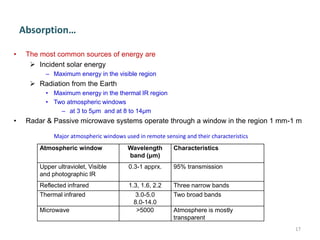
• Two atmospheric windows
– at 3 to 5μm and at 8 to 14μm
• Radar & Passive microwave systems operate through a window in the region 1 mm-1 m
17
Major atmospheric windows used in remote sensing and their characteristics
Atmospheric window Wavelength
band (μm)
Characteristics
Upper ultraviolet, Visible
and photographic IR
0.3-1 apprx. 95% transmission
Reflected infrared 1.3, 1.6, 2.2 Three narrow bands
Thermal infrared 3.0-5.0
8.0-14.0
Two broad bands
Microwave >5000 Atmosphere is mostly
transparent
EMR Spectrum
Introduction and Basic Concepts
18
Objectives
• What is meant by
– Electromagnetic energy
– Electromagnetic radiation (EMR) spectrum
• Source of radiation/energy in remote sensing
19
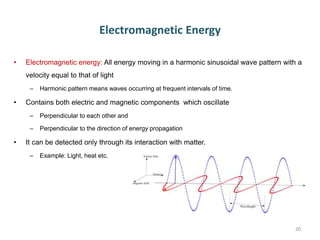
Electromagnetic Energy
• Electromagnetic energy: All energy moving in a harmonic sinusoidal wave pattern with a
velocity equal to that of light
– Harmonic pattern means waves occurring at frequent intervals of time.
• Contains both electric and magnetic components which oscillate
– Perpendicular to each other and
– Perpendicular to the direction of energy propagation
• It can be detected only through its interaction with matter.
– Example: Light, heat etc.
20
Electromagnetic Energy…
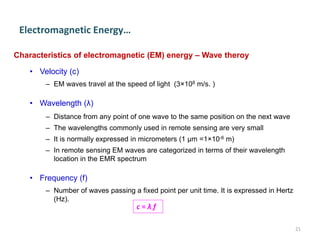
Characteristics of electromagnetic (EM) energy – Wave theroy
• Velocity (c)
– EM waves travel at the speed of light (3×10⁸ m/s. )
• Wavelength (λ)
– Distance from any point of one wave to the same position on the next wave
– The wavelengths commonly used in remote sensing are very small
– It is normally expressed in micrometers (1 μm =1×10⁻⁶ m)
– In remote sensing EM waves are categorized in terms of their wavelength
location in the EMR spectrum
• Frequency (f)
– Number of waves passing a fixed point per unit time. It is expressed in Hertz
(Hz).
21
c = λ f
Electromagnetic Energy…
Characteristics of electromagnetic (EM) energy – Particle theory
• Electromagnetic radiation is composed of discrete units
• These discrete units are called Photons or Quanta
• Photons are the basic units of EM energy
22
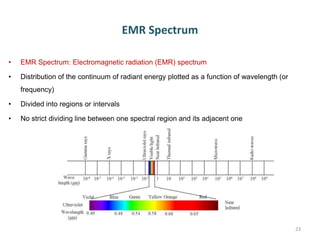
EMR Spectrum
• EMR Spectrum: Electromagnetic radiation (EMR) spectrum
• Distribution of the continuum of radiant energy plotted as a function of wavelength (or
frequency)
• Divided into regions or intervals
• No strict dividing line between one spectral region and its adjacent one
23
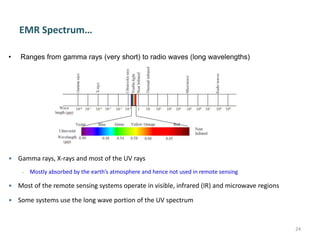
EMR Spectrum…
• Ranges from gamma rays (very short) to radio waves (long wavelengths)
24
 Gamma rays, X-rays and most of the UV rays
‒ Mostly absorbed by the earth’s atmosphere and hence not used in remote sensing
 Most of the remote sensing systems operate in visible, infrared (IR) and microwave regions
 Some systems use the long wave portion of the UV spectrum
EMR Spectrum…
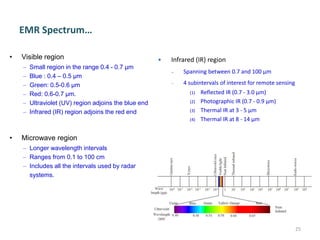
• Visible region
‒ Small region in the range 0.4 - 0.7 μm
‒ Blue : 0.4 – 0.5 μm
‒ Green: 0.5-0.6 μm
‒ Red: 0.6-0.7 μm.
‒ Ultraviolet (UV) region adjoins the blue end
‒ Infrared (IR) region adjoins the red end
• Microwave region
‒ Longer wavelength intervals
‒ Ranges from 0.1 to 100 cm
‒ Includes all the intervals used by radar
systems.
25
 Infrared (IR) region
‒ Spanning between 0.7 and 100 μm
‒ 4 subintervals of interest for remote sensing
(1) Reflected IR (0.7 - 3.0 μm)
(2) Photographic IR (0.7 - 0.9 μm)
(3) Thermal IR at 3 - 5 μm
(4) Thermal IR at 8 - 14 μm
EMR Spectrum…
26
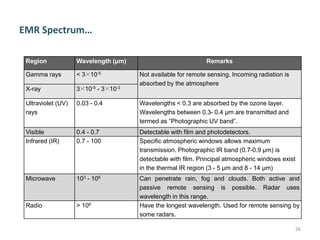
Region Wavelength (μm) Remarks
Gamma rays < 3×10⁻⁵ Not available for remote sensing. Incoming radiation is
absorbed by the atmosphere
X-ray 3×10⁻⁵ - 3×10⁻³
Ultraviolet (UV)
rays
0.03 - 0.4 Wavelengths < 0.3 are absorbed by the ozone layer.
Wavelengths between 0.3- 0.4 μm are transmitted and
termed as “Photographic UV band”.
Visible 0.4 - 0.7 Detectable with film and photodetectors.
Infrared (IR) 0.7 - 100 Specific atmospheric windows allows maximum
transmission. Photographic IR band (0.7-0.9 μm) is
detectable with film. Principal atmospheric windows exist
in the thermal IR region (3 - 5 μm and 8 - 14 μm)
Microwave 103 - 106 Can penetrate rain, fog and clouds. Both active and
passive remote sensing is possible. Radar uses
wavelength in this range.
Radio > 106 Have the longest wavelength. Used for remote sensing by
some radars.
Remote Sensing Systems
Different Parameters Of Sensors
27
Introduction
• In remote sensing resolution means the resolving power
 Capability to identify the presence of two objects
 Capability to identify the properties of the two objects
• An image that shows finer details is said to be of finer resolution
compared to the image that shows coarser details
28
Types of Resolution
• 4 types of resolutions are defined for the remote sensing systems
 Spatial resolution
 Spectral resolution
 Temporal resolution
 Radiometric resolution
29
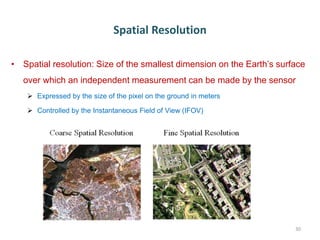
Spatial Resolution
• Spatial resolution: Size of the smallest dimension on the Earth’s surface
over which an independent measurement can be made by the sensor
 Expressed by the size of the pixel on the ground in meters
 Controlled by the Instantaneous Field of View (IFOV)
30
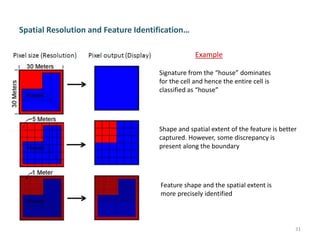
Spatial Resolution and Feature Identification…
31
Signature from the “house” dominates
for the cell and hence the entire cell is
classified as “house”
Shape and spatial extent of the feature is better
captured. However, some discrepancy is
present along the boundary
Feature shape and the spatial extent is
more precisely identified
Example
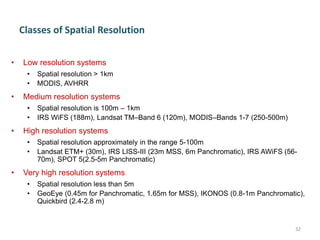
Classes of Spatial Resolution
• Low resolution systems
• Spatial resolution > 1km
• MODIS, AVHRR
• Medium resolution systems
• Spatial resolution is 100m – 1km
• IRS WiFS (188m), Landsat TM–Band 6 (120m), MODIS–Bands 1-7 (250-500m)
• High resolution systems
• Spatial resolution approximately in the range 5-100m
• Landsat ETM+ (30m), IRS LISS-III (23m MSS, 6m Panchromatic), IRS AWiFS (56-
70m), SPOT 5(2.5-5m Panchromatic)
• Very high resolution systems
• Spatial resolution less than 5m
• GeoEye (0.45m for Panchromatic, 1.65m for MSS), IKONOS (0.8-1m Panchromatic),
Quickbird (2.4-2.8 m)
32
Scale of an Image
• Scale : Ratio of distance on an image or map, to actual ground distance
• Maps or images with small "map-to-ground ratios" are referred to as small scale (e.g.
1:100,000), and those with larger ratios (e.g. 1:5,000) are called large scale.
• Example
What is the actual length of an object which is 1cm long in a map of scale
1:100,000?
Scale = 1:100,000
Object length in map = 1cm
Actual length on the ground = 1 cm x 100,000 = 100,000 cm = 1 km
33
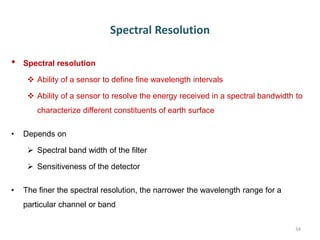
Spectral Resolution
• Spectral resolution
 Ability of a sensor to define fine wavelength intervals
 Ability of a sensor to resolve the energy received in a spectral bandwidth to
characterize different constituents of earth surface
• Depends on
 Spectral band width of the filter
 Sensitiveness of the detector
• The finer the spectral resolution, the narrower the wavelength range for a
particular channel or band
34
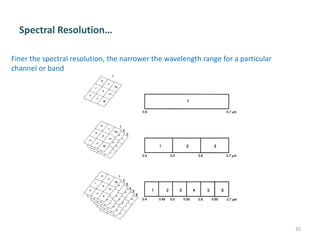
Spectral Resolution…
35
Finer the spectral resolution, the narrower the wavelength range for a particular
channel or band
Spectral Resolution…
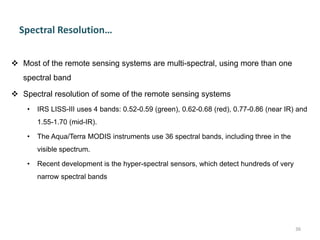
 Most of the remote sensing systems are multi-spectral, using more than one
spectral band
 Spectral resolution of some of the remote sensing systems
• IRS LISS-III uses 4 bands: 0.52-0.59 (green), 0.62-0.68 (red), 0.77-0.86 (near IR) and
1.55-1.70 (mid-IR).
• The Aqua/Terra MODIS instruments use 36 spectral bands, including three in the
visible spectrum.
• Recent development is the hyper-spectral sensors, which detect hundreds of very
narrow spectral bands
36
Spectral Resolution and Feature Identification
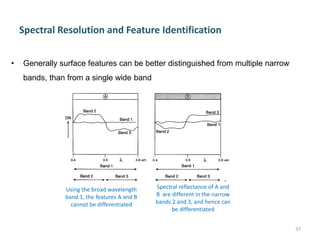
• Generally surface features can be better distinguished from multiple narrow
bands, than from a single wide band
37
Using the broad wavelength
band 1, the features A and B
cannot be differentiated
Spectral reflectance of A and
B are different in the narrow
bands 2 and 3, and hence can
be differentiated
Spectral Resolution in Remote Sensing
• Different features are identified from the image by comparing their responses
over different distinct spectral bands
• Broad classes, such as water and vegetation, can be easily separated using
very broad wavelength ranges like visible and near-infrared
• For more specific classes viz., vegetation type, rock classification etc, much finer
wavelength ranges and hence finer spectral resolution are required
38
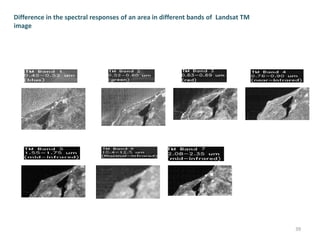
Difference in the spectral responses of an area in different bands of Landsat TM
image
39
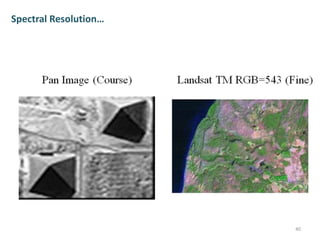
Spectral Resolution…
40

Remote sensing,Introduction and Basic Concepts

  • 1.
  • 2.
    Advantages of RemoteSensing • Major advantages of remote sensing are  Provides data for large areas  Provide data of very remote and inaccessible regions  Able to obtain imagery of any area over a continuous period of time – Possible to monitor any anthropogenic or natural changes in the landscape  Relatively inexpensive when compared to employing a team of surveyors  Easy and rapid collection of data  Rapid production of maps for interpretation 2
  • 3.
    Limitations of RemoteSensing • Some of the drawbacks of remote sensing are  The interpretation of imagery requires a certain skill level  Needs cross verification with ground (field) survey data  Data from multiple sources may create confusion  Objects can be misclassified or confused  Distortions may occur in an image due to the relative motion of sensor and source 3
  • 4.
    Energy Interactions inthe Atmosphere 4
  • 5.
    Objectives • Composition ofthe atmosphere • Interactions of the electromagnetic radiation with the atmospheric particles – Scattering 5
  • 6.
    Composition of theAtmosphere • Atmosphere : Gaseous envelop that surrounds the Earth’s surface  Much of the gases are concentrated within the lower 100km of the atmosphere  Only 3x10⁻⁵ percent of the gases are found above 100 km (Gibbson, 2000) 6 Composition of the Earth’s atmosphere (from Gibbson, 2000) Component Percentage Nitrogen (N2) 78.08 Oxygen (O2) 20.94 Argon 0.93 Carbon Dioxide (CO2) 0.0314 Ozone (O3) 0.00000004
  • 7.
    Composition of theAtmosphere…  Oxygen and Nitrogen - Present in the ratio 1:4 - Both together add to 99 percent of the total gaseous composition  Ozone - Present in very small quantities - Mostly concentrated in the atmosphere between 19 and 23km  The atmosphere also contains water vapor, methane, dust particles, pollen from vegetation, smoke particles etc. - Dust particles and the pollen form about 50% of the total particles - Size of these particles varies from approximately 0.01μm to 100μm  The gases and the particles present in the atmosphere cause scattering and absorption of the electromagnetic radiation passing through it 7
  • 8.
    Energy Interactions • Fromthe source to the sensor, the radiation passes through the atmosphere • Path length: The distance traveled by the radiation through the atmosphere 8 - Varies depending on the remote sensing techniques and sources - Space photography using solar energy • Path length = 2x Thickness of the earth’s atmosphere - Airborne thermal sensors using emitted energy from the objects on the earth • Path length = One way distance from the earth’s surface to the sensor
  • 9.
    Energy Interactions… • Theintensity and the spectral composition of the incident radiation are altered by the atmospheric effects • Atmospheric interaction depends on the - Properties of the radiation such as magnitude and wavelength - Atmospheric conditions - Path length • Interaction with the atmospheric particles - Scattering - Absorption 9
  • 10.
    Scattering -Rayleigh Scattering • Scatteringcaused by the atmospheric molecules and other tiny particles • Also known as selective scattering or molecular scattering • Dependent on the wavelength • Occurs when particles are much smaller than the wavelengths of the radiation  Particle size less than (1/10)th of the wavelength • Intensity of the scattered light is inversely proportional to the fourth power of wavelength  Shorter wavelengths are scattered more than longer wavelengths 10 http://home.comcast.net/~vinelandrobotics/
  • 11.
    Rayleigh Scattering ofthe Visible Part of the EM Energy • Scattering of the visible bands is caused mainly by the molecules of Oxygen and Nitrogen  Blue (shorter wavelength) is scattered more - Blue light is scattered around four times the red light - UV light is scattered about 16 times the red light - A "blue" sky is a manifestation of Rayleigh scatter  Orange or red colour during sunrise and sunset - Sun rays have to travel a longer path - Complete scattering (and absorption) of shorter wavelength radiations - Only the longer wavelength (orange and red) which are less scattered are visible  Other examples - The haze in imagery - Bluish-grey cast in a color image when taken from high altitude 11
  • 12.
    Scattering -Mie Scattering • Occurswhen the wavelengths of the energy is almost equal to the diameter of the atmospheric particles – Usually caused by the aerosol particles such as dust, smoke and pollen – Gas molecules are too small to cause Mie scattering of the radiation commonly used for remote sensing • Longer wavelengths also get scattered compared to Rayleigh scatter • Intensity of the scattered light varies approximately as the inverse of the wavelength 12 Source: http://hyperphysics.phy-astr.gsu.edu
  • 13.
    Scattering -Non-selective Scattering • Whenthe diameters of the atmospheric particles are much larger – Diameter is greater than10 times the wavelengths being sensed – Particles such as pollen, cloud droplets, ice crystals and raindrops can cause non-selective scattering of the visible light. • Non-selective scattering of visible light (of wavelength 0.4-0.7μ) – Generally caused by water droplets (5 to 100 μm diameter) – All visible and IR wavelengths get scattered equally – Gives white or grey color to the clouds Remote Sensing: M1L3 13
  • 14.
    Absorption • Absorption :Process in which the incident energy is retained by particles in the atmosphere • Energy is transformed into other forms • Unlike scattering, atmospheric absorption causes an effective loss of energy • Absorption depends on – Wavelength of the energy – Atmospheric composition – Arrangement of the gaseous molecules and their energy level • The absorbing medium will not only absorb a portion of the total energy, but will also reflect, refract or scatter the energy. The absorbed energy may also be transmitted back to the atmosphere. D. Nagesh Kumar, IISc Remote Sensing: M1L3 14
  • 15.
    Absorption… • The mostefficient absorbers of solar radiation are  Water vapour, carbon dioxide, and ozone • Gaseous components are selective absorbers of the electromagnetic radiation  Absorb electromagnetic energy in specific wavelength bands  Depends on the arrangement of the gaseous molecules and their energy levels Atmospheric window • The ranges of wavelength that are partially or wholly transmitted through the atmosphere • Remote sensing data acquisition is limited through these atmospheric windows D. Nagesh Kumar, IISc Remote Sensing: M1L3 15
  • 16.
    16 Atmospheric Window • Wavelengthsshorted than 0.1 μm – Absorbed by Nitrogen and other gaseous components • Wavelengths shorter than 0.3μm (X- rays, Gamma rays and part of ultraviolet rays) – Mostly absorbed by the ozone (O3) • Visible part of the spectrum – Little absorption occurs • Oxygen in the atmosphere causes absorption centered at 6.3μm. • Infrared (IR) radiation – Mainly absorbed by water vapour and carbon dioxide molecules • Far infrared region – Mostly absorbed by the atmosphere • Microwave region – Absorption is almost nil
  • 17.
    Absorption… • The mostcommon sources of energy are  Incident solar energy – Maximum energy in the visible region  Radiation from the Earth • Maximum energy in the thermal IR region • Two atmospheric windows – at 3 to 5μm and at 8 to 14μm • Radar & Passive microwave systems operate through a window in the region 1 mm-1 m 17 Major atmospheric windows used in remote sensing and their characteristics Atmospheric window Wavelength band (μm) Characteristics Upper ultraviolet, Visible and photographic IR 0.3-1 apprx. 95% transmission Reflected infrared 1.3, 1.6, 2.2 Three narrow bands Thermal infrared 3.0-5.0 8.0-14.0 Two broad bands Microwave >5000 Atmosphere is mostly transparent
  • 18.
  • 19.
    Objectives • What ismeant by – Electromagnetic energy – Electromagnetic radiation (EMR) spectrum • Source of radiation/energy in remote sensing 19
  • 20.
    Electromagnetic Energy • Electromagneticenergy: All energy moving in a harmonic sinusoidal wave pattern with a velocity equal to that of light – Harmonic pattern means waves occurring at frequent intervals of time. • Contains both electric and magnetic components which oscillate – Perpendicular to each other and – Perpendicular to the direction of energy propagation • It can be detected only through its interaction with matter. – Example: Light, heat etc. 20
  • 21.
    Electromagnetic Energy… Characteristics ofelectromagnetic (EM) energy – Wave theroy • Velocity (c) – EM waves travel at the speed of light (3×10⁸ m/s. ) • Wavelength (λ) – Distance from any point of one wave to the same position on the next wave – The wavelengths commonly used in remote sensing are very small – It is normally expressed in micrometers (1 μm =1×10⁻⁶ m) – In remote sensing EM waves are categorized in terms of their wavelength location in the EMR spectrum • Frequency (f) – Number of waves passing a fixed point per unit time. It is expressed in Hertz (Hz). 21 c = λ f
  • 22.
    Electromagnetic Energy… Characteristics ofelectromagnetic (EM) energy – Particle theory • Electromagnetic radiation is composed of discrete units • These discrete units are called Photons or Quanta • Photons are the basic units of EM energy 22
  • 23.
    EMR Spectrum • EMRSpectrum: Electromagnetic radiation (EMR) spectrum • Distribution of the continuum of radiant energy plotted as a function of wavelength (or frequency) • Divided into regions or intervals • No strict dividing line between one spectral region and its adjacent one 23
  • 24.
    EMR Spectrum… • Rangesfrom gamma rays (very short) to radio waves (long wavelengths) 24  Gamma rays, X-rays and most of the UV rays ‒ Mostly absorbed by the earth’s atmosphere and hence not used in remote sensing  Most of the remote sensing systems operate in visible, infrared (IR) and microwave regions  Some systems use the long wave portion of the UV spectrum
  • 25.
    EMR Spectrum… • Visibleregion ‒ Small region in the range 0.4 - 0.7 μm ‒ Blue : 0.4 – 0.5 μm ‒ Green: 0.5-0.6 μm ‒ Red: 0.6-0.7 μm. ‒ Ultraviolet (UV) region adjoins the blue end ‒ Infrared (IR) region adjoins the red end • Microwave region ‒ Longer wavelength intervals ‒ Ranges from 0.1 to 100 cm ‒ Includes all the intervals used by radar systems. 25  Infrared (IR) region ‒ Spanning between 0.7 and 100 μm ‒ 4 subintervals of interest for remote sensing (1) Reflected IR (0.7 - 3.0 μm) (2) Photographic IR (0.7 - 0.9 μm) (3) Thermal IR at 3 - 5 μm (4) Thermal IR at 8 - 14 μm
  • 26.
    EMR Spectrum… 26 Region Wavelength(μm) Remarks Gamma rays < 3×10⁻⁵ Not available for remote sensing. Incoming radiation is absorbed by the atmosphere X-ray 3×10⁻⁵ - 3×10⁻³ Ultraviolet (UV) rays 0.03 - 0.4 Wavelengths < 0.3 are absorbed by the ozone layer. Wavelengths between 0.3- 0.4 μm are transmitted and termed as “Photographic UV band”. Visible 0.4 - 0.7 Detectable with film and photodetectors. Infrared (IR) 0.7 - 100 Specific atmospheric windows allows maximum transmission. Photographic IR band (0.7-0.9 μm) is detectable with film. Principal atmospheric windows exist in the thermal IR region (3 - 5 μm and 8 - 14 μm) Microwave 103 - 106 Can penetrate rain, fog and clouds. Both active and passive remote sensing is possible. Radar uses wavelength in this range. Radio > 106 Have the longest wavelength. Used for remote sensing by some radars.
  • 27.
    Remote Sensing Systems DifferentParameters Of Sensors 27
  • 28.
    Introduction • In remotesensing resolution means the resolving power  Capability to identify the presence of two objects  Capability to identify the properties of the two objects • An image that shows finer details is said to be of finer resolution compared to the image that shows coarser details 28
  • 29.
    Types of Resolution •4 types of resolutions are defined for the remote sensing systems  Spatial resolution  Spectral resolution  Temporal resolution  Radiometric resolution 29
  • 30.
    Spatial Resolution • Spatialresolution: Size of the smallest dimension on the Earth’s surface over which an independent measurement can be made by the sensor  Expressed by the size of the pixel on the ground in meters  Controlled by the Instantaneous Field of View (IFOV) 30
  • 31.
    Spatial Resolution andFeature Identification… 31 Signature from the “house” dominates for the cell and hence the entire cell is classified as “house” Shape and spatial extent of the feature is better captured. However, some discrepancy is present along the boundary Feature shape and the spatial extent is more precisely identified Example
  • 32.
    Classes of SpatialResolution • Low resolution systems • Spatial resolution > 1km • MODIS, AVHRR • Medium resolution systems • Spatial resolution is 100m – 1km • IRS WiFS (188m), Landsat TM–Band 6 (120m), MODIS–Bands 1-7 (250-500m) • High resolution systems • Spatial resolution approximately in the range 5-100m • Landsat ETM+ (30m), IRS LISS-III (23m MSS, 6m Panchromatic), IRS AWiFS (56- 70m), SPOT 5(2.5-5m Panchromatic) • Very high resolution systems • Spatial resolution less than 5m • GeoEye (0.45m for Panchromatic, 1.65m for MSS), IKONOS (0.8-1m Panchromatic), Quickbird (2.4-2.8 m) 32
  • 33.
    Scale of anImage • Scale : Ratio of distance on an image or map, to actual ground distance • Maps or images with small "map-to-ground ratios" are referred to as small scale (e.g. 1:100,000), and those with larger ratios (e.g. 1:5,000) are called large scale. • Example What is the actual length of an object which is 1cm long in a map of scale 1:100,000? Scale = 1:100,000 Object length in map = 1cm Actual length on the ground = 1 cm x 100,000 = 100,000 cm = 1 km 33
  • 34.
    Spectral Resolution • Spectralresolution  Ability of a sensor to define fine wavelength intervals  Ability of a sensor to resolve the energy received in a spectral bandwidth to characterize different constituents of earth surface • Depends on  Spectral band width of the filter  Sensitiveness of the detector • The finer the spectral resolution, the narrower the wavelength range for a particular channel or band 34
  • 35.
    Spectral Resolution… 35 Finer thespectral resolution, the narrower the wavelength range for a particular channel or band
  • 36.
    Spectral Resolution…  Mostof the remote sensing systems are multi-spectral, using more than one spectral band  Spectral resolution of some of the remote sensing systems • IRS LISS-III uses 4 bands: 0.52-0.59 (green), 0.62-0.68 (red), 0.77-0.86 (near IR) and 1.55-1.70 (mid-IR). • The Aqua/Terra MODIS instruments use 36 spectral bands, including three in the visible spectrum. • Recent development is the hyper-spectral sensors, which detect hundreds of very narrow spectral bands 36
  • 37.
    Spectral Resolution andFeature Identification • Generally surface features can be better distinguished from multiple narrow bands, than from a single wide band 37 Using the broad wavelength band 1, the features A and B cannot be differentiated Spectral reflectance of A and B are different in the narrow bands 2 and 3, and hence can be differentiated
  • 38.
    Spectral Resolution inRemote Sensing • Different features are identified from the image by comparing their responses over different distinct spectral bands • Broad classes, such as water and vegetation, can be easily separated using very broad wavelength ranges like visible and near-infrared • For more specific classes viz., vegetation type, rock classification etc, much finer wavelength ranges and hence finer spectral resolution are required 38
  • 39.
    Difference in thespectral responses of an area in different bands of Landsat TM image 39
  • 40.