Interaction between
Electromagnetic Radiation and
Matter
By:
Abdullah Khan
Center For Integrated Mountain Research Punjab
University
Electromagnetism
Electromagnetic Radiation
EMR__ Foundation Of Remote Sensing
EMR__ Interaction with Atmosphere
Atmospheric Windows
EMR__ Interaction with Earth Surface Features
Types of Reflection
Spectral Reflectance Properties
Contents
 It is the science of charge and of the forces and fields
associated with charge. Electricity and magnetism are
two aspects of electromagnetism.
 It is the phenomena associated with electric and
magnetic fields and their interactions with each other
and with electric charges and currents.
Electromagnetism
is radiated by atomic particles at the source (the Sun)
propagates through the vacuum of space at the speed
of light
interacts with the Earth's atmosphere
interacts with the Earth's surface
interacts with the Earth's atmosphere once again, and
finally reaches the remote sensors where it interacts
with various optical systems and detectors
Electromagnetic Radiation
 The foundation of remote sensing technology is based on the
measurement and interpretation of the patterns of EMR.
 necessary for remote sensing: energy source to illuminate the target
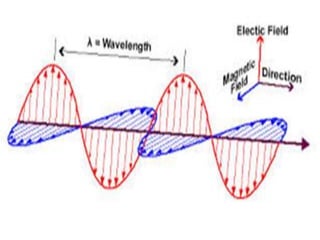
 consists of perpendicular fields travelling at the speed of light (c)
electrical field and magnetic field.
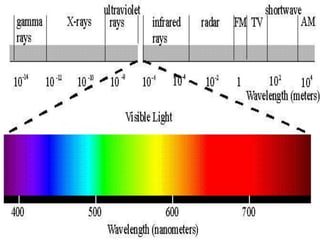
 The whole range of EMR is called spectrum.
 EMR is characterized by wavelength and frequency. Different
wavelengths or frequencies indicates different portion of EMR.
 EMR interact with atmosphere. The atmosphere causes significant
absorption and scattering of the wavelength.
 EMR also interact with the surface materials in the form of
absorption, reflection, and transmission.
EMR__Foundation of Remote Sensing Technology
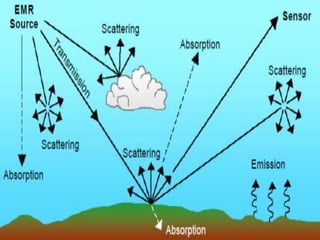
 As the energy travels through the Earth’s atmosphere it is either:-
a) Scattered
b) Absorbed
 Scattering: causes EM radiation to be redirected from its original
path.
Rayleigh Scattering
Mie Scattering
Non-selective Scattering
 Absorption: molecules in the atmosphere absorb energy.
EMR__Interaction with the Atmosphere
Rayleigh Scattering
o interaction of particles smaller in diameter than the
wavelengths of the radiation.
o preferential scattering of shorter wavelengths (e.g.
ultraviolet and blue).
o caused by oxygen and nitrogen molecules in the upper
atmosphere.
EMR__ Interaction with the Atmosphere
Mie Scattering
 interaction of particles about the same diameter as the
wavelengths of the radiation.
 tends to affect longer wavelengths than Rayleigh
scatter.
 caused by water vapor and dust particles in the lower
atmosphere.
EMR__ Interaction with the Atmosphere
Non-Selective Scattering
 interaction of particles of larger diameter than the
wavelengths of the radiation
 scatters visible wavelengths equally
 caused by water droplets (in fog and clouds)
EMR__ Interaction with the Atmosphere
 Ozone:-absorbs ultraviolet radiation from the sun.
 Carbon dioxide:-absorbs in the far infrared portion of
the spectrum.
 Water vapor:-absorbs long wave infrared and shortwave
microwave radiations.
 atmospheric absorption has maximum affect on shorter
wavelengths (gamma, x-ray, UV)
 atmospheric absorption has little to no affect on
microwave radiation (longer wavelengths).
Atmospheric absorption
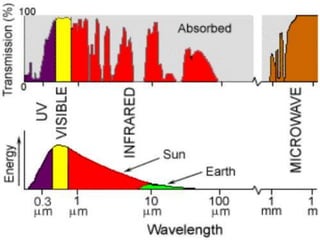
Atmospheric Windows
 those areas of the spectrum which are not severely
influenced by atmospheric absorption and thus, are
useful to remote sensors, are called atmospheric
windows.
 can pass through the atmosphere.
Atmospheric Blinds
 wavelengths which are blocked by the atmosphere.
EMR__Interaction with the Atmosphere
 three forms of interaction take place where energy is
incident upon the surface:
i. Absorption
ii. Transmission
iii. Reflection
 In remote sensing, are most interested in measuring the
radiation reflected from targets.
 The reflection of the energy depends on the degree of
surface roughness of the target relative to the
wavelength of the energy incident on it.
EMR__ Interaction with Earth’s Surface
Spectral Reflectance:
 the proportion of incident energy (I) of a given
wavelength interval that is reflected (R) by a particular
feature is referred to as the spectral reflectance (or
albedo) of that object.
Spectral Signature:
 the range of spectral reflectance of a particular feature at
different wavelengths is called the spectral signature (or
spectral reflectance curve) of the object.
EMR__Interaction with Earth Surface Features
 We refer to two types of reflection, which represent the two extreme
ends of the way in which energy is reflected from a target: specular
reflection and diffuse reflection.
 Whether a particular target reflects specularly or diffusely, or
somewhere in between, depends on the surface roughness of the
feature in comparison to the wavelength of the incoming radiation.
 If the wavelengths are much smaller than the surface variations or
the particle sizes that make up the surface, diffuse reflection will
dominate.
 For example, fine-grained sand would appear fairly smooth to long
wavelength microwaves but would appear quite rough to the visible
wavelengths.
Types of Reflection
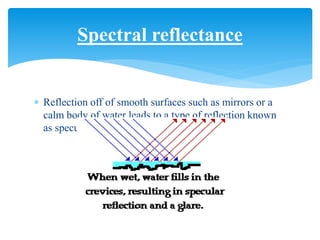
 Reflection off of smooth surfaces such as mirrors or a
calm body of water leads to a type of reflection known
as specular reflection.
Spectral reflectance
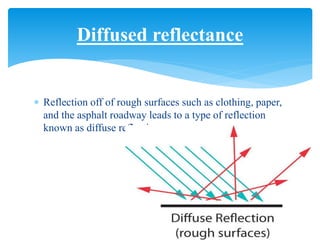
 Reflection off of rough surfaces such as clothing, paper,
and the asphalt roadway leads to a type of reflection
known as diffuse reflection.
Diffused reflectance
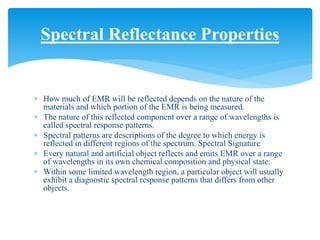
 How much of EMR will be reflected depends on the nature of the
materials and which portion of the EMR is being measured.
 The nature of this reflected component over a range of wavelengths is
called spectral response patterns.
 Spectral patterns are descriptions of the degree to which energy is
reflected in different regions of the spectrum. Spectral Signature
 Every natural and artificial object reflects and emits EMR over a range
of wavelengths in its own chemical composition and physical state.
 Within some limited wavelength region, a particular object will usually
exhibit a diagnostic spectral response patterns that differs from other
objects.
Spectral Reflectance Properties
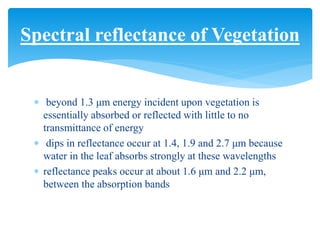
 beyond 1.3 μm energy incident upon vegetation is
essentially absorbed or reflected with little to no
transmittance of energy
 dips in reflectance occur at 1.4, 1.9 and 2.7 μm because
water in the leaf absorbs strongly at these wavelengths
 reflectance peaks occur at about 1.6 μm and 2.2 μm,
between the absorption bands
Spectral reflectance of Vegetation
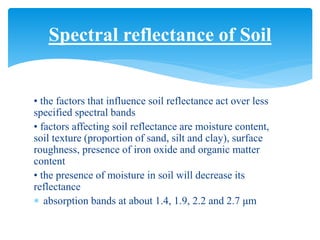
• the factors that influence soil reflectance act over less
specified spectral bands
• factors affecting soil reflectance are moisture content,
soil texture (proportion of sand, silt and clay), surface
roughness, presence of iron oxide and organic matter
content
• the presence of moisture in soil will decrease its
reflectance
 absorption bands at about 1.4, 1.9, 2.2 and 2.7 μm
Spectral reflectance of Soil
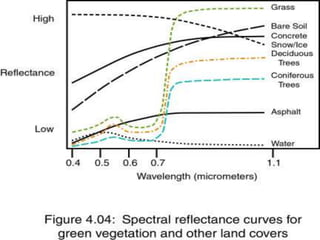
 Water absorbs radiation at near-IR wavelengths and
beyond (strong absorption bands at about 1.4, 1.9 and
2.7 μm)
 Clear water absorbs relatively little energy with
wavelengths < 0.6 μm, resulting in high transmittance in
the blue-green portion of the spectrum •
 • Increases in chlorophyll concentration tend to decrease
reflectance in blue wavelengths and increase it in green
wavelengths.
Spectral reflectance of Water
 www.wikipedia.com
 support.esri.com
 www.oceanoptics.com
 www.colorado.edu
 oregonstate.edu
 www.ntd-ed.org
 resources.yesican-science
References

Interaction between electromagnetic radiation and matter

  • 1.
    Interaction between Electromagnetic Radiationand Matter By: Abdullah Khan Center For Integrated Mountain Research Punjab University
  • 2.
    Electromagnetism Electromagnetic Radiation EMR__ FoundationOf Remote Sensing EMR__ Interaction with Atmosphere Atmospheric Windows EMR__ Interaction with Earth Surface Features Types of Reflection Spectral Reflectance Properties Contents
  • 3.
     It isthe science of charge and of the forces and fields associated with charge. Electricity and magnetism are two aspects of electromagnetism.  It is the phenomena associated with electric and magnetic fields and their interactions with each other and with electric charges and currents. Electromagnetism
  • 4.
    is radiated byatomic particles at the source (the Sun) propagates through the vacuum of space at the speed of light interacts with the Earth's atmosphere interacts with the Earth's surface interacts with the Earth's atmosphere once again, and finally reaches the remote sensors where it interacts with various optical systems and detectors Electromagnetic Radiation
  • 6.
     The foundationof remote sensing technology is based on the measurement and interpretation of the patterns of EMR.  necessary for remote sensing: energy source to illuminate the target  consists of perpendicular fields travelling at the speed of light (c) electrical field and magnetic field.  The whole range of EMR is called spectrum.  EMR is characterized by wavelength and frequency. Different wavelengths or frequencies indicates different portion of EMR.  EMR interact with atmosphere. The atmosphere causes significant absorption and scattering of the wavelength.  EMR also interact with the surface materials in the form of absorption, reflection, and transmission. EMR__Foundation of Remote Sensing Technology
  • 8.
     As theenergy travels through the Earth’s atmosphere it is either:- a) Scattered b) Absorbed  Scattering: causes EM radiation to be redirected from its original path. Rayleigh Scattering Mie Scattering Non-selective Scattering  Absorption: molecules in the atmosphere absorb energy. EMR__Interaction with the Atmosphere
  • 10.
    Rayleigh Scattering o interactionof particles smaller in diameter than the wavelengths of the radiation. o preferential scattering of shorter wavelengths (e.g. ultraviolet and blue). o caused by oxygen and nitrogen molecules in the upper atmosphere. EMR__ Interaction with the Atmosphere
  • 11.
    Mie Scattering  interactionof particles about the same diameter as the wavelengths of the radiation.  tends to affect longer wavelengths than Rayleigh scatter.  caused by water vapor and dust particles in the lower atmosphere. EMR__ Interaction with the Atmosphere
  • 12.
    Non-Selective Scattering  interactionof particles of larger diameter than the wavelengths of the radiation  scatters visible wavelengths equally  caused by water droplets (in fog and clouds) EMR__ Interaction with the Atmosphere
  • 13.
     Ozone:-absorbs ultravioletradiation from the sun.  Carbon dioxide:-absorbs in the far infrared portion of the spectrum.  Water vapor:-absorbs long wave infrared and shortwave microwave radiations.  atmospheric absorption has maximum affect on shorter wavelengths (gamma, x-ray, UV)  atmospheric absorption has little to no affect on microwave radiation (longer wavelengths). Atmospheric absorption
  • 14.
    Atmospheric Windows  thoseareas of the spectrum which are not severely influenced by atmospheric absorption and thus, are useful to remote sensors, are called atmospheric windows.  can pass through the atmosphere. Atmospheric Blinds  wavelengths which are blocked by the atmosphere. EMR__Interaction with the Atmosphere
  • 16.
     three formsof interaction take place where energy is incident upon the surface: i. Absorption ii. Transmission iii. Reflection  In remote sensing, are most interested in measuring the radiation reflected from targets.  The reflection of the energy depends on the degree of surface roughness of the target relative to the wavelength of the energy incident on it. EMR__ Interaction with Earth’s Surface
  • 17.
    Spectral Reflectance:  theproportion of incident energy (I) of a given wavelength interval that is reflected (R) by a particular feature is referred to as the spectral reflectance (or albedo) of that object. Spectral Signature:  the range of spectral reflectance of a particular feature at different wavelengths is called the spectral signature (or spectral reflectance curve) of the object. EMR__Interaction with Earth Surface Features
  • 18.
     We referto two types of reflection, which represent the two extreme ends of the way in which energy is reflected from a target: specular reflection and diffuse reflection.  Whether a particular target reflects specularly or diffusely, or somewhere in between, depends on the surface roughness of the feature in comparison to the wavelength of the incoming radiation.  If the wavelengths are much smaller than the surface variations or the particle sizes that make up the surface, diffuse reflection will dominate.  For example, fine-grained sand would appear fairly smooth to long wavelength microwaves but would appear quite rough to the visible wavelengths. Types of Reflection
  • 19.
     Reflection offof smooth surfaces such as mirrors or a calm body of water leads to a type of reflection known as specular reflection. Spectral reflectance
  • 20.
     Reflection offof rough surfaces such as clothing, paper, and the asphalt roadway leads to a type of reflection known as diffuse reflection. Diffused reflectance
  • 21.
     How muchof EMR will be reflected depends on the nature of the materials and which portion of the EMR is being measured.  The nature of this reflected component over a range of wavelengths is called spectral response patterns.  Spectral patterns are descriptions of the degree to which energy is reflected in different regions of the spectrum. Spectral Signature  Every natural and artificial object reflects and emits EMR over a range of wavelengths in its own chemical composition and physical state.  Within some limited wavelength region, a particular object will usually exhibit a diagnostic spectral response patterns that differs from other objects. Spectral Reflectance Properties
  • 22.
     beyond 1.3μm energy incident upon vegetation is essentially absorbed or reflected with little to no transmittance of energy  dips in reflectance occur at 1.4, 1.9 and 2.7 μm because water in the leaf absorbs strongly at these wavelengths  reflectance peaks occur at about 1.6 μm and 2.2 μm, between the absorption bands Spectral reflectance of Vegetation
  • 23.
    • the factorsthat influence soil reflectance act over less specified spectral bands • factors affecting soil reflectance are moisture content, soil texture (proportion of sand, silt and clay), surface roughness, presence of iron oxide and organic matter content • the presence of moisture in soil will decrease its reflectance  absorption bands at about 1.4, 1.9, 2.2 and 2.7 μm Spectral reflectance of Soil
  • 24.
     Water absorbsradiation at near-IR wavelengths and beyond (strong absorption bands at about 1.4, 1.9 and 2.7 μm)  Clear water absorbs relatively little energy with wavelengths < 0.6 μm, resulting in high transmittance in the blue-green portion of the spectrum •  • Increases in chlorophyll concentration tend to decrease reflectance in blue wavelengths and increase it in green wavelengths. Spectral reflectance of Water
  • 26.
     www.wikipedia.com  support.esri.com www.oceanoptics.com  www.colorado.edu  oregonstate.edu  www.ntd-ed.org  resources.yesican-science References