ELECTROMAGNETIC
SPECTRUM
Electromagnetic Radiation
The first requirement for remote sensing is to have an energy
source to illuminate the target (unless the sensed energy is
being emitted by the target). This energy is in the form of
electromagnetic radiation.
All electromagnetic radiation has fundamental
properties and behaves in predictable ways
according to the basics of wave theory.
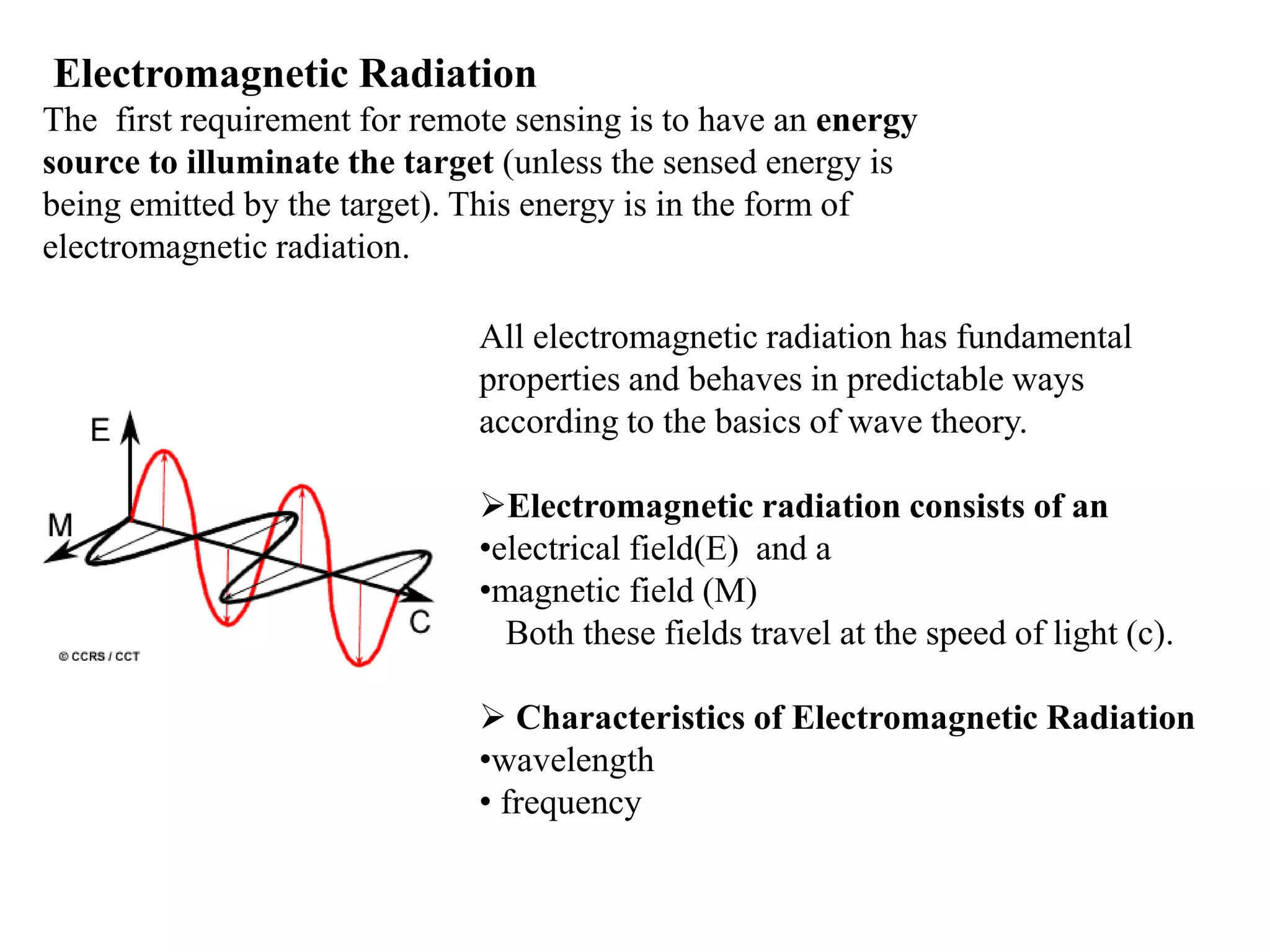
Electromagnetic radiation consists of an
•electrical field(E) and a
•magnetic field (M)
Both these fields travel at the speed of light (c).
 Characteristics of Electromagnetic Radiation
•wavelength
• frequency
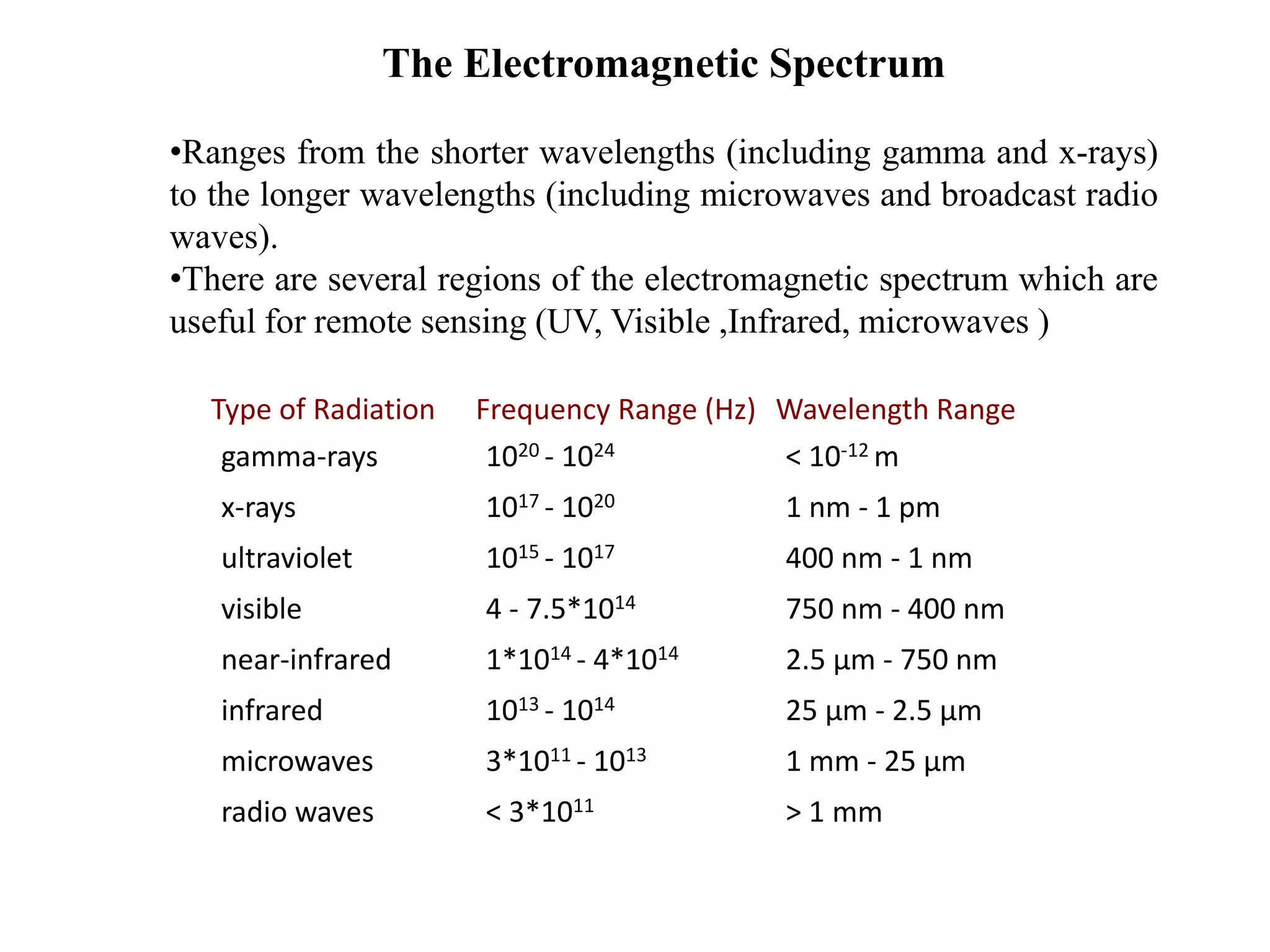
Type of Radiation Frequency Range (Hz) Wavelength Range
gamma-rays 1020 - 1024 < 10-12 m
x-rays 1017 - 1020 1 nm - 1 pm
ultraviolet 1015 - 1017 400 nm - 1 nm
visible 4 - 7.5*1014 750 nm - 400 nm
near-infrared 1*1014 - 4*1014 2.5 μm - 750 nm
infrared 1013 - 1014 25 μm - 2.5 μm
microwaves 3*1011 - 1013 1 mm - 25 μm
radio waves < 3*1011 > 1 mm
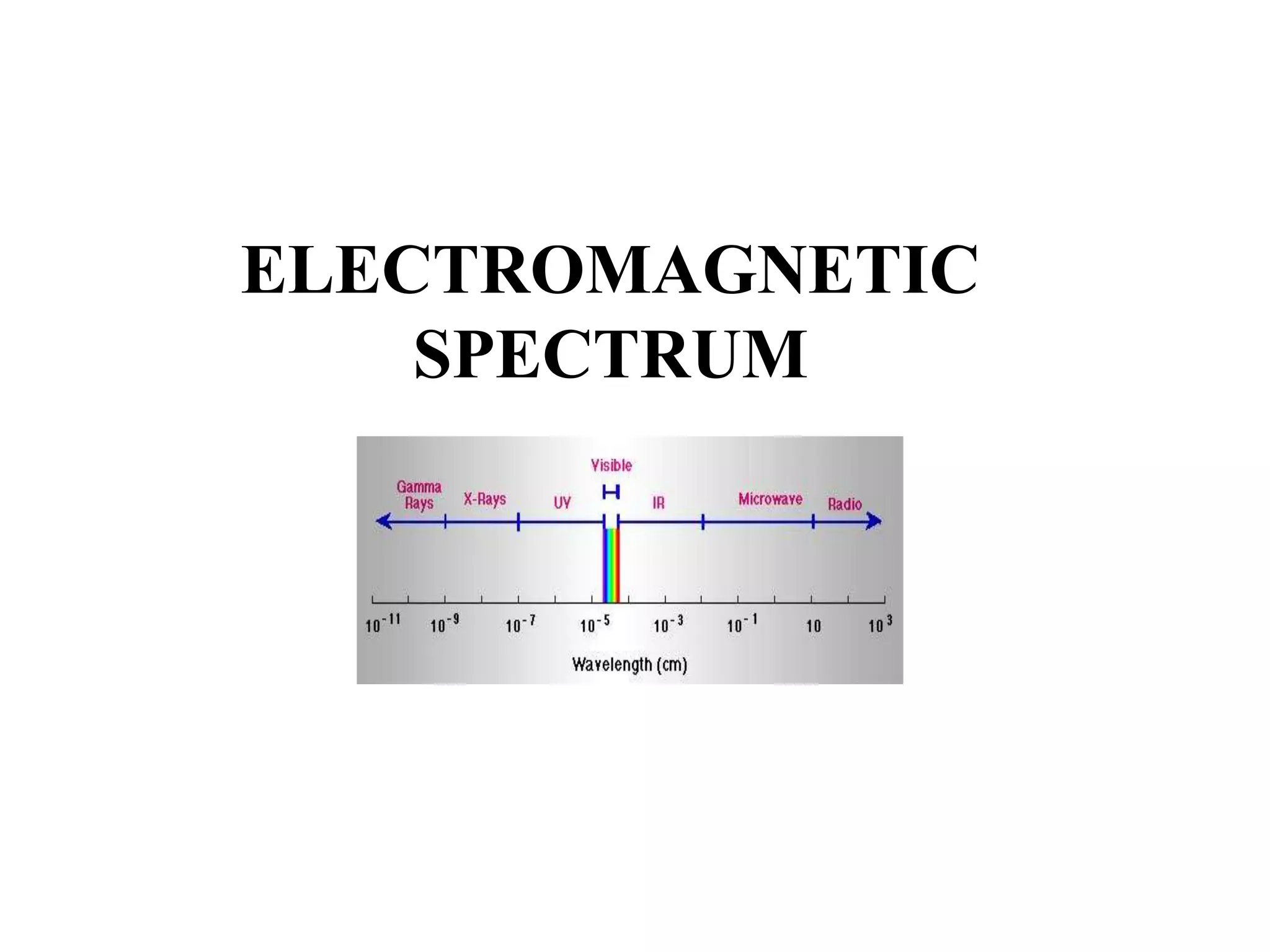
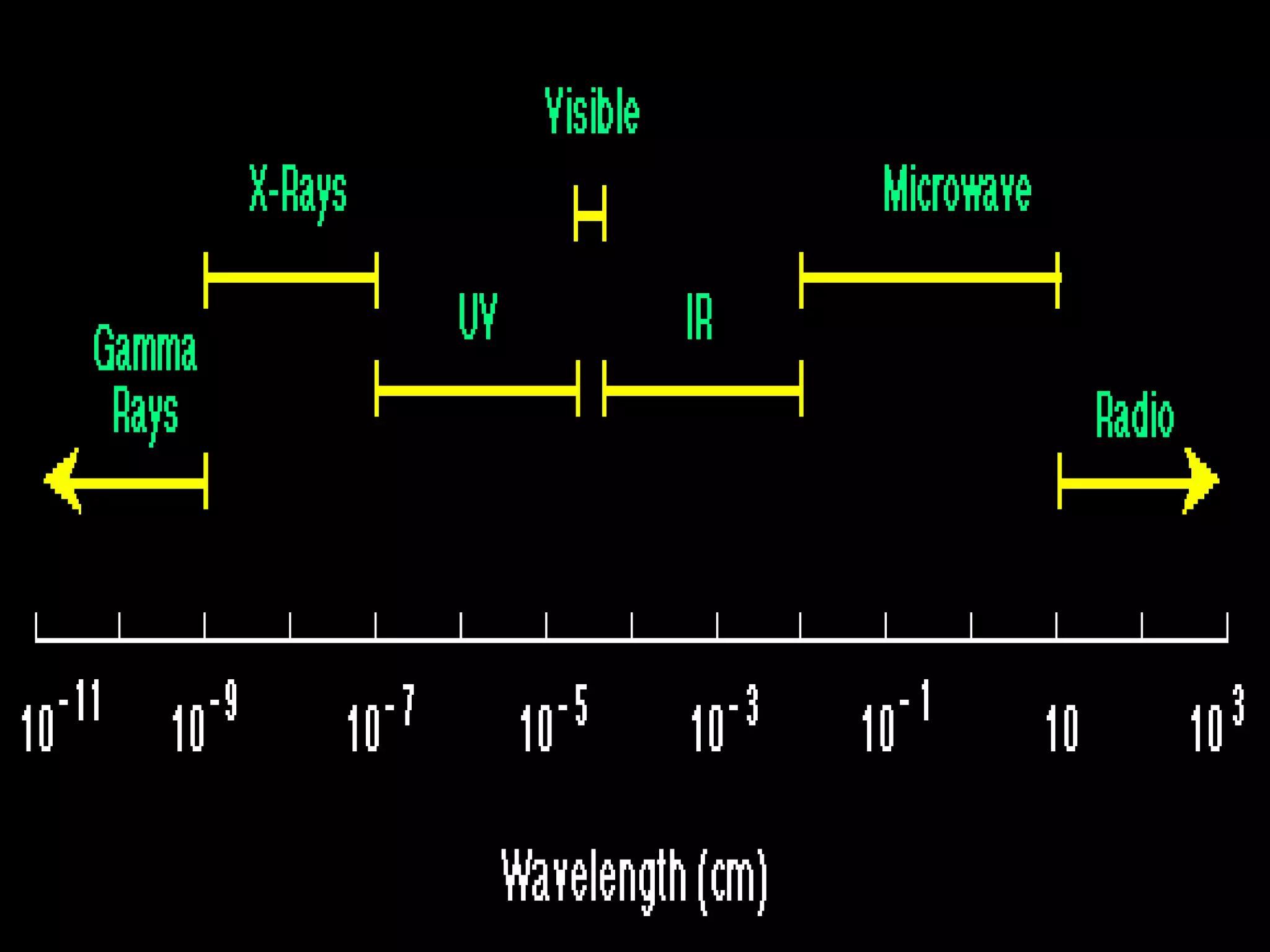
The Electromagnetic Spectrum
•Ranges from the shorter wavelengths (including gamma and x-rays)
to the longer wavelengths (including microwaves and broadcast radio
waves).
•There are several regions of the electromagnetic spectrum which are
useful for remote sensing (UV, Visible ,Infrared, microwaves )
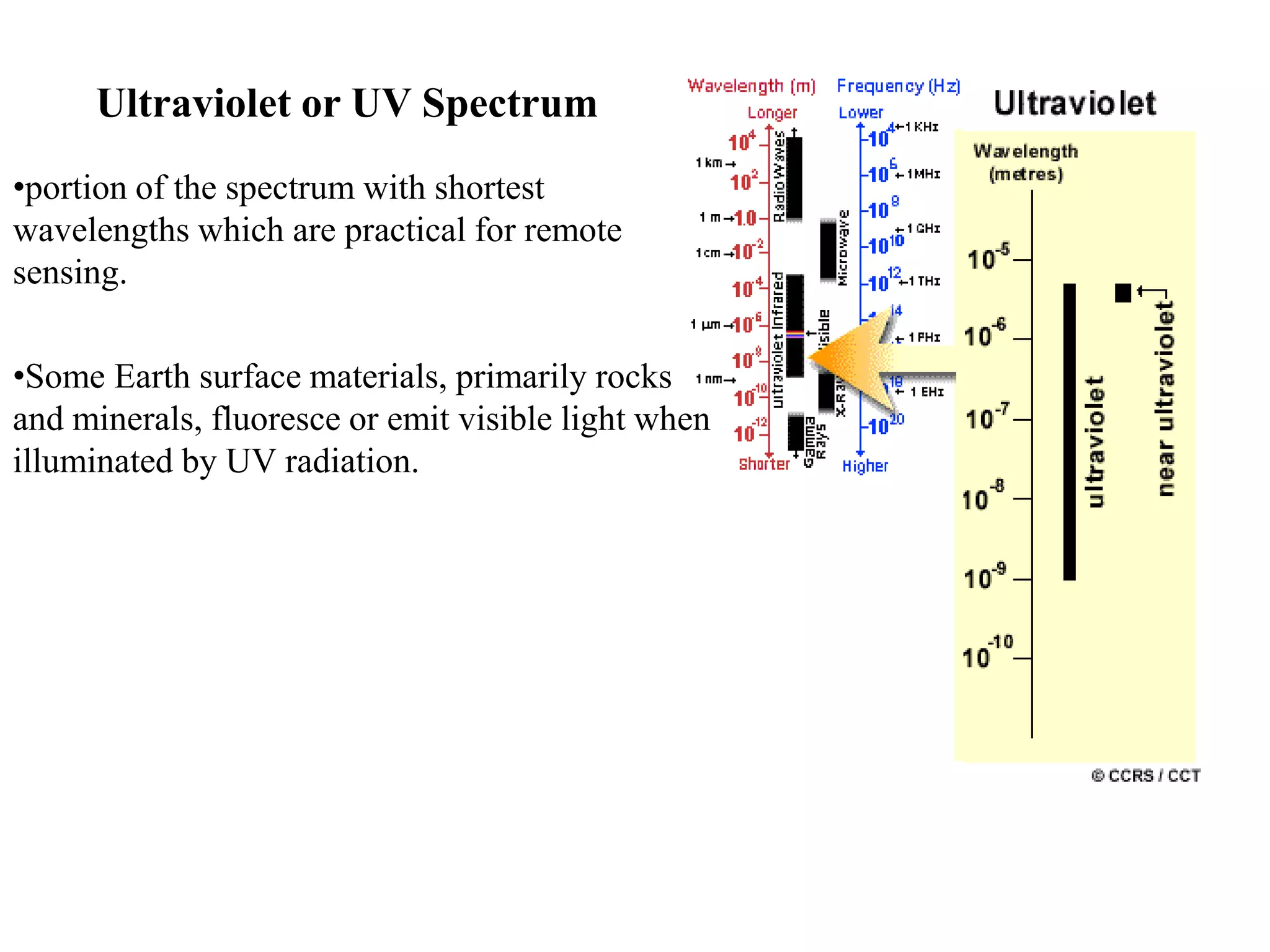
Ultraviolet or UV Spectrum
•portion of the spectrum with shortest
wavelengths which are practical for remote
sensing.
•Some Earth surface materials, primarily rocks
and minerals, fluoresce or emit visible light when
illuminated by UV radiation.
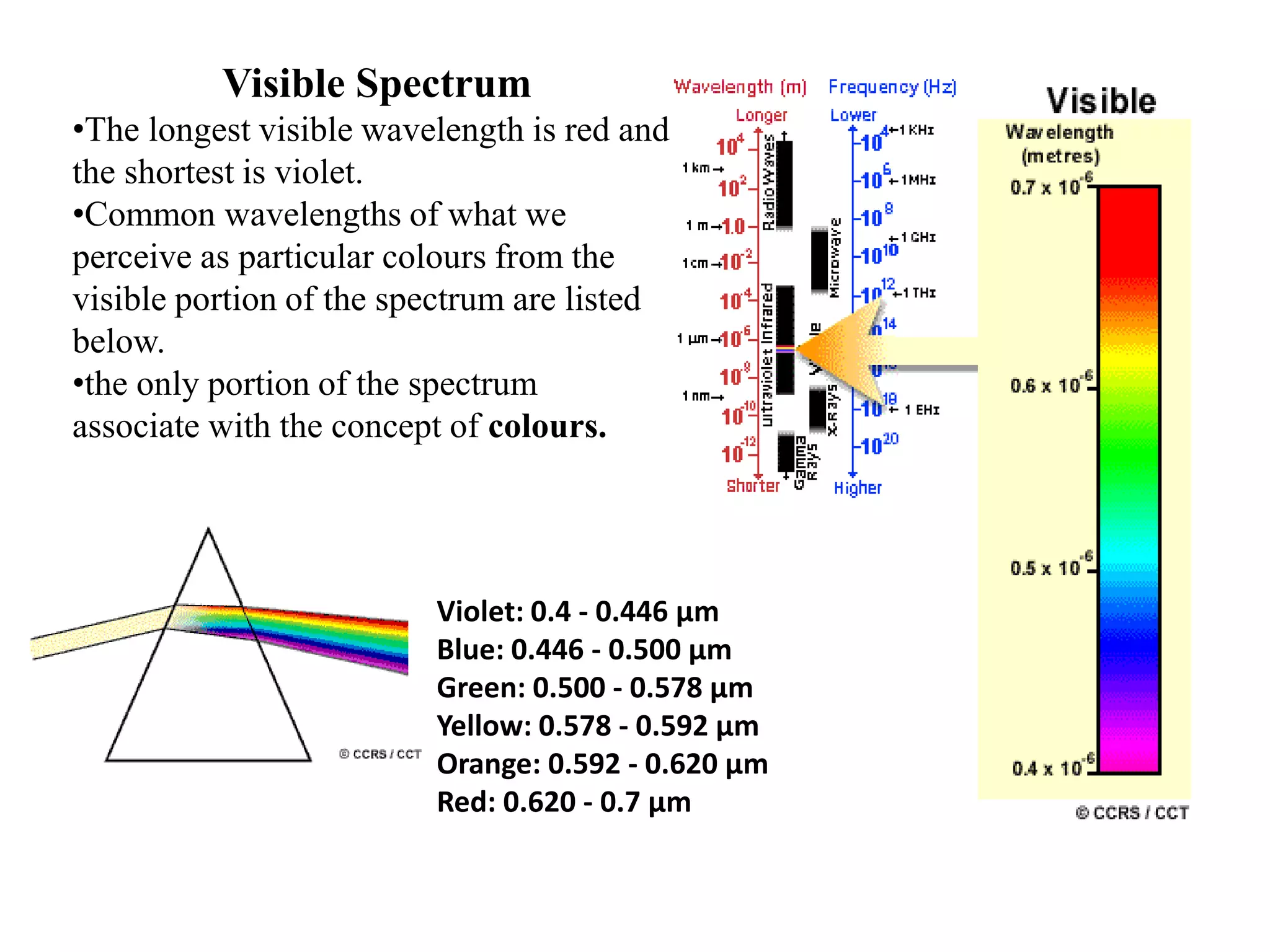
Violet: 0.4 - 0.446 μm
Blue: 0.446 - 0.500 μm
Green: 0.500 - 0.578 μm
Yellow: 0.578 - 0.592 μm
Orange: 0.592 - 0.620 μm
Red: 0.620 - 0.7 μm
Visible Spectrum
•The longest visible wavelength is red and
the shortest is violet.
•Common wavelengths of what we
perceive as particular colours from the
visible portion of the spectrum are listed
below.
•the only portion of the spectrum
associate with the concept of colours.
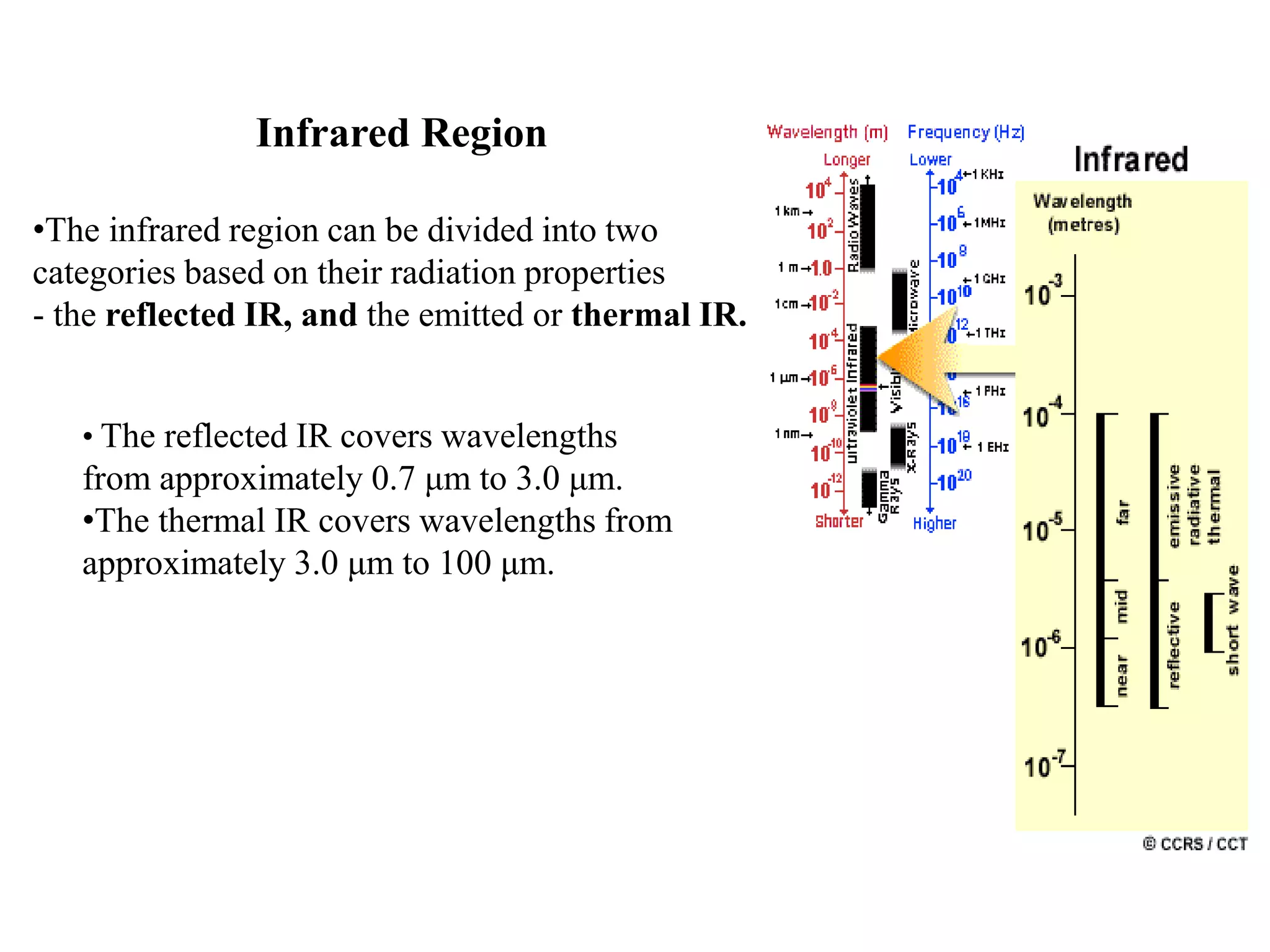
Infrared Region
•The infrared region can be divided into two
categories based on their radiation properties
- the reflected IR, and the emitted or thermal IR.
• The reflected IR covers wavelengths
from approximately 0.7 μm to 3.0 μm.
•The thermal IR covers wavelengths from
approximately 3.0 μm to 100 μm.
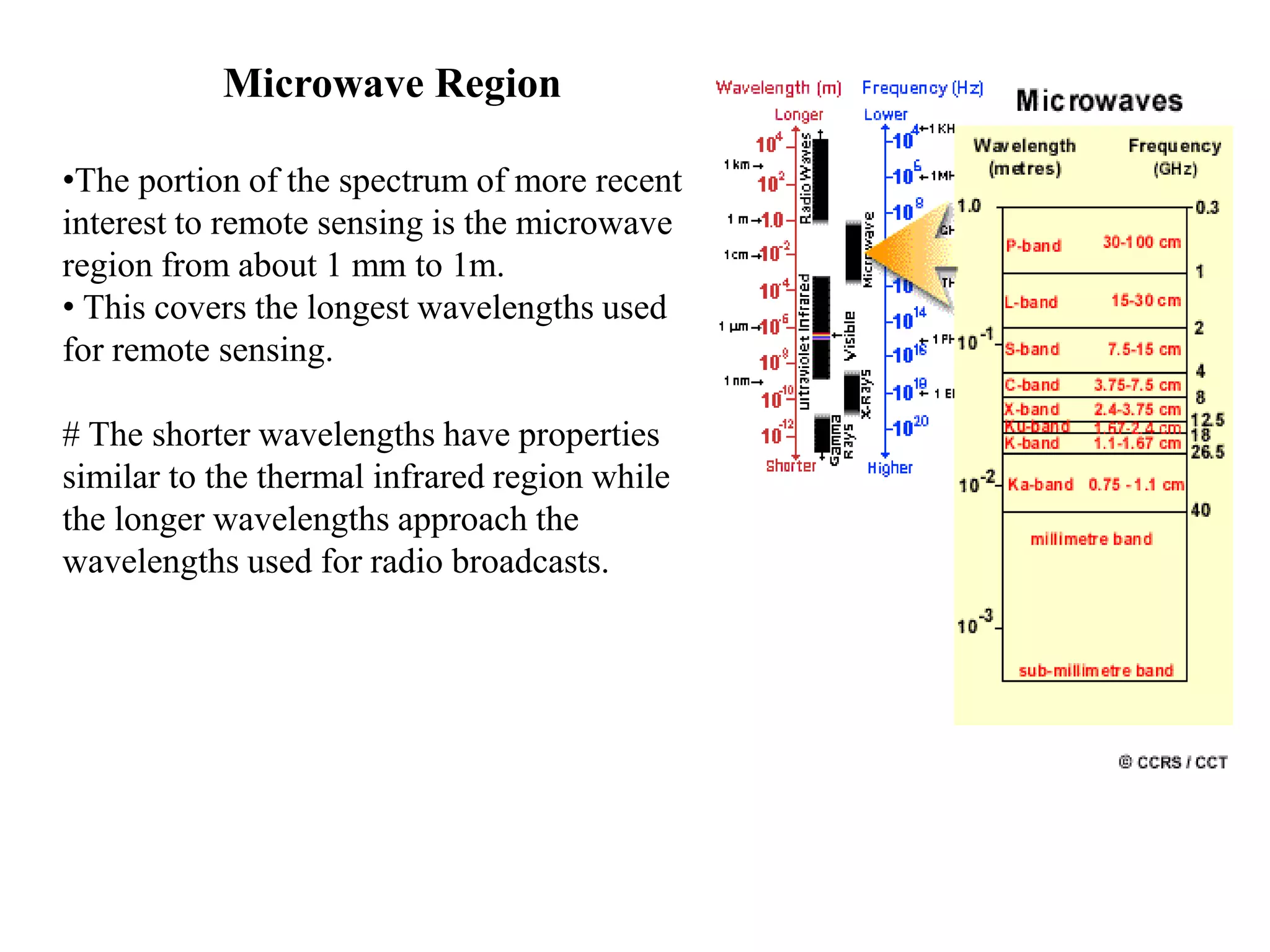
Microwave Region
•The portion of the spectrum of more recent
interest to remote sensing is the microwave
region from about 1 mm to 1m.
• This covers the longest wavelengths used
for remote sensing.
# The shorter wavelengths have properties
similar to the thermal infrared region while
the longer wavelengths approach the
wavelengths used for radio broadcasts.
Interaction of EM radiation
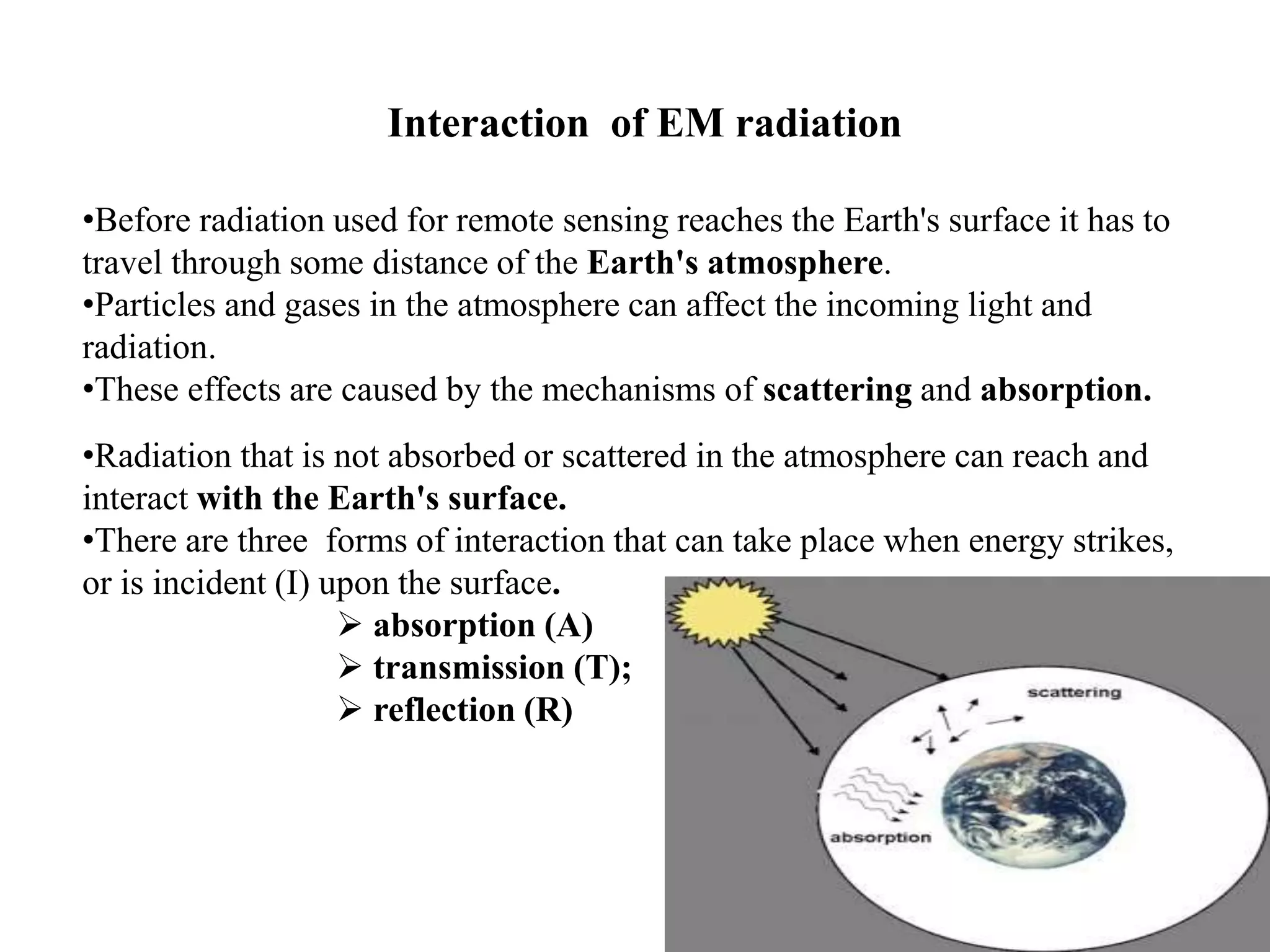
•Before radiation used for remote sensing reaches the Earth's surface it has to
travel through some distance of the Earth's atmosphere.
•Particles and gases in the atmosphere can affect the incoming light and
radiation.
•These effects are caused by the mechanisms of scattering and absorption.
•Radiation that is not absorbed or scattered in the atmosphere can reach and
interact with the Earth's surface.
•There are three forms of interaction that can take place when energy strikes,
or is incident (I) upon the surface.
 absorption (A)
 transmission (T);
 reflection (R)
Interaction with atmosphere
Scattering
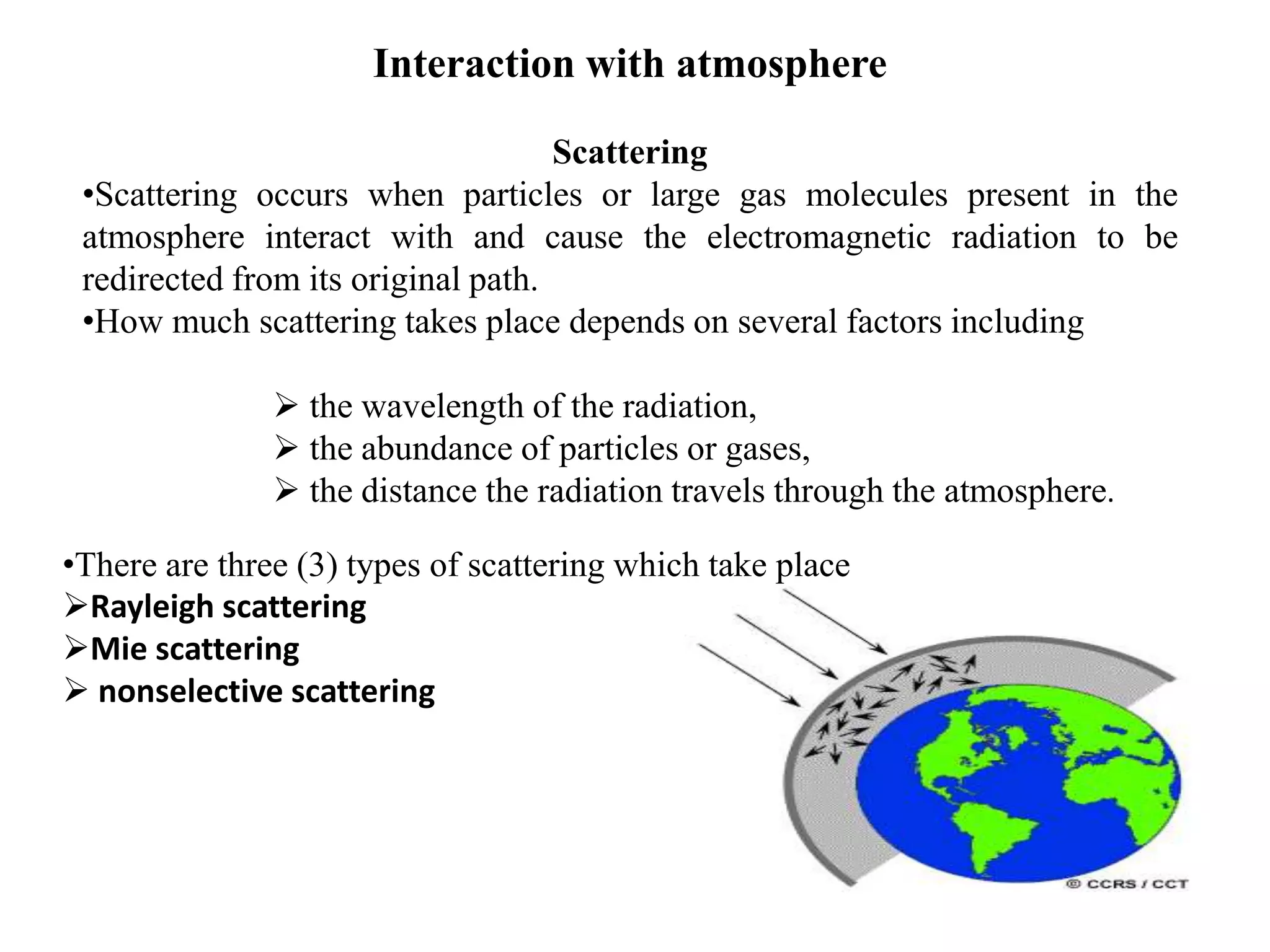
•Scattering occurs when particles or large gas molecules present in the
atmosphere interact with and cause the electromagnetic radiation to be
redirected from its original path.
•How much scattering takes place depends on several factors including
 the wavelength of the radiation,
 the abundance of particles or gases,
 the distance the radiation travels through the atmosphere.
•There are three (3) types of scattering which take place
Rayleigh scattering
Mie scattering
 nonselective scattering
Rayleigh scattering
• Occurs when particles are very small compared to the wavelength of the
radiation.
• Causes shorter wavelengths of energy to be scattered much more than
longer wavelengths.
• Rayleigh scattering is the dominant scattering mechanism in the upper
atmosphere.
• The fact that the sky appears "blue" during the day is because of this
phenomenon.
Mie scattering
•Occurs when the particles are just about the same size as the wavelength of the
radiation.
•Dust, pollen, smoke and water vapour are common causes of Mie scattering
• Mie scattering occurs mostly in the lower portions of the atmosphere
Nonselective scattering.
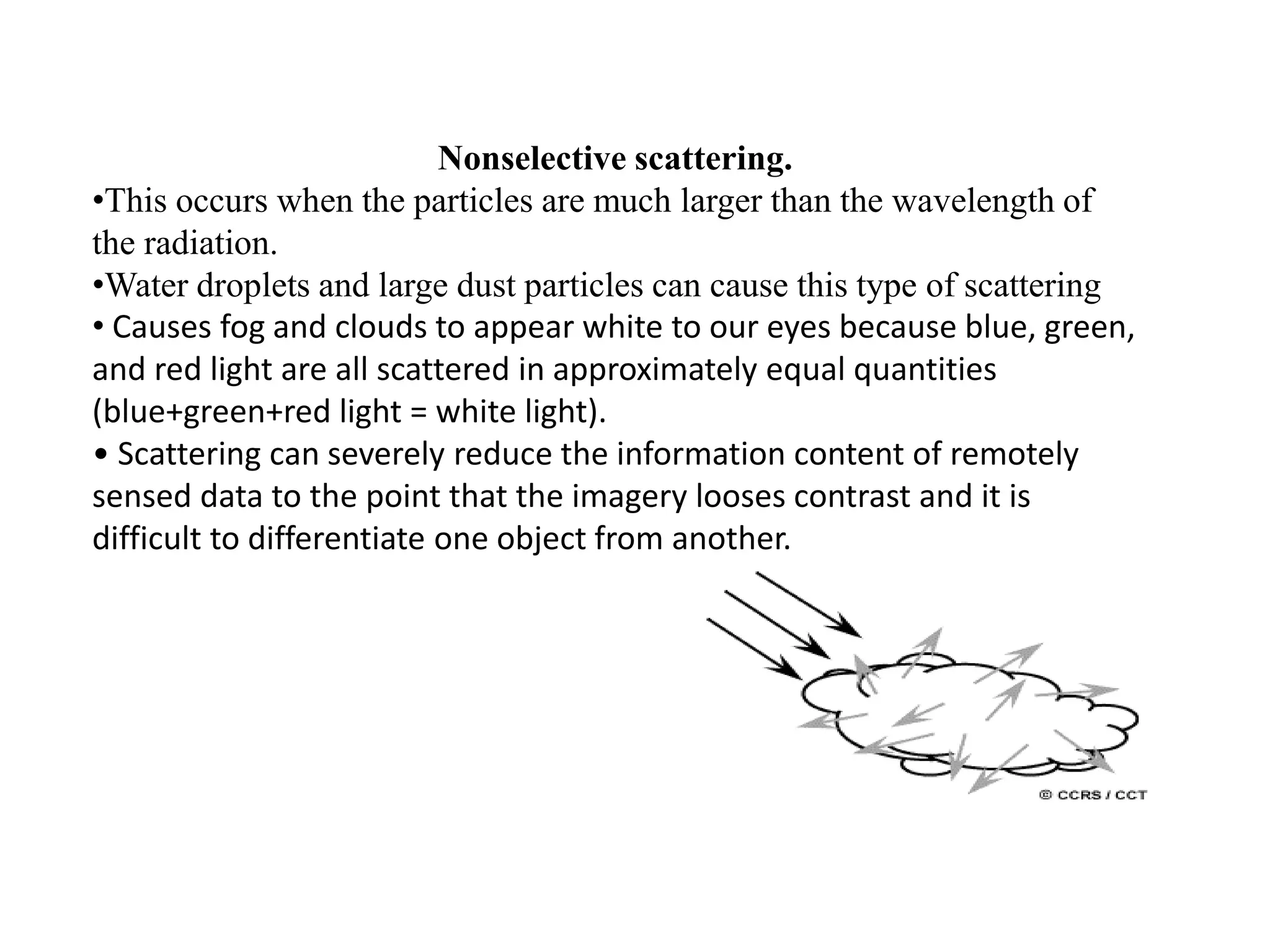
•This occurs when the particles are much larger than the wavelength of
the radiation.
•Water droplets and large dust particles can cause this type of scattering
• Causes fog and clouds to appear white to our eyes because blue, green,
and red light are all scattered in approximately equal quantities
(blue+green+red light = white light).
• Scattering can severely reduce the information content of remotely
sensed data to the point that the imagery looses contrast and it is
difficult to differentiate one object from another.
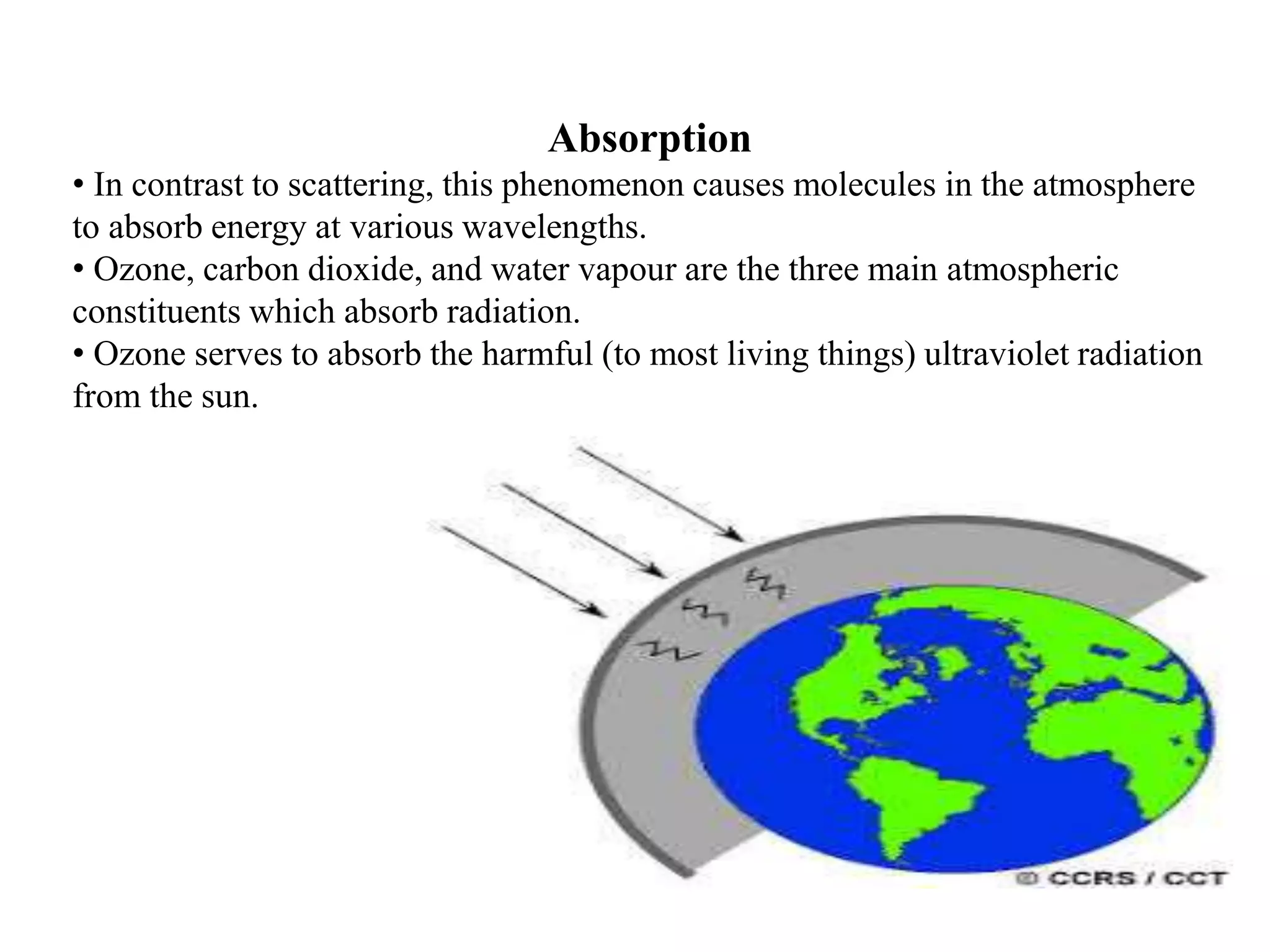
Absorption
• In contrast to scattering, this phenomenon causes molecules in the atmosphere
to absorb energy at various wavelengths.
• Ozone, carbon dioxide, and water vapour are the three main atmospheric
constituents which absorb radiation.
• Ozone serves to absorb the harmful (to most living things) ultraviolet radiation
from the sun.
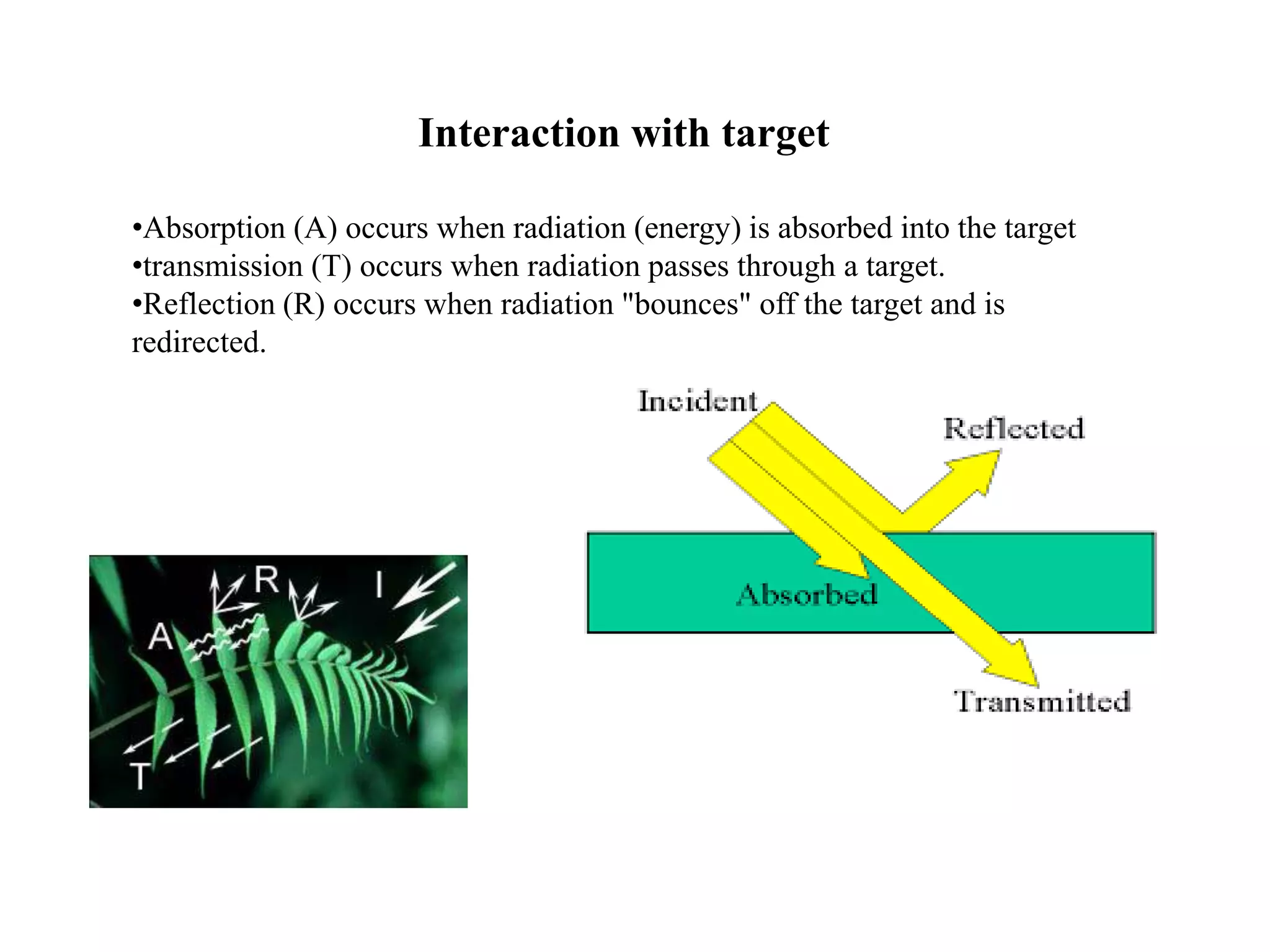
Interaction with target
•Absorption (A) occurs when radiation (energy) is absorbed into the target
•transmission (T) occurs when radiation passes through a target.
•Reflection (R) occurs when radiation "bounces" off the target and is
redirected.
In remote sensing, we are most interested in measuring the radiation
reflected from targets.
 the two ways in which energy is reflected from a target are:
• specular reflection and
• diffuse reflection.
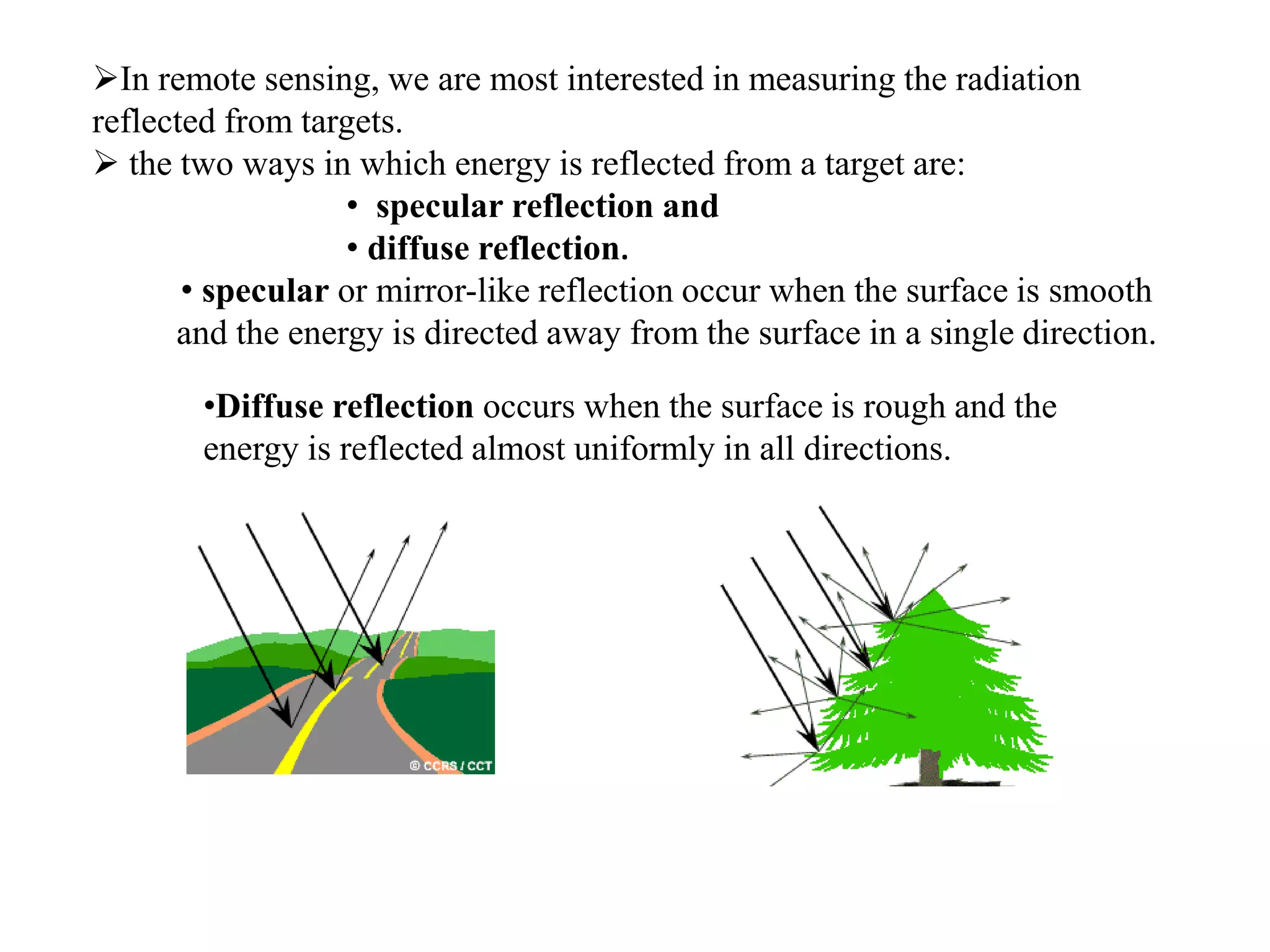
• specular or mirror-like reflection occur when the surface is smooth
and the energy is directed away from the surface in a single direction.
•Diffuse reflection occurs when the surface is rough and the
energy is reflected almost uniformly in all directions.
Electromagnetic spectrum and its  interaction with atmosphere &amp; matter

Electromagnetic spectrum and its interaction with atmosphere &amp; matter

  • 1.
  • 2.
    Electromagnetic Radiation The firstrequirement for remote sensing is to have an energy source to illuminate the target (unless the sensed energy is being emitted by the target). This energy is in the form of electromagnetic radiation. All electromagnetic radiation has fundamental properties and behaves in predictable ways according to the basics of wave theory. Electromagnetic radiation consists of an •electrical field(E) and a •magnetic field (M) Both these fields travel at the speed of light (c).  Characteristics of Electromagnetic Radiation •wavelength • frequency
  • 3.
    Type of RadiationFrequency Range (Hz) Wavelength Range gamma-rays 1020 - 1024 < 10-12 m x-rays 1017 - 1020 1 nm - 1 pm ultraviolet 1015 - 1017 400 nm - 1 nm visible 4 - 7.5*1014 750 nm - 400 nm near-infrared 1*1014 - 4*1014 2.5 μm - 750 nm infrared 1013 - 1014 25 μm - 2.5 μm microwaves 3*1011 - 1013 1 mm - 25 μm radio waves < 3*1011 > 1 mm The Electromagnetic Spectrum •Ranges from the shorter wavelengths (including gamma and x-rays) to the longer wavelengths (including microwaves and broadcast radio waves). •There are several regions of the electromagnetic spectrum which are useful for remote sensing (UV, Visible ,Infrared, microwaves )
  • 5.
    Ultraviolet or UVSpectrum •portion of the spectrum with shortest wavelengths which are practical for remote sensing. •Some Earth surface materials, primarily rocks and minerals, fluoresce or emit visible light when illuminated by UV radiation.
  • 6.
    Violet: 0.4 -0.446 μm Blue: 0.446 - 0.500 μm Green: 0.500 - 0.578 μm Yellow: 0.578 - 0.592 μm Orange: 0.592 - 0.620 μm Red: 0.620 - 0.7 μm Visible Spectrum •The longest visible wavelength is red and the shortest is violet. •Common wavelengths of what we perceive as particular colours from the visible portion of the spectrum are listed below. •the only portion of the spectrum associate with the concept of colours.
  • 7.
    Infrared Region •The infraredregion can be divided into two categories based on their radiation properties - the reflected IR, and the emitted or thermal IR. • The reflected IR covers wavelengths from approximately 0.7 μm to 3.0 μm. •The thermal IR covers wavelengths from approximately 3.0 μm to 100 μm.
  • 8.
    Microwave Region •The portionof the spectrum of more recent interest to remote sensing is the microwave region from about 1 mm to 1m. • This covers the longest wavelengths used for remote sensing. # The shorter wavelengths have properties similar to the thermal infrared region while the longer wavelengths approach the wavelengths used for radio broadcasts.
  • 9.
    Interaction of EMradiation •Before radiation used for remote sensing reaches the Earth's surface it has to travel through some distance of the Earth's atmosphere. •Particles and gases in the atmosphere can affect the incoming light and radiation. •These effects are caused by the mechanisms of scattering and absorption. •Radiation that is not absorbed or scattered in the atmosphere can reach and interact with the Earth's surface. •There are three forms of interaction that can take place when energy strikes, or is incident (I) upon the surface.  absorption (A)  transmission (T);  reflection (R)
  • 10.
    Interaction with atmosphere Scattering •Scatteringoccurs when particles or large gas molecules present in the atmosphere interact with and cause the electromagnetic radiation to be redirected from its original path. •How much scattering takes place depends on several factors including  the wavelength of the radiation,  the abundance of particles or gases,  the distance the radiation travels through the atmosphere. •There are three (3) types of scattering which take place Rayleigh scattering Mie scattering  nonselective scattering
  • 11.
    Rayleigh scattering • Occurswhen particles are very small compared to the wavelength of the radiation. • Causes shorter wavelengths of energy to be scattered much more than longer wavelengths. • Rayleigh scattering is the dominant scattering mechanism in the upper atmosphere. • The fact that the sky appears "blue" during the day is because of this phenomenon. Mie scattering •Occurs when the particles are just about the same size as the wavelength of the radiation. •Dust, pollen, smoke and water vapour are common causes of Mie scattering • Mie scattering occurs mostly in the lower portions of the atmosphere
  • 12.
    Nonselective scattering. •This occurswhen the particles are much larger than the wavelength of the radiation. •Water droplets and large dust particles can cause this type of scattering • Causes fog and clouds to appear white to our eyes because blue, green, and red light are all scattered in approximately equal quantities (blue+green+red light = white light). • Scattering can severely reduce the information content of remotely sensed data to the point that the imagery looses contrast and it is difficult to differentiate one object from another.
  • 13.
    Absorption • In contrastto scattering, this phenomenon causes molecules in the atmosphere to absorb energy at various wavelengths. • Ozone, carbon dioxide, and water vapour are the three main atmospheric constituents which absorb radiation. • Ozone serves to absorb the harmful (to most living things) ultraviolet radiation from the sun.
  • 14.
    Interaction with target •Absorption(A) occurs when radiation (energy) is absorbed into the target •transmission (T) occurs when radiation passes through a target. •Reflection (R) occurs when radiation "bounces" off the target and is redirected.
  • 15.
    In remote sensing,we are most interested in measuring the radiation reflected from targets.  the two ways in which energy is reflected from a target are: • specular reflection and • diffuse reflection. • specular or mirror-like reflection occur when the surface is smooth and the energy is directed away from the surface in a single direction. •Diffuse reflection occurs when the surface is rough and the energy is reflected almost uniformly in all directions.