RECOMBINANT DNA TECHNOLOGY
ITS APPROACHES
presented by:
MAHENDRA G.S.
M.Pharm
1
CONTENT
 Introduction to rDNA technology.
 History
 Schematic representation
 Tools and enzymes required for rDNA technology
 Applications of rDNA technology
2
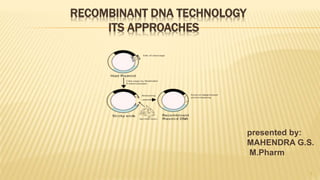
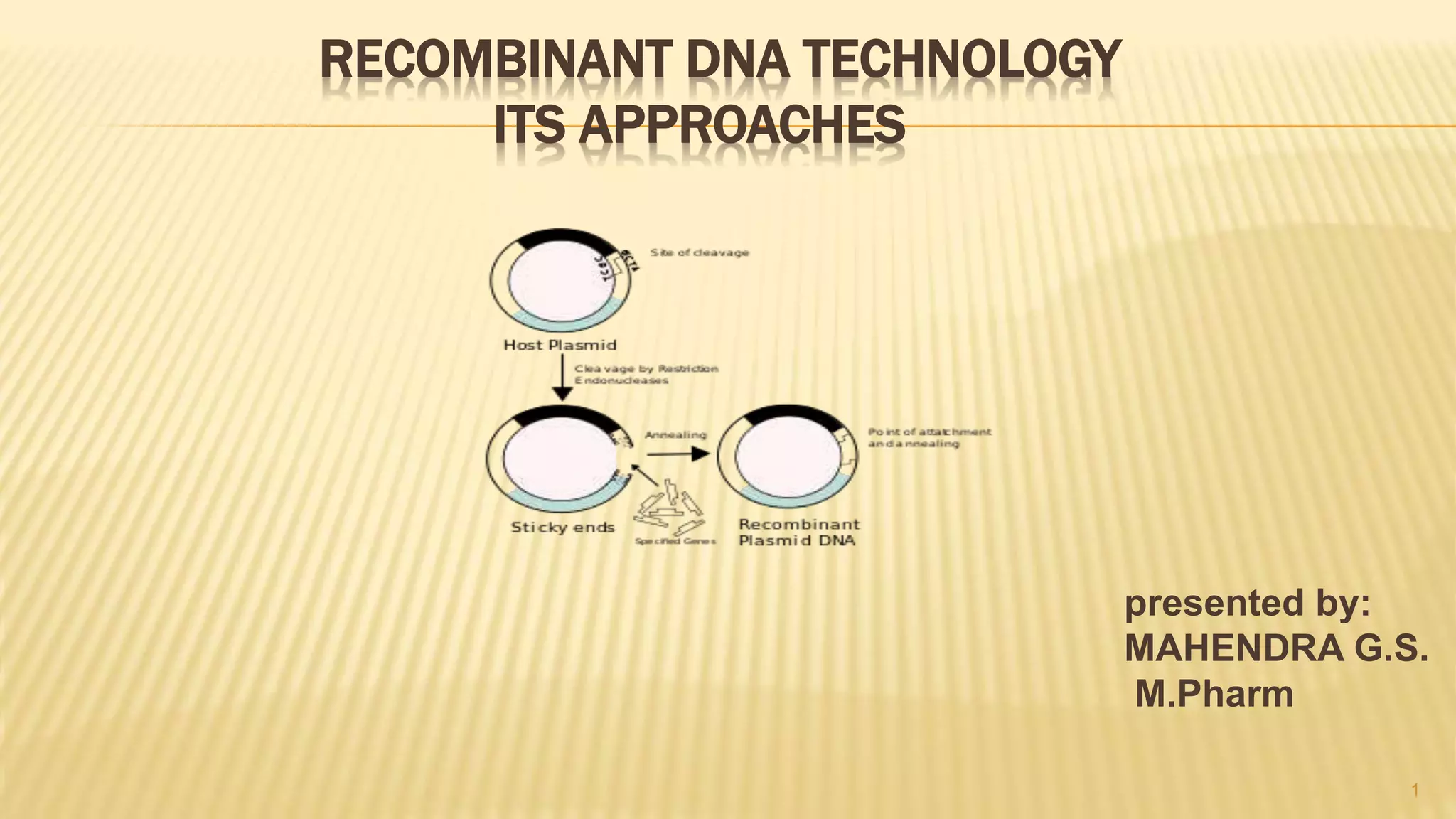
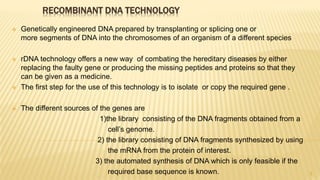
RECOMBINANT DNA TECHNOLOGY
 Genetically engineered DNA prepared by transplanting or splicing one or
more segments of DNA into the chromosomes of an organism of a different species
 rDNA technology offers a new way of combating the hereditary diseases by either
replacing the faulty gene or producing the missing peptides and proteins so that they
can be given as a medicine.
 The first step for the use of this technology is to isolate or copy the required gene .
 The different sources of the genes are
1)the library consisting of the DNA fragments obtained from a
cell’s genome.
2) the library consisting of DNA fragments synthesized by using
the mRNA from the protein of interest.
3) the automated synthesis of DNA which is only feasible if the
required base sequence is known. 3
 RecombinantDNA technology is used for cloning(clone).
clone- a molecule, cell or organism that was produced from another single entity.
Word derived from Greek ( cutting of a twig)
 1970s gene cloning became a reality.
 It was possible by the discovery of
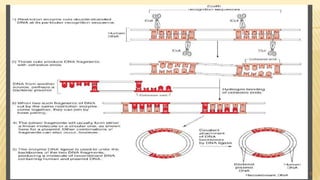
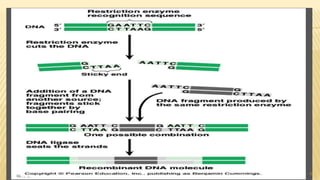
Restriction Enzyme – DNA cutting enzyme
Plasmid DNA vector- circular form of self replacing DNA.
 1970,hind lll isolated the first restriction enzyme to be used for DNA cloning.
Endonucleus: cuts within DNA sequence
Exonucleus: cuts from the ends of DNA sequences.
 1970s PAUL BERG isolated chromosomal DNA from E.coli and DNA from simian
virus40(SV40),cut both DNA samples with EcoRI and successful ligated the
together.
 1975 recombinant DNA Advisory committee (RAC) to set guidelines for working
with recombinant organism.
4
5
6
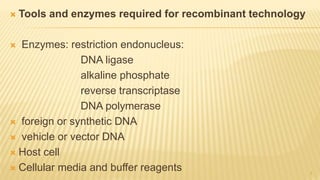
 Tools and enzymes required for recombinant technology
 Enzymes: restriction endonucleus:
DNA ligase
alkaline phosphate
reverse transcriptase
DNA polymerase
 foreign or synthetic DNA
 vehicle or vector DNA
 Host cell
 Cellular media and buffer reagents 7
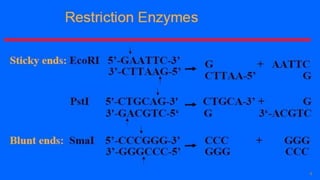
 Restriction Enzymes
 –Primarily found in bacteria in 1960s (Werner Arber).
 –Cut DNA by cleaving the phosphodiesterbond that joins
adjacent nucleotides in a DNA strand
 –Bind to, recognize, and cut DNA within specific sequences of
bases called a recognition sequence or restriction site.
8
9
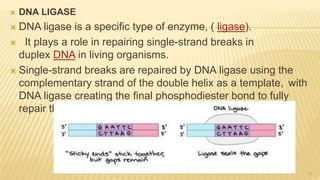
 DNA LIGASE
 DNA ligase is a specific type of enzyme, ( ligase).
 It plays a role in repairing single-strand breaks in
duplex DNA in living organisms.
 Single-strand breaks are repaired by DNA ligase using the
complementary strand of the double helix as a template, with
DNA ligase creating the final phosphodiester bond to fully
repair the DNA.
10
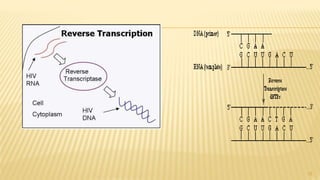
 A reverse transcriptase (RT) is an enzyme used to
generate complementaryDNA (cDNA) from an RNA template, a process
termed reverse transcription.
 Reverse transcriptase creates single-stranded DNA from an RNA template.
 Reverse transcriptase are multifunctional enzymes.
 These enzymes exhibit an RNA and DNA directed polymerase activity.
 In addition reverse transcriptase catalyse the degradation of RNA in an RNA-
DNA hybrid. The exonucleolytic activity proceeds in a 5' ---> 3' direction.
 In 1970, Mizutani et al found that retroviruses (RNA virus) contain RNA dependent
DNA polymerase which is called as ReverseTranscriptase.
11
12
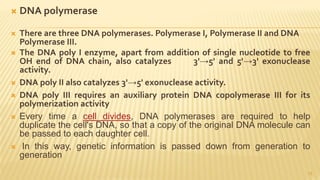
 DNA polymerase
 There are three DNA polymerases. Polymerase I, Polymerase II and DNA
Polymerase III.
 The DNA poly I enzyme, apart from addition of single nucleotide to free
OH end of DNA chain, also catalyzes 3'→5' and 5'→3' exonuclease
activity.
 DNA poly II also catalyzes 3'→5' exonuclease activity.
 DNA poly III requires an auxiliary protein DNA copolymerase III for its
polymerization activity
 Every time a cell divides, DNA polymerases are required to help
duplicate the cell's DNA, so that a copy of the original DNA molecule can
be passed to each daughter cell.
 In this way, genetic information is passed down from generation to
generation
13
14
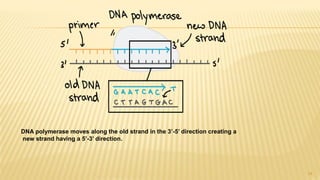
DNA polymerase moves along the old strand in the 3’-5’ direction creating a
new strand having a 5’-3’ direction.
CLONING VECTORS
 Types of Vectors
 –Bacterial plasmid vectors
 –Bacteriophage vectors
 –Cosmid vectors
 –Expression vectors
 –Bacterial Artificial Chromosomes (BAC)
 –Yeast Artificial Chromosomes (YAC)
15
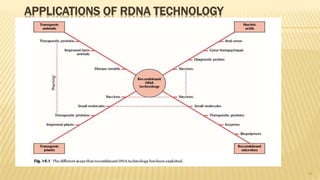
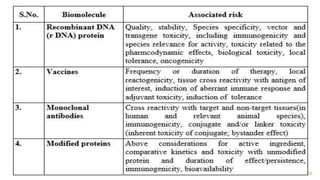
APPLICATIONS OF RDNA TECHNOLOGY
16
17
18
19
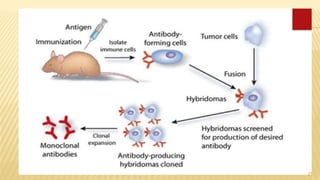
MONOCLONAL ANTIBODIES
 Antibodies are specific proteins produced by the immune system
in
response to presence of a specific antigen.
 Monoclonal antibodies produce from single clone of antigen.
 That’s why are monospecific in nature.
 Production through hybridoma technology.
 Applications:
 mAb are used for diagnosis of disease, Pregnancy and
Treatment of cancer.
20
21
MOLECULAR DIAGONISTIC OF DISEASE
 Infectious diseases diagnosis mainly depends upon isolation
and identification of pathogens, which may take several days.
 Development of diagnostic kits to identify pathogenic
organisms by knowing the organism-specific DNA sequence
has provided rapid,specific and correct diagnosis.
 Various diagnostic kits have been developed for AIDS,
cancer, foot and mouth diseases, tuberculosis, etc.
22
DNA FINGERPRINTING
 Dr. Alec Jeffreys developed DNA fingerprinting technique.
 Every person have its unique finger patterns that differs from other
individual.
 There is possibility to alter these patterns but specific principle is
unknown.
 Finger prints are detected on the basis of number of highly polymorphic
genes i.e. VNTR’s.(variable number tardem repeat)
 Applications:
 Used in criminal identification.
 For child parentage establishment.
 Helpful for deduction of racial group.
23
USES IN THE ENVIRONMENT
 By Recombinant DNA technology plastic degradation can be
enhanced by genetically modified organisms.
 Genetically modified strain of Pseudomonas putida able to
degrade chemicals in oil spills.
 used in development of bioindicators.
 bacteria have been genetically modified as 'bioluminescors' that
give off light in response to several chemical pollutants.
 used for the production of transgenic plants with:
 higher yield
 nutritional values.
 increased resistance to stress and pests 24
NEW APPROACH
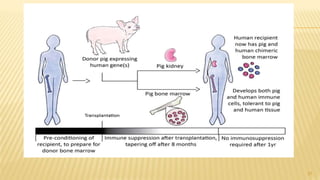
 used in the treatment of organ failure I.e.
XENOTRANSPLANTATION.
 Used in GENE THERAPY.
 Used in design , development and isolation of protein.
25
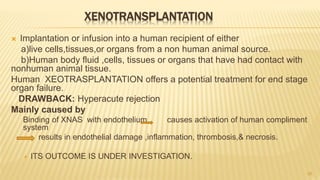
XENOTRANSPLANTATION
 Implantation or infusion into a human recipient of either
a)live cells,tissues,or organs from a non human animal source.
b)Human body fluid ,cells, tissues or organs that have had contact with
nonhuman animal tissue.
Human XEOTRASPLANTATION offers a potential treatment for end stage
organ failure.
DRAWBACK: Hyperacute rejection
Mainly caused by
Binding of XNAS with endothelium causes activation of human compliment
system
results in endothelial damage ,inflammation, thrombosis,& necrosis.
 ITS OUTCOME IS UNDER INVESTIGATION.
26
27
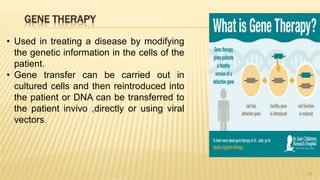
GENE THERAPY
28
• Used in treating a disease by modifying
the genetic information in the cells of the
patient.
• Gene transfer can be carried out in
cultured cells and then reintroduced into
the patient or DNA can be transferred to
the patient invivo ,directly or using viral
vectors.
29
REFERENCE
 https://en.wikipedia.org/wiki/DNA_ligase
 https://en.wikipedia.org/wiki/Reverse_transcriptase
 https://en.wikipedia.org/wiki/DNA_polymerase
 https://en.wikipedia.org/wiki/Plasmid
 https://en.wikipedia.org/wiki/Xenotransplantation
 http://www.sciencedirect.com/science/article/pii/S0734975099000105
 Introduction to Biotechnology, Second Edition William J.Thieman and Michael A.Palladino
 Applications of recombinant DNA technology inHealth,Agriculture,Environment, Industry
 PRESENTED TO:DR.SUMAIRA RASOOL
30

Recombinant DNA technology

  • 1.
    RECOMBINANT DNA TECHNOLOGY ITSAPPROACHES presented by: MAHENDRA G.S. M.Pharm 1
  • 2.
    CONTENT  Introduction torDNA technology.  History  Schematic representation  Tools and enzymes required for rDNA technology  Applications of rDNA technology 2
  • 3.
    RECOMBINANT DNA TECHNOLOGY Genetically engineered DNA prepared by transplanting or splicing one or more segments of DNA into the chromosomes of an organism of a different species  rDNA technology offers a new way of combating the hereditary diseases by either replacing the faulty gene or producing the missing peptides and proteins so that they can be given as a medicine.  The first step for the use of this technology is to isolate or copy the required gene .  The different sources of the genes are 1)the library consisting of the DNA fragments obtained from a cell’s genome. 2) the library consisting of DNA fragments synthesized by using the mRNA from the protein of interest. 3) the automated synthesis of DNA which is only feasible if the required base sequence is known. 3
  • 4.
     RecombinantDNA technologyis used for cloning(clone). clone- a molecule, cell or organism that was produced from another single entity. Word derived from Greek ( cutting of a twig)  1970s gene cloning became a reality.  It was possible by the discovery of Restriction Enzyme – DNA cutting enzyme Plasmid DNA vector- circular form of self replacing DNA.  1970,hind lll isolated the first restriction enzyme to be used for DNA cloning. Endonucleus: cuts within DNA sequence Exonucleus: cuts from the ends of DNA sequences.  1970s PAUL BERG isolated chromosomal DNA from E.coli and DNA from simian virus40(SV40),cut both DNA samples with EcoRI and successful ligated the together.  1975 recombinant DNA Advisory committee (RAC) to set guidelines for working with recombinant organism. 4
  • 5.
  • 6.
  • 7.
     Tools andenzymes required for recombinant technology  Enzymes: restriction endonucleus: DNA ligase alkaline phosphate reverse transcriptase DNA polymerase  foreign or synthetic DNA  vehicle or vector DNA  Host cell  Cellular media and buffer reagents 7
  • 8.
     Restriction Enzymes –Primarily found in bacteria in 1960s (Werner Arber).  –Cut DNA by cleaving the phosphodiesterbond that joins adjacent nucleotides in a DNA strand  –Bind to, recognize, and cut DNA within specific sequences of bases called a recognition sequence or restriction site. 8
  • 9.
  • 10.
     DNA LIGASE DNA ligase is a specific type of enzyme, ( ligase).  It plays a role in repairing single-strand breaks in duplex DNA in living organisms.  Single-strand breaks are repaired by DNA ligase using the complementary strand of the double helix as a template, with DNA ligase creating the final phosphodiester bond to fully repair the DNA. 10
  • 11.
     A reversetranscriptase (RT) is an enzyme used to generate complementaryDNA (cDNA) from an RNA template, a process termed reverse transcription.  Reverse transcriptase creates single-stranded DNA from an RNA template.  Reverse transcriptase are multifunctional enzymes.  These enzymes exhibit an RNA and DNA directed polymerase activity.  In addition reverse transcriptase catalyse the degradation of RNA in an RNA- DNA hybrid. The exonucleolytic activity proceeds in a 5' ---> 3' direction.  In 1970, Mizutani et al found that retroviruses (RNA virus) contain RNA dependent DNA polymerase which is called as ReverseTranscriptase. 11
  • 12.
  • 13.
     DNA polymerase There are three DNA polymerases. Polymerase I, Polymerase II and DNA Polymerase III.  The DNA poly I enzyme, apart from addition of single nucleotide to free OH end of DNA chain, also catalyzes 3'→5' and 5'→3' exonuclease activity.  DNA poly II also catalyzes 3'→5' exonuclease activity.  DNA poly III requires an auxiliary protein DNA copolymerase III for its polymerization activity  Every time a cell divides, DNA polymerases are required to help duplicate the cell's DNA, so that a copy of the original DNA molecule can be passed to each daughter cell.  In this way, genetic information is passed down from generation to generation 13
  • 14.
    14 DNA polymerase movesalong the old strand in the 3’-5’ direction creating a new strand having a 5’-3’ direction.
  • 15.
    CLONING VECTORS  Typesof Vectors  –Bacterial plasmid vectors  –Bacteriophage vectors  –Cosmid vectors  –Expression vectors  –Bacterial Artificial Chromosomes (BAC)  –Yeast Artificial Chromosomes (YAC) 15
  • 16.
    APPLICATIONS OF RDNATECHNOLOGY 16
  • 17.
  • 18.
  • 19.
  • 20.
    MONOCLONAL ANTIBODIES  Antibodiesare specific proteins produced by the immune system in response to presence of a specific antigen.  Monoclonal antibodies produce from single clone of antigen.  That’s why are monospecific in nature.  Production through hybridoma technology.  Applications:  mAb are used for diagnosis of disease, Pregnancy and Treatment of cancer. 20
  • 21.
  • 22.
    MOLECULAR DIAGONISTIC OFDISEASE  Infectious diseases diagnosis mainly depends upon isolation and identification of pathogens, which may take several days.  Development of diagnostic kits to identify pathogenic organisms by knowing the organism-specific DNA sequence has provided rapid,specific and correct diagnosis.  Various diagnostic kits have been developed for AIDS, cancer, foot and mouth diseases, tuberculosis, etc. 22
  • 23.
    DNA FINGERPRINTING  Dr.Alec Jeffreys developed DNA fingerprinting technique.  Every person have its unique finger patterns that differs from other individual.  There is possibility to alter these patterns but specific principle is unknown.  Finger prints are detected on the basis of number of highly polymorphic genes i.e. VNTR’s.(variable number tardem repeat)  Applications:  Used in criminal identification.  For child parentage establishment.  Helpful for deduction of racial group. 23
  • 24.
    USES IN THEENVIRONMENT  By Recombinant DNA technology plastic degradation can be enhanced by genetically modified organisms.  Genetically modified strain of Pseudomonas putida able to degrade chemicals in oil spills.  used in development of bioindicators.  bacteria have been genetically modified as 'bioluminescors' that give off light in response to several chemical pollutants.  used for the production of transgenic plants with:  higher yield  nutritional values.  increased resistance to stress and pests 24
  • 25.
    NEW APPROACH  usedin the treatment of organ failure I.e. XENOTRANSPLANTATION.  Used in GENE THERAPY.  Used in design , development and isolation of protein. 25
  • 26.
    XENOTRANSPLANTATION  Implantation orinfusion into a human recipient of either a)live cells,tissues,or organs from a non human animal source. b)Human body fluid ,cells, tissues or organs that have had contact with nonhuman animal tissue. Human XEOTRASPLANTATION offers a potential treatment for end stage organ failure. DRAWBACK: Hyperacute rejection Mainly caused by Binding of XNAS with endothelium causes activation of human compliment system results in endothelial damage ,inflammation, thrombosis,& necrosis.  ITS OUTCOME IS UNDER INVESTIGATION. 26
  • 27.
  • 28.
    GENE THERAPY 28 • Usedin treating a disease by modifying the genetic information in the cells of the patient. • Gene transfer can be carried out in cultured cells and then reintroduced into the patient or DNA can be transferred to the patient invivo ,directly or using viral vectors.
  • 29.
  • 30.
    REFERENCE  https://en.wikipedia.org/wiki/DNA_ligase  https://en.wikipedia.org/wiki/Reverse_transcriptase https://en.wikipedia.org/wiki/DNA_polymerase  https://en.wikipedia.org/wiki/Plasmid  https://en.wikipedia.org/wiki/Xenotransplantation  http://www.sciencedirect.com/science/article/pii/S0734975099000105  Introduction to Biotechnology, Second Edition William J.Thieman and Michael A.Palladino  Applications of recombinant DNA technology inHealth,Agriculture,Environment, Industry  PRESENTED TO:DR.SUMAIRA RASOOL 30