Quality Assurance
MAHENDRA G S
NGSMIPS
Quality Assurance are essential operations of
the pharmaceutical industry. Drugs must be
marketed as safe and therapeutically active
formulations whose performance is consistent
and predictable.
Introduction
• The objective of Quality Assurance Department is
to check and direct degree or grades of excellence
of processes and products.
• To Ethical pharmaceutical manufacturer, it implies
a detail system of inspections and control covering
the production, evaluation and distribution of every
drug bearing our company label.
Introduction
• It is the purpose of these operations to produce
medications of superior efficacy, safety and elegance and
to provide the assurance to physician, the pharmacist and
the consumer, that the given product performs uniformly
and in a manner satisfactory for the purpose for which it
is recommended.
Introduction
Quality assurance is a wide-ranging concept
covering all matters that individually or collectively
influence the quality of a product. It is the totality
of the arrangements made with the object of
ensuring that pharmaceutical products are of the
quality required for their intended use.
Introduction
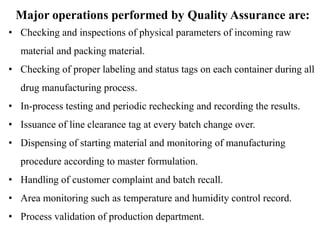
Major operations performed by Quality Assurance are:
• Checking and inspections of physical parameters of incoming raw
material and packing material.
• Checking of proper labeling and status tags on each container during all
drug manufacturing process.
• In-process testing and periodic rechecking and recording the results.
• Issuance of line clearance tag at every batch change over.
• Dispensing of starting material and monitoring of manufacturing
procedure according to master formulation.
• Handling of customer complaint and batch recall.
• Area monitoring such as temperature and humidity control record.
• Process validation of production department.
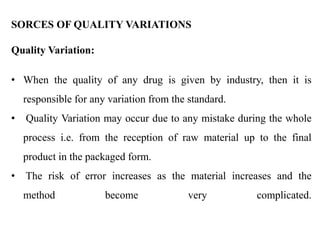
SORCES OF QUALITY VARIATIONS
Quality Variation:
• When the quality of any drug is given by industry, then it is
responsible for any variation from the standard.
• Quality Variation may occur due to any mistake during the whole
process i.e. from the reception of raw material up to the final
product in the packaged form.
• The risk of error increases as the material increases and the
method become very complicated.
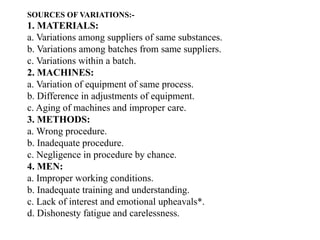
SOURCES OF VARIATIONS:-
1. MATERIALS:
a. Variations among suppliers of same substances.
b. Variations among batches from same suppliers.
c. Variations within a batch.
2. MACHINES:
a. Variation of equipment of same process.
b. Difference in adjustments of equipment.
c. Aging of machines and improper care.
3. METHODS:
a. Wrong procedure.
b. Inadequate procedure.
c. Negligence in procedure by chance.
4. MEN:
a. Improper working conditions.
b. Inadequate training and understanding.
c. Lack of interest and emotional upheavals*.
d. Dishonesty fatigue and carelessness.
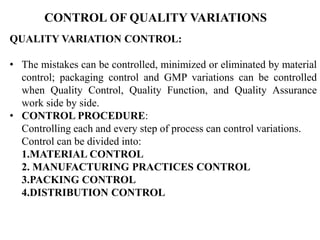
CONTROL OF QUALITY VARIATIONS
QUALITY VARIATION CONTROL:
• The mistakes can be controlled, minimized or eliminated by material
control; packaging control and GMP variations can be controlled
when Quality Control, Quality Function, and Quality Assurance
work side by side.
• CONTROL PROCEDURE:
Controlling each and every step of process can control variations.
Control can be divided into:
1.MATERIAL CONTROL
2. MANUFACTURING PRACTICES CONTROL
3.PACKING CONTROL
4.DISTRIBUTION CONTROL
1.MATERIAL CONTROL:
It starts just after the reception of materials. Most of the
materials that are active substances, excipients, packaging
and printed materials are received by the industry from
suppliers. Thus there should be adequate established system
for the receipt, testing and storage of all these supplies.
There should be a complete record of all the procedures and
tests. In the material following things are included:
• Drug substances.
• Excipients.
• Packaging and printed materials.
• After the reception of material, it is kept in a definite area. Thus
before laboratory testing, proper containers, labels, lot number, expiry
dates etc. all are checked.
• The material is stored in a proper way either they are arranged
alphabetically or they are differentiated depending upon physical
nature.
• Then samples are taken for laboratory testing and a label (Sampled) is
fixed on material.
• In case of active constituents, percentage purity, adulteration, expiry
date, lot number, exact packing etc. is checked.
2.MANUFACTURING PRACTICES CONTROL:
Successful GMP is difficult to attain but to some extent, it
can be modified and controlled. Specific procedures can be
applied to attain the best quality. In case of manufacturing,
following controls are important:
A. Personnel.
B. Equipment and building.
C. Control of record.
D. Production procedure control.
(A). PERSONNEL:
Usually properly educated and well-trained persons should be in the
industry.
• There should be proper selection and training in all departments i.e.
production, packaging, labeling, etc, etc.
• There should be general lectures for less educated persons who work
in the labeling or packaging section in an understandable language.
• They should be made aware of the fact that what is the importance of
life saving.
• They should be warned about all the dangers of their mistakes and
errors.
• There should be properly educated supervisors working above the
workers.
• The supervisors should always be there so that in case of any trouble
or question, they must be available.
(B). EQUIPMENT AND BUILDING:
• The equipments and building used in storage, processing,
checking and packaging should be of a suitable design,
size, construction and location.
• In case of equipments, these should be constructed in a
proper size and proper way. The size should be such that
complete batch can be processed all at once.
• The surfaces of equipments should be non-reactive, non-
absorptive and nonadditive.
(C) CONTROL OF RECORD:
The records such as master formula record and batch production record must be
maintained.
1. MASTER FORMULA RECORD:
a. The master formula record must be prepared for each product.
b. It must be signed by a competent and responsible person.
c. The language must be so that it may not be miss-interpreted.
d. It should be checked by another competent person and must be countersigned.
f. Master formula record include the following information:
i. Name of the product, dosage form and strength.
ii. Complete list of ingredients including excipients.
iii. Quality by weight or volume of each and every ingredient.
iv. Standards or specifications of each ingredient.
v. Any calculated excess of an ingredient.
vi. Theoretical yield and termination of process.
vii. Manufacturing and control instructions, specifications and precautions.
viii. Complete description of closures, containers, labeling, packaging and other
finishing material.
2. BATCH PRODUCTION RECORD:
• Batch production record must be prepared, maintained
and controlled for each batch of a product.
• It must be retained for about 5-years after product
distribution.
• Batch production record should have following
information in addition to master formula record.
i. Batch number.
ii. Code number.
iii. Manufacturing date.
iv. Expiry date.
(D). PRODUCTION PROCEDURE CONTROL:
• The processes of manufacturing are operated according to
the established rules from the reception of material up to
delivery of final product.
• In the production procedure control, some tests are done
during the process, which is called “In Process Quality
Control (IPQC)”.
• The IPQC is under Quality Control Department.
• Both Quality Control and Production Departments are
responsible for the production procedure control.
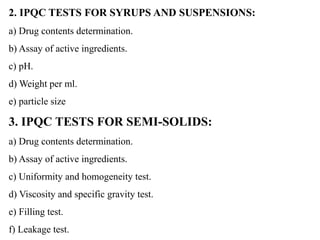
2. IPQC TESTS FOR SYRUPS AND SUSPENSIONS:
a) Drug contents determination.
b) Assay of active ingredients.
c) pH.
d) Weight per ml.
e) particle size
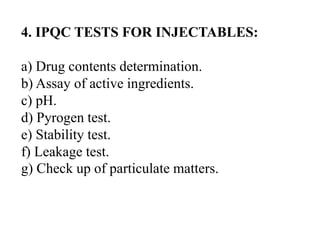
3. IPQC TESTS FOR SEMI-SOLIDS:
a) Drug contents determination.
b) Assay of active ingredients.
c) Uniformity and homogeneity test.
d) Viscosity and specific gravity test.
e) Filling test.
f) Leakage test.
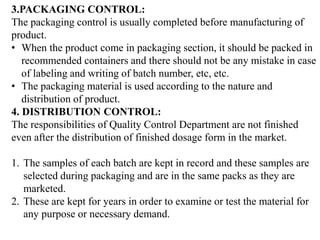
4. IPQC TESTS FOR INJECTABLES:
a) Drug contents determination.
b) Assay of active ingredients.
c) pH.
d) Pyrogen test.
e) Stability test.
f) Leakage test.
g) Check up of particulate matters.
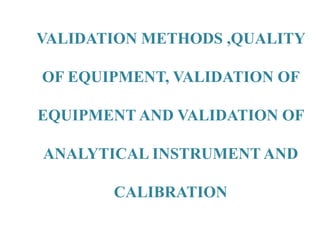
3.PACKAGING CONTROL:
The packaging control is usually completed before manufacturing of
product.
• When the product come in packaging section, it should be packed in
recommended containers and there should not be any mistake in case
of labeling and writing of batch number, etc, etc.
• The packaging material is used according to the nature and
distribution of product.
4. DISTRIBUTION CONTROL:
The responsibilities of Quality Control Department are not finished
even after the distribution of finished dosage form in the market.
1. The samples of each batch are kept in record and these samples are
selected during packaging and are in the same packs as they are
marketed.
2. These are kept for years in order to examine or test the material for
any purpose or necessary demand.
VALIDATION METHODS ,QUALITY
OF EQUIPMENT, VALIDATION OF
EQUIPMENT AND VALIDATION OF
ANALYTICAL INSTRUMENT AND
CALIBRATION
CONTENTS
 INTRODUCTION
 VALIDATION
TYPES
NEED FOR VALIDATION
 SELECTION PARAMETERS OF
ANALYTICALMETHODS
 ANALYTICALPARAMETERS
 STEPS OF VALIDATION PROCESS
 DOCUMENTATION
CONTINUE..
 QUALIFICATION
 ASPECTS OF VALIDATION
 METHODS
 ADVANTAGES
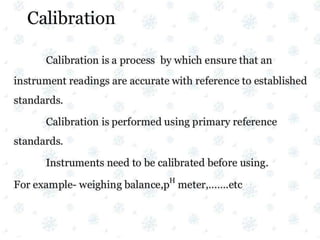
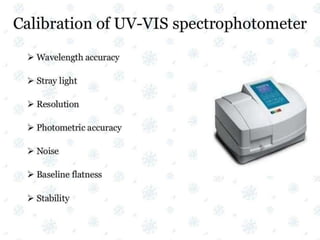
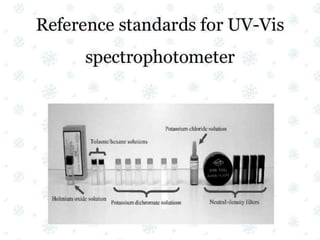
 CALIBRATIONAND VALIDATION UV – VIS
SPECTROSCOPY IR SPECTROSCOPY
HPLC HPTLC
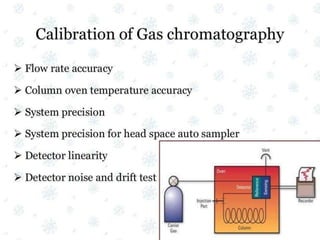
GAS CHROMATOGRAPHY (GC)
INTRODUTION - QUALITY
 In view of the changing national scenario in every field
and public consciousness towards quality, the Indian
industries have reached a critical stage and are poised to
produce “quality” goods for domestic as well as for
global markets. It can be stated without exaggeration that
the rate of scientific and technical progress plays a
crucial role in meeting the multiple objectives of quality
assurance, consumer protection, export promotion and
hence safety.
CONTINUE..
 Even a small unnoticed thing, for instance slight
deviation from the optimum value of tyre pressure in the
automobile, would result in a considerable amount of
national loss in terms of consumption of
petrol/diesel.
 Hence people are now more conscious towards the kind
of goods they are buying. That is why there is a
significant rise in the number of premium goods with
good brand name.
VALIDATION
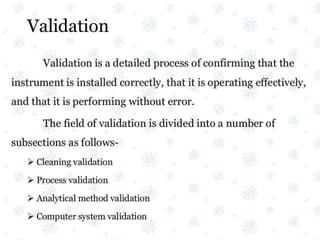
• A process involving confirmation or establishing by
laboratory studies that method / procedure / system /
analyst give accurate and reproducible result for
intended analytical application in a proven and
established range.
• Process of providing documented evidence that the
system/procedure does that it is intended to do
precisely and reliably
CONTINUE..
 Collection and evaluation in a documented form of
repetitive evidence collected according to agreed
protocols to provide high degree of assurance that
the procedure under consideration will consistently
produce a product meeting its pre-determined
specifications or quality attributes.
TYPES
PROSPECTIVE VALIDATION
 This type of validation is performed before production, during a
product’s development stage. A risk analysis is performed to assess
the production process by breaking it down into separate steps.
These are individually evaluated and based on past experience, the
likelihood of each one leading to critical situations is determined.
 Once you’ve identified the critical sub-processes, these are the
steps you should follow:
 Evaluate individual risk for each one
 Investigate and assess
 Potential causes
 Probability of situations arising
 The extent of their effects
 Draw up the trial plans
 Set priorities for the validation
 After this, you can begin with the trials and make an over
 assessment. Prospective validation is essential for limiting the risk
of quality lapses and errors occurring during the actual production.
CONCURRENT VALIDATION
 You should monitor the first three batches produced on a
production-scale as closely as possible. The data gathered
through this step can provide an in-depth insight of the
fundamentals, which greatly impacts the effectiveness of
concurrent validation.
 Together with comprehensive trend analysis, which
includes other aspects like stability, you should perform
concurrent validation throughout a product’s life to
whatever extent it is needed.
RETROSPECTIVE VALIDATION
 As the name suggests, retrospective validation is rather like validation in
hindsight. It involves examining the past experiences of the process and
evaluating the final control tests. This evaluation is done while assuming
that the procedures, composition and equipment remains unchanged. To
determine how well the process parameters adhere to the permissible
range, you can also conduct a trend analysis.
 Retrospective validation should not be considered a quality assurance
measure, rather it should be performed only in certain circumstances, like
when you’re introducing validation requirements for the first time. It is
more useful for establishing priorities for validation, so avoid this
technique for new products or processes.
REVALIDATION
As the method under validation is required to be used
as written, any modifications requires revalidation.
 Quantify additional components
 Method simplification or improvement
 Safety concern
 Changes in manufacturing process
 Economic consideration
 Sample throughput
 Complexity of the method
 FDA guidelines/requirements
NEED FOR VALIDATION
 Setting standards of evaluation procedures for checking
compliance and taking remedial measures.
 Economic : reduction in cost associated with process
sampling and testing. The consistently and reliability of
validated analytical procedure is to produce a quality
product with all the quality attributes, thus providing
indirect cost saving from reduced testing or re-testing and
elimination of product rejection.
CONTINUE..
 As quality of the product cannot always be assured by routine
quality control because of testing of statistically insignificant
number of samples, the validation thus shall provide adequacy
and reliability of a system or a procedure to meet the pre-
determined criteria/attributes providing high degree of
confidence that the same level of quality of consistently built
into each unit of finished product from batch to batch.
 Closer interaction with pharmacopoeial forum to address
analytical problems.
 For taking appropriate action in case of non- compliance.
SELECTION OF ANALYTICAL METHOD
 One of the most difficult situations that an analyst
may be confronted with is to select most suitable
procedure for a particular problem.
 we are mostly relying on knowledge, experience,
scanning of literature, dependent on habits/fashion –
is that not muddling things.
The selected method must have the following parameters;
 As simple as possible
 Most specific
 Most productive, economical and convenient
 As accurate and precise as required
 Multiple source of key components (reagents, columns, TLC plates)
should be avoided.
 Validation characteristics such as accuracy, precision, sensitivity,
ruggedness etc.,
 NOTE: before finally selecting a method for application – trial run
of the proposed method is advisable.
PARAMETERS FOR SELECTION
DATAFORANALYTICAL PROCEDURES
 Justification for proposing
 Scientific basis – principle involving, procedure,
merits/demerits
 List of reagents, test solutions –
preparation, storage conditions, shelf life
 List of instruments – parameters – instrument
type, dimensions, sensitivity
 Detailed step by step procedure –
preparation of sample, standard and blank
CONTINUE..
• detailed complete formulae for calculation terms/symbols
for each parameter.
• Precautions, usual and unusual hazards
• It must be specified whether the method is capable of
detecting decomposition products/impurities/related
substances or not.
• Whether the proposed method is stability indicating or not.
ANALYTICALPARAMETERS TO BE
VALIDATED
 ACCURACY – It relates to the closeness of test results to
true value, i.e., measure of exactness of analytical method.
Expressed by %.
 PRECISION - It expresses as degree of agreement among
individual test results when procedure/method is applied to a
homogenous sample.
 SPECIFICITY/SELECTIVITY – Ability of the method to
measure accurately and specifically the analyte of interest in
presence of matrix and other components likely to be present
in the sample matrix and impurities.
CONTINUE..
 LINEARITY AND RANGE – Ability of the method to elicit
test results that are directly propotional to the concentration
of analyte. Range is the lowest and highest level of analyte
that the method can determine with reasonable accuracy
and precision in the range of the claim.
 LIMIT OF DETECTION – Lowest concentration of the
analyte in the sample that the method can detect but not
necessarily quantify under the stated experimental
conditions simply indicates that the sample is below or above
certain level.
CONTINUE..
 LIMIT OF QUANTITATION – It is defined as the
lowest concentration of the substance (analyte) in a
sample that can be estimated quantitatively with
acceptable precision, accuracy and reliability by a
given method under experimental conditions.
 RUGGEDNESS – Degree of reproducibility of test
results obtained by analysing the same sample under
variety of normal test conditions.
CONTINUE..
 ROBUSTNESS – It is the measure of the capacity of the
analytical method to remain unaffected by small but
deliberate variations in procedure.
 SENSITIVITY – capacity of the test procedure to record
small variations in concentrations.
 TRANSFERABILITY – It is the ability of the method to be
used correctly by others without recourse to additional
information.
 INFORMATION – defined as difference in uncertainty before
and after experimented data.
CONTINUE..
 TRACEABILITY – All aspects of the
procedure including calibration, specifications
of the reagents and other operational parameters
are well defined.
STEPS FOR VALIDATION
PROCESS
 Establish validation of proposed protocols
 Perform experimental studies
 Evaluate the analytical results
 Carry out statistical evaluation
 Prepare the report documenting all the results.
DOCUMENTATION
 “Do as written & write as done”
 Good documentation is an essential part. Its aim is to define
the specification for all the materials and method of analysis
and control, so that all personnel concerned with quality
control know what to do and when to do, so that authorized
persons have all the information necessary to decide whether
or not to release a batch for sale, to provide an audit tract
that to permit investigation of history of any suspected
defective batch.
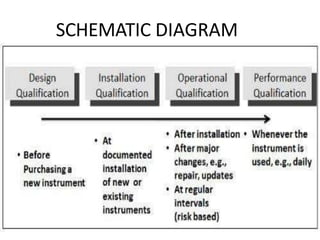
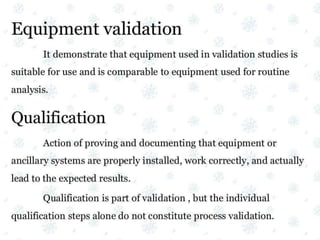
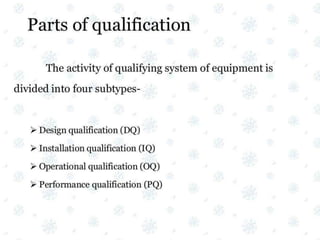
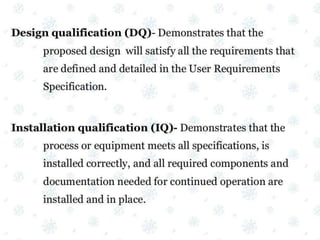
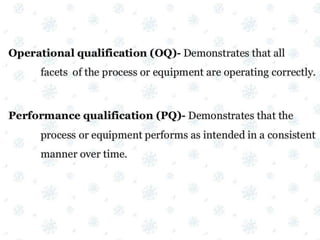
QUALIFICATION
 Qualification is an act or process to assure
something complies with some conditions,
standards or specific requirements.
ASPECTS OF VALIDATION
 Documentation Availability –
documentation that is required
All the
should be
verified and made available. This includes
electrical schematics, mechanical and
instrument drawings, utility and supply ratings,
spare parts lists, and such.
 Component and Design Verification – The
design of the equipment and its components
should be verified in accordance with
specifications and verification norms.
CONTINUE..
• Electrical Connections and Supply – All the
electrical connections and the power
supply to the equipment needs to be checked
thoroughly before you begin the validation
process.
• Utility Supply – Hydraulic, pneumatic, and
other input supplies, as well as the
connections, should be verified for quality and
checked for leaks.
CONTINUE..
 Safety Compliance – Safety checks should be
tested and noise levels should be within applicable
standards. Electrical connections and fail-safes need
to be checked and tested, and the wiring needs to be
checked for leaks. Radiation and interference levels
should be within acceptable limits too.
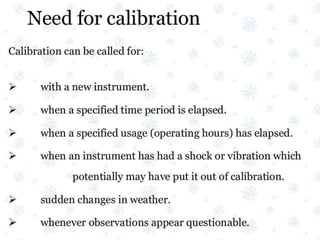
 Critical Instrument Calibration – Any sensors or
monitoring instruments need to be
correctly. The accuracy of primary
calibrated
monitoring
instruments and controls should be within the limits
of traceable standards, and the resolution should
be within the required range.
CONTINUE..
 Environmental Verification – Instruments need to be
checked for operation in various environments. This
includes testing within the required ranges of temperature,
humidity, light, electrostatic discharge isolation, and other
conditions.
 Standard Operating Procedures – SOPs for various
procedures should be available, like cleaning, periodic
maintenance, software configuration, disaster recovery, etc.
 Instrumentation for Validation- instruments used
to validate the installation qualification should be listed
and should be within the due date for re-calibration.
SCHEMATIC DIAGRAM
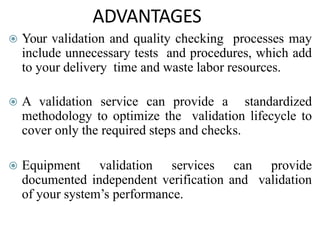
ADVANTAGES
 Your validation and quality checking processes may
include unnecessary tests and procedures, which add
to your delivery time and waste labor resources.
 A validation service can provide a standardized
methodology to optimize the validation lifecycle to
cover only the required steps and checks.
 Equipment validation services can provide
documented independent verification and validation
of your system’s performance.
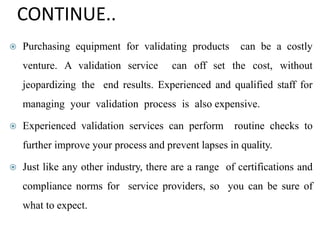
CONTINUE..
 Purchasing equipment for validating products can be a costly
venture. A validation service can off set the cost, without
jeopardizing the end results. Experienced and qualified staff for
managing your validation process is also expensive.
 Experienced validation services can perform routine checks to
further improve your process and prevent lapses in quality.
 Just like any other industry, there are a range of certifications and
compliance norms for service providers, so you can be sure of
what to expect.
CALIBRATION AND
VALIDATION OF
ANALYTICAL INSTRUMENTS