PROTECTING GROUPS
Prepared By :
MAHENDRA G S
M-Pharm,Pharmaceutical
Chemistry
JSSCP, MYSURU
Definition of Protecting Groups
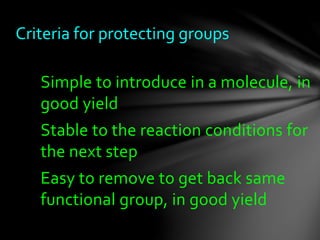
Criteria for Protecting Groups
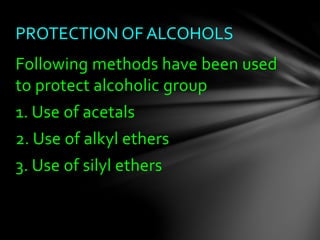
Protection of alcohols
Protection of amines
Protection of aldehydes & ketones
CONTENTS
Definition
OEt
O O
OEt
OOH
NaBH4
OH OH
LiAlH4
The ester cannot be directly reduced leaving
the ketone unaffected
The problem may be circumvented
in two ways:
a) By the use of protecting groups
b) By changing the synthetic
strategy to theTM
Solution of problem
If it is necessary to reduce an ester in
presence of a ketone then
First the ketone must be converted to
a function which is stable to the
reducing agent/
The ester then be reduced and
ketone subsequently regenerated.
Solution of problem
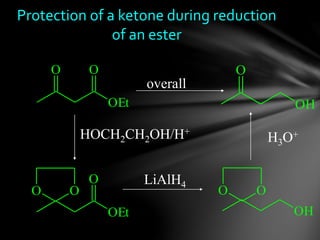
Protection of a ketone during reduction
of an ester
OEt
O O
OH
O
OEt
O
OO
OH
OO
overall
HOCH2CH2OH/H+
LiAlH4
H3O+
Simple to introduce in a molecule, in
good yield
Stable to the reaction conditions for
the next step
Easy to remove to get back same
functional group, in good yield
Criteria for protecting groups
Following methods have been used
to protect alcoholic group
1. Use of acetals
2. Use of alkyl ethers
3. Use of silyl ethers
PROTECTION OF ALCOHOLS
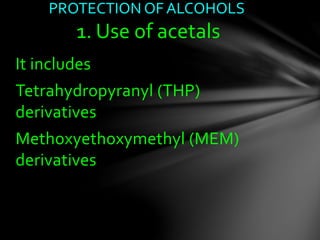
It includes
Tetrahydropyranyl (THP)
derivatives
Methoxyethoxymethyl (MEM)
derivatives
PROTECTION OF ALCOHOLS
1. Use of acetals
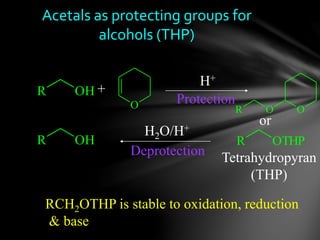
Acetals as protecting groups for
alcohols (THP)
R OH +
O OOR
Tetrahydropyran
(THP)
H+
or
OTHPR
RCH2OTHP is stable to oxidation, reduction
& base
H2O/H+
R OH
Deprotection
Protection
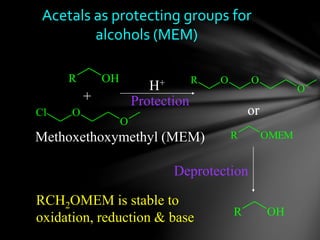
Acetals as protecting groups for
alcohols (MEM)
R OH
+
Cl O
O
or
OMEMR
R OH
Methoxethoxymethyl (MEM)
RCH2OMEM is stable to
oxidation, reduction & base
H+
Protection
Deprotection
O O
O
R
It includes
benzyl ethers
t-butylethers
PROTECTION OF ALCOHOLS
2. Use of ethers
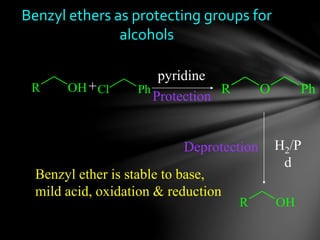
Benzyl ethers as protecting groups for
alcohols
R OH+Cl Ph R O Ph
pyridine
R OH
H2/P
d
Benzyl ether is stable to base,
mild acid, oxidation & reduction
Protection
Deprotection
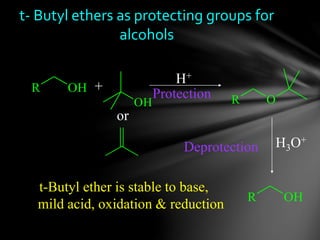
t- Butyl ethers as protecting groups for
alcohols
R OH +
OH R O
or
H+
Protection
R OH
H3O+
Deprotection
t-Butyl ether is stable to base,
mild acid, oxidation & reduction
PROTECTION OF ALCOHOLS
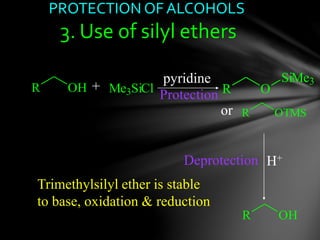
3. Use of silyl ethers
R OH + Me3SiCl R O
SiMe3pyridine
Protection
R OH
or R OTMS
H+Deprotection
Trimethylsilyl ether is stable
to base, oxidation & reduction
PROTECTION OF ALCOHOLS
3. Use of silyl ethers
Trimethylsilyl ethers are attacked by
certain nucleophiles.
To overcome this problem a number
of more bulky trialkylsilyl protecting
groups have been developed
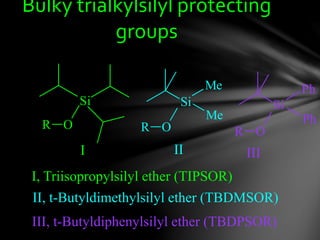
Bulky trialkylsilyl protecting
groups
OR
Si
OR
Me
Me
Si Si
Ph
Ph
OR
I II III
I, Triisopropylsilyl ether (TIPSOR)
II, t-Butyldimethylsilyl ether (TBDMSOR)
III, t-Butyldiphenylsilyl ether (TBDPSOR)

Protecting Groups

  • 1.
    PROTECTING GROUPS Prepared By: MAHENDRA G S M-Pharm,Pharmaceutical Chemistry JSSCP, MYSURU
  • 2.
    Definition of ProtectingGroups Criteria for Protecting Groups Protection of alcohols Protection of amines Protection of aldehydes & ketones CONTENTS
  • 3.
    Definition OEt O O OEt OOH NaBH4 OH OH LiAlH4 Theester cannot be directly reduced leaving the ketone unaffected
  • 4.
    The problem maybe circumvented in two ways: a) By the use of protecting groups b) By changing the synthetic strategy to theTM Solution of problem
  • 5.
    If it isnecessary to reduce an ester in presence of a ketone then First the ketone must be converted to a function which is stable to the reducing agent/ The ester then be reduced and ketone subsequently regenerated. Solution of problem
  • 6.
    Protection of aketone during reduction of an ester OEt O O OH O OEt O OO OH OO overall HOCH2CH2OH/H+ LiAlH4 H3O+
  • 7.
    Simple to introducein a molecule, in good yield Stable to the reaction conditions for the next step Easy to remove to get back same functional group, in good yield Criteria for protecting groups
  • 8.
    Following methods havebeen used to protect alcoholic group 1. Use of acetals 2. Use of alkyl ethers 3. Use of silyl ethers PROTECTION OF ALCOHOLS
  • 9.
    It includes Tetrahydropyranyl (THP) derivatives Methoxyethoxymethyl(MEM) derivatives PROTECTION OF ALCOHOLS 1. Use of acetals
  • 10.
    Acetals as protectinggroups for alcohols (THP) R OH + O OOR Tetrahydropyran (THP) H+ or OTHPR RCH2OTHP is stable to oxidation, reduction & base H2O/H+ R OH Deprotection Protection
  • 11.
    Acetals as protectinggroups for alcohols (MEM) R OH + Cl O O or OMEMR R OH Methoxethoxymethyl (MEM) RCH2OMEM is stable to oxidation, reduction & base H+ Protection Deprotection O O O R
  • 12.
  • 13.
    Benzyl ethers asprotecting groups for alcohols R OH+Cl Ph R O Ph pyridine R OH H2/P d Benzyl ether is stable to base, mild acid, oxidation & reduction Protection Deprotection
  • 14.
    t- Butyl ethersas protecting groups for alcohols R OH + OH R O or H+ Protection R OH H3O+ Deprotection t-Butyl ether is stable to base, mild acid, oxidation & reduction
  • 15.
    PROTECTION OF ALCOHOLS 3.Use of silyl ethers R OH + Me3SiCl R O SiMe3pyridine Protection R OH or R OTMS H+Deprotection Trimethylsilyl ether is stable to base, oxidation & reduction
  • 16.
    PROTECTION OF ALCOHOLS 3.Use of silyl ethers Trimethylsilyl ethers are attacked by certain nucleophiles. To overcome this problem a number of more bulky trialkylsilyl protecting groups have been developed
  • 17.
    Bulky trialkylsilyl protecting groups OR Si OR Me Me SiSi Ph Ph OR I II III I, Triisopropylsilyl ether (TIPSOR) II, t-Butyldimethylsilyl ether (TBDMSOR) III, t-Butyldiphenylsilyl ether (TBDPSOR)