MITOCHONDRIAL
GENETICS
NAME : BALAJI S
Adm. No. CAU/CPGS/MBB/M18/05
M.Sc Plant Molecular Biology And
Biotechnology
School of Crop Improvement
CAU, CPGS, Umiam
Meghalaya -793103
1
STRUCTURE AND THEIR ROLE
2
ORIGIN OF MITOCHONDRIA
3
• In circular form, the mitochondrial and chloroplast genomes look
remarkably similar to bacterial genomes.
• This similarity, along with other observations, led to the “endosymbiont
hypothesis” – the idea that both mitochondria and chloroplasts are derived
from primitive organisms that were free-living and much like bacterial
organisms.
• Organelle genomes are inherited independently of the nuclear genome
and they exhibit a uniparental mode of inheritance, with traits being
passed to offspring only from their mother.
• The organelles are only contributed from the maternal gamete (e.g. egg
cell), and not from the paternal gamete (e.g. sperm cell or pollen grain).
4
AEROBIC RESPIRATION OCCUR IN
MITOCHONDRIA
5
6
7
8
• Mitochondria are found in plants, animals, fungi, and aerobic protists.
• The mtDNA encodes essential enzymes involved in ATP production.
• mtDNA is usually a circular, double-stranded DNA molecule that is not
packaged with histones.
• There are a few exceptions where mtDNA is linear, generally in lower
eukaryotes such as yeast and some other fungi.
• mtDNA differs greatly in size among organisms.
• In animals, it is typically 16–18 kb, while in plants it ranges in size from 100
kb to 2.5 Mb.
• There are multiple copies of mtDNA per organelle, with anywhere from
several to as many as 30 copies in Euglena protozoans.
9
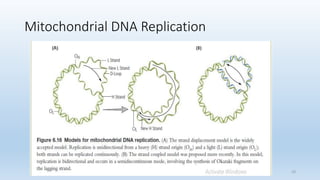
Mitochondrial DNA Replication
10
Mitochondria: Energy Conversion
• A mitochondrion is a semiautonomous, self-reproducing organelle in
the cytoplasm of eukaryotic cells.
• It has a diameter of 1–2 μm and contains multiple copies of circular
mitochondrial DNA (mtDNA) of 16569 base pairs in man.
• The number of mitochondria per cell and their shape differ in
different cell types and can change.
• An average eukaryotic cell contains 103–104 copies of mitchondria.
• Mitochondria in animal cells and chloroplasts in plant cells are the
sites of essential energy-delivering processes.
• Human mtDNA encodes 13 proteins of the respiratory chain.
11
Principal events in mitochondria
12
• Each mitochondrion is surrounded by two highly specialized membranes, the
outer and inner membranes.
• The inner membrane is folded into numerous cristae and encloses the matrix
space.
• The essential energy-generating process in mitochondria is oxidative
phosphorylation (OXPHOS).
• Relatively simple energy carriers such as NADH and FADH2 (nicotinamide adenine
dinucleotide in the reduced form and flavin adenine dinucleotide in the reduced
form) are produced from the degradation of carbohydrates, fats, and other
foodstuffs by oxidation.
• The important energy carrier adenosine triphosphate (ATP) is formed by oxidative
phosphorylation of adenosine diphosphate (ADP) through a series of biochemical
reactions in the inner membrane of mitochondria (respiratory chain).
• Another important function is intracellular oxygen transfer.
13
Oxidative phosphorylation in mitochondria
14
• Adenosine triphosphate (ATP) plays a central role in the conversion of
energy in biological systems.
• It is formed from NADH (nicotinamide adenine dinucleotide) and
adenosine diphosphate (ADP) by oxidative phosphorylation (OXPHOS).
• ATP is a nucleotide consisting of adenine, a ribose, and a triphosphate unit.
• It is energy-rich because the triphosphate unit contains two phospho-
anhydride bonds.
• Energy (free energy) is released when ATP is hydrolysed to form ADP.
• The energy contained in ATP and bound to phosphate is released, for
example, during muscle contraction.
15
Electron transfer in the inner mitochondrial
membrane
16
17
• The genomes of mitochondria and chloroplasts contain genes for the formation
of the different components of the respiratory chain and oxidative
phosphorylation.
• Three enzyme complexes regulate electron transfer: the NADH-dehydrogenase
complex, the b–c1 complex, and the cytochrome oxidase complex (C).
• Intermediaries are quinone (Q) derivatives such as ubiquinone and cytochrome
c.
• Electron transport leads to the formation of protons (H+).
• These lead to the conversion of ADP and Pi (inorganic phosphate) into ATP
(oxidative phosphorylation).
• ATP represents a phosphate-bound reservoir of energy, which serves as an
energy supplier for all biological systems. This is the reason why genetic defects in
mitochondria become manifest primarily as diseases with reduced muscle
strength and other degenerative signs.
18
Mitochondrial genes in yeast
• The mitochondrial genome of yeast is large (120 kb).
• Its genes contain introns.
• It contains genes for the tRNAs, for the respiratory chain (cytochrome oxidase 1,
2, and 3; cytochrome b), for 15 S and 21 S rRNA, and for subunits 6, 8, and 9 of
the ATPase system.
• The yeast mitochondrial genome is remarkable because its ribosomal RNA genes
are separated.
• The gene for 21 S rRNA contains an intron.
• About 25% of the mitochondrial genome of yeast contains AT-rich DNA without a
coding function.
• The genetic code of the mitochondrial genome differs from the universal code in
nuclear DNA with respect to usage of some codons.
19
20
21
The Mitochondrial Genome of Man
• The mitochondrial genome in mammals is small and compact.
• It contains no introns, and in some regions the genes overlap, so that
practically every base pair is part of a coding gene.
• The mitochondrial genomes of humans and mice have been
sequenced and contain extensive homologies.
• Each consists of about 16.5 kb, i.e., they are considerably smaller
than a yeast mitochondrial or a chloroplast genome.
• In germ cells, mitochondria are almost exclusively present in oocytes,
whereas spermatozoa contain few. Thus, they are inherited from the
mother, through an oocyte (maternal inheritance).
22
A. Mitochondrial genes in man
• The human mitochondrial genome, sequenced in 1981 by Andersen et al., has 16569 base pairs.
• Each mitochondrion contains 2–10 DNA molecules.
• A heavy (H) and a light (L) single strand can be differentiated by a density gradient.
• Human mtDNA contains 13 protein coding regions for four metabolic processes: (i) for NADH
dehydrogenase; (ii) for the cytochrome c oxidase complex (subunits 1, 2, and 3); (iii) for cytochrome b; and
(iv) for subunits 6 and 8 of the ATPase complex.
• Unlike that of yeast, mammalian mitochondrial DNA contains seven subunits for NADH dehydrogenase (ND1,
ND2, ND3, ND4L, ND4, ND5, and ND6).
• Of the mitochondrial coding capacity, 60% is taken up by the seven subunits of NADH reductase (ND).
• Most genes are found on the H strand. The L strand codes for a protein (ND subunit 6) and 8 tRNAs. From
the H strand, two RNAs are transcribed, a short one for the rRNAs and a long one for mRNA and 14 tRNAs.
• A single transcript is made from the L strand. A 7 S RNA is transcribed in a counterclockwise manner close to
the origin of replication (ORI), located between 11 and 12 o’clock on the circular structure.
23
24
Cooperation between mitochondrial and
nuclear genome
• Many mitochondrial proteins are aggregates of gene products of
nuclear and mitochondrial genes.
• These gene products are transported into the mitochondria after
nuclear transcription and cytoplasmic translation.
• In the mitochondria,they form functional proteins from subunits of
mitochondrial and nuclear gene products.
• This explains why a number of mitochondrial genetic disorders show
Mendelian inheritance, while purely mitochondrially determined
disorders show exclusively maternal inheritance.
25
26
27
Mitochondrial Diseases
• A large, complex, and heterogeneous group of diseases is caused by mutations or
deletions in human mtDNA.
• The clinical spectrum and age of onset of mitochondrial diseases vary widely.
• Organs with high-energy requirements are particularly vulnerable to mitochondrial
disorders: the brain, heart, skeletal muscle, eye, ear, liver, pancreas, and kidney.
• Normally, acquired mitochondrial mutations accumulate with age.
• Mitochondrial mutations are transmitted by maternal inheritance.
• The mutation rate of mitochondrial DNA is ten times higher than that of nuclear DNA.
• Mitochondrial mutations are generated during oxidative phosphorylation through
pathways involving reactive oxygen molecules.
• Mutations accumulate because effective DNA repair and protective histones are lacking.
• At birth most mtDNA molecules are identical (homoplasmy); later they differ as a result
of mutations accumulated in different mitochondria (heteroplasmy).
28
A. Mutations and deletions in mitochondrial
DNA in man
• Both deletions and point mutations are causes of mitochondrial
genetic disorders.
• Some are characteristic and recur in different, unrelated patients.
29
30
B. Maternal inheritance of a mitochondrial
disease
• Hereditary mitochondrial diseases are transmitted only through the
maternal line, since spermatozoa contain hardly any mitochondria.
• Thus, the disease will not be transmitted from an affected man to his
children.
31
32
C. Heteroplasmy for mitochondrial
mutations
• Many mutations or deletions in mitochondria are acquired during an
individual's lifetime.
• Their proportion may be different in different tissues and influenced
by age. This difference is referred to as heteroplasmy.
• This contributes to the considerable variability of mitochondrial
diseases.
• A germline mutation may be present in all cells (homoplasmy).
• The proportion of defective mitochondria varies after repeated cell
divisions.
33
34
35
Mitochondrial DNA Analysis
• Sometimes there is not enough nuclear DNA for analysis, or it is
highly degraded.
• Because every cell has hundreds of mitochondria with several
hundred mtDNA molecules and mtDNA degrades less rapidly than
nuclear DNA, older biological samples (e.g. strands of hair, solid bone,
or teeth) often lack usable nuclear DNA but have abundant mtDNA.
• mtDNA has even been successfully isolated from the fossil bones of a
60,000-year-old anatomically modern man from Lake Mungo in
Australia.
• In modern people, this sequence now exists as an insert on
chromosome 11 in the nuclear genome.
36
• Mitochondrial DNA analysis is used to examine DNA from forensic
samples when experts presume that nuclear DNA, which can provide
a more precise match, is not present in sufficient quantities to
warrant STR (or minisatellite) analysis.
• Analysis typically involves PCR amplification and direct sequencing
of two highly variable regions in the D loop region of the mtDNA
called hypervariable (HV) regions 1 and 2
37
DEFINITIONS
• D loop (mtDNA) Displacement loop. A region of 500–600 nucleotides where
replication begins in mitochondrial DNA.
• DNA polymerase γ The eukaryotic DNA polymerase involved in high fidelity
replication and repair of mitochondrial DNA.
• heteroplasmy A condition in which both mutant and normal mitochondrial DNA
coexist within the same cell.
• homoplasmy The normal condition in which all the mitochondrial DNA (mtDNA)
within the cells of an individual are identical.
• Kearns–Sayre syndrome A disease linked to mitochondrial DNA (mtDNA)
mutations that is characterized by paralysis of eye muscles, progressive muscle
degeneration, heart disease, hearing loss, diabetes, and kidney failure.
• Leber’s hereditary optic neuropathy (LHON) A form of young-adult blindness
linked to a small inherited mutation in a mitochondrial gene.
38
39
40
Alberts B et al ., (1998) Essential Cell Biology. An Introduction to the
Molecular Biology of the Cell. Garland Publishing , New York.
Anderson S et al ., (1981.) Sequence and organization of the human
mitochondrial genome. Nature 290:457–474.
Singer M, Berg P (1991) Genes and Genomes. Blackwell Scientific
Publishers, Oxford.
http://www.mitomap.org
www.DIFFERNCEBETWEEN.COM
reference
41
42

MITOCHONDRIAL GENETICS

  • 1.
    MITOCHONDRIAL GENETICS NAME : BALAJIS Adm. No. CAU/CPGS/MBB/M18/05 M.Sc Plant Molecular Biology And Biotechnology School of Crop Improvement CAU, CPGS, Umiam Meghalaya -793103 1
  • 2.
  • 3.
  • 4.
    • In circularform, the mitochondrial and chloroplast genomes look remarkably similar to bacterial genomes. • This similarity, along with other observations, led to the “endosymbiont hypothesis” – the idea that both mitochondria and chloroplasts are derived from primitive organisms that were free-living and much like bacterial organisms. • Organelle genomes are inherited independently of the nuclear genome and they exhibit a uniparental mode of inheritance, with traits being passed to offspring only from their mother. • The organelles are only contributed from the maternal gamete (e.g. egg cell), and not from the paternal gamete (e.g. sperm cell or pollen grain). 4
  • 5.
    AEROBIC RESPIRATION OCCURIN MITOCHONDRIA 5
  • 6.
  • 7.
  • 8.
  • 9.
    • Mitochondria arefound in plants, animals, fungi, and aerobic protists. • The mtDNA encodes essential enzymes involved in ATP production. • mtDNA is usually a circular, double-stranded DNA molecule that is not packaged with histones. • There are a few exceptions where mtDNA is linear, generally in lower eukaryotes such as yeast and some other fungi. • mtDNA differs greatly in size among organisms. • In animals, it is typically 16–18 kb, while in plants it ranges in size from 100 kb to 2.5 Mb. • There are multiple copies of mtDNA per organelle, with anywhere from several to as many as 30 copies in Euglena protozoans. 9
  • 10.
  • 11.
    Mitochondria: Energy Conversion •A mitochondrion is a semiautonomous, self-reproducing organelle in the cytoplasm of eukaryotic cells. • It has a diameter of 1–2 μm and contains multiple copies of circular mitochondrial DNA (mtDNA) of 16569 base pairs in man. • The number of mitochondria per cell and their shape differ in different cell types and can change. • An average eukaryotic cell contains 103–104 copies of mitchondria. • Mitochondria in animal cells and chloroplasts in plant cells are the sites of essential energy-delivering processes. • Human mtDNA encodes 13 proteins of the respiratory chain. 11
  • 12.
    Principal events inmitochondria 12
  • 13.
    • Each mitochondrionis surrounded by two highly specialized membranes, the outer and inner membranes. • The inner membrane is folded into numerous cristae and encloses the matrix space. • The essential energy-generating process in mitochondria is oxidative phosphorylation (OXPHOS). • Relatively simple energy carriers such as NADH and FADH2 (nicotinamide adenine dinucleotide in the reduced form and flavin adenine dinucleotide in the reduced form) are produced from the degradation of carbohydrates, fats, and other foodstuffs by oxidation. • The important energy carrier adenosine triphosphate (ATP) is formed by oxidative phosphorylation of adenosine diphosphate (ADP) through a series of biochemical reactions in the inner membrane of mitochondria (respiratory chain). • Another important function is intracellular oxygen transfer. 13
  • 14.
  • 15.
    • Adenosine triphosphate(ATP) plays a central role in the conversion of energy in biological systems. • It is formed from NADH (nicotinamide adenine dinucleotide) and adenosine diphosphate (ADP) by oxidative phosphorylation (OXPHOS). • ATP is a nucleotide consisting of adenine, a ribose, and a triphosphate unit. • It is energy-rich because the triphosphate unit contains two phospho- anhydride bonds. • Energy (free energy) is released when ATP is hydrolysed to form ADP. • The energy contained in ATP and bound to phosphate is released, for example, during muscle contraction. 15
  • 16.
    Electron transfer inthe inner mitochondrial membrane 16
  • 17.
  • 18.
    • The genomesof mitochondria and chloroplasts contain genes for the formation of the different components of the respiratory chain and oxidative phosphorylation. • Three enzyme complexes regulate electron transfer: the NADH-dehydrogenase complex, the b–c1 complex, and the cytochrome oxidase complex (C). • Intermediaries are quinone (Q) derivatives such as ubiquinone and cytochrome c. • Electron transport leads to the formation of protons (H+). • These lead to the conversion of ADP and Pi (inorganic phosphate) into ATP (oxidative phosphorylation). • ATP represents a phosphate-bound reservoir of energy, which serves as an energy supplier for all biological systems. This is the reason why genetic defects in mitochondria become manifest primarily as diseases with reduced muscle strength and other degenerative signs. 18
  • 19.
    Mitochondrial genes inyeast • The mitochondrial genome of yeast is large (120 kb). • Its genes contain introns. • It contains genes for the tRNAs, for the respiratory chain (cytochrome oxidase 1, 2, and 3; cytochrome b), for 15 S and 21 S rRNA, and for subunits 6, 8, and 9 of the ATPase system. • The yeast mitochondrial genome is remarkable because its ribosomal RNA genes are separated. • The gene for 21 S rRNA contains an intron. • About 25% of the mitochondrial genome of yeast contains AT-rich DNA without a coding function. • The genetic code of the mitochondrial genome differs from the universal code in nuclear DNA with respect to usage of some codons. 19
  • 20.
  • 21.
  • 22.
    The Mitochondrial Genomeof Man • The mitochondrial genome in mammals is small and compact. • It contains no introns, and in some regions the genes overlap, so that practically every base pair is part of a coding gene. • The mitochondrial genomes of humans and mice have been sequenced and contain extensive homologies. • Each consists of about 16.5 kb, i.e., they are considerably smaller than a yeast mitochondrial or a chloroplast genome. • In germ cells, mitochondria are almost exclusively present in oocytes, whereas spermatozoa contain few. Thus, they are inherited from the mother, through an oocyte (maternal inheritance). 22
  • 23.
    A. Mitochondrial genesin man • The human mitochondrial genome, sequenced in 1981 by Andersen et al., has 16569 base pairs. • Each mitochondrion contains 2–10 DNA molecules. • A heavy (H) and a light (L) single strand can be differentiated by a density gradient. • Human mtDNA contains 13 protein coding regions for four metabolic processes: (i) for NADH dehydrogenase; (ii) for the cytochrome c oxidase complex (subunits 1, 2, and 3); (iii) for cytochrome b; and (iv) for subunits 6 and 8 of the ATPase complex. • Unlike that of yeast, mammalian mitochondrial DNA contains seven subunits for NADH dehydrogenase (ND1, ND2, ND3, ND4L, ND4, ND5, and ND6). • Of the mitochondrial coding capacity, 60% is taken up by the seven subunits of NADH reductase (ND). • Most genes are found on the H strand. The L strand codes for a protein (ND subunit 6) and 8 tRNAs. From the H strand, two RNAs are transcribed, a short one for the rRNAs and a long one for mRNA and 14 tRNAs. • A single transcript is made from the L strand. A 7 S RNA is transcribed in a counterclockwise manner close to the origin of replication (ORI), located between 11 and 12 o’clock on the circular structure. 23
  • 24.
  • 25.
    Cooperation between mitochondrialand nuclear genome • Many mitochondrial proteins are aggregates of gene products of nuclear and mitochondrial genes. • These gene products are transported into the mitochondria after nuclear transcription and cytoplasmic translation. • In the mitochondria,they form functional proteins from subunits of mitochondrial and nuclear gene products. • This explains why a number of mitochondrial genetic disorders show Mendelian inheritance, while purely mitochondrially determined disorders show exclusively maternal inheritance. 25
  • 26.
  • 27.
  • 28.
    Mitochondrial Diseases • Alarge, complex, and heterogeneous group of diseases is caused by mutations or deletions in human mtDNA. • The clinical spectrum and age of onset of mitochondrial diseases vary widely. • Organs with high-energy requirements are particularly vulnerable to mitochondrial disorders: the brain, heart, skeletal muscle, eye, ear, liver, pancreas, and kidney. • Normally, acquired mitochondrial mutations accumulate with age. • Mitochondrial mutations are transmitted by maternal inheritance. • The mutation rate of mitochondrial DNA is ten times higher than that of nuclear DNA. • Mitochondrial mutations are generated during oxidative phosphorylation through pathways involving reactive oxygen molecules. • Mutations accumulate because effective DNA repair and protective histones are lacking. • At birth most mtDNA molecules are identical (homoplasmy); later they differ as a result of mutations accumulated in different mitochondria (heteroplasmy). 28
  • 29.
    A. Mutations anddeletions in mitochondrial DNA in man • Both deletions and point mutations are causes of mitochondrial genetic disorders. • Some are characteristic and recur in different, unrelated patients. 29
  • 30.
  • 31.
    B. Maternal inheritanceof a mitochondrial disease • Hereditary mitochondrial diseases are transmitted only through the maternal line, since spermatozoa contain hardly any mitochondria. • Thus, the disease will not be transmitted from an affected man to his children. 31
  • 32.
  • 33.
    C. Heteroplasmy formitochondrial mutations • Many mutations or deletions in mitochondria are acquired during an individual's lifetime. • Their proportion may be different in different tissues and influenced by age. This difference is referred to as heteroplasmy. • This contributes to the considerable variability of mitochondrial diseases. • A germline mutation may be present in all cells (homoplasmy). • The proportion of defective mitochondria varies after repeated cell divisions. 33
  • 34.
  • 35.
  • 36.
    Mitochondrial DNA Analysis •Sometimes there is not enough nuclear DNA for analysis, or it is highly degraded. • Because every cell has hundreds of mitochondria with several hundred mtDNA molecules and mtDNA degrades less rapidly than nuclear DNA, older biological samples (e.g. strands of hair, solid bone, or teeth) often lack usable nuclear DNA but have abundant mtDNA. • mtDNA has even been successfully isolated from the fossil bones of a 60,000-year-old anatomically modern man from Lake Mungo in Australia. • In modern people, this sequence now exists as an insert on chromosome 11 in the nuclear genome. 36
  • 37.
    • Mitochondrial DNAanalysis is used to examine DNA from forensic samples when experts presume that nuclear DNA, which can provide a more precise match, is not present in sufficient quantities to warrant STR (or minisatellite) analysis. • Analysis typically involves PCR amplification and direct sequencing of two highly variable regions in the D loop region of the mtDNA called hypervariable (HV) regions 1 and 2 37
  • 38.
    DEFINITIONS • D loop(mtDNA) Displacement loop. A region of 500–600 nucleotides where replication begins in mitochondrial DNA. • DNA polymerase γ The eukaryotic DNA polymerase involved in high fidelity replication and repair of mitochondrial DNA. • heteroplasmy A condition in which both mutant and normal mitochondrial DNA coexist within the same cell. • homoplasmy The normal condition in which all the mitochondrial DNA (mtDNA) within the cells of an individual are identical. • Kearns–Sayre syndrome A disease linked to mitochondrial DNA (mtDNA) mutations that is characterized by paralysis of eye muscles, progressive muscle degeneration, heart disease, hearing loss, diabetes, and kidney failure. • Leber’s hereditary optic neuropathy (LHON) A form of young-adult blindness linked to a small inherited mutation in a mitochondrial gene. 38
  • 39.
  • 40.
  • 41.
    Alberts B etal ., (1998) Essential Cell Biology. An Introduction to the Molecular Biology of the Cell. Garland Publishing , New York. Anderson S et al ., (1981.) Sequence and organization of the human mitochondrial genome. Nature 290:457–474. Singer M, Berg P (1991) Genes and Genomes. Blackwell Scientific Publishers, Oxford. http://www.mitomap.org www.DIFFERNCEBETWEEN.COM reference 41
  • 42.