Prepared By :
MAHENDRA G S
M-Pharm,Pharmaceutical
Chemistry
JSSCP, MYSURU
 The technique was
introduced in 1960
by Berson and Yalow
as an assay for the
concentration of
insulin in plasma.
 It represented the
first time that
hormone levels in
the blood could be
detected by an
invitro assay.
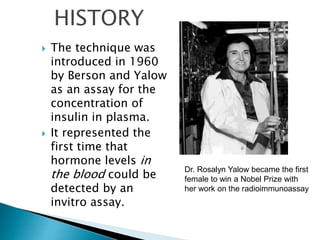
Dr. Rosalyn Yalow became the first
female to win a Nobel Prize with
her work on the radioimmunoassay
HISTORY
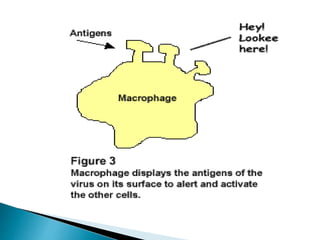
 An antigen is a substance with the ability to induce an
immunological response. They typically enter the body
from an infection. They are recognized at their epitopes by
B cells or by the T cell receptor on T cells.
 Proteins or glycoproteins make the best antigens because
they are the best at stimulating antigen recognition
molecules. Some immunoassays test for antigens, rather
than antibodies.
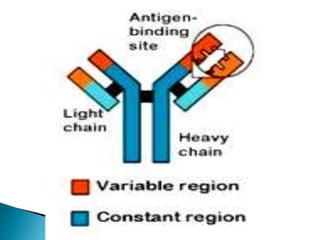
• Antibodies are produced by the
B-lymphocytes. They are glycoproteins
belonging to the “immunoglobulin supergene
family” that are produced in response to a
foreign substance in the body.
• Antibodies have a generally common structure,
but have regions that vary among them to
accommodate the specific antigens.
 Polyclonal antibodies are more likely to
produce a false positive because they are
less specific to antigen epitopes and have
varying binding affinities.
◦ A mouse (or rabbit) is immunized by being
injected with an antigen; the antigen generates an
antibody response in the animal.
◦ The animal is bled and the antibodies are
collected.
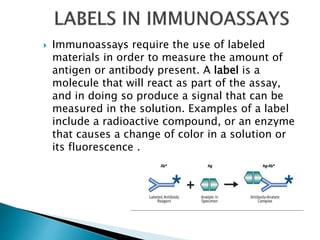
 Immunoassays require the use of labeled
materials in order to measure the amount of
antigen or antibody present. A label is a
molecule that will react as part of the assay,
and in doing so produce a signal that can be
measured in the solution. Examples of a label
include a radioactive compound, or an enzyme
that causes a change of color in a solution or
its fluorescence .
 Radioimmunoassay (RIA) involves the
separation of a protein (from a mixture) using
the specificity of antibody - antigen binding
and quantitation using radioactivity.
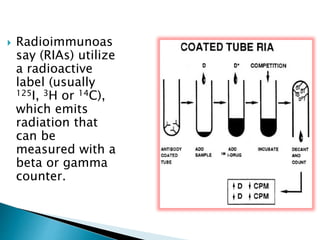
 Radioimmunoas
say (RIAs) utilize
a radioactive
label (usually
125I, 3H or 14C),
which emits
radiation that
can be
measured with a
beta or gamma
counter.
 The technique of
radioimmunoassay has
revolutionized research and
clinical practice in many areas,
e.g.,
◦ blood banking
◦ diagnosis of allergies
◦ endocrinology
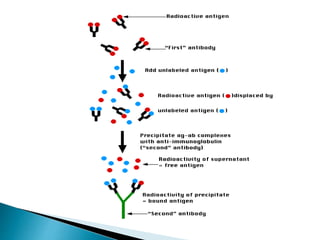
 A mixture is prepared of
◦ radioactive antigen
 Because of the ease with which iodine
atoms can be introduced into tyrosine
residues in a protein, the radioactive
isotopes 125I or 131I are often used.
◦ antibodies against that antigen.
 Known amounts of unlabeled ("cold") antigen
are added to samples of the mixture. These
compete for the binding sites of the
antibodies.
 At increasing concentrations of unlabeled
antigen, an increasing amount of radioactive
antigen is displaced from the antibody
molecules.
 The antibody-bound antigen is separated
from the free antigen in the supernatant
fluid, and the radioactivity of each is
measured.
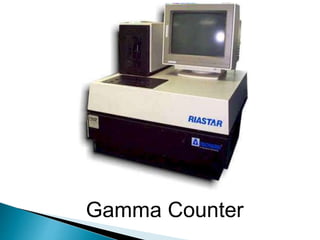
Gamma Counter
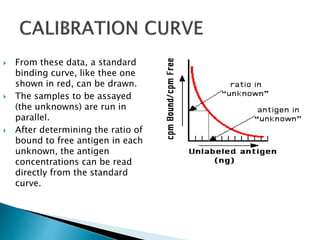
 From these data, a standard
binding curve, like thee one
shown in red, can be drawn.
 The samples to be assayed
(the unknowns) are run in
parallel.
 After determining the ratio of
bound to free antigen in each
unknown, the antigen
concentrations can be read
directly from the standard
curve.
 Precipitate the antigen-antibody complexes
by adding a "second" antibody directed
against the first.
 For example, if a rabbit IgG is used to bind the
antigen, the complex can be precipitated by
adding an antirabbit-IgG antiserum (e.g., raised
by immunizing a goat with rabbit IgG).
 Radioimmunoassay is widely-used
because of its great sensitivity.
 Using antibodies of high affinity, it is
possible to detect a few pictograms
(10−12 g) of antigen in the tube.
 The greater the specificity of the
antiserum, the greater the specificity of
the assay
 RIA has become a major tool in the clinical
laboratory where it is used to assay .
 plasma levels of:
◦ most of our hormones;
◦ digitoxin or digoxin in patients receiving
these drugs;
◦ certain abused drugs.
 Presence of hepatitis B surface antigen
(HBsAg) in donated blood.
 Anti-DNA antibodies in systemic lupus
erythematosus (SLE).
 Screening donated blood for evidence of viral
contamination by
◦ HIV-1 and HIV-2 (presence of anti-HIV
antibodies)
◦ Hepatitis C (presence of antibodies)
◦ Hepatitis B (testing for both antibodies and a viral
antigen)
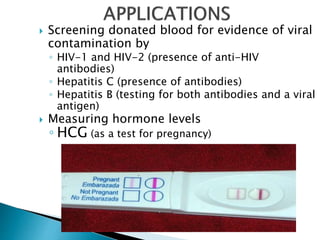
 Measuring hormone levels
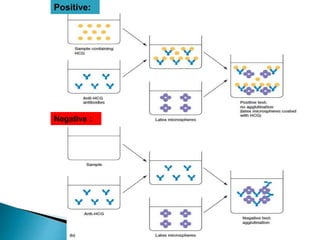
◦ HCG (as a test for pregnancy)
Negative :
Positive:
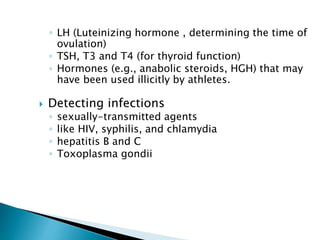
◦ LH (Luteinizing hormone , determining the time of
ovulation)
◦ TSH, T3 and T4 (for thyroid function)
◦ Hormones (e.g., anabolic steroids, HGH) that may
have been used illicitly by athletes.
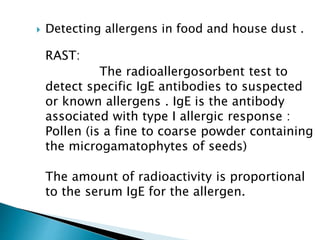
 Detecting infections
◦ sexually-transmitted agents
◦ like HIV, syphilis, and chlamydia
◦ hepatitis B and C
◦ Toxoplasma gondii
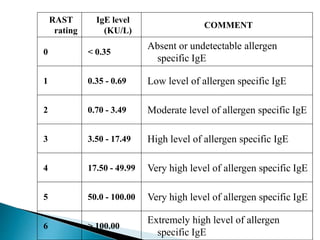
 Detecting allergens in food and house dust .
RAST:
The radioallergosorbent test to
detect specific IgE antibodies to suspected
or known allergens . IgE is the antibody
associated with type I allergic response :
Pollen (is a fine to coarse powder containing
the microgamatophytes of seeds)
The amount of radioactivity is proportional
to the serum IgE for the allergen.
RAST
rating
IgE level
(KU/L)
COMMENT
0 < 0.35
Absent or undetectable allergen
specific IgE
1 0.35 - 0.69 Low level of allergen specific IgE
2 0.70 - 3.49 Moderate level of allergen specific IgE
3 3.50 - 17.49 High level of allergen specific IgE
4 17.50 - 49.99 Very high level of allergen specific IgE
5 50.0 - 100.00 Very high level of allergen specific IgE
6 > 100.00
Extremely high level of allergen
specific IgE
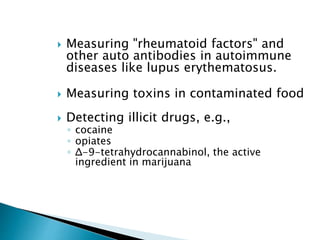
 Measuring "rheumatoid factors" and
other auto antibodies in autoimmune
diseases like lupus erythematosus.
 Measuring toxins in contaminated food
 Detecting illicit drugs, e.g.,
◦ cocaine
◦ opiates
◦ Δ-9-tetrahydrocannabinol, the active
ingredient in marijuana
 Analysis of hormones, vitamins,metabolites,
diagnostic markers
◦ Eg. ACTH, FSH, T3, T4, Glucagon, Insulin,
Testosterone, vitamin B12, prostaglandins,
glucocorticoids,
 Therapeutic drug monitoring:
◦ Barbiturates, morphine, digoxin,
 Diagnostic procedures for detecting infection
◦ HIV, Hepatitis A, B etc
26
• used to assay
 plasma levels of:
most of our hormones;
digitoxin or digoxin in patients receiving
these drugs;
certain abused drugs
 for the presence of hepatitis B surface
antigen (HBsAg) in donated blood;
27
 In Endocrinology
Insulin, HCG, Vasopressin
Detects Endocrine Disorders
Physiology of Endocrine Function
 In Pharmacology
Morphine
Detect Drug Abuse or Drug
Poisoning
Study Drug Kinetics
28
 Narcotic drug detection
 tracking of leukemia virus
 diagnosis and treatment of peptic ulcers
 research with Neurotransmitters
29
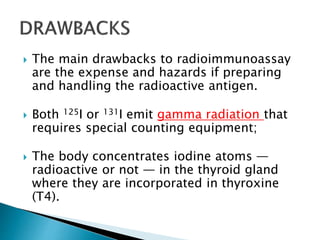
 The main drawbacks to radioimmunoassay
are the expense and hazards if preparing
and handling the radioactive antigen.
 Both 125I or 131I emit gamma radiation that
requires special counting equipment;
 The body concentrates iodine atoms —
radioactive or not — in the thyroid gland
where they are incorporated in thyroxine
(T4).
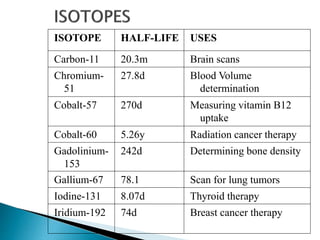
ISOTOPE HALF-LIFE USES
Carbon-11 20.3m Brain scans
Chromium-
51
27.8d Blood Volume
determination
Cobalt-57 270d Measuring vitamin B12
uptake
Cobalt-60 5.26y Radiation cancer therapy
Gadolinium-
153
242d Determining bone density
Gallium-67 78.1 Scan for lung tumors
Iodine-131 8.07d Thyroid therapy
Iridium-192 74d Breast cancer therapy
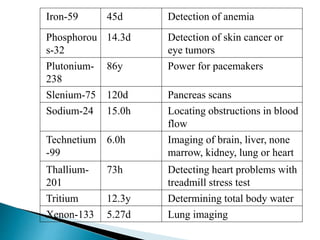
Iron-59 45d Detection of anemia
Phosphorou
s-32
14.3d Detection of skin cancer or
eye tumors
Plutonium-
238
86y Power for pacemakers
Slenium-75 120d Pancreas scans
Sodium-24 15.0h Locating obstructions in blood
flow
Technetium
-99
6.0h Imaging of brain, liver, none
marrow, kidney, lung or heart
Thallium-
201
73h Detecting heart problems with
treadmill stress test
Tritium 12.3y Determining total body water
Xenon-133 5.27d Lung imaging
• http://en.wikipedia.org/wiki/RIA
.
• http://www.millipore.com/immunodetect
on/id3/radioimmunoassay.
Radio immuno assay