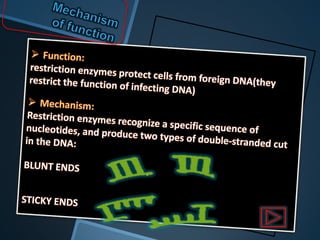
Restriction
  Endonuclease
MCB5706:BIOMOLECULAR
     ENGINEERING
   Prof Tan Wen Siang
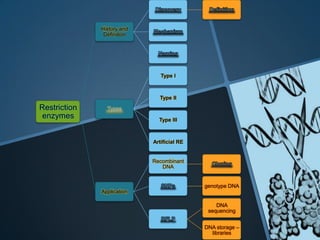
History and
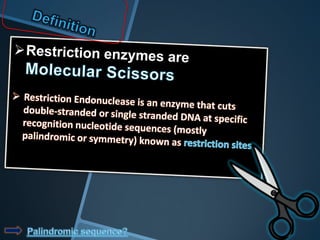
               Definition


                               Type I


                              Type II
Restriction     Types
 enzymes                      Type III


                            Artificial RE


                            Recombinant
                               DNA


                                            genotype DNA
              Application

                                                DNA
                                             sequencing


                                            DNA storage –
                                              libraries
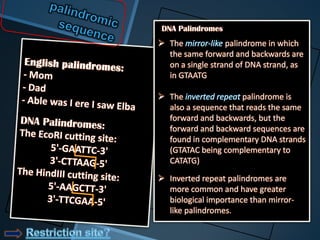
DNA Palindromes
 The             palindrome in which
  the same forward and backwards are
  on a single strand of DNA strand, as
  in GTAATG

 The                palindrome is
  also a sequence that reads the same
  forward and backwards, but the
  forward and backward sequences are
  found in complementary DNA strands
  (GTATAC being complementary to
  CATATG)
 Inverted repeat palindromes are
  more common and have greater
  biological importance than mirror-
  like palindromes.
Back
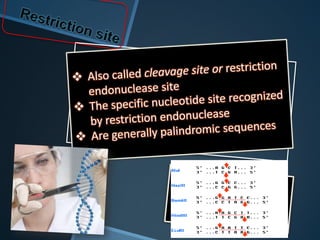
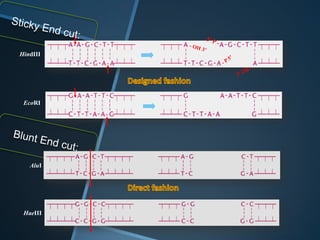
HindIII


 EcoRI


   AluI


 HaeIII
Back
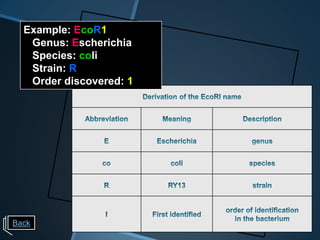
Example: EcoR1
   Genus: Escherichia
   Species: coli
   Strain: R
   Order discovered: 1


Back
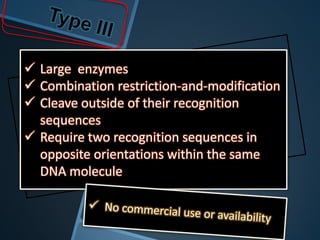
 Large enzymes
 Combination restriction-and-modification
 Cleave outside of their recognition
  sequences
 Require two recognition sequences in
  opposite orientations within the same
  DNA molecule
 Cleave only normal and modified DNA
  (methylated, hydroxymethylated and
  glucosyl-hydroxymethylated bases).
 Recognition sequences have not been well
  defined
 Cleavage takes place ~30 bp away from one
  of the sites
 generated by fusing a natural or engineered DNA
     binding domain to a nuclease domain
    can target large DNA sites (up to 36 bp)
    can be engineered to bind to desired DNA
     sequences


Back
   Application in cut and paste DNA make genetic
    engineering possible with coordination of Ligase Enzyme
   Rrestriction site could be added to primers
    (forward&Reverse) that will be used for amplifying gene
   Both vector and amplified gene will be cut by RE to
    produce sticky ends
   In ligation mixture the target gene will be inserted to vector
    with the aid of sticky ends and DNA ligase
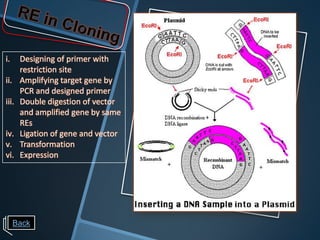
i.     Designing of primer with
       restriction site
ii.    Amplifying target gene by
       PCR and designed primer
iii.   Double digestion of vector
       and amplified gene by same
       REs
iv.    Ligation of gene and vector
v.     Transformation
vi.    Expression


      Back
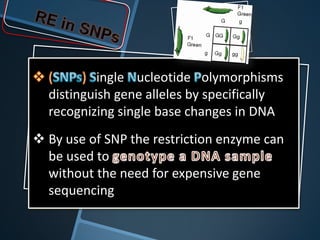
(     ) ingle ucleotide olymorphisms
 distinguish gene alleles by specifically
 recognizing single base changes in DNA
 By use of SNP the restriction enzyme can
  be used to
  without the need for expensive gene
  sequencing
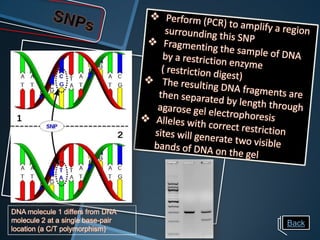
DNA molecule 1 differs from DNA
molecule 2 at a single base-pair   Back
location (a C/T polymorphism)
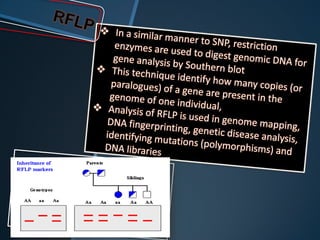
 (RFLP) Restriction Fragment Length
  Polymorphism
 Molecular biologists have identified
  regions of the human genome where
  restriction fragment lengths are highly
  variable between individuals
 Electrophoresis of these RFLP’s produce
  different patterns of DNA bands
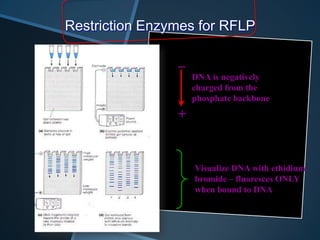
Restriction Enzymes for RFLP

                _
                    DNA is negatively
                    charged from the
                    phosphate backbone
                +


                    Visualize DNA with ethidium
                    bromide – fluoresces ONLY
                    when bound to DNA
Restriction Enzymes

Restriction Enzymes

  • 1.
    Restriction Endonuclease MCB5706:BIOMOLECULAR ENGINEERING Prof Tan Wen Siang
  • 2.
    History and Definition Type I Type II Restriction Types enzymes Type III Artificial RE Recombinant DNA genotype DNA Application DNA sequencing DNA storage – libraries
  • 5.
    DNA Palindromes  The palindrome in which the same forward and backwards are on a single strand of DNA strand, as in GTAATG  The palindrome is also a sequence that reads the same forward and backwards, but the forward and backward sequences are found in complementary DNA strands (GTATAC being complementary to CATATG)  Inverted repeat palindromes are more common and have greater biological importance than mirror- like palindromes.
  • 7.
  • 9.
    HindIII EcoRI AluI HaeIII
  • 10.
  • 12.
    Example: EcoR1 Genus: Escherichia Species: coli Strain: R Order discovered: 1 Back
  • 16.
     Large enzymes Combination restriction-and-modification  Cleave outside of their recognition sequences  Require two recognition sequences in opposite orientations within the same DNA molecule
  • 17.
     Cleave onlynormal and modified DNA (methylated, hydroxymethylated and glucosyl-hydroxymethylated bases).  Recognition sequences have not been well defined  Cleavage takes place ~30 bp away from one of the sites
  • 18.
     generated byfusing a natural or engineered DNA binding domain to a nuclease domain  can target large DNA sites (up to 36 bp)  can be engineered to bind to desired DNA sequences Back
  • 19.
    Application in cut and paste DNA make genetic engineering possible with coordination of Ligase Enzyme  Rrestriction site could be added to primers (forward&Reverse) that will be used for amplifying gene  Both vector and amplified gene will be cut by RE to produce sticky ends  In ligation mixture the target gene will be inserted to vector with the aid of sticky ends and DNA ligase
  • 20.
    i. Designing of primer with restriction site ii. Amplifying target gene by PCR and designed primer iii. Double digestion of vector and amplified gene by same REs iv. Ligation of gene and vector v. Transformation vi. Expression Back
  • 21.
    ( ) ingle ucleotide olymorphisms distinguish gene alleles by specifically recognizing single base changes in DNA  By use of SNP the restriction enzyme can be used to without the need for expensive gene sequencing
  • 22.
    DNA molecule 1differs from DNA molecule 2 at a single base-pair Back location (a C/T polymorphism)
  • 23.
     (RFLP) RestrictionFragment Length Polymorphism  Molecular biologists have identified regions of the human genome where restriction fragment lengths are highly variable between individuals  Electrophoresis of these RFLP’s produce different patterns of DNA bands
  • 25.
    Restriction Enzymes forRFLP _ DNA is negatively charged from the phosphate backbone + Visualize DNA with ethidium bromide – fluoresces ONLY when bound to DNA