R-DNA
TECHNOLOGY
Likhita Chandra
2nd sem M.Tech, UVCE
UNIVERSITY OF VISVESVARAYA COLLEGE OF ENGINEERING
Jnana Bharathi, Bengaluru - 560056
Submitted by :
LIKHITA CHANDRA - P25UV22T050002
IInd
Semester M.Tech
Environmental Engineering
UVCE, Bengaluru.
Under the guidance of :
B. SANTHAVEERANAGOUD
Professor
Environmental Engineering
UVCE,
Seminar on
RECOMBINANT DNA
TECHNOLOGY
2
Contents
1. Introduction
2. Concepts Of R-DNA Technology
3. Why Recombinant Dna Technology?
4. History Of Recombinant DNA
5. Tools Of Recombinant DNA Technology
6. Steps Involved In Recombinant Dna Technology:
7. Applications of R-DNA
8. Applications of R-DNA In Environmental Issues:
9. Drawbacks Of Rdna Technology
10. Biosafety
3
Introduction
❖ Recombinant DNA technology, or RDT, was only the theory that targeted gene expression might
be changed to change certain characteristics in living things during the previous century. In the
modern day, this field has significantly advanced human progress.
❖ With its broad range of uses, this technology holds the potential to enhance many aspects of life,
including health, food availability, and resilience to various harmful environmental effects.
❖ This technology allows for the safe, low-cost, and insufficient production of essential protein
requirements and health concerns.
❖ The power of rDNA technology comes from our ability to study and modify gene function by
manipulating genes and transforming them into cells of plants and animals.
4
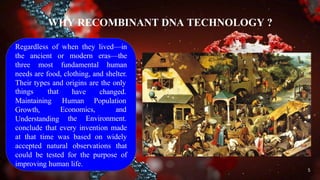
WHY RECOMBINANT DNA TECHNOLOGY ?
Regardless of when they lived—in
the ancient or modern eras—the
three most fundamental human
needs are food, clothing, and shelter.
Their types and origins are the only
things that have
Human
changed.
Population
Economics, and
Maintaining
Growth,
Understanding the Environment.
conclude that every invention made
at that time was based on widely
accepted natural observations that
could be tested for the purpose of
improving human life.
5
Concepts Of rDNA Technology
Recombinant DNA (Rdna) technology encompasses the manipulation of genetic
information outside an organism to obtain superior and desired traits in living organisms or
subsequent derivatives.
This methodology involves the insertion of DNA fragments from a range of sources,
containing desirable gene sequences via appropriate vectors.
Alteration of an organism’s genome can be achieved by introducing one or more new genes
and regulatory elements, or by recombining genes and regulatory elements to suppress or
inhibit the expression of endogenous genes.
Recombinant DNA Technology aims to segregate and evaluate a gene, implement desired
modifications to one or more segregated genes, then revert modified genes to living cells.
6
History of Recombinant DNA
❖ The first breakthrough of rDNA technology occurred with the discovery of restriction endonucleases (restriction
enzyme) during the late 1960s by Werner, Arber and Hamilton Smith. The restriction enzymes were discovered in
microorganisms. These enzymes protect the host cell from the bacteriophage.
❖ In 1969, Herbert Boyer isolated restriction enzyme EcoRI from E. coli that cleaves the DNA between G and A in the
base sequence GAATTC.
❖ In 1970 Howard Temin and Davin Baltimore independently discovered the enzyme reverse transcriptase from
retroviruses. Later on this enzyme was used to construct a DNA called complementary DNA (cDNA) from any
mRNA.
❖ In, 1972 David Jackson, Robert Symons and Paul Berg successfully generated rDNA molecules. They allowed the
sticky ends of complementary DNA by using an enzyme DNA ligase.
❖ In 1973 for the first time S.Cohen and H. Boyer developed a recombinant plasmid (pSC101) which after using as
vector replicated well within a bacterial host.
❖ In, 1975, Edwin M.Southern developed a method for detection of specific DNA fragments for isolation of a gene
from complex mixture of DNA. This method is known as the Southern blotting technique.
7
Tools Of Recombinant DNA Technology
1. The restriction enzymes, polymerases, and ligases are among the enzymes that aid in
cutting, synthesis, and binding, respectively. The position at which the desired gene is
inserted into the vector genome is largely determined by the restriction enzymes used in
recombinant DNA technology.
2. The intended gene is carried and integrated with the aid of the vectors. These are the
most effective means of transferring the target gene into the host organism, making them a
crucial component of the recombinant DNA technology toolkit. Due to their large copy
number, plasmids and bacteriophages are the most often utilized vectors in recombinant
DNA technology.
3. The organism is known as the host, into which recombinant DNA is inserted. The
ultimate tool in recombinant DNA technology is the host, which accepts the vector that
has been engineered with the desired DNA with the aid of enzymes.
8
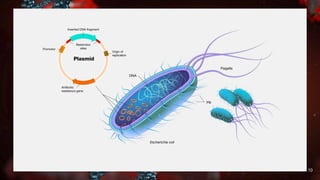
Plasmid
❏ These are double stranded DNA that are usually circular and mostly
found inside certain bacterial specie e.g. E.coli.
❏ Plasmid is an extrachromosomal DNA molecule in bacteria that is
capable of replicating, independent of chromosomal DNA. They serve
as a vehicle to carry a foreign DNA sequence into a given host cell.
❏ However most plasmids are now commercially available, ready to be
used, providing specific fragment insertion sites.
❏ Plasmids in genetic engineering are also known as ‘vectors’. Vectors
also include viruses known as bacteriophage that use bacteria as their
host to replicate. Hence a bacteriophage can be used to transfect and
create several copies of the DNA fragment of interest by replicating
several times in a bacteria.
9
10
Cloning
The term ‘clone’means, exact copy of the parent. A duplicateor a look alike carrying the same genetic signature or
genetic map. Cloning is the best application of recombinant DNA technology and could be applied to something as
simple as DNA fragment or a larger, sophisticated mammalian specie such as humans. Molecular cloning is carried
out in‐vitrowhere a specific fragment of DNAis isolated from an organism ‘donor’and introduced into a
‘plasmid’that replicates in a ‘host’cell making multiple copies of that DNA fragment.
The features required to facilitate cloning into a vector
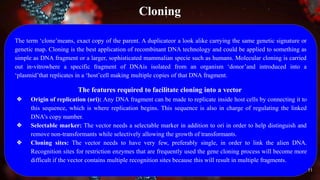
❖ Origin of replication (ori): Any DNA fragment can be made to replicate inside host cells by connecting it to
this sequence, which is where replication begins. This sequence is also in charge of regulating the linked
DNA's copy number.
❖ Selectable marker: The vector needs a selectable marker in addition to ori in order to help distinguish and
remove non-transformants while selectively allowing the growth of transformants.
❖ Cloning sites: The vector needs to have very few, preferably single, in order to link the alien DNA.
Recognition sites for restriction enzymes that are frequently used the gene cloning process will become more
difficult if the vector contains multiple recognition sites because this will result in multiple fragments.
11
Steps Involved in Recombinant DNA Technology:
The complete process of recombinant DNA technology includes multiple steps, maintained in a
specific sequence to generate the desired product.
1. Isolation of Genetic Material: The first and the initial step in Recombinant DNA
technology is to isolate the desired DNA in its pure form i.e. free from other
macromolecules.
2. Cutting the gene at the recognition sites: The restriction enzymes play a major role in
determining the location at which the desired gene is inserted into the vector genome.
These reactions are called ‘restriction enzyme digestions’.
3. Amplifying the gene copies through Polymerase chain reaction (PCR): It is a process to
amplify a single copy of DNA into thousands to millions of copies once the proper gene of
interest has been cut using restriction enzymes.
12
Step-4. Ligation of DNA Molecules: In this step of
Ligation, the joining of the two pieces – a cut fragment of
DNA and the vector together with the help of the enzyme
DNA ligase.
Step-5. Insertion of Recombinant DNA Into Host: In
this step, the recombinant DNA is introduced into a
recipient host cell. This process is termed as
Transformation. Once the recombinant DNA is inserted
into the host cell, it gets multiplied and is expressed in the
form of the manufactured protein under optimal
conditions.
13
14
1. Pharmaceutical manufacture: Using genetically engineered microbes or cells, rDNA technology enables the large-scale
manufacture of hormones, medicinal proteins, and vaccinations.
2. Gene therapy: offers prospective remedies for genetic problems by introducing, replacing, or correcting certain genes in
human cells.
3. Genetically engineered Organisms (GMOs): improved features like tolerance to pests, diseases, and environmental
challenges are created in genetically engineered crops by the application of rDNA technology.
4. Increased Nutritious Content: By using genetic engineering, crops' nutritional value can be increased, helping to solve
problems with dietary deficits and malnutrition. Examples: Golden rice, Herbicide-resistant crops, Insect-resistant crops
5. Bioremediation: Contaminants and pollutants in the environment can be broken down by genetically modified microbes,
which help clean up polluted areas. Enzyme Production: rDNA technology makes it possible to produce particular enzymes
that are needed in a variety of industrial processes, including the manufacturing of biofuels, textiles, and detergents.
6. Drug Development: By using genetically modified animals as models, researchers can better understand the mechanisms
underlying different medical problems, test novel therapeutic possibilities, and investigate diseases.
15
Applications of R-DNA
Applications of R-DNA in Environmental issues:
❏ The release of genetically engineered microbes, for example, Pseudomonas fluorescens strain
designated HK44, for bioremediation purposes in the field was first practised by the University of
Tennessee and Oak Ridge National Laboratory by working in collaboration. The engineered
strain contained naphthalene catabolic plasmid pUTK21 and a transposon-based
bioluminescence-producing lux gene fused within a promoter that resulted in improved
naphthalene degradation and a coincident bioluminescent response. HK44 serves as a reporter for
naphthalene bioavailability and biodegradation whereas its bioluminescence signaling ability
makes it able to be used as an online tool for in situ monitoring of bioremediation processes. The
production of a bioluminescent signal is detectable using fibre optics and photon counting
modules.
16
❏ The introduction of the AtPHR1 gene into landscape plants Verbena, Petunia, and
Torenia altered their capacity to absorb Pi. It's possible that the AtPHR1 transgenic
plants, which have improved Pi absorption capacity, will enable efficient
phytoremediation in contaminated aquatic environments.
❏ Biodegradable plastics: Polymers are harmful to the environment and do not
biodegrade. Biopolymers, which can take the place of plastics, can be produced by
transgenic plants. The attractive source of non-polluting, biodegradable plastic is
polyhydroxyalkanoates or PHAs. Transgenic plant-based PHA production offers a
financially feasible substitute. One instance is the transgenic sugarcane's ability to
produce bacterial polyester polyhydroxybutyrate (PHB).
17
Drawbacks of rDNA Technology
❖ Migration of proprietary DNA and cross-contamination between organisms.
❖ Inappropriate handling of recombinant organisms could contaminate the environment.
❖ The recombinant organisms are a population of clones that share the same vulnerabilities. Rapid population
extinction can be caused by a single illness or pest.
❖ Genes resistant to antibiotics are employed as marker genes to distinguish transformed cells. Human pathogens
that are resistant to antibiotics are the result of this.
❖ Certain chemicals produced by insect-resistant plants are toxic to insects. Such plants develop into resistant
insects through repeated growth. It's conceivable since long-term exposure can lead to insect mutations.
❖ Animal rights organizations have brought up a number of ethical concerns about the use of genetically modified
food and transgenic animals as animal models.
18
Biosafety
Recombinant DNA (rDNA) technology raises particular risks
associated with manipulating genetic material and creating
genetically modified organisms, which makes biosafety
guidelines especially pertinent. The majority of rDNA
research and activities are governed by national biosafety
regulations and guidelines. Enforcing biosafety laws in
India, including those concerning rDNA technology,
is the responsibility of the Genetic Engineering
Appraisal Committee (GEAC) of the Ministry of
Environment, Forests, and Climate Change.
19
Biosafety Guidelines in India:
1. Institutional Biosafety Committees (IBSCs): Organizations conducting research involving genetically
modified organisms (GMOs) are required to establish Institutional Biosafety Committees. These
committees are responsible for reviewing and approving research proposals, ensuring compliance
with biosafety guidelines, and monitoring ongoing activities.
2. Risk Assessment: Prior to initiating any research involving GMOs, a thorough risk assessment must be
conducted. This includes evaluating the potential risks associated with the introduced genetic
material, the host organism, and the experimental procedures.
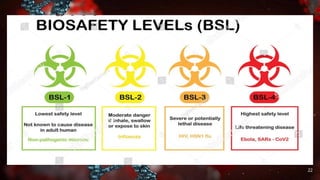
3. Containment Measures: Biosafety guidelines specify containment measures based on the risk assessment.
Containment levels are determined by the nature of the genetic material, the host organism, and the
potential risks. Different levels of containment (e.g., BSL-1, BSL-2, BSL-3) may be required for different
experiments.
20
1. Compliance with Environmental Laws: Researchers and organizations must comply
with environmental laws and regulations to prevent the unintentional release of genetically modified
organisms into the environment.
2. Monitoring and Reporting: Ongoing monitoring and reporting of activities involving GMOs are
essential. Any unexpected events or deviations from approved protocols must be reported to the
relevant authorities.
3. Public Consultation: In some cases, biosafety guidelines may involve public consultation, especially
when the research activities have potential implications for public health or the
environment. Transparency and communication with the public are integral components of
responsible GMO research.
4. Periodic Review and Updates: Biosafety guidelines are subject to periodic review and updates to
incorporate new scientific knowledge and address emerging challenges. This ensures that the
regulations remain effective and up-to-date.
21
22
Conclusions
❏ To sum up, recombinant DNA (rDNA) technology is a game-changer in the field of biotechnology,
providing previously unheard-of opportunities for both practical and scientific advancement. The fields
of agriculture, industry, medicine, and environmental management have all been transformed by the
ability to manipulate and recombine genetic material from various sources.
❏ rDNA technology has opened up new avenues for innovation and brought new answers to long-standing
problems through the production of useful proteins and genetically modified organisms (GMOs).
❏ Even though rDNA technology has a lot of potential uses, responsible usage and ethical considerations
must always come first.
❏ It is crucial to maintain a careful balance between scientific advancement and ethical obligations in order
to guarantee that the potential of genetic engineering is utilized for the benefit of society. Strict safety
regulations, strong regulatory frameworks, and open public communication are all crucial for negotiating
the moral complexities of rDNA technology.
23
References
❖ https://sci-hub.mksa.top/10.1016/b978-0-12-802211-5.00010-2
❖ https://www.sciencedirect.com/science/article/abs/pii/B9780128161098000131
❖ https://chaudhary.kau.edu.sa/files/0030235/files/19046_lect%20recombinant%20dna%
20tech_molecular%20genetics%20lect%202nd%20yr%20mt-1st%20semester.pdf
❖ https://www.hindawi.com/journals/ijg/2016/2405954/
❖ https://ncert.nic.in/ncerts/l/lebo111.pdf
24
Thank
25

R-DNA TECHNOLOGY.pptx...............................

  • 1.
  • 2.
    UNIVERSITY OF VISVESVARAYACOLLEGE OF ENGINEERING Jnana Bharathi, Bengaluru - 560056 Submitted by : LIKHITA CHANDRA - P25UV22T050002 IInd Semester M.Tech Environmental Engineering UVCE, Bengaluru. Under the guidance of : B. SANTHAVEERANAGOUD Professor Environmental Engineering UVCE, Seminar on RECOMBINANT DNA TECHNOLOGY 2
  • 3.
    Contents 1. Introduction 2. ConceptsOf R-DNA Technology 3. Why Recombinant Dna Technology? 4. History Of Recombinant DNA 5. Tools Of Recombinant DNA Technology 6. Steps Involved In Recombinant Dna Technology: 7. Applications of R-DNA 8. Applications of R-DNA In Environmental Issues: 9. Drawbacks Of Rdna Technology 10. Biosafety 3
  • 4.
    Introduction ❖ Recombinant DNAtechnology, or RDT, was only the theory that targeted gene expression might be changed to change certain characteristics in living things during the previous century. In the modern day, this field has significantly advanced human progress. ❖ With its broad range of uses, this technology holds the potential to enhance many aspects of life, including health, food availability, and resilience to various harmful environmental effects. ❖ This technology allows for the safe, low-cost, and insufficient production of essential protein requirements and health concerns. ❖ The power of rDNA technology comes from our ability to study and modify gene function by manipulating genes and transforming them into cells of plants and animals. 4
  • 5.
    WHY RECOMBINANT DNATECHNOLOGY ? Regardless of when they lived—in the ancient or modern eras—the three most fundamental human needs are food, clothing, and shelter. Their types and origins are the only things that have Human changed. Population Economics, and Maintaining Growth, Understanding the Environment. conclude that every invention made at that time was based on widely accepted natural observations that could be tested for the purpose of improving human life. 5
  • 6.
    Concepts Of rDNATechnology Recombinant DNA (Rdna) technology encompasses the manipulation of genetic information outside an organism to obtain superior and desired traits in living organisms or subsequent derivatives. This methodology involves the insertion of DNA fragments from a range of sources, containing desirable gene sequences via appropriate vectors. Alteration of an organism’s genome can be achieved by introducing one or more new genes and regulatory elements, or by recombining genes and regulatory elements to suppress or inhibit the expression of endogenous genes. Recombinant DNA Technology aims to segregate and evaluate a gene, implement desired modifications to one or more segregated genes, then revert modified genes to living cells. 6
  • 7.
    History of RecombinantDNA ❖ The first breakthrough of rDNA technology occurred with the discovery of restriction endonucleases (restriction enzyme) during the late 1960s by Werner, Arber and Hamilton Smith. The restriction enzymes were discovered in microorganisms. These enzymes protect the host cell from the bacteriophage. ❖ In 1969, Herbert Boyer isolated restriction enzyme EcoRI from E. coli that cleaves the DNA between G and A in the base sequence GAATTC. ❖ In 1970 Howard Temin and Davin Baltimore independently discovered the enzyme reverse transcriptase from retroviruses. Later on this enzyme was used to construct a DNA called complementary DNA (cDNA) from any mRNA. ❖ In, 1972 David Jackson, Robert Symons and Paul Berg successfully generated rDNA molecules. They allowed the sticky ends of complementary DNA by using an enzyme DNA ligase. ❖ In 1973 for the first time S.Cohen and H. Boyer developed a recombinant plasmid (pSC101) which after using as vector replicated well within a bacterial host. ❖ In, 1975, Edwin M.Southern developed a method for detection of specific DNA fragments for isolation of a gene from complex mixture of DNA. This method is known as the Southern blotting technique. 7
  • 8.
    Tools Of RecombinantDNA Technology 1. The restriction enzymes, polymerases, and ligases are among the enzymes that aid in cutting, synthesis, and binding, respectively. The position at which the desired gene is inserted into the vector genome is largely determined by the restriction enzymes used in recombinant DNA technology. 2. The intended gene is carried and integrated with the aid of the vectors. These are the most effective means of transferring the target gene into the host organism, making them a crucial component of the recombinant DNA technology toolkit. Due to their large copy number, plasmids and bacteriophages are the most often utilized vectors in recombinant DNA technology. 3. The organism is known as the host, into which recombinant DNA is inserted. The ultimate tool in recombinant DNA technology is the host, which accepts the vector that has been engineered with the desired DNA with the aid of enzymes. 8
  • 9.
    Plasmid ❏ These aredouble stranded DNA that are usually circular and mostly found inside certain bacterial specie e.g. E.coli. ❏ Plasmid is an extrachromosomal DNA molecule in bacteria that is capable of replicating, independent of chromosomal DNA. They serve as a vehicle to carry a foreign DNA sequence into a given host cell. ❏ However most plasmids are now commercially available, ready to be used, providing specific fragment insertion sites. ❏ Plasmids in genetic engineering are also known as ‘vectors’. Vectors also include viruses known as bacteriophage that use bacteria as their host to replicate. Hence a bacteriophage can be used to transfect and create several copies of the DNA fragment of interest by replicating several times in a bacteria. 9
  • 10.
  • 11.
    Cloning The term ‘clone’means,exact copy of the parent. A duplicateor a look alike carrying the same genetic signature or genetic map. Cloning is the best application of recombinant DNA technology and could be applied to something as simple as DNA fragment or a larger, sophisticated mammalian specie such as humans. Molecular cloning is carried out in‐vitrowhere a specific fragment of DNAis isolated from an organism ‘donor’and introduced into a ‘plasmid’that replicates in a ‘host’cell making multiple copies of that DNA fragment. The features required to facilitate cloning into a vector ❖ Origin of replication (ori): Any DNA fragment can be made to replicate inside host cells by connecting it to this sequence, which is where replication begins. This sequence is also in charge of regulating the linked DNA's copy number. ❖ Selectable marker: The vector needs a selectable marker in addition to ori in order to help distinguish and remove non-transformants while selectively allowing the growth of transformants. ❖ Cloning sites: The vector needs to have very few, preferably single, in order to link the alien DNA. Recognition sites for restriction enzymes that are frequently used the gene cloning process will become more difficult if the vector contains multiple recognition sites because this will result in multiple fragments. 11
  • 12.
    Steps Involved inRecombinant DNA Technology: The complete process of recombinant DNA technology includes multiple steps, maintained in a specific sequence to generate the desired product. 1. Isolation of Genetic Material: The first and the initial step in Recombinant DNA technology is to isolate the desired DNA in its pure form i.e. free from other macromolecules. 2. Cutting the gene at the recognition sites: The restriction enzymes play a major role in determining the location at which the desired gene is inserted into the vector genome. These reactions are called ‘restriction enzyme digestions’. 3. Amplifying the gene copies through Polymerase chain reaction (PCR): It is a process to amplify a single copy of DNA into thousands to millions of copies once the proper gene of interest has been cut using restriction enzymes. 12
  • 13.
    Step-4. Ligation ofDNA Molecules: In this step of Ligation, the joining of the two pieces – a cut fragment of DNA and the vector together with the help of the enzyme DNA ligase. Step-5. Insertion of Recombinant DNA Into Host: In this step, the recombinant DNA is introduced into a recipient host cell. This process is termed as Transformation. Once the recombinant DNA is inserted into the host cell, it gets multiplied and is expressed in the form of the manufactured protein under optimal conditions. 13
  • 14.
  • 15.
    1. Pharmaceutical manufacture:Using genetically engineered microbes or cells, rDNA technology enables the large-scale manufacture of hormones, medicinal proteins, and vaccinations. 2. Gene therapy: offers prospective remedies for genetic problems by introducing, replacing, or correcting certain genes in human cells. 3. Genetically engineered Organisms (GMOs): improved features like tolerance to pests, diseases, and environmental challenges are created in genetically engineered crops by the application of rDNA technology. 4. Increased Nutritious Content: By using genetic engineering, crops' nutritional value can be increased, helping to solve problems with dietary deficits and malnutrition. Examples: Golden rice, Herbicide-resistant crops, Insect-resistant crops 5. Bioremediation: Contaminants and pollutants in the environment can be broken down by genetically modified microbes, which help clean up polluted areas. Enzyme Production: rDNA technology makes it possible to produce particular enzymes that are needed in a variety of industrial processes, including the manufacturing of biofuels, textiles, and detergents. 6. Drug Development: By using genetically modified animals as models, researchers can better understand the mechanisms underlying different medical problems, test novel therapeutic possibilities, and investigate diseases. 15 Applications of R-DNA
  • 16.
    Applications of R-DNAin Environmental issues: ❏ The release of genetically engineered microbes, for example, Pseudomonas fluorescens strain designated HK44, for bioremediation purposes in the field was first practised by the University of Tennessee and Oak Ridge National Laboratory by working in collaboration. The engineered strain contained naphthalene catabolic plasmid pUTK21 and a transposon-based bioluminescence-producing lux gene fused within a promoter that resulted in improved naphthalene degradation and a coincident bioluminescent response. HK44 serves as a reporter for naphthalene bioavailability and biodegradation whereas its bioluminescence signaling ability makes it able to be used as an online tool for in situ monitoring of bioremediation processes. The production of a bioluminescent signal is detectable using fibre optics and photon counting modules. 16
  • 17.
    ❏ The introductionof the AtPHR1 gene into landscape plants Verbena, Petunia, and Torenia altered their capacity to absorb Pi. It's possible that the AtPHR1 transgenic plants, which have improved Pi absorption capacity, will enable efficient phytoremediation in contaminated aquatic environments. ❏ Biodegradable plastics: Polymers are harmful to the environment and do not biodegrade. Biopolymers, which can take the place of plastics, can be produced by transgenic plants. The attractive source of non-polluting, biodegradable plastic is polyhydroxyalkanoates or PHAs. Transgenic plant-based PHA production offers a financially feasible substitute. One instance is the transgenic sugarcane's ability to produce bacterial polyester polyhydroxybutyrate (PHB). 17
  • 18.
    Drawbacks of rDNATechnology ❖ Migration of proprietary DNA and cross-contamination between organisms. ❖ Inappropriate handling of recombinant organisms could contaminate the environment. ❖ The recombinant organisms are a population of clones that share the same vulnerabilities. Rapid population extinction can be caused by a single illness or pest. ❖ Genes resistant to antibiotics are employed as marker genes to distinguish transformed cells. Human pathogens that are resistant to antibiotics are the result of this. ❖ Certain chemicals produced by insect-resistant plants are toxic to insects. Such plants develop into resistant insects through repeated growth. It's conceivable since long-term exposure can lead to insect mutations. ❖ Animal rights organizations have brought up a number of ethical concerns about the use of genetically modified food and transgenic animals as animal models. 18
  • 19.
    Biosafety Recombinant DNA (rDNA)technology raises particular risks associated with manipulating genetic material and creating genetically modified organisms, which makes biosafety guidelines especially pertinent. The majority of rDNA research and activities are governed by national biosafety regulations and guidelines. Enforcing biosafety laws in India, including those concerning rDNA technology, is the responsibility of the Genetic Engineering Appraisal Committee (GEAC) of the Ministry of Environment, Forests, and Climate Change. 19
  • 20.
    Biosafety Guidelines inIndia: 1. Institutional Biosafety Committees (IBSCs): Organizations conducting research involving genetically modified organisms (GMOs) are required to establish Institutional Biosafety Committees. These committees are responsible for reviewing and approving research proposals, ensuring compliance with biosafety guidelines, and monitoring ongoing activities. 2. Risk Assessment: Prior to initiating any research involving GMOs, a thorough risk assessment must be conducted. This includes evaluating the potential risks associated with the introduced genetic material, the host organism, and the experimental procedures. 3. Containment Measures: Biosafety guidelines specify containment measures based on the risk assessment. Containment levels are determined by the nature of the genetic material, the host organism, and the potential risks. Different levels of containment (e.g., BSL-1, BSL-2, BSL-3) may be required for different experiments. 20
  • 21.
    1. Compliance withEnvironmental Laws: Researchers and organizations must comply with environmental laws and regulations to prevent the unintentional release of genetically modified organisms into the environment. 2. Monitoring and Reporting: Ongoing monitoring and reporting of activities involving GMOs are essential. Any unexpected events or deviations from approved protocols must be reported to the relevant authorities. 3. Public Consultation: In some cases, biosafety guidelines may involve public consultation, especially when the research activities have potential implications for public health or the environment. Transparency and communication with the public are integral components of responsible GMO research. 4. Periodic Review and Updates: Biosafety guidelines are subject to periodic review and updates to incorporate new scientific knowledge and address emerging challenges. This ensures that the regulations remain effective and up-to-date. 21
  • 22.
  • 23.
    Conclusions ❏ To sumup, recombinant DNA (rDNA) technology is a game-changer in the field of biotechnology, providing previously unheard-of opportunities for both practical and scientific advancement. The fields of agriculture, industry, medicine, and environmental management have all been transformed by the ability to manipulate and recombine genetic material from various sources. ❏ rDNA technology has opened up new avenues for innovation and brought new answers to long-standing problems through the production of useful proteins and genetically modified organisms (GMOs). ❏ Even though rDNA technology has a lot of potential uses, responsible usage and ethical considerations must always come first. ❏ It is crucial to maintain a careful balance between scientific advancement and ethical obligations in order to guarantee that the potential of genetic engineering is utilized for the benefit of society. Strict safety regulations, strong regulatory frameworks, and open public communication are all crucial for negotiating the moral complexities of rDNA technology. 23
  • 24.
    References ❖ https://sci-hub.mksa.top/10.1016/b978-0-12-802211-5.00010-2 ❖ https://www.sciencedirect.com/science/article/abs/pii/B9780128161098000131 ❖https://chaudhary.kau.edu.sa/files/0030235/files/19046_lect%20recombinant%20dna% 20tech_molecular%20genetics%20lect%202nd%20yr%20mt-1st%20semester.pdf ❖ https://www.hindawi.com/journals/ijg/2016/2405954/ ❖ https://ncert.nic.in/ncerts/l/lebo111.pdf 24
  • 25.