Restriction Enzymes: Molecular Scissors
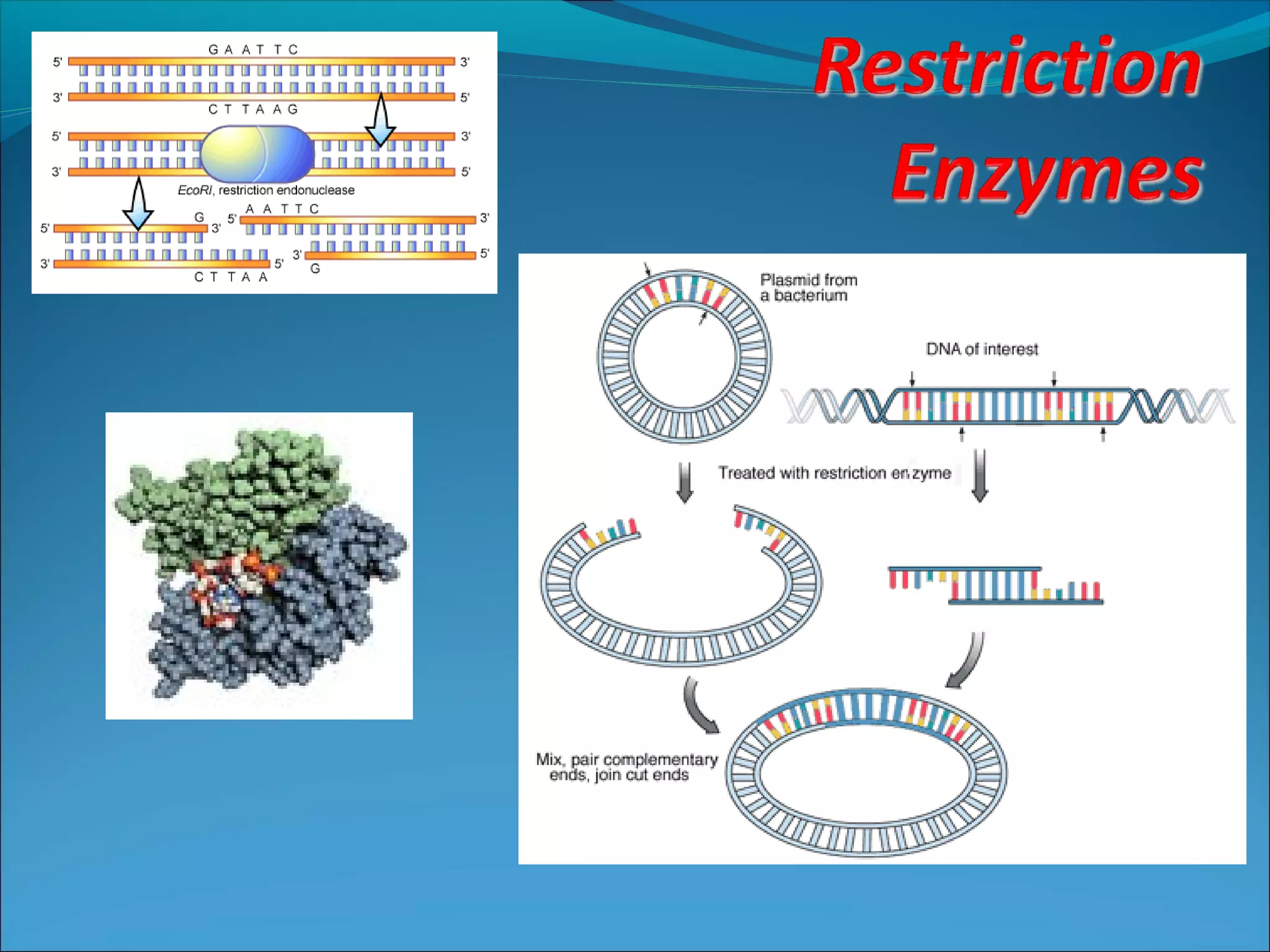
Restriction enzymes
(endonuleases) cut
DNA at specific
sequences
What kinds of bonds
are broken when
restriction enzymes
cut?
Covalent bonds (within
a single strand)
Hydrogen bonds
(between strands) as a
result of the strands
Hydrogen
bond
Covalent bond
Origins of Restriction Enzymes
Naturally found in different types of bacteria
Bacteria use restriction enzymes to protect themselves
from foreign DNA
Bacteria have mechanisms to protect themselves from the
actions of their own restriction enzymes
Have been isolated and sold for use in lab work
Restriction EndonucleasesRestriction Endonucleases
Also called restriction enzymes
1962: “molecular scissors” discovered in in bacteria
E. coli bacteria have an enzymatic immune system that
recognizes and destroys foreign DNA
3,000 enzymes have been identified, around 200 have
unique properties, many are purified and available
commercially
Restriction EndonucleasesRestriction Endonucleases
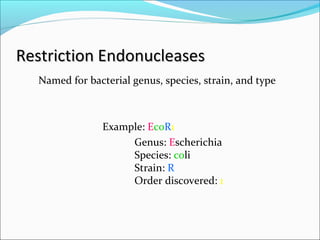
Named for bacterial genus, species, strain, and type
Example: EcoR1
Genus: Escherichia
Species: coli
Strain: R
Order discovered: 1
Restriction EndonucleasesRestriction Endonucleases
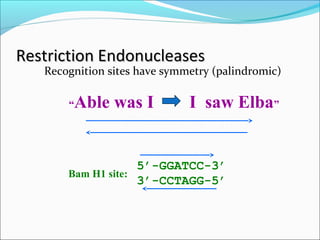
Recognition sites have symmetry (palindromic)
“Able was I I saw Elba”
Bam H1 site:
5’-GGATCC-3’
3’-CCTAGG-5’
Restriction EndonucleasesRestriction Endonucleases
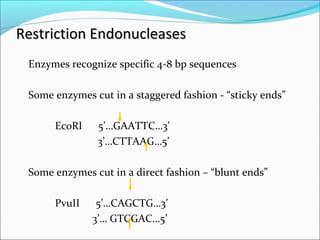
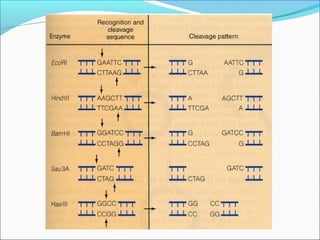
Enzymes recognize specific 4-8 bp sequences
Some enzymes cut in a staggered fashion - “sticky ends”
EcoRI 5’…GAATTC…3’
3’…CTTAAG…5’
Some enzymes cut in a direct fashion – “blunt ends”
PvuII 5’…CAGCTG…3’
3’… GTCGAC…5’
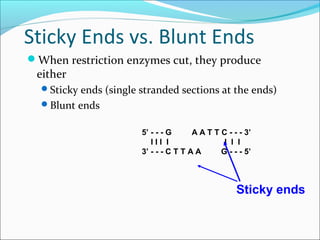
Sticky Ends vs. Blunt Ends
When restriction enzymes cut, they produce
either
Sticky ends (single stranded sections at the ends)
Blunt ends
5’ - - - G A A T T C - - - 3’
I I I I I I I
3’ - - - C T T A A G - - - 5’
Sticky ends
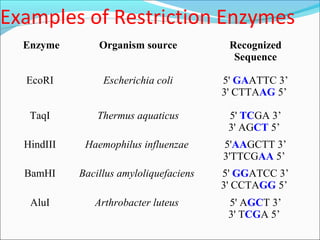
Examples of Restriction Enzymes
Enzyme Organism source Recognized
Sequence
EcoRI Escherichia coli 5' GAATTC 3’
3' CTTAAG 5’
TaqI Thermus aquaticus 5' TCGA 3’
3' AGCT 5’
HindIII Haemophilus influenzae 5'AAGCTT 3’
3'TTCGAA 5’
BamHI Bacillus amyloliquefaciens 5' GGATCC 3’
3' CCTAGG 5’
AluI Arthrobacter luteus 5' AGCT 3’
3' TCGA 5’
Restriction EndonucleasesRestriction Endonucleases
Why don’t bacteria destroy their own
DNA with their restriction enzymes?
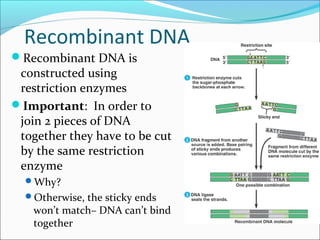
Recombinant DNA
Recombinant DNA is
constructed using
restriction enzymes
Important: In order to
join 2 pieces of DNA
together they have to be cut
by the same restriction
enzyme
Why?
Otherwise, the sticky ends
won’t match– DNA can’t bind
together
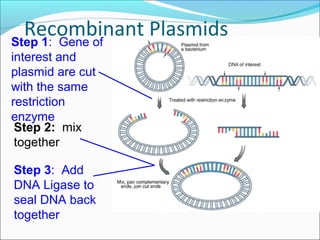
Recombinant PlasmidsStep 1: Gene of
interest and
plasmid are cut
with the same
restriction
enzyme
Step 2: mix
together
Step 3: Add
DNA Ligase to
seal DNA back
together
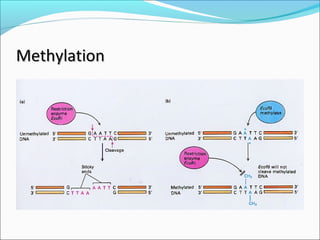
MethylationMethylation
Uses for Restriction EnzymesUses for Restriction Enzymes
RFLP analysis (Restriction Fragment Length Polymorphism)
DNA sequencing
DNA storage – libraries
Transformation
Large scale analysis – gene chips
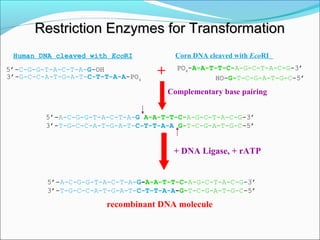
Human DNA cleaved with EcoRI Corn DNA cleaved with EcoRI
5’-C-G-G-T-A-C-T-A-G-OH
3’-G-C-C-A-T-G-A-T-C-T-T-A-A-PO4
PO4
-A-A-T-T-C-A-G-C-T-A-C-G-3’
HO-G-T-C-G-A-T-G-C-5’
+
5’-A-C-G-G-T-A-C-T-A-G A-A-T-T-C-A-G-C-T-A-C-G-3’
3’-T-G-C-C-A-T-G-A-T-C-T-T-A-A G-T-C-G-A-T-G-C-5’
Complementary base pairing
+ DNA Ligase, + rATP
recombinant DNA molecule
5’-A-C-G-G-T-A-C-T-A-G-A-A-T-T-C-A-G-C-T-A-C-G-3’
3’-T-G-C-C-A-T-G-A-T-C-T-T-A-A-G-T-C-G-A-T-G-C-5’
Restriction Enzymes for TransformationRestriction Enzymes for Transformation
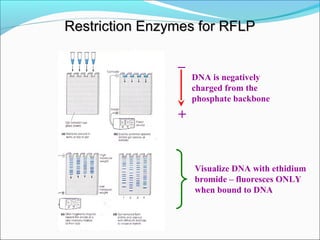
_
+
DNA is negatively
charged from the
phosphate backbone
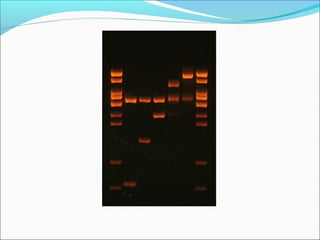
Visualize DNA with ethidium
bromide – fluoresces ONLY
when bound to DNA
Restriction Enzymes for RFLPRestriction Enzymes for RFLP
restriction enzymes

restriction enzymes

  • 2.
    Restriction Enzymes: MolecularScissors Restriction enzymes (endonuleases) cut DNA at specific sequences What kinds of bonds are broken when restriction enzymes cut? Covalent bonds (within a single strand) Hydrogen bonds (between strands) as a result of the strands Hydrogen bond Covalent bond
  • 3.
    Origins of RestrictionEnzymes Naturally found in different types of bacteria Bacteria use restriction enzymes to protect themselves from foreign DNA Bacteria have mechanisms to protect themselves from the actions of their own restriction enzymes Have been isolated and sold for use in lab work
  • 4.
    Restriction EndonucleasesRestriction Endonucleases Alsocalled restriction enzymes 1962: “molecular scissors” discovered in in bacteria E. coli bacteria have an enzymatic immune system that recognizes and destroys foreign DNA 3,000 enzymes have been identified, around 200 have unique properties, many are purified and available commercially
  • 5.
    Restriction EndonucleasesRestriction Endonucleases Namedfor bacterial genus, species, strain, and type Example: EcoR1 Genus: Escherichia Species: coli Strain: R Order discovered: 1
  • 6.
    Restriction EndonucleasesRestriction Endonucleases Recognitionsites have symmetry (palindromic) “Able was I I saw Elba” Bam H1 site: 5’-GGATCC-3’ 3’-CCTAGG-5’
  • 7.
    Restriction EndonucleasesRestriction Endonucleases Enzymesrecognize specific 4-8 bp sequences Some enzymes cut in a staggered fashion - “sticky ends” EcoRI 5’…GAATTC…3’ 3’…CTTAAG…5’ Some enzymes cut in a direct fashion – “blunt ends” PvuII 5’…CAGCTG…3’ 3’… GTCGAC…5’
  • 8.
    Sticky Ends vs.Blunt Ends When restriction enzymes cut, they produce either Sticky ends (single stranded sections at the ends) Blunt ends 5’ - - - G A A T T C - - - 3’ I I I I I I I 3’ - - - C T T A A G - - - 5’ Sticky ends
  • 9.
    Examples of RestrictionEnzymes Enzyme Organism source Recognized Sequence EcoRI Escherichia coli 5' GAATTC 3’ 3' CTTAAG 5’ TaqI Thermus aquaticus 5' TCGA 3’ 3' AGCT 5’ HindIII Haemophilus influenzae 5'AAGCTT 3’ 3'TTCGAA 5’ BamHI Bacillus amyloliquefaciens 5' GGATCC 3’ 3' CCTAGG 5’ AluI Arthrobacter luteus 5' AGCT 3’ 3' TCGA 5’
  • 11.
    Restriction EndonucleasesRestriction Endonucleases Whydon’t bacteria destroy their own DNA with their restriction enzymes?
  • 12.
    Recombinant DNA Recombinant DNAis constructed using restriction enzymes Important: In order to join 2 pieces of DNA together they have to be cut by the same restriction enzyme Why? Otherwise, the sticky ends won’t match– DNA can’t bind together
  • 13.
    Recombinant PlasmidsStep 1:Gene of interest and plasmid are cut with the same restriction enzyme Step 2: mix together Step 3: Add DNA Ligase to seal DNA back together
  • 14.
  • 15.
    Uses for RestrictionEnzymesUses for Restriction Enzymes RFLP analysis (Restriction Fragment Length Polymorphism) DNA sequencing DNA storage – libraries Transformation Large scale analysis – gene chips
  • 16.
    Human DNA cleavedwith EcoRI Corn DNA cleaved with EcoRI 5’-C-G-G-T-A-C-T-A-G-OH 3’-G-C-C-A-T-G-A-T-C-T-T-A-A-PO4 PO4 -A-A-T-T-C-A-G-C-T-A-C-G-3’ HO-G-T-C-G-A-T-G-C-5’ + 5’-A-C-G-G-T-A-C-T-A-G A-A-T-T-C-A-G-C-T-A-C-G-3’ 3’-T-G-C-C-A-T-G-A-T-C-T-T-A-A G-T-C-G-A-T-G-C-5’ Complementary base pairing + DNA Ligase, + rATP recombinant DNA molecule 5’-A-C-G-G-T-A-C-T-A-G-A-A-T-T-C-A-G-C-T-A-C-G-3’ 3’-T-G-C-C-A-T-G-A-T-C-T-T-A-A-G-T-C-G-A-T-G-C-5’ Restriction Enzymes for TransformationRestriction Enzymes for Transformation
  • 17.
    _ + DNA is negatively chargedfrom the phosphate backbone Visualize DNA with ethidium bromide – fluoresces ONLY when bound to DNA Restriction Enzymes for RFLPRestriction Enzymes for RFLP

Editor's Notes

  • #10 Bases in blue are the actual bases that restriction enzymes cut between. In many cases, there are multiple subunits of a restriction enzyme– each subunit recognizes a particular sequence on one of the strands then cuts it at a certain distance away from that. Recognized sequences for restriction enzymes tend to be palindromic (read the same backwards and forwards)