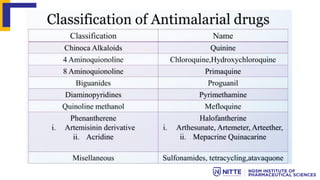
Dr.Mahendra G S
Assistant Professor, NGSMIPS
Antimalarials
Introduction
➢ Malaria is a life-threatening disease caused by parasites from the
Plasmodium genus, transmitted to humans through the bites of infected
Anopheles mosquitoes.
➢ Malaria remains a significant global health issue, particularly in tropical and
subtropical regions, affecting millions of people annually.
➢ Malaria is primarily transmitted through the bite of an infected female
Anopheles mosquito. Other modes of transmission include:
• Blood transfusions, Organ transplants, Sharing needles or syringes,
From a pregnant mother to her unborn child (congenital malaria).
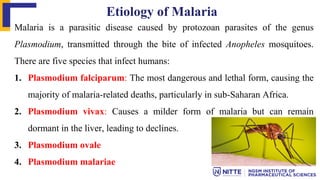
Malaria is a parasitic disease caused by protozoan parasites of the genus
Plasmodium, transmitted through the bite of infected Anopheles mosquitoes.
There are five species that infect humans:
1. Plasmodium falciparum: The most dangerous and lethal form, causing the
majority of malaria-related deaths, particularly in sub-Saharan Africa.
2. Plasmodium vivax: Causes a milder form of malaria but can remain
dormant in the liver, leading to declines.
3. Plasmodium ovale
4. Plasmodium malariae
Etiology of Malaria
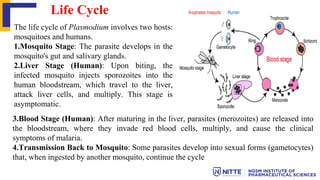
The life cycle of Plasmodium involves two hosts:
mosquitoes and humans.
1.Mosquito Stage: The parasite develops in the
mosquito's gut and salivary glands.
2.Liver Stage (Human): Upon biting, the
infected mosquito injects sporozoites into the
human bloodstream, which travel to the liver,
attack liver cells, and multiply. This stage is
asymptomatic.
3.Blood Stage (Human): After maturing in the liver, parasites (merozoites) are released into
the bloodstream, where they invade red blood cells, multiply, and cause the clinical
symptoms of malaria.
4.Transmission Back to Mosquito: Some parasites develop into sexual forms (gametocytes)
that, when ingested by another mosquito, continue the cycle
Life Cycle
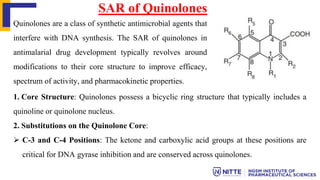
SAR of Quinolones
Quinolones are a class of synthetic antimicrobial agents that
interfere with DNA synthesis. The SAR of quinolones in
antimalarial drug development typically revolves around
modifications to their core structure to improve efficacy,
spectrum of activity, and pharmacokinetic properties.
1. Core Structure: Quinolones possess a bicyclic ring structure that typically includes a
quinoline or quinolone nucleus.
2. Substitutions on the Quinolone Core:
➢ C-3 and C-4 Positions: The ketone and carboxylic acid groups at these positions are
critical for DNA gyrase inhibition and are conserved across quinolones.
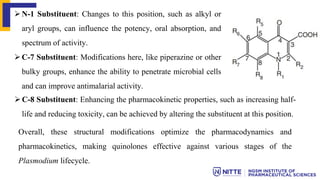
➢N-1 Substituent: Changes to this position, such as alkyl or
aryl groups, can influence the potency, oral absorption, and
spectrum of activity.
➢C-7 Substituent: Modifications here, like piperazine or other
bulky groups, enhance the ability to penetrate microbial cells
and can improve antimalarial activity.
Overall, these structural modifications optimize the pharmacodynamics and
pharmacokinetics, making quinolones effective against various stages of the
Plasmodium lifecycle.
➢C-8 Substituent: Enhancing the pharmacokinetic properties, such as increasing half-
life and reducing toxicity, can be achieved by altering the substituent at this position.
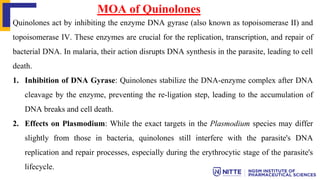
Quinolones act by inhibiting the enzyme DNA gyrase (also known as topoisomerase II) and
topoisomerase IV. These enzymes are crucial for the replication, transcription, and repair of
bacterial DNA. In malaria, their action disrupts DNA synthesis in the parasite, leading to cell
death.
1. Inhibition of DNA Gyrase: Quinolones stabilize the DNA-enzyme complex after DNA
cleavage by the enzyme, preventing the re-ligation step, leading to the accumulation of
DNA breaks and cell death.
2. Effects on Plasmodium: While the exact targets in the Plasmodium species may differ
slightly from those in bacteria, quinolones still interfere with the parasite's DNA
replication and repair processes, especially during the erythrocytic stage of the parasite's
lifecycle.
MOA of Quinolones
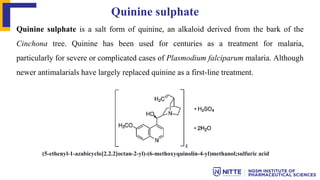
Quinine sulphate
(5-ethenyl-1-azabicyclo[2.2.2]octan-2-yl)-(6-methoxyquinolin-4-yl)methanol;sulfuric acid
Quinine sulphate is a salt form of quinine, an alkaloid derived from the bark of the
Cinchona tree. Quinine has been used for centuries as a treatment for malaria,
particularly for severe or complicated cases of Plasmodium falciparum malaria. Although
newer antimalarials have largely replaced quinine as a first-line treatment.
Quinine acts as a blood schizonticide, targeting the asexual blood stage of
the malaria parasite. Although the exact mechanism of action is not fully
understood.
Inhibit heme polymerization: Inside the parasite's digestive vacuole,
quinine interferes with the polymerization of toxic heme into hemozoin. This
causes an accumulation of toxic heme, which is lethal to the parasite.
Mechanism of Action
➢ Cinchonism: A common syndrome associated with quinine toxicity.
➢ Hypoglycemia: Quinine stimulates insulin release, which can cause hypoglycemia,
particularly in pregnant women and those with severe malaria.
➢ Cardiovascular Effects: Quinine can prolong the QT interval
➢ Hematologic Effects: Rarely, quinine can cause hemolytic anemia.
➢ Hypersensitivity Reactions
Side Effects
Use
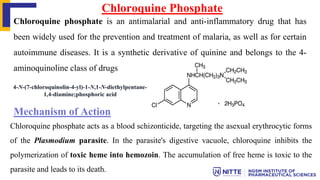
Chloroquine Phosphate
Chloroquine phosphate is an antimalarial and anti-inflammatory drug that has
been widely used for the prevention and treatment of malaria, as well as for certain
autoimmune diseases. It is a synthetic derivative of quinine and belongs to the 4-
aminoquinoline class of drugs
4-N-(7-chloroquinolin-4-yl)-1-N,1-N-diethylpentane-
1,4-diamine;phosphoric acid
Chloroquine phosphate acts as a blood schizonticide, targeting the asexual erythrocytic forms
of the Plasmodium parasite. In the parasite's digestive vacuole, chloroquine inhibits the
polymerization of toxic heme into hemozoin. The accumulation of free heme is toxic to the
parasite and leads to its death.
Mechanism of Action
Side Effects
• Nausea, vomiting, and diarrhea.
• Headache, dizziness, and blurred vision.
• Itching, particularly in dark-skinned individuals.
Serious Side Effects:
• Retinopathy, Cardiac Toxicity and Hypoglycemia
• Myopathy and Neuropathy: Long-term use can lead to muscle weakness and nerve
damage.
• Hemolysis: In patients with G6PD (glucose-6-phosphate dehydrogenase) deficiency,
chloroquine can cause hemolytic anemia.
➢ Treatment of Malaria and Malaria Prophylaxis
➢ Rheumatoid Arthritis
➢ Systemic Lupus Erythematosus (SLE): It is commonly used to manage symptoms of
lupus, such as skin rashes, joint pain, and fatigue.
➢ Amoebiasis: Extra-intestinal Amoebiasis
Use
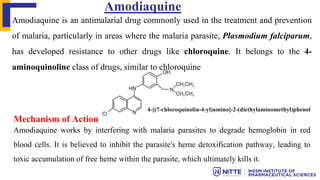
Amodiaquine
Amodiaquine is an antimalarial drug commonly used in the treatment and prevention
of malaria, particularly in areas where the malaria parasite, Plasmodium falciparum,
has developed resistance to other drugs like chloroquine. It belongs to the 4-
aminoquinoline class of drugs, similar to chloroquine
Amodiaquine works by interfering with malaria parasites to degrade hemoglobin in red
blood cells. It is believed to inhibit the parasite's heme detoxification pathway, leading to
toxic accumulation of free heme within the parasite, which ultimately kills it.
Mechanism of Action
4-[(7-chloroquinolin-4-yl)amino]-2-(diethylaminomethyl)phenol
Use
Side Effects
Amodiaquine can cause side effects such as gastrointestinal upset (nausea,
vomiting, diarrhea), headache, and dizziness. In some cases, more serious side
effects can occur, such as liver damage or blood disorders, particularly with long-
term or repeated use.
•Uncomplicated Malaria: Amodiaquine is used to treat Plasmodium falciparum malaria,
especially in areas where chloroquine-resistant strains are prevalent.
•Combination Therapy: It is often combined with artesunate to form the combination
therapy known as ASAQ (Amodiaquine-Artesunate), which is recommended for the
treatment of uncomplicated malaria.
•Prophylaxis (Prevention)
Pamaquine*
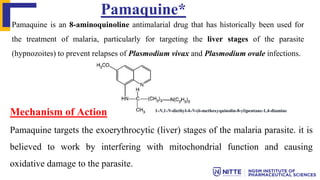
Pamaquine is an 8-aminoquinoline antimalarial drug that has historically been used for
the treatment of malaria, particularly for targeting the liver stages of the parasite
(hypnozoites) to prevent relapses of Plasmodium vivax and Plasmodium ovale infections.
1-N,1-N-diethyl-4-N-(6-methoxyquinolin-8-yl)pentane-1,4-diamine
Pamaquine targets the exoerythrocytic (liver) stages of the malaria parasite. it is
believed to work by interfering with mitochondrial function and causing
oxidative damage to the parasite.
Mechanism of Action
➢ Pamaquine can cause hemolytic anemia in individuals with glucose-6-phosphate
dehydrogenase (G6PD) deficiency. This is a significant concern, as the hemolysis can be
severe or even life-threatening in individuals with this genetic condition.
➢ Other side effects may include nausea, abdominal pain, vomiting, and headaches.
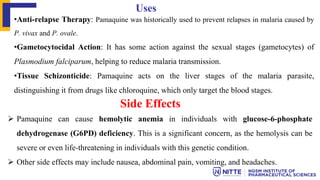
•Anti-relapse Therapy: Pamaquine was historically used to prevent relapses in malaria caused by
P. vivax and P. ovale.
•Gametocytocidal Action: It has some action against the sexual stages (gametocytes) of
Plasmodium falciparum, helping to reduce malaria transmission.
•Tissue Schizonticide: Pamaquine acts on the liver stages of the malaria parasite,
distinguishing it from drugs like chloroquine, which only target the blood stages.
Side Effects
Uses
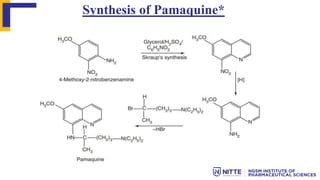
Synthesis of Pamaquine*
Primaquine
Primaquine is belonging to the class of drugs known as 8-aminoquinolines. It
is primarily used for the radical cure (elimination of liver stages) of
Plasmodium vivax and Plasmodium ovale malaria.
Primaquine interferes with the mitochondrial function of the parasite, generating reactive
oxygen species(ROS) that damage the parasite's cellular structures. This oxidative stress
ultimately leads to the death of the parasite.
Mechanism of Action
4-N-(6-methoxyquinolin-8-yl)pentane-1,4-diamine
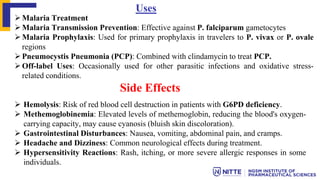
➢Malaria Treatment
➢Malaria Transmission Prevention: Effective against P. falciparum gametocytes
➢Malaria Prophylaxis: Used for primary prophylaxis in travelers to P. vivax or P. ovale
regions
➢Pneumocystis Pneumonia (PCP): Combined with clindamycin to treat PCP.
➢Off-label Uses: Occasionally used for other parasitic infections and oxidative stress-
related conditions.
Uses
➢ Hemolysis: Risk of red blood cell destruction in patients with G6PD deficiency.
➢ Methemoglobinemia: Elevated levels of methemoglobin, reducing the blood's oxygen-
carrying capacity, may cause cyanosis (bluish skin discoloration).
➢ Gastrointestinal Disturbances: Nausea, vomiting, abdominal pain, and cramps.
➢ Headache and Dizziness: Common neurological effects during treatment.
➢ Hypersensitivity Reactions: Rash, itching, or more severe allergic responses in some
individuals.
Side Effects
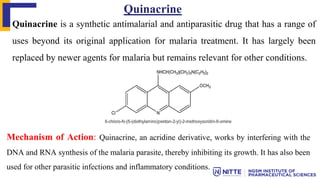
Quinacrine
Mechanism of Action: Quinacrine, an acridine derivative, works by interfering with the
DNA and RNA synthesis of the malaria parasite, thereby inhibiting its growth. It has also been
used for other parasitic infections and inflammatory conditions.
Quinacrine is a synthetic antimalarial and antiparasitic drug that has a range of
uses beyond its original application for malaria treatment. It has largely been
replaced by newer agents for malaria but remains relevant for other conditions.
➢ Formerly used for malaria treatment but is now largely replaced by more
effective and less toxic drugs.
➢ Used for the treatment of giardiasis (intestinal infection caused by the parasite
Giardia lamblia).
➢ Occasionally used for certain autoimmune conditions, such as lupus, due to its
anti-inflammatory properties.
Uses
➢ Gastrointestinal disturbances, nausea, vomiting.
➢ Neuropsychiatric effects: Dizziness, headache, mood changes.
➢ Skin discoloration (yellowing) with prolonged use.
➢ Rare but serious: aplastic anemia.
Side Effects
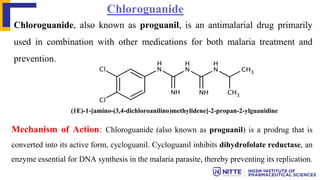
Chloroguanide
Mechanism of Action: Chloroguanide (also known as proguanil) is a prodrug that is
converted into its active form, cycloguanil. Cycloguanil inhibits dihydrofolate reductase, an
enzyme essential for DNA synthesis in the malaria parasite, thereby preventing its replication.
Chloroguanide, also known as proguanil, is an antimalarial drug primarily
used in combination with other medications for both malaria treatment and
prevention.
(1E)-1-[amino-(3,4-dichloroanilino)methylidene]-2-propan-2-ylguanidine
Uses
➢ Primarily used in combination with atovaquone (as atovaquone-proguanil
or Malarone) for the prevention and treatment of malaria caused by
Plasmodium falciparum.
➢ Also used for malaria prophylaxis in travelers.
Side Effects
➢ Mild gastrointestinal symptoms, such as nausea or diarrhea.
➢ Occasional mouth ulcers and hair loss.
➢ Rare side effects include elevated liver enzymes and allergic reactions.
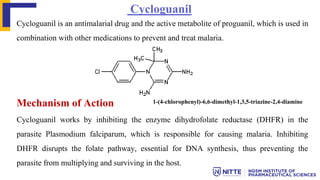
Cycloguanil
Cycloguanil is an antimalarial drug and the active metabolite of proguanil, which is used in
combination with other medications to prevent and treat malaria.
Cycloguanil works by inhibiting the enzyme dihydrofolate reductase (DHFR) in the
parasite Plasmodium falciparum, which is responsible for causing malaria. Inhibiting
DHFR disrupts the folate pathway, essential for DNA synthesis, thus preventing the
parasite from multiplying and surviving in the host.
Mechanism of Action 1-(4-chlorophenyl)-6,6-dimethyl-1,3,5-triazine-2,4-diamine
➢ Malaria Prevention (Prophylaxis): Cycloguanil is often used as part of combination
therapy (e.g., with atovaquone in Malarone) for the prevention of malaria,
➢ Malaria Treatment: Cycloguanil is also part of the treatment for malaria, especially in
combination with other drugs like atovaquone.
➢ Combination with Other Drugs: Cycloguanil's role in combination therapy is crucial
because Plasmodium parasites can rapidly develop resistance to single-agent therapies.
Uses
•Gastrointestinal Issues: Nausea, Vomiting, Abdominal pain, Diarrhea
•Headache: Mild to moderate headaches are commonly reported.
•Mouth Ulcers: Proguanil (and hence its metabolite Cycloguanil) may cause mouth sores or
ulcers in some individuals.
•Skin Reactions: Rash, Itching (pruritus)
•In rare cases, more severe skin reactions like erythema multiforme or Stevens-Johnson
syndrome.
Side Effects
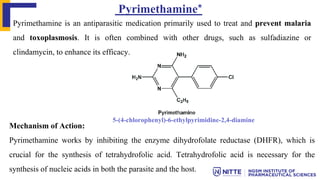
Pyrimethamine*
Mechanism of Action:
Pyrimethamine works by inhibiting the enzyme dihydrofolate reductase (DHFR), which is
crucial for the synthesis of tetrahydrofolic acid. Tetrahydrofolic acid is necessary for the
synthesis of nucleic acids in both the parasite and the host.
Pyrimethamine is an antiparasitic medication primarily used to treat and prevent malaria
and toxoplasmosis. It is often combined with other drugs, such as sulfadiazine or
clindamycin, to enhance its efficacy.
5-(4-chlorophenyl)-6-ethylpyrimidine-2,4-diamine
Side Effects
➢ Bone marrow suppression (e.g., megaloblastic anemia)
➢ Gastrointestinal upset
➢ Hypersensitivity reactions
➢ CNS effects, such as headache or dizziness
➢ Folate deficiency, which is why leucovorin (folinic acid) is often co-
administered to prevent this complication.
➢ Malaria: Pyrimethamine is used in combination with sulfadoxine (Fansidar) as a
second-line treatment for chloroquine-resistant malaria.
➢ Toxoplasmosis: In combination with sulfadiazine or clindamycin, it is the first-line
treatment for toxoplasmosis, particularly in immunocompromised patients, such as
those with AIDS.
Clinical Uses
CHO