ANTIBIOTICS
Mahendra G S
NGSM Institute of Pharmaceutical Sciences
Introduction
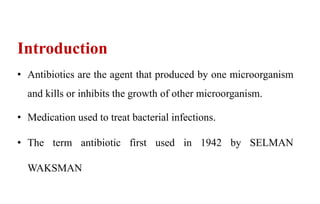
• Antibiotics are the agent that produced by one microorganism
and kills or inhibits the growth of other microorganism.
• Medication used to treat bacterial infections.
• The term antibiotic first used in 1942 by SELMAN
WAKSMAN
History of Antibiotics
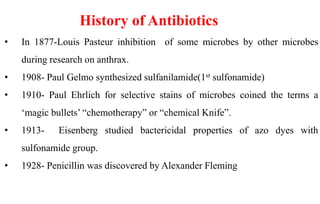
• In 1877-Louis Pasteur inhibition of some microbes by other microbes
during research on anthrax.
• 1908- Paul Gelmo synthesized sulfanilamide(1st sulfonamide)
• 1910- Paul Ehrlich for selective stains of microbes coined the terms a
‘magic bullets’ “chemotherapy” or “chemical Knife”.
• 1913- Eisenberg studied bactericidal properties of azo dyes with
sulfonamide group.
• 1928- Penicillin was discovered by Alexander Fleming
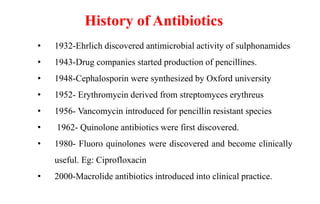
• 1932-Ehrlich discovered antimicrobial activity of sulphonamides
• 1943-Drug companies started production of pencillines.
• 1948-Cephalosporin were synthesized by Oxford university
• 1952- Erythromycin derived from streptomyces erythreus
• 1956- Vancomycin introduced for pencillin resistant species
• 1962- Quinolone antibiotics were first discovered.
• 1980- Fluoro quinolones were discovered and become clinically
useful. Eg: Ciprofloxacin
• 2000-Macrolide antibiotics introduced into clinical practice.
History of Antibiotics
History of Penicillin
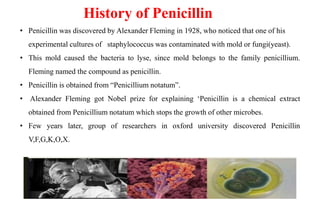
• Penicillin was discovered by Alexander Fleming in 1928, who noticed that one of his
experimental cultures of staphylococcus was contaminated with mold or fungi(yeast).
• This mold caused the bacteria to lyse, since mold belongs to the family penicillium.
Fleming named the compound as penicillin.
• Penicillin is obtained from “Penicillium notatum”.
• Alexander Fleming got Nobel prize for explaining ‘Penicillin is a chemical extract
obtained from Penicillium notatum which stops the growth of other microbes.
• Few years later, group of researchers in oxford university discovered Penicillin
V,F,G,K,O,X.
 Florey & chain- introduced the penicillins for chemotherapy
 Waksman- In 1942 given definition for antibiotics.
ANTIBIOTICS-DEFINITION
 These are the chemical substances produced by microorganisms which has the capacity of
inhibiting the growth or even destroying other microorganisms (Waksman definition)
 Antibiotics are the chemical substances or drugs produced by living organism or marine
sources which will inhibit the growth of other microorganism in small concentrations and
kill the microorganisms in high concentration.
 Antibiotics are not effective against viral infections.
 Antibiotics also includes synthesis and semisynthetic antimicrobial compounds.
Eg: chloramphenicol and sulphonamides.
CLASSIFICATION
Antibiotics are classified into:
1.Based on Spectrum of Activity.
2.Based on The Source of Origin.
3.Based on Mechanism of Action
4.Based on Chemical Structure
BASED ON SPECTRUM OF ACTIVITY & DEGREE OF SELECTIVITY
 Narrow spectrum Antibiotics: high degree of selectivity towards single species
of microorganism.
Eg: Nystatin, Bacitracin
 Broad spectrum Antibiotics: They inhibit the growth of gram +ve and gram –ve
bacteria including different species of microorganisms.
Eg: tetracyclines and chloramphenicol
BASED ON SOURCE FROM WHICH ANTIBIOTICS ARE
OBTAINED THEY ARE CLASSIFIED AS
Natural Antibiotics: They are obtained from the fermentation of
microorganism.
Eg: Bacitracin, Polymyxin-B
Semisynthetic Antibiotics: They are produced commercially by
addition of chemical agents to produce final products.
Eg: Penicillin G or V
Synthetic Antibiotics: Antibiotics which have purely synthetic origin.
Eg: chloramphenicol
BASED ON MECHANISM OF ACTION
Drugs that interfere with biosynthesis of Bacterial cellwall.
Eg: cephalosporins, Penicillins, viomycin, cycloserin
 Drugs that interfere with the functioning of Cytoplasmic Membrane.
Eg: Nystatin, amphotericin-B, Polymixin
Drugs that interfere with the Protein Synthesis of bacteria.
Eg: Chloramphenicol, erythromycin, aminoglycosides, tetracyclines.
 Drugs that interfere with the Nucleic Acid biosynthesis.
Eg: Actinomycin, Griseofulvin, Rifamycin, Mitomycin
BASED ON CHEMICAL STRUCTURE
 Beta Lactam Antibiotics: Drugs that contain β-lactam ring in the structure.
Eg: Pencillins, Cephalosporins, Monobactams, Β-lactamase Inhibitors
 Aminoglycoside antibiotics: Drug that contain sugar moieties with amino groups.
Eg: streptomycin, gentamycin, neomycin, kanamycin.
 Tetracyclines: Drugs that contain four cyclic compounds.
Eg: chlortetracycline, oxytetracycline and doxycycline
 Peptide antibiotics: Drugs that contain amino acid groups.
Eg: bacitracin, amphotericin
 Macrolides: Drugs that contain macrocyclic ring with lactone groups.
Eg: Erythromycin, Azithromycin
 Licomycins: Drugs that contain more than 16 atoms
Eg: licomycin and clindamycin
 Antifungal antibiotics: Drugs used to treat fungal infections.
Eg: Griseofulvin
 Miscellaneous: Eg: chloramphenicol

antibiotics.pptx

  • 1.
    ANTIBIOTICS Mahendra G S NGSMInstitute of Pharmaceutical Sciences
  • 2.
    Introduction • Antibiotics arethe agent that produced by one microorganism and kills or inhibits the growth of other microorganism. • Medication used to treat bacterial infections. • The term antibiotic first used in 1942 by SELMAN WAKSMAN
  • 3.
    History of Antibiotics •In 1877-Louis Pasteur inhibition of some microbes by other microbes during research on anthrax. • 1908- Paul Gelmo synthesized sulfanilamide(1st sulfonamide) • 1910- Paul Ehrlich for selective stains of microbes coined the terms a ‘magic bullets’ “chemotherapy” or “chemical Knife”. • 1913- Eisenberg studied bactericidal properties of azo dyes with sulfonamide group. • 1928- Penicillin was discovered by Alexander Fleming
  • 4.
    • 1932-Ehrlich discoveredantimicrobial activity of sulphonamides • 1943-Drug companies started production of pencillines. • 1948-Cephalosporin were synthesized by Oxford university • 1952- Erythromycin derived from streptomyces erythreus • 1956- Vancomycin introduced for pencillin resistant species • 1962- Quinolone antibiotics were first discovered. • 1980- Fluoro quinolones were discovered and become clinically useful. Eg: Ciprofloxacin • 2000-Macrolide antibiotics introduced into clinical practice. History of Antibiotics
  • 5.
    History of Penicillin •Penicillin was discovered by Alexander Fleming in 1928, who noticed that one of his experimental cultures of staphylococcus was contaminated with mold or fungi(yeast). • This mold caused the bacteria to lyse, since mold belongs to the family penicillium. Fleming named the compound as penicillin. • Penicillin is obtained from “Penicillium notatum”. • Alexander Fleming got Nobel prize for explaining ‘Penicillin is a chemical extract obtained from Penicillium notatum which stops the growth of other microbes. • Few years later, group of researchers in oxford university discovered Penicillin V,F,G,K,O,X.
  • 6.
     Florey &chain- introduced the penicillins for chemotherapy  Waksman- In 1942 given definition for antibiotics. ANTIBIOTICS-DEFINITION  These are the chemical substances produced by microorganisms which has the capacity of inhibiting the growth or even destroying other microorganisms (Waksman definition)  Antibiotics are the chemical substances or drugs produced by living organism or marine sources which will inhibit the growth of other microorganism in small concentrations and kill the microorganisms in high concentration.  Antibiotics are not effective against viral infections.  Antibiotics also includes synthesis and semisynthetic antimicrobial compounds. Eg: chloramphenicol and sulphonamides.
  • 7.
    CLASSIFICATION Antibiotics are classifiedinto: 1.Based on Spectrum of Activity. 2.Based on The Source of Origin. 3.Based on Mechanism of Action 4.Based on Chemical Structure
  • 8.
    BASED ON SPECTRUMOF ACTIVITY & DEGREE OF SELECTIVITY  Narrow spectrum Antibiotics: high degree of selectivity towards single species of microorganism. Eg: Nystatin, Bacitracin  Broad spectrum Antibiotics: They inhibit the growth of gram +ve and gram –ve bacteria including different species of microorganisms. Eg: tetracyclines and chloramphenicol
  • 9.
    BASED ON SOURCEFROM WHICH ANTIBIOTICS ARE OBTAINED THEY ARE CLASSIFIED AS Natural Antibiotics: They are obtained from the fermentation of microorganism. Eg: Bacitracin, Polymyxin-B Semisynthetic Antibiotics: They are produced commercially by addition of chemical agents to produce final products. Eg: Penicillin G or V Synthetic Antibiotics: Antibiotics which have purely synthetic origin. Eg: chloramphenicol
  • 10.
    BASED ON MECHANISMOF ACTION Drugs that interfere with biosynthesis of Bacterial cellwall. Eg: cephalosporins, Penicillins, viomycin, cycloserin  Drugs that interfere with the functioning of Cytoplasmic Membrane. Eg: Nystatin, amphotericin-B, Polymixin Drugs that interfere with the Protein Synthesis of bacteria. Eg: Chloramphenicol, erythromycin, aminoglycosides, tetracyclines.  Drugs that interfere with the Nucleic Acid biosynthesis. Eg: Actinomycin, Griseofulvin, Rifamycin, Mitomycin
  • 11.
    BASED ON CHEMICALSTRUCTURE  Beta Lactam Antibiotics: Drugs that contain β-lactam ring in the structure. Eg: Pencillins, Cephalosporins, Monobactams, Β-lactamase Inhibitors  Aminoglycoside antibiotics: Drug that contain sugar moieties with amino groups. Eg: streptomycin, gentamycin, neomycin, kanamycin.  Tetracyclines: Drugs that contain four cyclic compounds. Eg: chlortetracycline, oxytetracycline and doxycycline  Peptide antibiotics: Drugs that contain amino acid groups. Eg: bacitracin, amphotericin  Macrolides: Drugs that contain macrocyclic ring with lactone groups. Eg: Erythromycin, Azithromycin  Licomycins: Drugs that contain more than 16 atoms Eg: licomycin and clindamycin  Antifungal antibiotics: Drugs used to treat fungal infections. Eg: Griseofulvin  Miscellaneous: Eg: chloramphenicol