
Anti-infective Agents
Dr.Mahendra G S
Assistant Professor, NGSMIPS
• In 1867, Joseph Lister introduced antiseptic property principles by using phenol as a spray
on an incision site & on wounds.
• In 1881-1900, Paul Ehrlich -Microbiologist -discovered selective toxicity by using dyes and
arsenicals.
• Prior to Ehrlich's studies, the local antimicrobial properties of phenol and iodine were well
known, but systemic agents are cinchona for malaria and ipecac for amoebic dysentry.
• Ehrlich also discovered salvarsan as the effective antisyphilitic drug.
Anti-infective Agents
Anti-infective agents are classified as:
• Local anti-infective agents
• Preservatives
• Antifungal agents
• Synthetic antibacterial agents(Urinary antiinfective agents)
• Anti tubercular agents
• Anti protozoal agents
• Anthelmintics
• Antiscabies & antipedicular agents
Local anti-infective agents are substances used to prevent or treat infections
on specific areas of the body, such as the skin, mucous membranes, or other external
surfaces. These agents can be classified into several categories, including:
1.Antiseptics: These are chemicals that kill or prevent the growth of microorganisms
on living tissue. Examples include alcohols, oxidizing agents, halogens, nitrofurans,
dyes and mercury compounds.
2.Disinfectants: These are agents that prevent the transmission of infection on
inanimate objects. Phenols, Surfactants
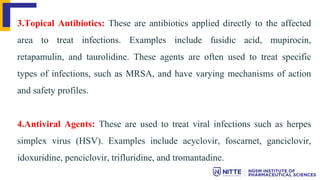
3.Topical Antibiotics: These are antibiotics applied directly to the affected
area to treat infections. Examples include fusidic acid, mupirocin,
retapamulin, and taurolidine. These agents are often used to treat specific
types of infections, such as MRSA, and have varying mechanisms of action
and safety profiles.
4.Antiviral Agents: These are used to treat viral infections such as herpes
simplex virus (HSV). Examples include acyclovir, foscarnet, ganciclovir,
idoxuridine, penciclovir, trifluridine, and tromantadine.
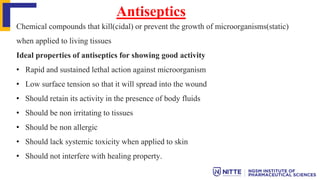
Antiseptics
Chemical compounds that kill(cidal) or prevent the growth of microorganisms(static)
when applied to living tissues
Ideal properties of antiseptics for showing good activity
• Rapid and sustained lethal action against microorganism
• Low surface tension so that it will spread into the wound
• Should retain its activity in the presence of body fluids
• Should be non irritating to tissues
• Should be non allergic
• Should lack systemic toxicity when applied to skin
• Should not interfere with healing property.
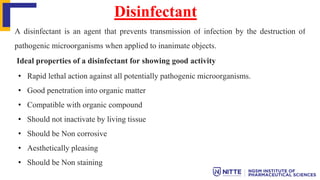
A disinfectant is an agent that prevents transmission of infection by the destruction of
pathogenic microorganisms when applied to inanimate objects.
Disinfectant
• Rapid lethal action against all potentially pathogenic microorganisms.
• Good penetration into organic matter
• Compatible with organic compound
• Should not inactivate by living tissue
• Should be Non corrosive
• Aesthetically pleasing
• Should be Non staining
Ideal properties of a disinfectant for showing good activity
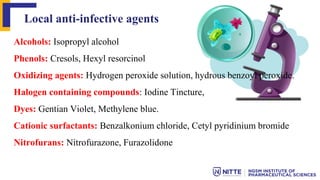
Local anti-infective agents
Alcohols: Isopropyl alcohol
Phenols: Cresols, Hexyl resorcinol
Oxidizing agents: Hydrogen peroxide solution, hydrous benzoyl peroxide.
Halogen containing compounds: Iodine Tincture,
Dyes: Gentian Violet, Methylene blue.
Cationic surfactants: Benzalkonium chloride, Cetyl pyridinium bromide
Nitrofurans: Nitrofurazone, Furazolidone
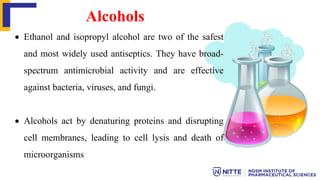
Alcohols
 Ethanol and isopropyl alcohol are two of the safest
and most widely used antiseptics. They have broad-
spectrum antimicrobial activity and are effective
against bacteria, viruses, and fungi.
 Alcohols act by denaturing proteins and disrupting
cell membranes, leading to cell lysis and death of
microorganisms
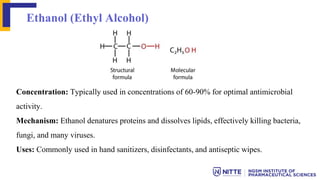
Concentration: Typically used in concentrations of 60-90% for optimal antimicrobial
activity.
Mechanism: Ethanol denatures proteins and dissolves lipids, effectively killing bacteria,
fungi, and many viruses.
Uses: Commonly used in hand sanitizers, disinfectants, and antiseptic wipes.
Ethanol (Ethyl Alcohol)
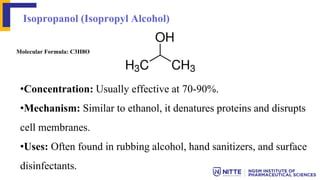
•Concentration: Usually effective at 70-90%.
•Mechanism: Similar to ethanol, it denatures proteins and disrupts
cell membranes.
•Uses: Often found in rubbing alcohol, hand sanitizers, and surface
disinfectants.
Isopropanol (Isopropyl Alcohol)
Molecular Formula: C3H8O
Uses:
• Hand Sanitizers: Alcohol-based hand sanitizers typically contain 60-95% alcohol. They are effective
against a broad spectrum of pathogens, including bacteria and many viruses.
• Surface Disinfectants: Alcohol solutions are used to disinfect surfaces in healthcare settings and
laboratories.
• Skin Antiseptics: Before injections or surgeries, skin is often swabbed with alcohol to reduce the risk
of infection.
Disadvantages:
• Flammability: Alcohols are highly flammable and need to be used with caution.
• Skin irritation: Prolonged or repeated use can cause skin dryness and irritation.
• Limited residual activity: Alcohols evaporate quickly, which limits their residual antimicrobial activity.
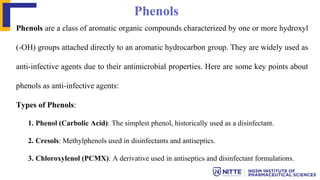
Phenols are a class of aromatic organic compounds characterized by one or more hydroxyl
(-OH) groups attached directly to an aromatic hydrocarbon group. They are widely used as
anti-infective agents due to their antimicrobial properties. Here are some key points about
phenols as anti-infective agents:
Types of Phenols:
1. Phenol (Carbolic Acid): The simplest phenol, historically used as a disinfectant.
2. Cresols: Methylphenols used in disinfectants and antiseptics.
3. Chloroxylenol (PCMX): A derivative used in antiseptics and disinfectant formulations.
Phenols
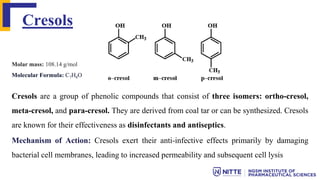
Mechanism of Action: Cresols exert their anti-infective effects primarily by damaging
bacterial cell membranes, leading to increased permeability and subsequent cell lysis
Cresols
Cresols are a group of phenolic compounds that consist of three isomers: ortho-cresol,
meta-cresol, and para-cresol. They are derived from coal tar or can be synthesized. Cresols
are known for their effectiveness as disinfectants and antiseptics.
Molar mass: 108.14 g/mol
Molecular Formula: C7H8O
•Applications: Cresols are used in dental disinfectants to remove
infected dental pulp and are also employed in surface disinfectants.
They are effective at low concentrations, typically around 2% for
disinfection purposes.
•Toxicity: While cresols are effective, they can be toxic, causing
irritation and potential systemic effects if ingested or improperly
handled. Care must be taken to avoid exposure, especially in sensitive
environments.
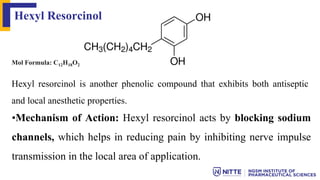
•Mechanism of Action: Hexyl resorcinol acts by blocking sodium
channels, which helps in reducing pain by inhibiting nerve impulse
transmission in the local area of application.
Hexyl Resorcinol
Hexyl resorcinol is another phenolic compound that exhibits both antiseptic
and local anesthetic properties.
Mol Formula: C12H18O2
Applications: This compound is commonly found in topical antiseptics for
minor skin infections, throat lozenges, and various cosmetic products. It is
particularly useful for treating sore throats and minor cuts or scrapes due to its
dual action as an antiseptic and anesthetic.
Toxicity: Hexyl resorcinol is considered less toxic than other phenolic
compounds, with a relatively safe profile when used as directed. However,
excessive dosages can lead to adverse effects, so caution is advised
• Oxidizing agents are a class of compounds that can act as anti-infective
agents due to their ability to disrupt the cellular structure and function of
pathogens.
• These agents work by inducing oxidative stress, leading to the production
of reactive oxygen species (ROS) that can damage proteins, lipids, and
nucleic acids of microorganisms.
• Here are a few common oxidizing agents used for their anti-infective
properties:
Oxidizing agents
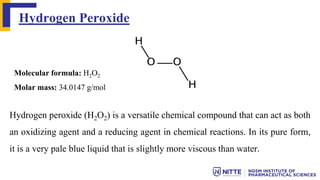
Hydrogen peroxide (H2O2) is a versatile chemical compound that can act as both
an oxidizing agent and a reducing agent in chemical reactions. In its pure form,
it is a very pale blue liquid that is slightly more viscous than water.
Molecular formula: H2O2
Molar mass: 34.0147 g/mol
Hydrogen Peroxide
Uses of Hydrogen Peroxide
Hydrogen peroxide has several important uses, including
• Antiseptic
• Oral Hygiene
• Teeth Whitening
• Hair Bleaching
• Disinfectant
• Earwax Removal
• Acne Treatment
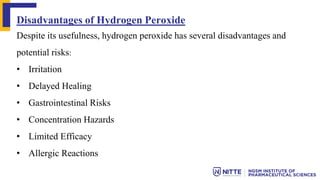
Disadvantages of Hydrogen Peroxide
Despite its usefulness, hydrogen peroxide has several disadvantages and
potential risks:
• Irritation
• Delayed Healing
• Gastrointestinal Risks
• Concentration Hazards
• Limited Efficacy
• Allergic Reactions
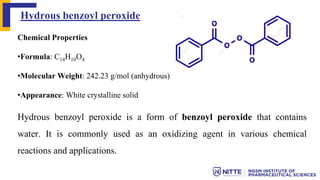
Chemical Properties
•Formula: C14H10O4
•Molecular Weight: 242.23 g/mol (anhydrous)
•Appearance: White crystalline solid
Hydrous benzoyl peroxide is a form of benzoyl peroxide that contains
water. It is commonly used as an oxidizing agent in various chemical
reactions and applications.
Hydrous benzoyl peroxide
Uses
1.Acne Treatment: Benzoyl peroxide is one of the most effective over-the-
counter treatments for acne.
2.Antiseptic Properties: It has strong antibacterial properties, making it
effective against a broad range of bacteria on the skin.
3.Keratolytic Action: It helps to exfoliate the skin, promoting the removal of
dead skin cells.
4.Anti-Inflammatory: It reduces inflammation associated with acne, helping
to decrease redness and swelling.
Disadvantages
1.Skin Irritation
2.Bleaching Effect: Benzoyl peroxide can bleach hair and colored fabrics,
including clothing, towels, and bedding.
3.Photosensitivity: It can increase the skin's sensitivity to sunlight
4.Allergic Reactions: In rare cases, individuals may experience an allergic
reaction, characterized by severe itching, swelling, or difficulty breathing.
5.Dryness and Peeling: Overuse or use on sensitive skin can lead to excessive
dryness and peeling, which can be uncomfortable and unsightly.
Iodine tincture is a well-known anti-infective agent containing iodine, a halogen. It is
widely used for its antiseptic properties to disinfect wounds and prepare the skin
before surgery. Here are some key points about iodine tincture.
Composition:
•Iodine: Typically, iodine tincture contains 2-7% iodine.
•Potassium Iodide: Acts as a solubilizing agent, usually present in concentrations around 2-5%.
•Solvent: Ethanol or isopropanol, making up the majority of the solution, often around 50-70%.
•Water: May be present in varying amounts.
Iodine Tincture
Mechanism of Action:
• Broad-Spectrum Antimicrobial: Iodine is effective against a wide range of
pathogens, including bacteria, viruses, fungi, and protozoa.
• Protein Denaturation: Iodine works by penetrating the cell walls of microorganisms
and disrupting their proteins and nucleic acids, leading to cell death.
Uses:
•Preoperative Skin Preparation: Used to disinfect the skin before surgical procedures to
reduce the risk of infections.
•Wound Disinfection: Applied to minor cuts, abrasions, and burns to prevent infection.
•First Aid: Commonly included in first aid kits for its effectiveness in emergency situations.
Advantages:
•Rapid Action: Iodine tincture works quickly to kill a wide range of microorganisms.
•Broad Spectrum: Effective against various types of pathogens.
•Availability: Widely available and easy to use.
Iodine tincture has some disadvantages:
• Skin Irritation
• Staining: It can stain the skin, clothing, and other surfaces.
• Allergic Reactions
• Toxicity: Ingestion or excessive application can lead to iodine toxicity, causing
symptoms such as stomach pain, vomiting, and diarrhea.
• Interference with Healing: Prolonged use may interfere with the healing process of
wounds.
• Not Suitable for Certain Wounds: It should not be used on large wounds, severe
burns, or mucous membranes as it can be too harsh and cause tissue damage
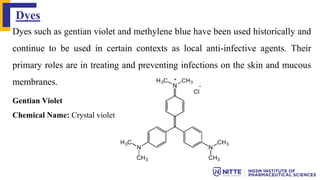
Gentian Violet
Chemical Name: Crystal violet
Dyes such as gentian violet and methylene blue have been used historically and
continue to be used in certain contexts as local anti-infective agents. Their
primary roles are in treating and preventing infections on the skin and mucous
membranes.
Dyes
Mechanism of Action:
•Gentian violet works by binding to the DNA of microorganisms, disrupting cell division
and ultimately leading to cell death. Its action is due to its ability to intercalate into the
DNA, inhibiting the replication and transcription processes of the microorganisms.
Clinical Uses:
• Oral Thrush: Applied inside the mouth for treating oral candidiasis.
• Skin Infections: Used for fungal infections of the skin and minor bacterial skin
infections.
• Wound Care: Applied to minor cuts, scrapes, and burns to prevent infection.
• Navel Care in Newborns: Sometimes used to prevent infection in the umbilical stump
of newborns
Limitations
• Staining: Most of these dyes can cause significant staining of skin,
clothing, and other materials.
• Skin Irritation: Prolonged use or application to sensitive areas can lead to
skin irritation or contact dermatitis.
• Allergic Reactions: Some individuals may experience allergic reactions,
necessitating a patch test before use.
• Resistance: Overuse can lead to the development of resistant strains of
microorganisms, reducing the effectiveness of these agents.
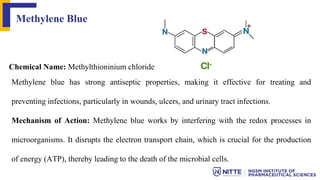
Methylene Blue
Chemical Name: Methylthioninium chloride
Methylene blue has strong antiseptic properties, making it effective for treating and
preventing infections, particularly in wounds, ulcers, and urinary tract infections.
Mechanism of Action: Methylene blue works by interfering with the redox processes in
microorganisms. It disrupts the electron transport chain, which is crucial for the production
of energy (ATP), thereby leading to the death of the microbial cells.
Limitations
• Staining: Methylene blue can stain skin, mucous membranes, and clothing, which may
be a cosmetic concern for patients.
• Skin Irritation: Can cause irritation or an allergic reaction in some individuals. It is
advisable to perform a patch test before extensive use.
• Resistance: Prolonged or inappropriate use can lead to the development of resistant
strains of microorganisms.
• Photosensitivity: May increase sensitivity to light, leading to phototoxic reactions in
some cases.
• Cationic surfactants are a type of surfactant where the surface-active part of the
molecule carries a positive charge.
• They are commonly used in various applications due to their unique properties.
• Cationic surfactants typically have a hydrophobic tail and a positively charged
hydrophilic head.
• Common examples include quaternary ammonium compounds (quats), such as
cetyltrimethylammonium bromide (CTAB) and benzalkonium chloride (BAC).
Cationic Surfactants
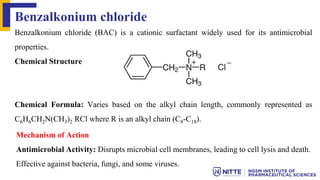
Benzalkonium chloride (BAC) is a cationic surfactant widely used for its antimicrobial
properties.
Chemical Structure
Chemical Formula: Varies based on the alkyl chain length, commonly represented as
C6H6CH2N(CH3)2 RCl where R is an alkyl chain (C8-C18).
Benzalkonium chloride
Mechanism of Action
Antimicrobial Activity: Disrupts microbial cell membranes, leading to cell lysis and death.
Effective against bacteria, fungi, and some viruses.
Uses
• Disinfectants and Sanitizers: Common in household disinfectants, healthcare, and food
industry sanitizers.
• Preservatives: Used in pharmaceuticals, cosmetics, and personal care products.
• Surface Cleaners: Incorporated in cleaning products for surfaces in homes and
industries.
• Water Treatment: Used for controlling algae and as a biocide in water systems.
Safety
Toxicity: Low toxicity in recommended concentrations, but can cause skin and eye irritation.
High concentrations can be harmful.
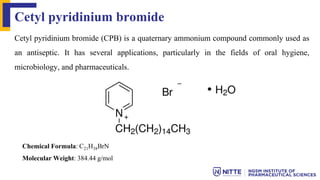
Cetyl pyridinium bromide (CPB) is a quaternary ammonium compound commonly used as
an antiseptic. It has several applications, particularly in the fields of oral hygiene,
microbiology, and pharmaceuticals.
Cetyl pyridinium bromide
Chemical Formula: C21H38BrN
Molecular Weight: 384.44 g/mol
Mechanism of Action
CPB works by disrupting the cell membranes of bacteria and other microorganisms. The
cetyl group interacts with the lipid bilayer of the cell membrane, while the pyridinium
moiety disrupts the membrane structure, leading to cell lysis and death of the
microorganism.
Uses
1.Oral Hygiene: CPB is an active ingredient in some mouthwashes and throat lozenges. It
helps reduce plaque, gingivitis, and bad breath by targeting and killing bacteria in the
mouth.
2.Microbiology: In laboratory settings, CPB is used to inhibit microbial growth. It is
particularly effective against a variety of bacteria and fungi.
3.Pharmaceuticals: CPB is included in formulations for topical antiseptics and
disinfectants. It can be used in solutions or gels to prevent infections in wounds or surgical
sites.
Side Effects
• While CPB is generally considered safe for use in oral hygiene
products, excessive use can cause irritation of the mucous
membranes.
• Ingesting large quantities can be toxic, so products containing
CPB should be used according to the instructions.
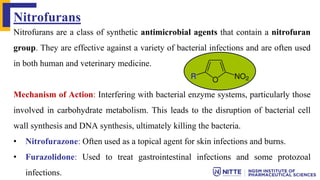
Nitrofurans are a class of synthetic antimicrobial agents that contain a nitrofuran
group. They are effective against a variety of bacterial infections and are often used
in both human and veterinary medicine.
Mechanism of Action: Interfering with bacterial enzyme systems, particularly those
involved in carbohydrate metabolism. This leads to the disruption of bacterial cell
wall synthesis and DNA synthesis, ultimately killing the bacteria.
• Nitrofurazone: Often used as a topical agent for skin infections and burns.
• Furazolidone: Used to treat gastrointestinal infections and some protozoal
infections.
Nitrofurans
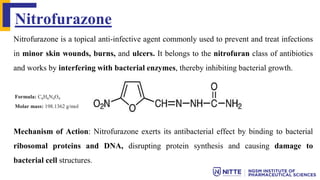
Nitrofurazone
Nitrofurazone is a topical anti-infective agent commonly used to prevent and treat infections
in minor skin wounds, burns, and ulcers. It belongs to the nitrofuran class of antibiotics
and works by interfering with bacterial enzymes, thereby inhibiting bacterial growth.
Mechanism of Action: Nitrofurazone exerts its antibacterial effect by binding to bacterial
ribosomal proteins and DNA, disrupting protein synthesis and causing damage to
bacterial cell structures.
Formula: C6H6N4O4
Molar mass: 198.1362 g/mol
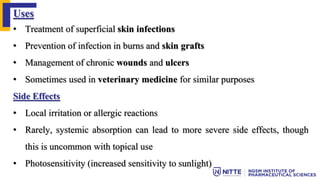
Uses
• Treatment of superficial skin infections
• Prevention of infection in burns and skin grafts
• Management of chronic wounds and ulcers
• Sometimes used in veterinary medicine for similar purposes
Side Effects
• Local irritation or allergic reactions
• Rarely, systemic absorption can lead to more severe side effects, though
this is uncommon with topical use
• Photosensitivity (increased sensitivity to sunlight)
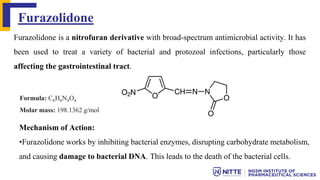
Mechanism of Action:
•Furazolidone works by inhibiting bacterial enzymes, disrupting carbohydrate metabolism,
and causing damage to bacterial DNA. This leads to the death of the bacterial cells.
Furazolidone is a nitrofuran derivative with broad-spectrum antimicrobial activity. It has
been used to treat a variety of bacterial and protozoal infections, particularly those
affecting the gastrointestinal tract.
Furazolidone
Formula: C6H6N4O4
Molar mass: 198.1362 g/mol
Clinical Uses:
•Gastrointestinal Infections: Furazolidone has been used to treat diarrhea and enteritis
caused by susceptible bacteria and protozoa.
•Giardiasis: It is effective in the treatment of giardiasis, a parasitic infection of the
small intestine.
•Traveler's Diarrhea: Furazolidone is sometimes used for the treatment of traveler's
diarrhea caused by bacterial pathogens.
•Helicobacter pylori Infection: It has been used in combination with other medications
to treat H. pylori infection, which is associated with peptic ulcers.
Adverse Effects:
•Gastrointestinal: Nausea, vomiting, and diarrhea are the most common side
effects.
•Allergic Reactions: Rash, itching, and other allergic reactions can occur.
•Neurological: In rare cases, furazolidone may cause peripheral neuropathy or
neurotoxicity, especially with prolonged use.
•Hematological: It may cause hemolysis in individuals with glucose-6-
phosphate dehydrogenase (G6PD) deficiency.
Thank you!