Recombinant DNA technology
Presented to : Sir Ashfaq
Presented by: Nasira Bashir
Roll number : 01
Contents
 Introduction
 Discovery
 Goals and objectives
 rDNA technology procedure
 Enzymes
 Vectors
 Techniques
 Applications
 Summary
Recombinant DNA technology
DNA molecules that are extracted from different
sources and chemically joined together; for example
DNA comprising ananimal gene may be recombined
with DNA from a bacterium
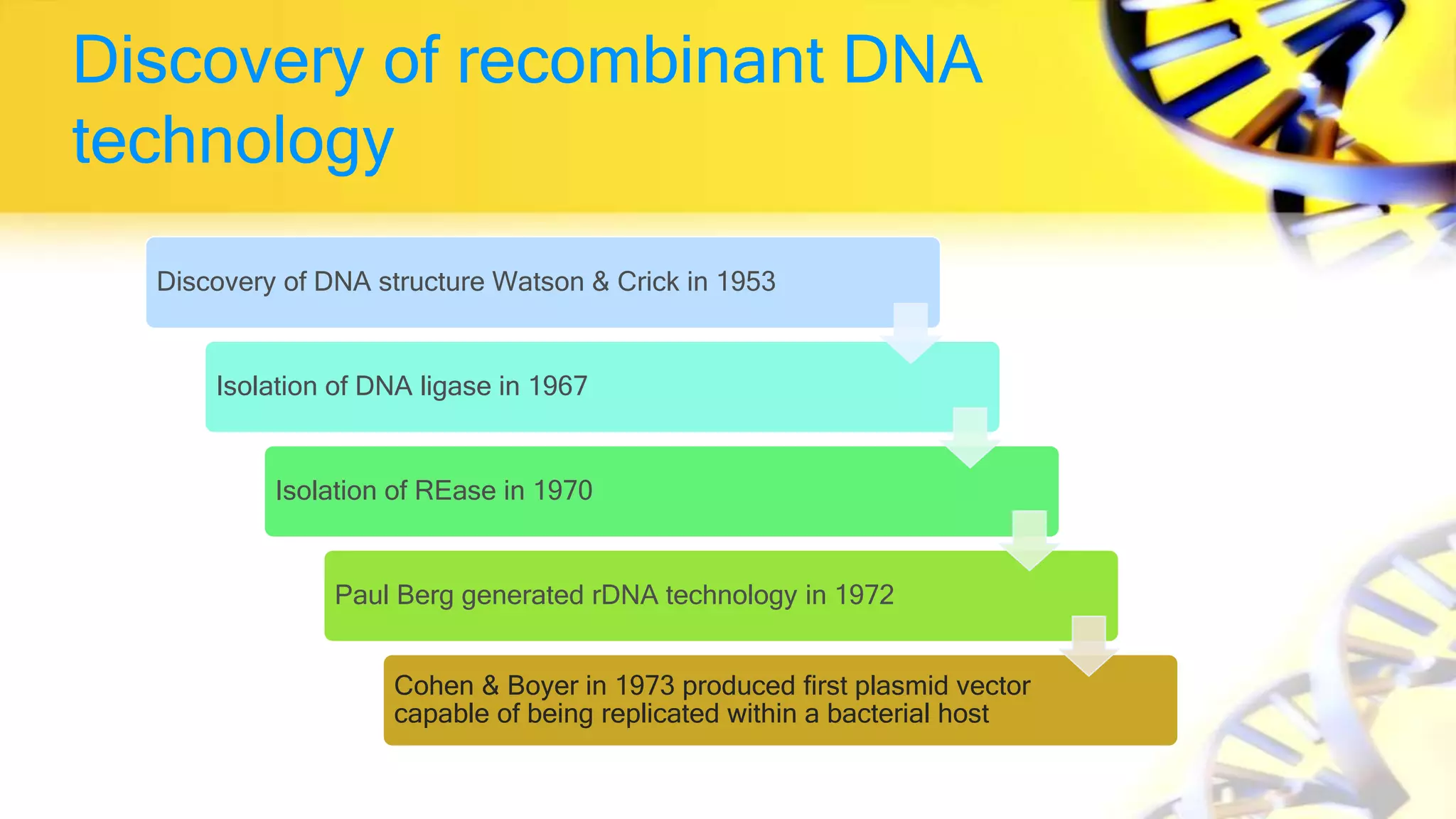
Discovery of recombinant DNA
technology
Discovery of DNA structure Watson & Crick in 1953
Isolation of DNA ligase in 1967
Isolation of REase in 1970
Paul Berg generated rDNA technology in 1972
Cohen & Boyer in 1973 produced first plasmid vector
capable of being replicated within a bacterial host
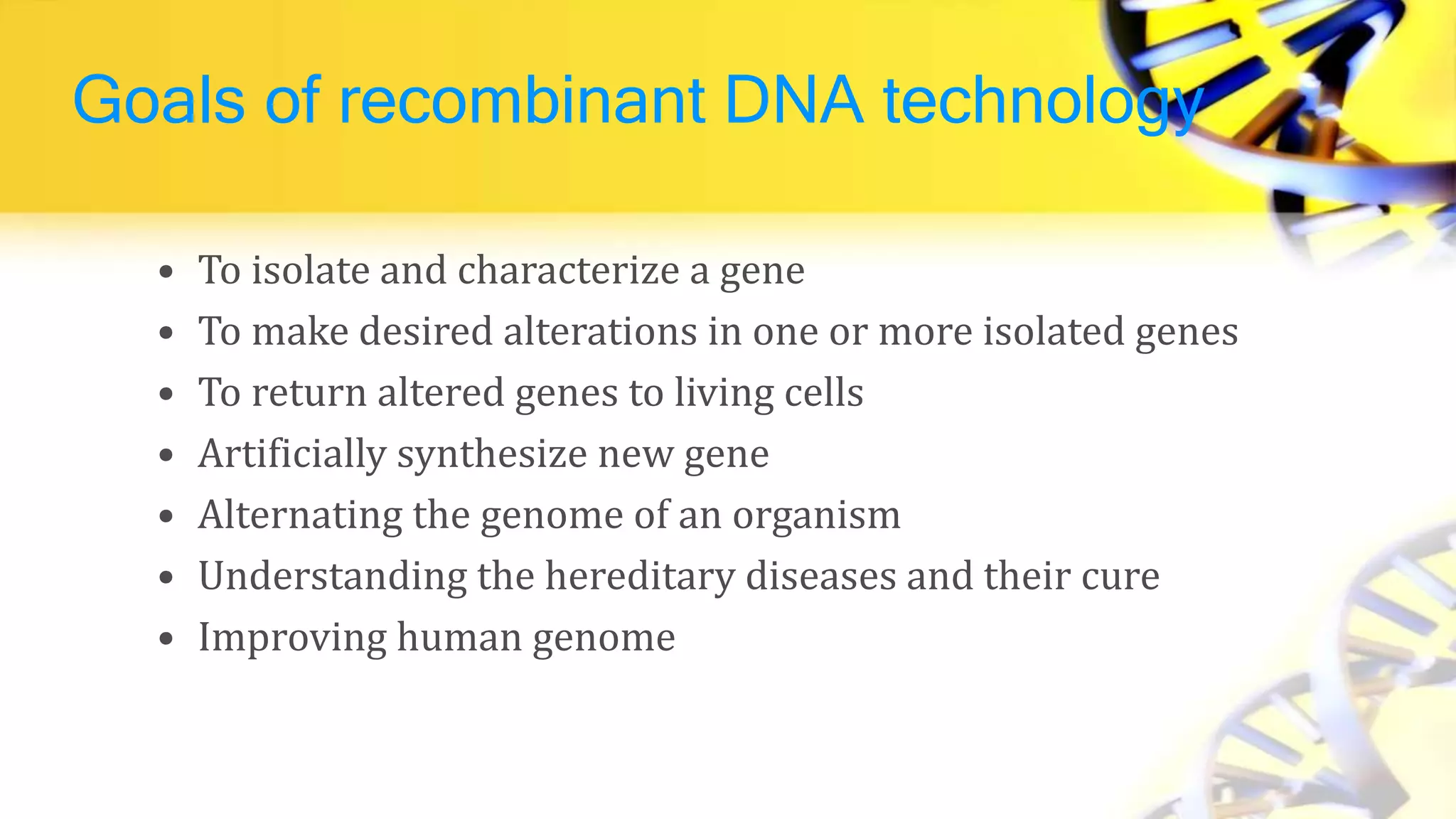
Goals of recombinant DNA technology
• To isolate and characterize a gene
• To make desired alterations in one or more isolated genes
• To return altered genes to living cells
• Artificially synthesize new gene
• Alternating the genome of an organism
• Understanding the hereditary diseases and their cure
• Improving human genome
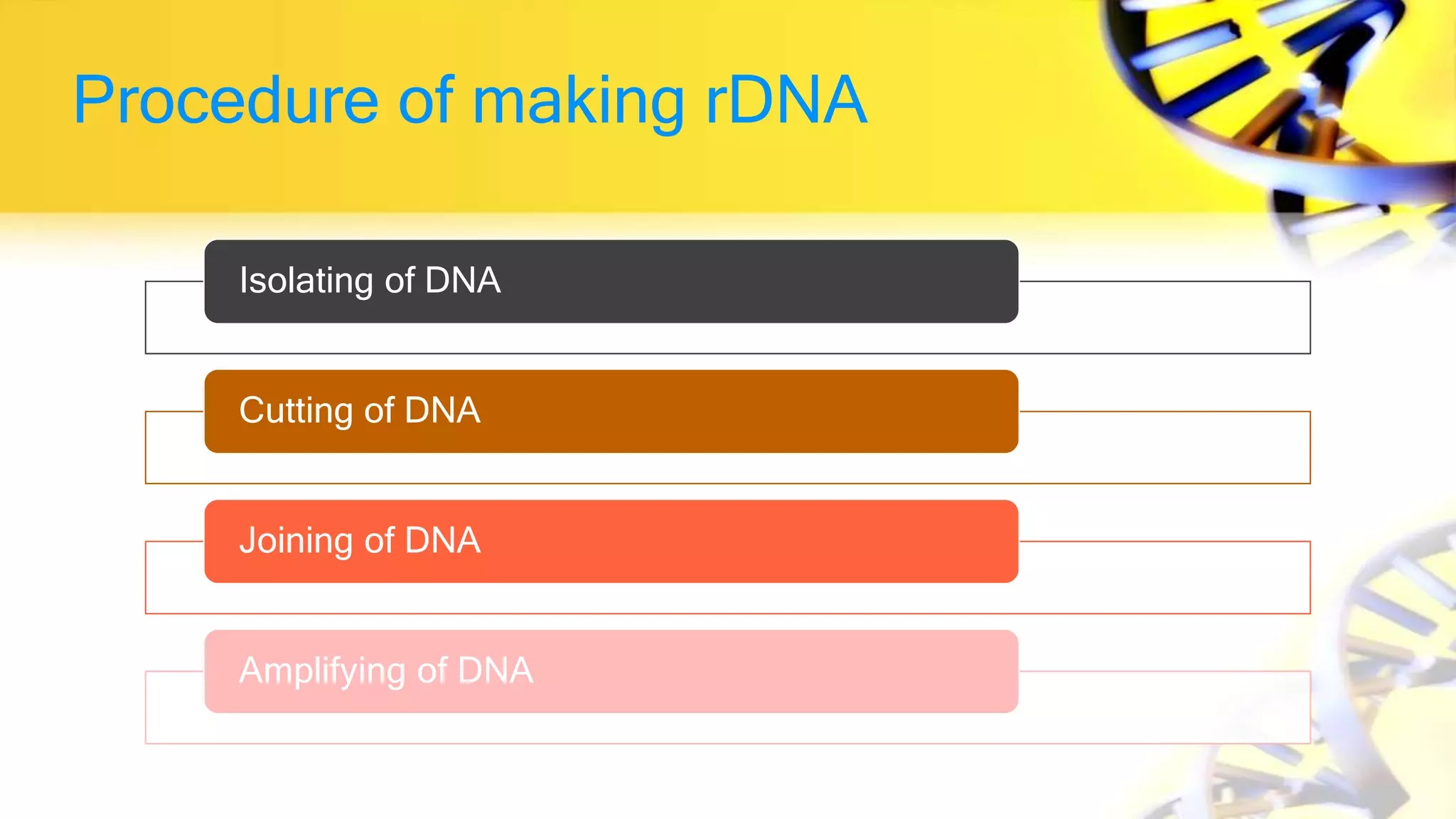
Procedure of making rDNA
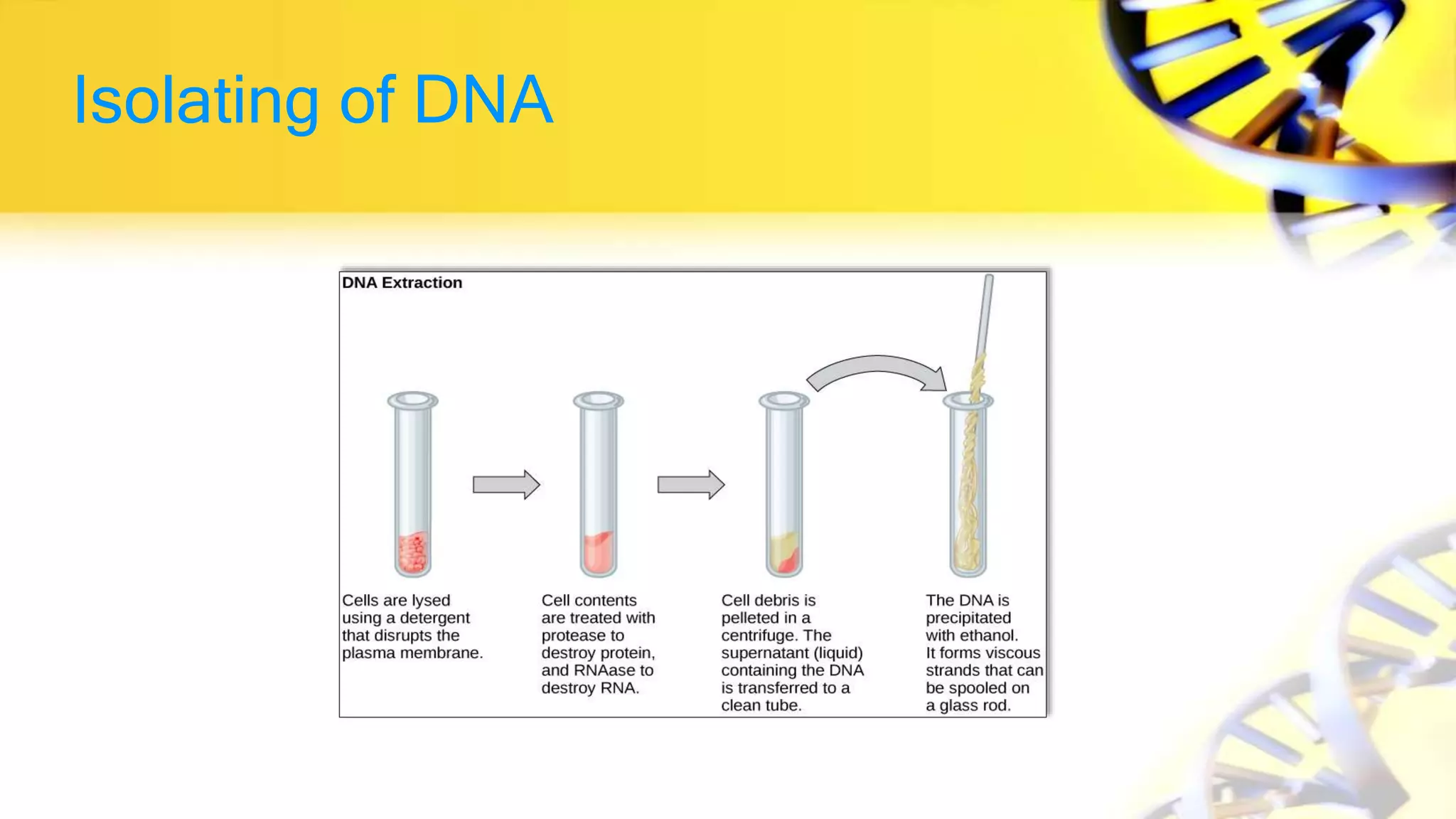
Isolating of DNA
Cutting of DNA
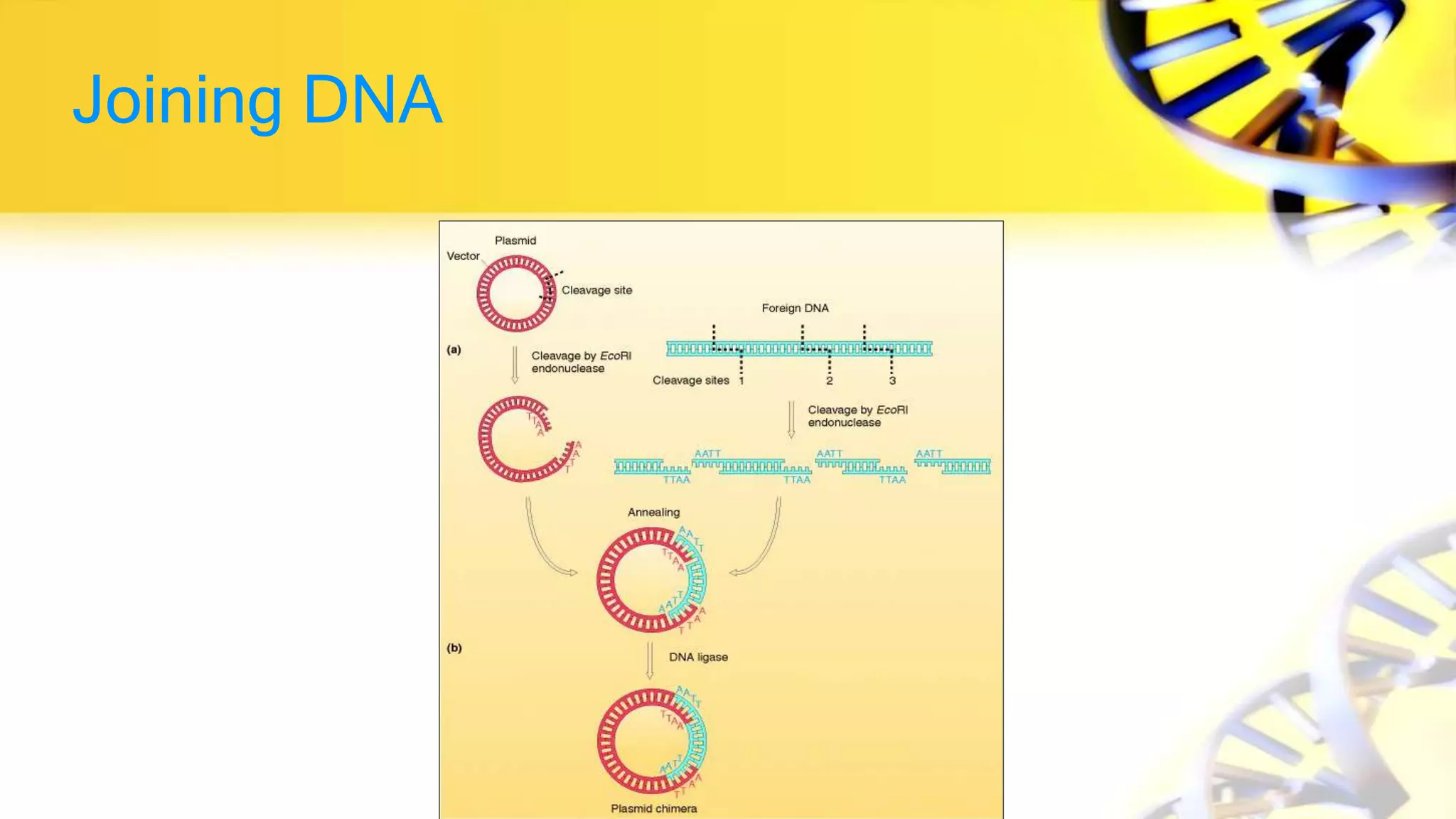
Joining of DNA
Amplifying of DNA
Isolating of DNA
Cutting of DNA
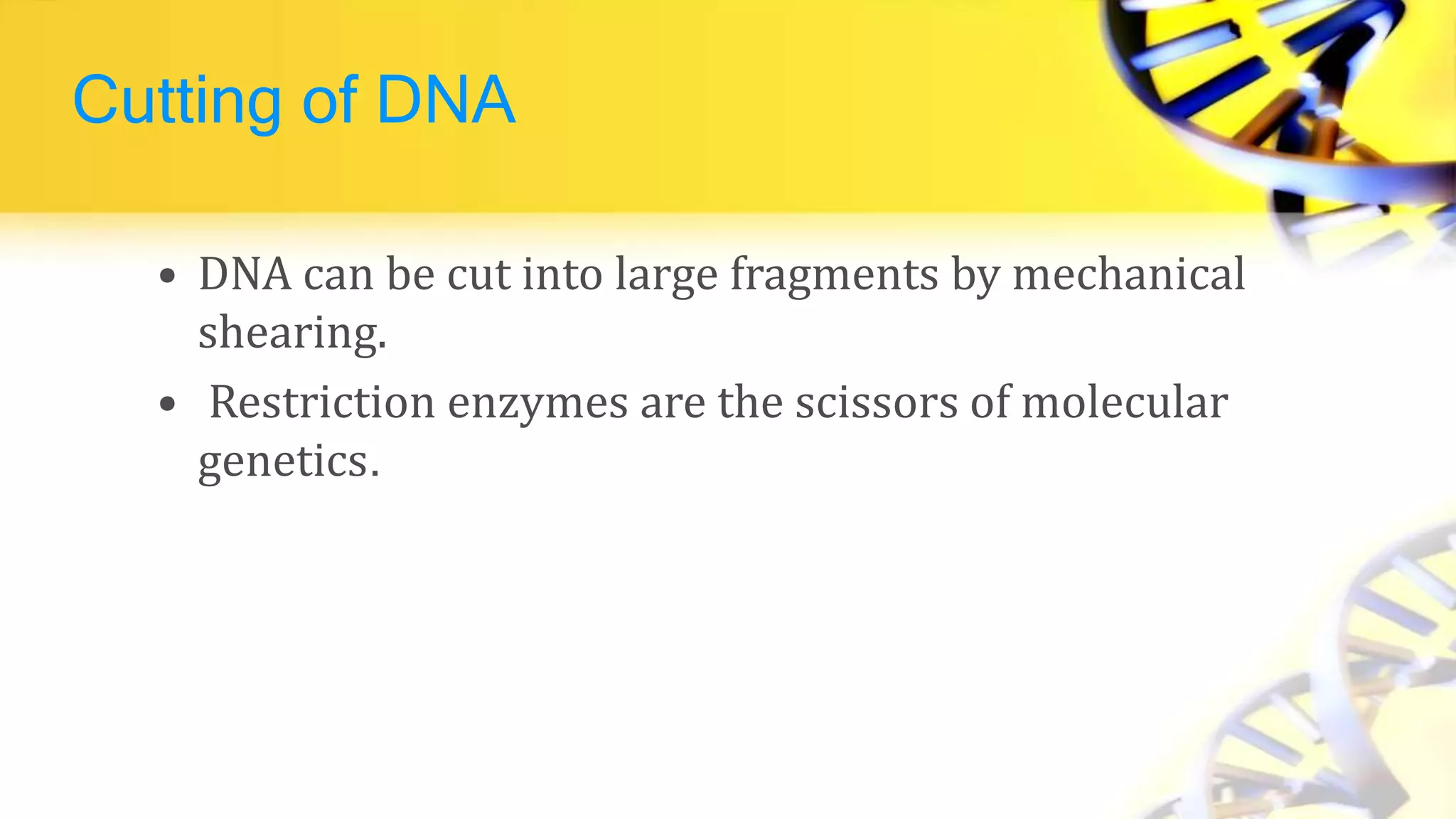
• DNA can be cut into large fragments by mechanical
shearing.
• Restriction enzymes are the scissors of molecular
genetics.
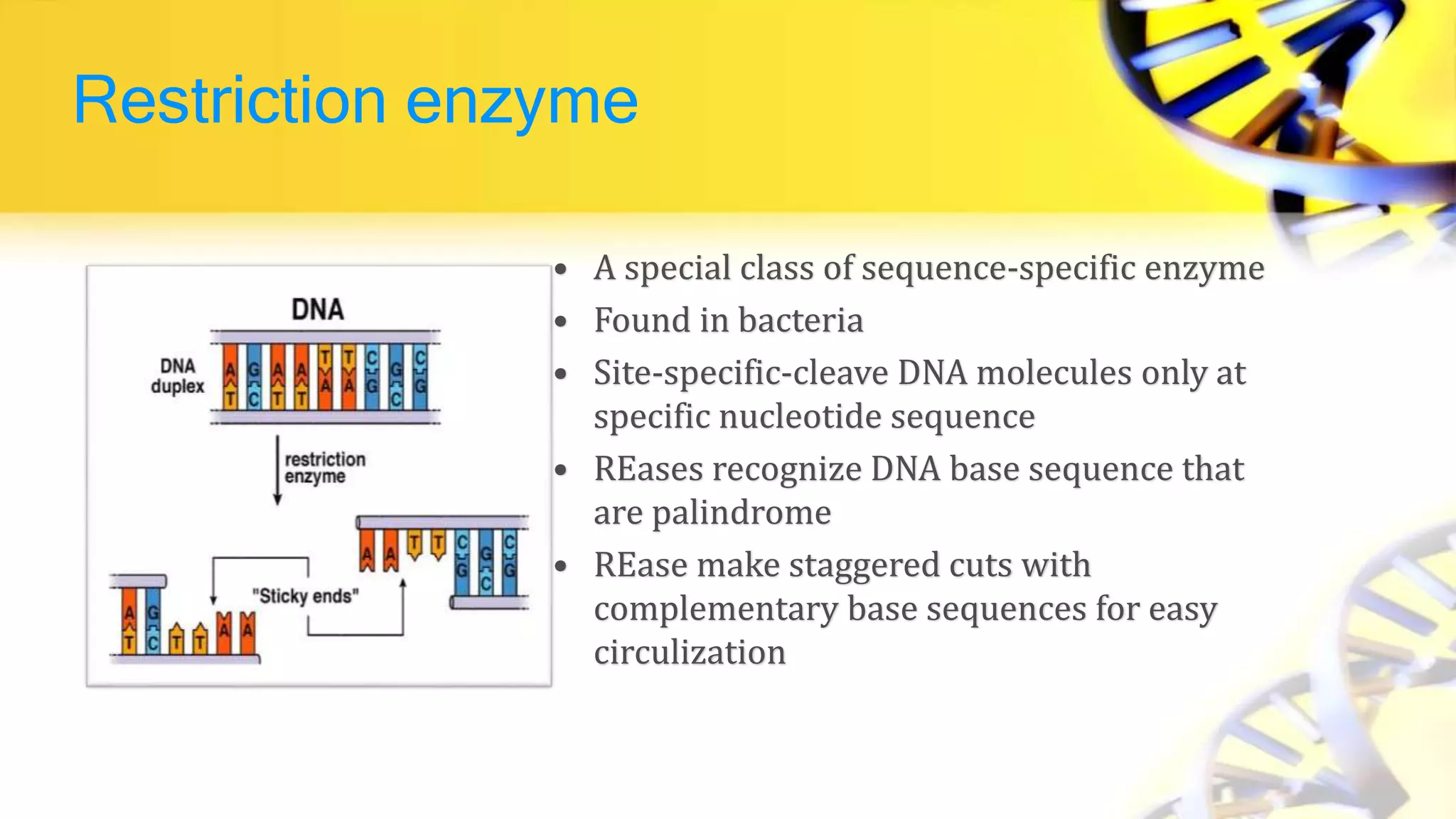
Restriction enzyme
• A special class of sequence-specific enzyme
• Found in bacteria
• Site-specific-cleave DNA molecules only at
specific nucleotide sequence
• REases recognize DNA base sequence that
are palindrome
• REase make staggered cuts with
complementary base sequences for easy
circulization
Joining DNA
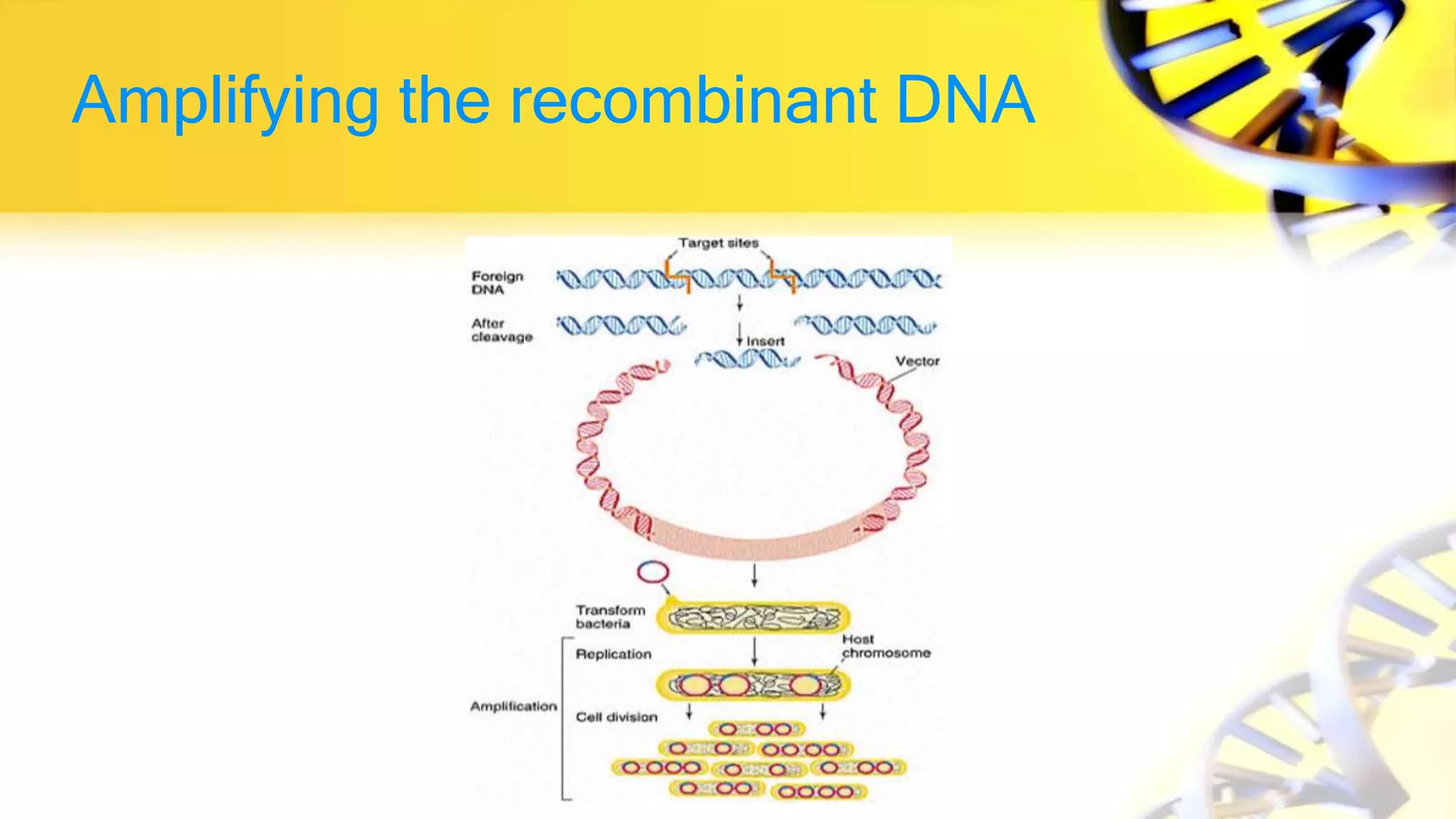
Amplifying the recombinant DNA
• Transforming the recombinant DNA into a bacterial host strain.
• The cells are treated with CaCl2
• DNA is added
• Cells are heat shocked at 42 C
• DNA goes into cell by a somewhat unknown mechanism.
• Once in a cell, the recombinant DNA will be replicated.
• When the cell divides, the replicated recombinant molecules go to both
daughter cells which themselves will divide later. Thus, the DNA is
amplified
Amplifying the recombinant DNA
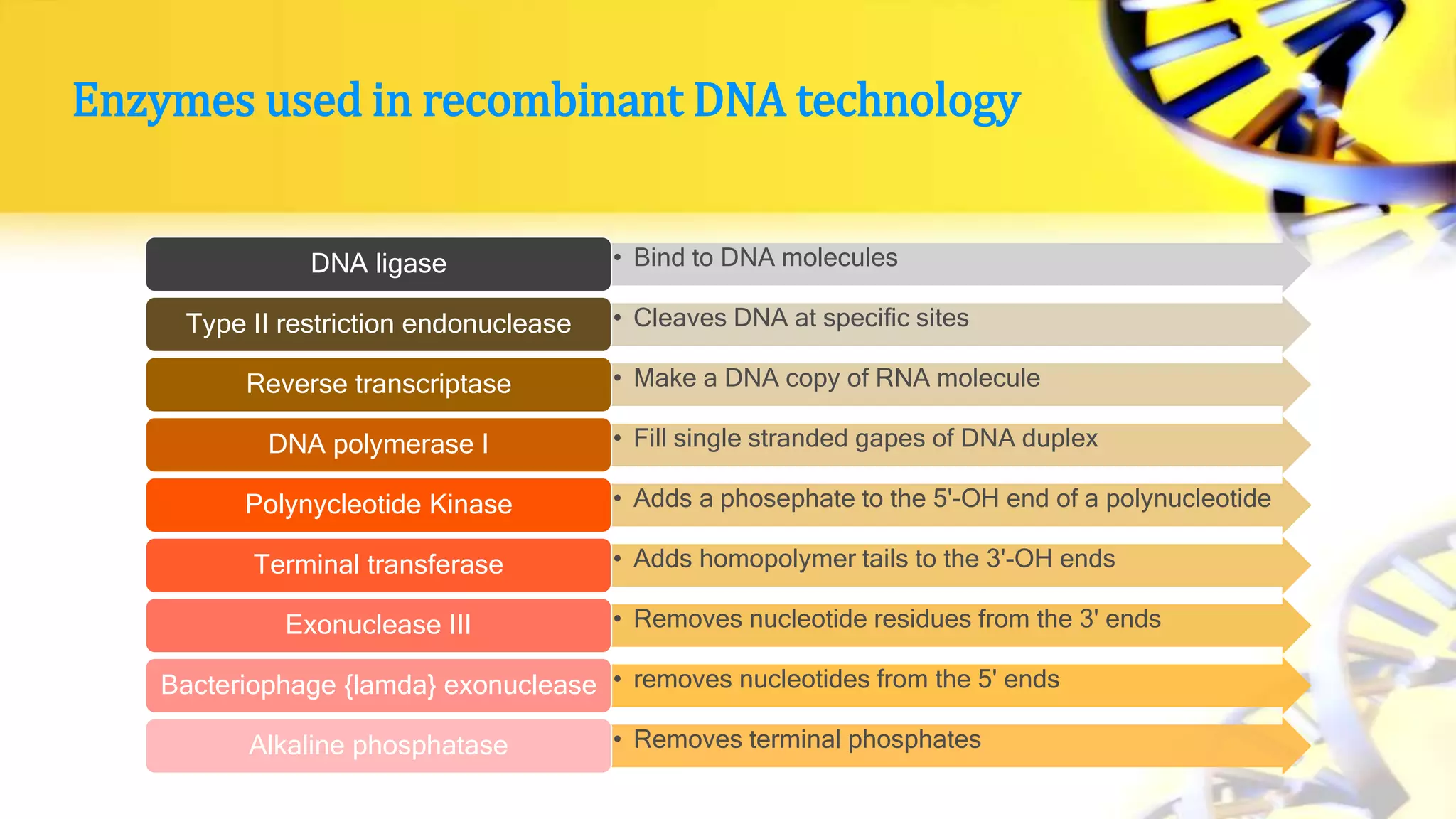
Enzymes used in recombinant DNA technology
• Bind to DNA moleculesDNA ligase
• Cleaves DNA at specific sitesType II restriction endonuclease
• Make a DNA copy of RNA moleculeReverse transcriptase
• Fill single stranded gapes of DNA duplexDNA polymerase I
• Adds a phosephate to the 5'-OH end of a polynucleotidePolynycleotide Kinase
• Adds homopolymer tails to the 3'-OH endsTerminal transferase
• Removes nucleotide residues from the 3' endsExonuclease III
• removes nucleotides from the 5' endsBacteriophage {lamda} exonuclease
• Removes terminal phosphatesAlkaline phosphatase
Vectors used in rDNA technology
• A vector is an area of DNA that can join another DNA
part without losing the limit for self-replication
• Should be capable of replicating in host cell
• Should have convenient RE sites for inserting DNA of
interest
• Should have a selectable marker to indicate which
host cells received recombinant DNA molecule
• Should be small and easy to isolate
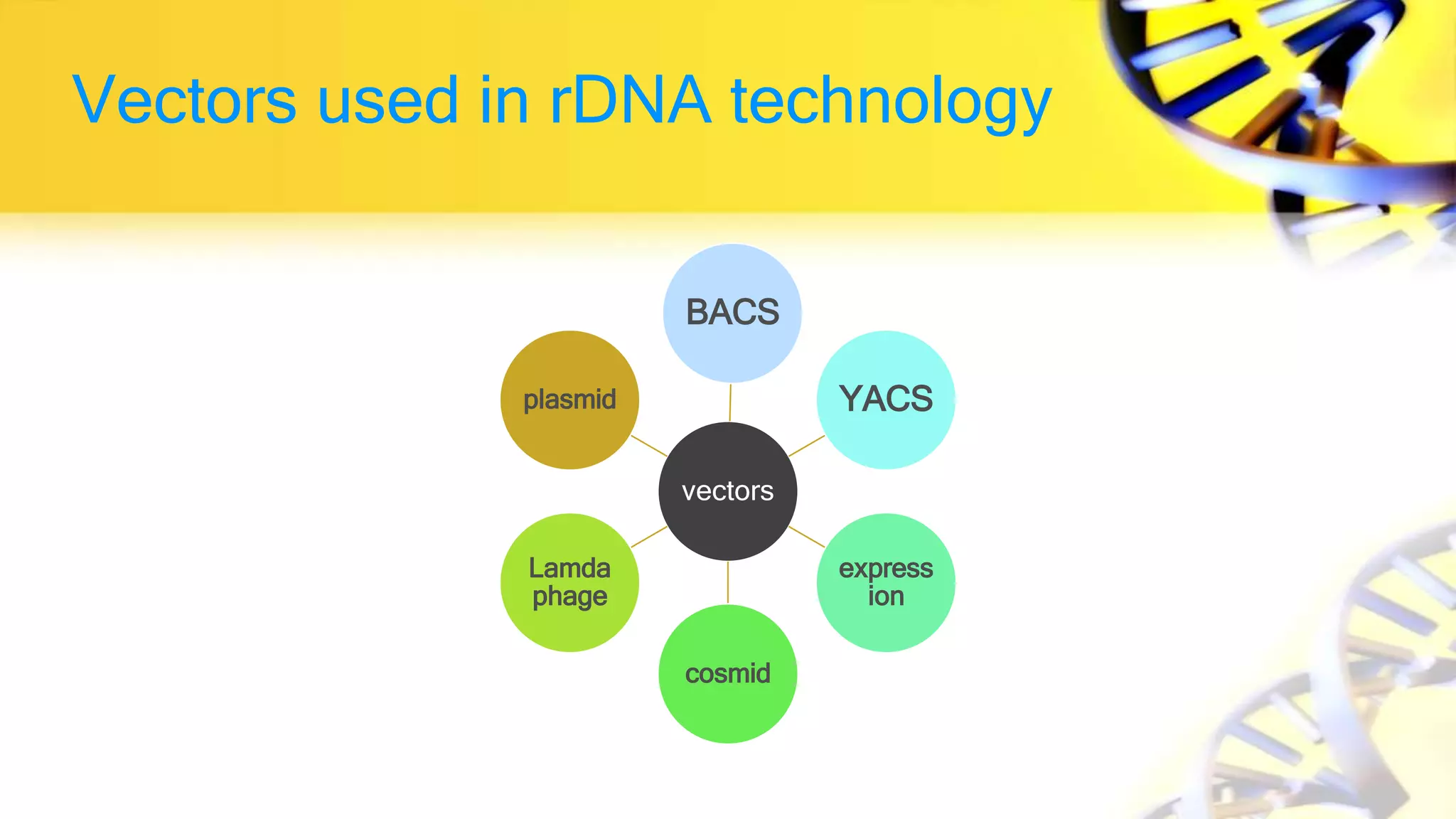
Vectors used in rDNA technology
vectors
BACS
YACS
express
ion
cosmid
Lamda
phage
plasmid
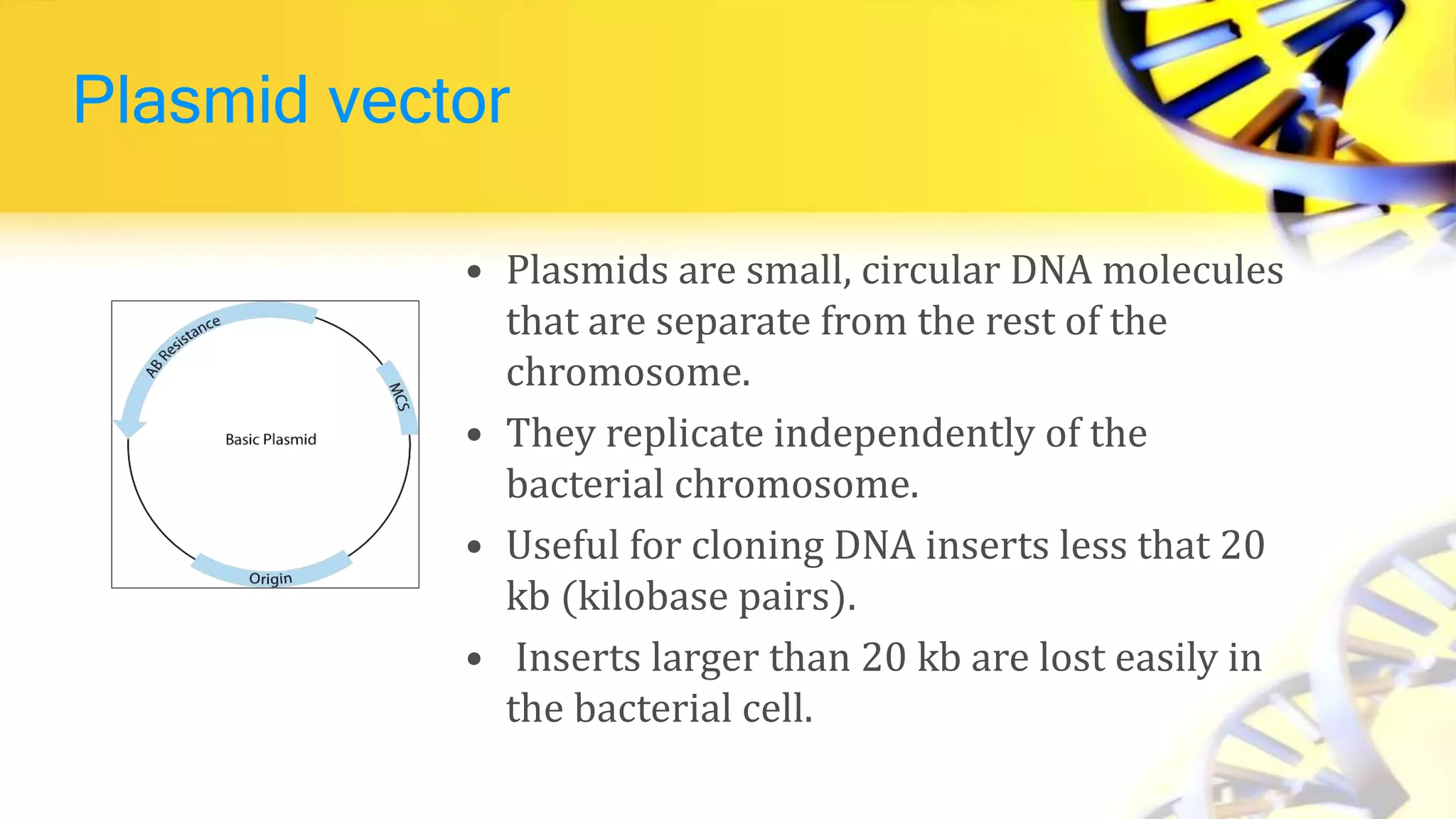
Plasmid vector
• Plasmids are small, circular DNA molecules
that are separate from the rest of the
chromosome.
• They replicate independently of the
bacterial chromosome.
• Useful for cloning DNA inserts less that 20
kb (kilobase pairs).
• Inserts larger than 20 kb are lost easily in
the bacterial cell.
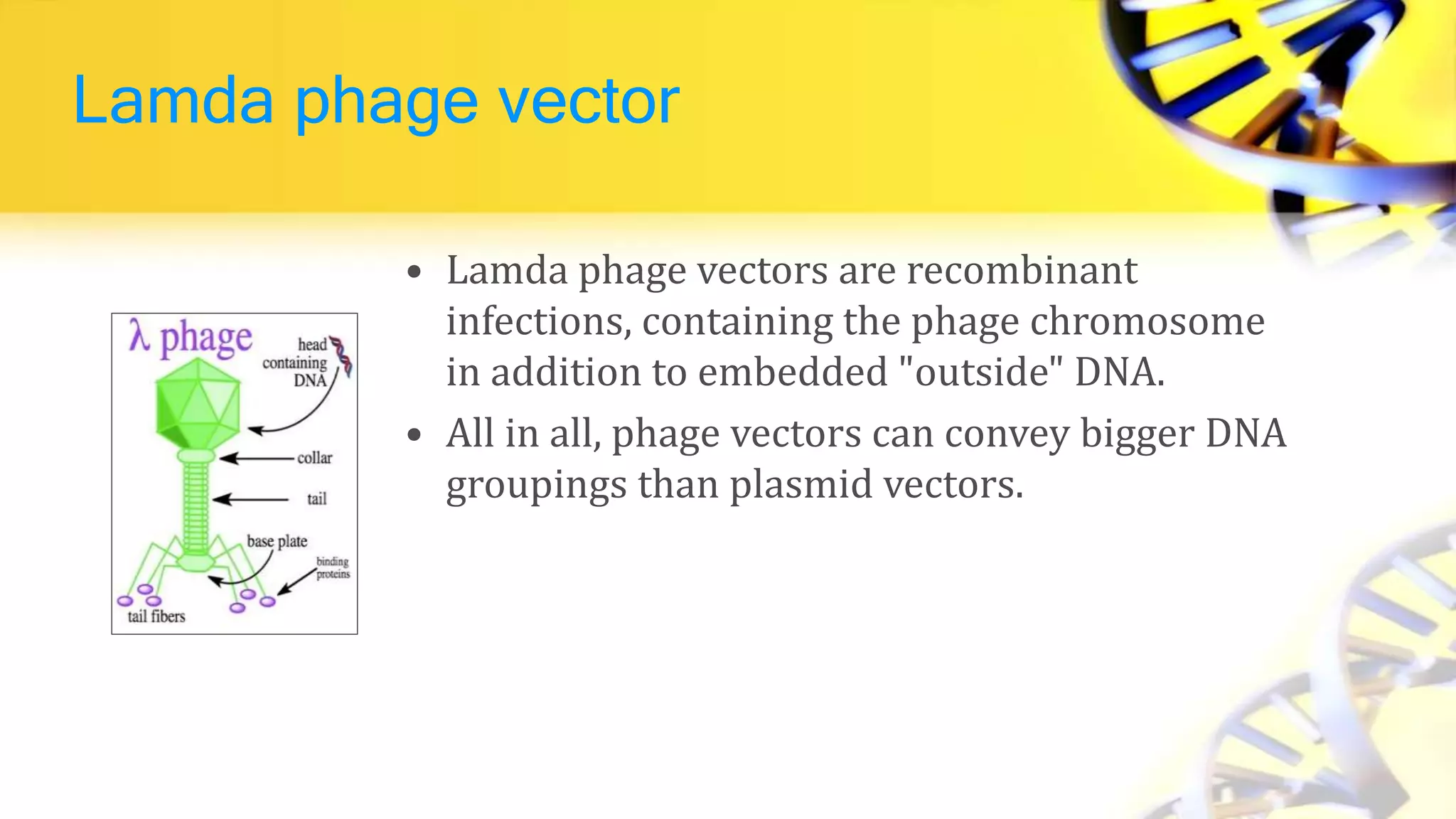
Lamda phage vector
• Lamda phage vectors are recombinant
infections, containing the phage chromosome
in addition to embedded "outside" DNA.
• All in all, phage vectors can convey bigger DNA
groupings than plasmid vectors.
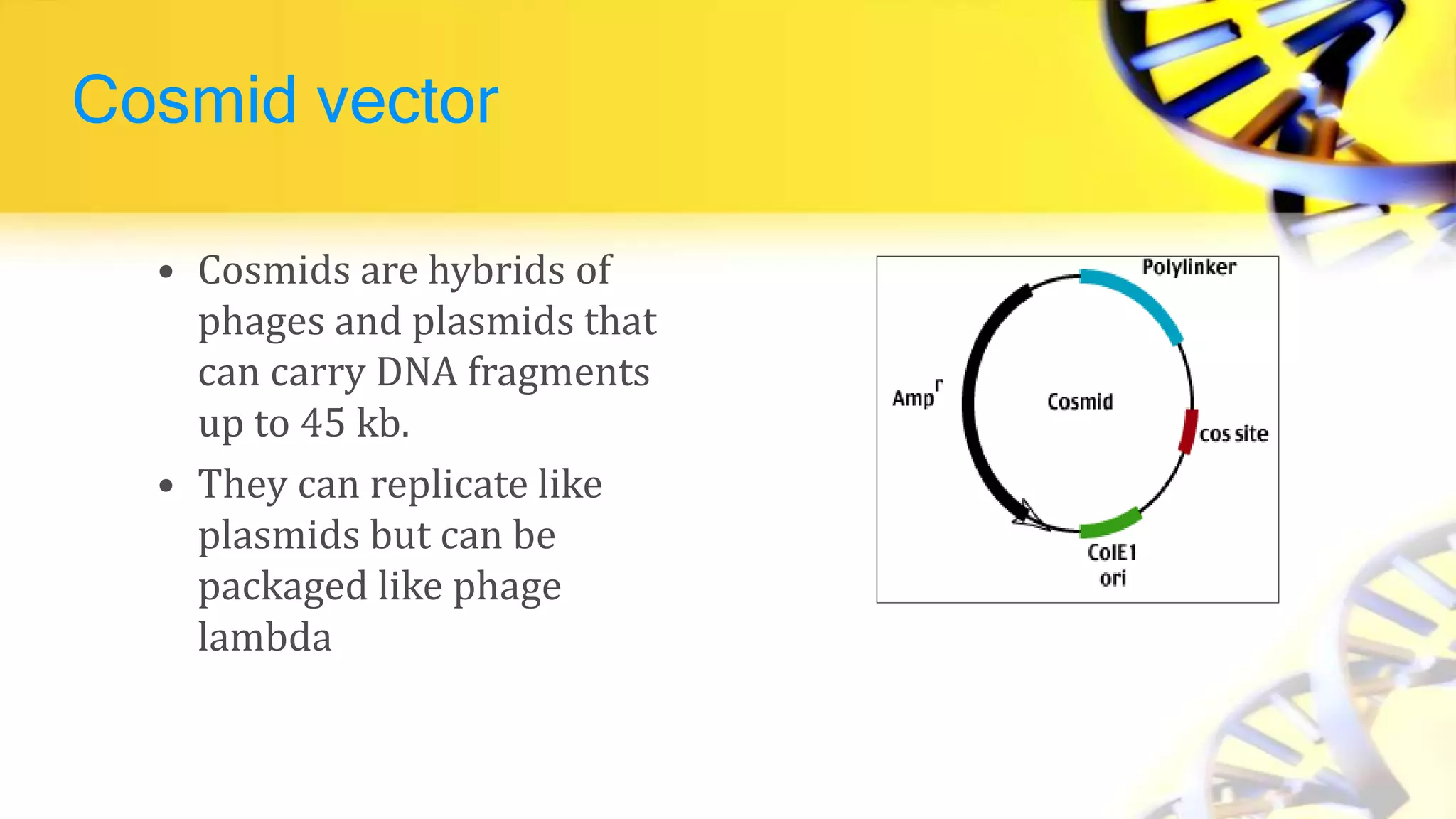
Cosmid vector
• Cosmids are hybrids of
phages and plasmids that
can carry DNA fragments
up to 45 kb.
• They can replicate like
plasmids but can be
packaged like phage
lambda
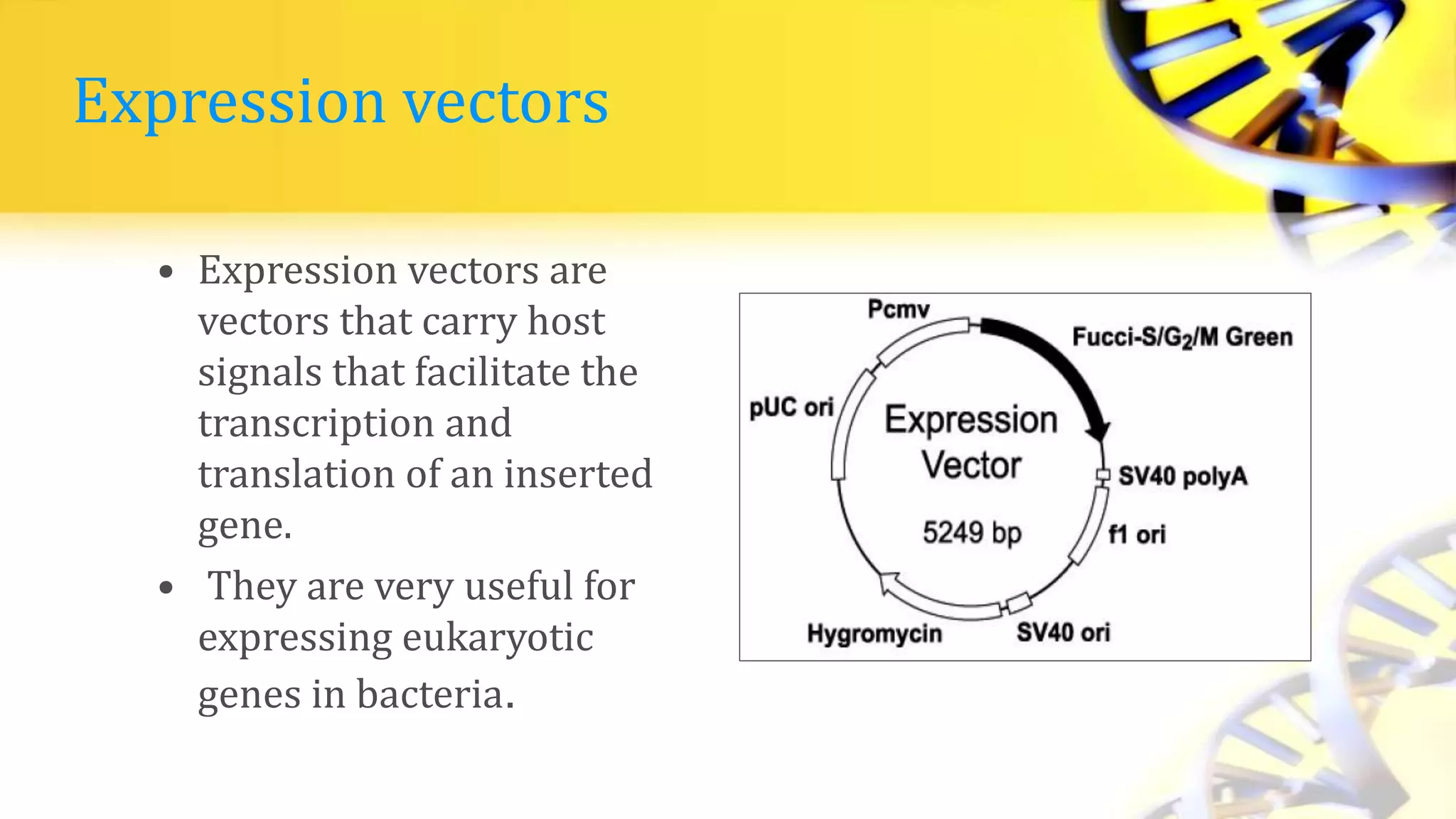
Expression vectors
• Expression vectors are
vectors that carry host
signals that facilitate the
transcription and
translation of an inserted
gene.
• They are very useful for
expressing eukaryotic
genes in bacteria.
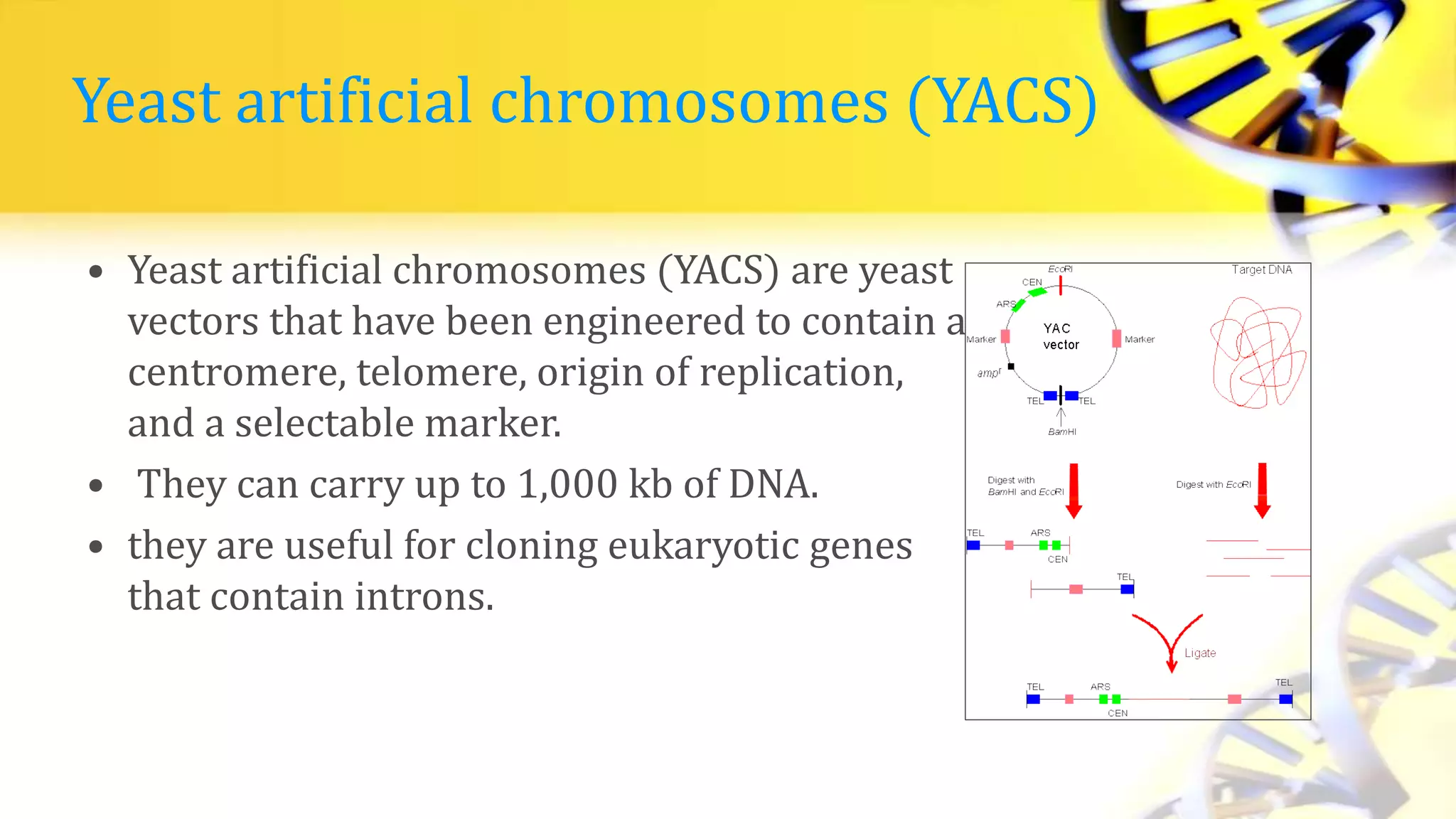
Yeast artificial chromosomes (YACS)
• Yeast artificial chromosomes (YACS) are yeast
vectors that have been engineered to contain a
centromere, telomere, origin of replication,
and a selectable marker.
• They can carry up to 1,000 kb of DNA.
• they are useful for cloning eukaryotic genes
that contain introns.
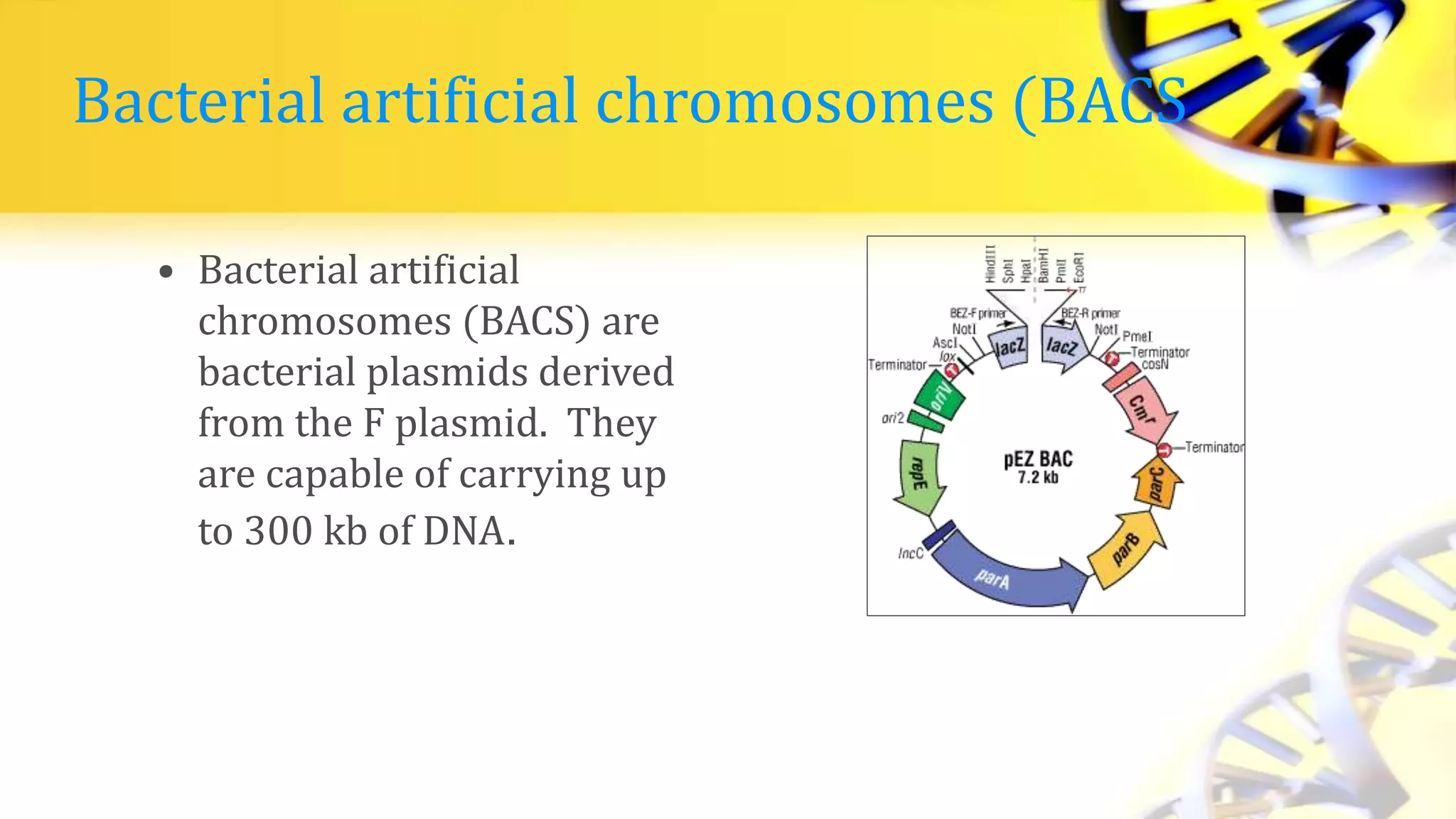
Bacterial artificial chromosomes (BACS
• Bacterial artificial
chromosomes (BACS) are
bacterial plasmids derived
from the F plasmid. They
are capable of carrying up
to 300 kb of DNA.
Techniques used in rDNA technology
• Gel electrophoresis
• Cloning libraries
• Restriction enzyme mapping
• PCR
• Nucleic Acid Hybridization
• DNA Microarrays
Gel electrophoresis
 Gel electrophoresis – DNA fragments of different
sizes can be separated by an electrical field applied
to a “gel”.
The negatively charged DNA migrates away from the
negative electrode and to the positive electrode.
The smaller the fragment the faster it migrates.
Cloning libraries
• Libraries are collection of DNA clones in a certain
vector.
• The goal is to have each gene represented in the
library at least once.
• Genomic - made from RE DNA fragments of total
genomic DNA
• cDNA (complementary DNA) – made from DNA
synthesized from mRNA
PCR
• Allows the isolation of a specific segment of DNA
from a small DNA (or cell sample) using DNA
primers at the ends of the segment of interest.
Restriction enzyme mapping
• Frequently it is important to have a restriction enzyme site
map of a cloned gene for further manipulations of the gene.
• This is accomplished by digestion of the gene singly with
several enzymes and then in combinations.
• The fragments are subjected to gel electrophoresis to
separate the fragments by size and the sites are deduced
based on the sizes of the fragments.
Nucleic Acid Hybridization
• A Southern allows the detection of a gene of interest
by probing DNA fragments that have been separated
by electrophoresis with a “labeled” probe.
• Northern Blot (probe RNA on a gel with a DNA
probe)
• Western Blot (probe proteins on a gel with an
antibody)
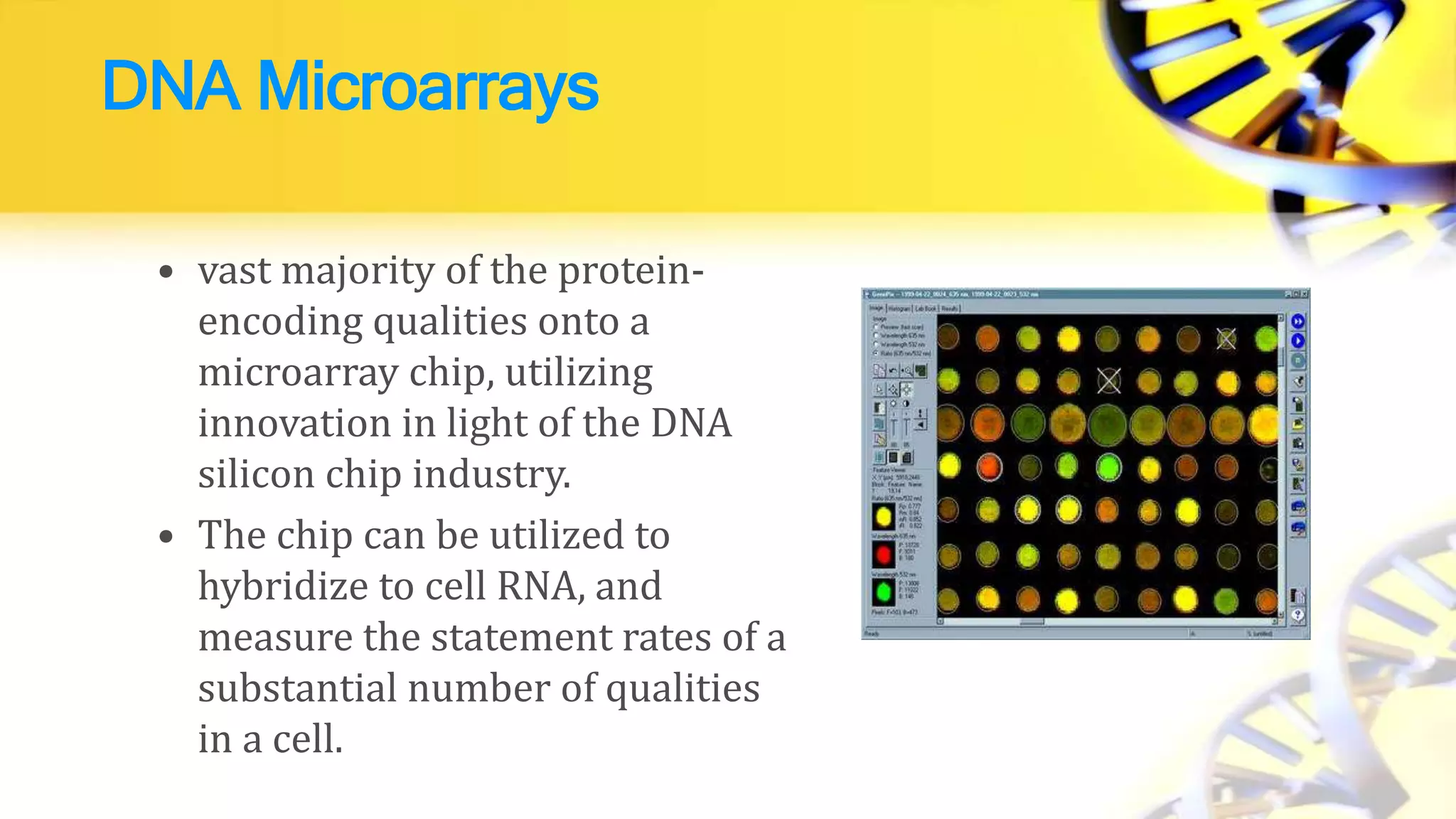
DNA Microarrays
• vast majority of the protein-
encoding qualities onto a
microarray chip, utilizing
innovation in light of the DNA
silicon chip industry.
• The chip can be utilized to
hybridize to cell RNA, and
measure the statement rates of a
substantial number of qualities
in a cell.
Applications of rDNA technology
• Agriculture: growing crops of your choice (GM food),
pesticide resistant crops, fruits with attractive colors, all
being grown in artificial conditions
• Pharmacology: artificial insulin production, drug delivery to
target sites
• Medicine: gene therapy, antiviral therapy, vaccination,
synthesizing clotting factors
• Other uses:fluorescent fishes, glowing plants etc
Conclusion
Refrences
• Griffiths AJF, Gelbart WM, Miller JH, et al. Modern Genetic
Analysis New York: W. H. Freeman; 1999.
• S.S.Sandhu Recombinant DNA technology I. K. International
Pvt Ltd, 01-Jun-2010
• http://www.infoplease.com/cig/biology/dna-technology-
applications.html
• http://biology.kenyon.edu/courses/biol114/Chap08/Chapt
er_08a.html

Recombinant dna technology

  • 1.
    Recombinant DNA technology Presentedto : Sir Ashfaq Presented by: Nasira Bashir Roll number : 01
  • 2.
    Contents  Introduction  Discovery Goals and objectives  rDNA technology procedure  Enzymes  Vectors  Techniques  Applications  Summary
  • 3.
    Recombinant DNA technology DNAmolecules that are extracted from different sources and chemically joined together; for example DNA comprising ananimal gene may be recombined with DNA from a bacterium
  • 4.
    Discovery of recombinantDNA technology Discovery of DNA structure Watson & Crick in 1953 Isolation of DNA ligase in 1967 Isolation of REase in 1970 Paul Berg generated rDNA technology in 1972 Cohen & Boyer in 1973 produced first plasmid vector capable of being replicated within a bacterial host
  • 5.
    Goals of recombinantDNA technology • To isolate and characterize a gene • To make desired alterations in one or more isolated genes • To return altered genes to living cells • Artificially synthesize new gene • Alternating the genome of an organism • Understanding the hereditary diseases and their cure • Improving human genome
  • 6.
    Procedure of makingrDNA Isolating of DNA Cutting of DNA Joining of DNA Amplifying of DNA
  • 7.
  • 8.
    Cutting of DNA •DNA can be cut into large fragments by mechanical shearing. • Restriction enzymes are the scissors of molecular genetics.
  • 9.
    Restriction enzyme • Aspecial class of sequence-specific enzyme • Found in bacteria • Site-specific-cleave DNA molecules only at specific nucleotide sequence • REases recognize DNA base sequence that are palindrome • REase make staggered cuts with complementary base sequences for easy circulization
  • 10.
  • 11.
    Amplifying the recombinantDNA • Transforming the recombinant DNA into a bacterial host strain. • The cells are treated with CaCl2 • DNA is added • Cells are heat shocked at 42 C • DNA goes into cell by a somewhat unknown mechanism. • Once in a cell, the recombinant DNA will be replicated. • When the cell divides, the replicated recombinant molecules go to both daughter cells which themselves will divide later. Thus, the DNA is amplified
  • 12.
  • 13.
    Enzymes used inrecombinant DNA technology • Bind to DNA moleculesDNA ligase • Cleaves DNA at specific sitesType II restriction endonuclease • Make a DNA copy of RNA moleculeReverse transcriptase • Fill single stranded gapes of DNA duplexDNA polymerase I • Adds a phosephate to the 5'-OH end of a polynucleotidePolynycleotide Kinase • Adds homopolymer tails to the 3'-OH endsTerminal transferase • Removes nucleotide residues from the 3' endsExonuclease III • removes nucleotides from the 5' endsBacteriophage {lamda} exonuclease • Removes terminal phosphatesAlkaline phosphatase
  • 14.
    Vectors used inrDNA technology • A vector is an area of DNA that can join another DNA part without losing the limit for self-replication • Should be capable of replicating in host cell • Should have convenient RE sites for inserting DNA of interest • Should have a selectable marker to indicate which host cells received recombinant DNA molecule • Should be small and easy to isolate
  • 15.
    Vectors used inrDNA technology vectors BACS YACS express ion cosmid Lamda phage plasmid
  • 16.
    Plasmid vector • Plasmidsare small, circular DNA molecules that are separate from the rest of the chromosome. • They replicate independently of the bacterial chromosome. • Useful for cloning DNA inserts less that 20 kb (kilobase pairs). • Inserts larger than 20 kb are lost easily in the bacterial cell.
  • 17.
    Lamda phage vector •Lamda phage vectors are recombinant infections, containing the phage chromosome in addition to embedded "outside" DNA. • All in all, phage vectors can convey bigger DNA groupings than plasmid vectors.
  • 18.
    Cosmid vector • Cosmidsare hybrids of phages and plasmids that can carry DNA fragments up to 45 kb. • They can replicate like plasmids but can be packaged like phage lambda
  • 19.
    Expression vectors • Expressionvectors are vectors that carry host signals that facilitate the transcription and translation of an inserted gene. • They are very useful for expressing eukaryotic genes in bacteria.
  • 20.
    Yeast artificial chromosomes(YACS) • Yeast artificial chromosomes (YACS) are yeast vectors that have been engineered to contain a centromere, telomere, origin of replication, and a selectable marker. • They can carry up to 1,000 kb of DNA. • they are useful for cloning eukaryotic genes that contain introns.
  • 21.
    Bacterial artificial chromosomes(BACS • Bacterial artificial chromosomes (BACS) are bacterial plasmids derived from the F plasmid. They are capable of carrying up to 300 kb of DNA.
  • 22.
    Techniques used inrDNA technology • Gel electrophoresis • Cloning libraries • Restriction enzyme mapping • PCR • Nucleic Acid Hybridization • DNA Microarrays
  • 23.
    Gel electrophoresis  Gelelectrophoresis – DNA fragments of different sizes can be separated by an electrical field applied to a “gel”. The negatively charged DNA migrates away from the negative electrode and to the positive electrode. The smaller the fragment the faster it migrates.
  • 24.
    Cloning libraries • Librariesare collection of DNA clones in a certain vector. • The goal is to have each gene represented in the library at least once. • Genomic - made from RE DNA fragments of total genomic DNA • cDNA (complementary DNA) – made from DNA synthesized from mRNA
  • 25.
    PCR • Allows theisolation of a specific segment of DNA from a small DNA (or cell sample) using DNA primers at the ends of the segment of interest.
  • 26.
    Restriction enzyme mapping •Frequently it is important to have a restriction enzyme site map of a cloned gene for further manipulations of the gene. • This is accomplished by digestion of the gene singly with several enzymes and then in combinations. • The fragments are subjected to gel electrophoresis to separate the fragments by size and the sites are deduced based on the sizes of the fragments.
  • 27.
    Nucleic Acid Hybridization •A Southern allows the detection of a gene of interest by probing DNA fragments that have been separated by electrophoresis with a “labeled” probe. • Northern Blot (probe RNA on a gel with a DNA probe) • Western Blot (probe proteins on a gel with an antibody)
  • 28.
    DNA Microarrays • vastmajority of the protein- encoding qualities onto a microarray chip, utilizing innovation in light of the DNA silicon chip industry. • The chip can be utilized to hybridize to cell RNA, and measure the statement rates of a substantial number of qualities in a cell.
  • 29.
    Applications of rDNAtechnology • Agriculture: growing crops of your choice (GM food), pesticide resistant crops, fruits with attractive colors, all being grown in artificial conditions • Pharmacology: artificial insulin production, drug delivery to target sites • Medicine: gene therapy, antiviral therapy, vaccination, synthesizing clotting factors • Other uses:fluorescent fishes, glowing plants etc
  • 30.
  • 31.
    Refrences • Griffiths AJF,Gelbart WM, Miller JH, et al. Modern Genetic Analysis New York: W. H. Freeman; 1999. • S.S.Sandhu Recombinant DNA technology I. K. International Pvt Ltd, 01-Jun-2010 • http://www.infoplease.com/cig/biology/dna-technology- applications.html • http://biology.kenyon.edu/courses/biol114/Chap08/Chapt er_08a.html