Mahendra G S
NGSM Institute of Pharmaceutical Sciences
TETRACYCLINES
TETRACYCLINES
• Tetracyclines are obtained napthacene derivatives which are
bacteriostatic and broad spectrum antibiotics rhat kills various types
of infections caused by both gram +ve and gram -ve microorganism.
• TETRA = four , CYCLINES = cyclic compounds
• Tetracyclines have been introduced 50 years ago as broad spectrum
antibiotics.
• They are biosynthesized from CH3COOH and C3H7COOH units in
the microorganisms.
• They are active against both gram +ve and gram –ve bacteria.
• Tetracyclines are available for oral route and parentral route.
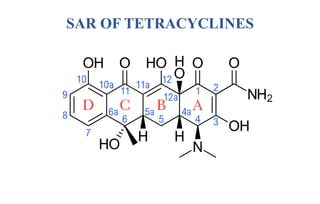
SAR OF TETRACYCLINES
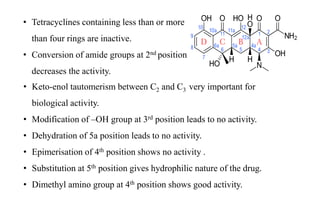
• Tetracyclines containing less than or more
than four rings are inactive.
• Conversion of amide groups at 2nd position
decreases the activity.
• Keto-enol tautomerism between C2 and C3 very important for
biological activity.
• Modification of –OH group at 3rd position leads to no activity.
• Dehydration of 5a position leads to no activity.
• Epimerisation of 4th position shows no activity .
• Substitution at 5th position gives hydrophilic nature of the drug.
• Dimethyl amino group at 4th position shows good activity.
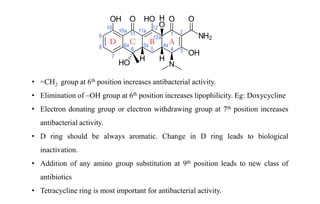
• =CH2 group at 6th position increases antibacterial activity.
• Elimination of –OH group at 6th position increases lipophilicity. Eg: Doxycycline
• Electron donating group or electron withdrawing group at 7th position increases
antibacterial activity.
• D ring should be always aromatic. Change in D ring leads to biological
inactivation.
• Addition of any amino group substitution at 9th position leads to new class of
antibiotics
• Tetracycline ring is most important for antibacterial activity.
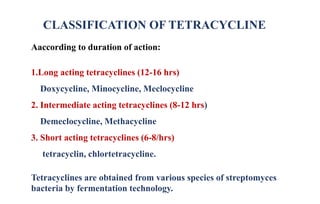
CLASSIFICATION OF TETRACYCLINE
Aaccording to duration of action:
1.Long acting tetracyclines (12-16 hrs)
Doxycycline, Minocycline, Meclocycline
2. Intermediate acting tetracyclines (8-12 hrs)
Demeclocycline, Methacycline
3. Short acting tetracyclines (6-8/hrs)
tetracyclin, chlortetracycline.
Tetracyclines are obtained from various species of streptomyces
bacteria by fermentation technology.
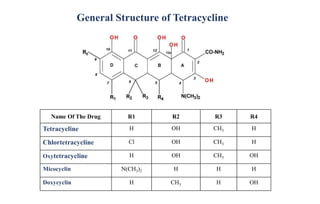
General Structure of Tetracycline
Name Of The Drug R1 R2 R3 R4
Tetracycline H OH CH3 H
Chlortetracycline Cl OH CH3 H
Oxytetracycline H OH CH3 OH
Micocyclin N(CH3)2 H H H
Doxycyclin H CH3 H OH
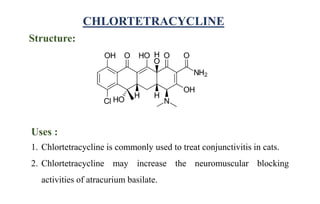
CHLORTETRACYCLINE
Structure:
Uses :
1. Chlortetracycline is commonly used to treat conjunctivitis in cats.
2. Chlortetracycline may increase the neuromuscular blocking
activities of atracurium basilate.
Structure:
Uses :
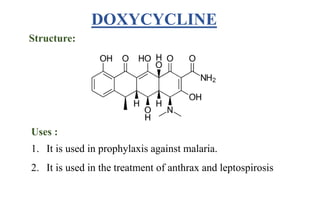
1. It is used in prophylaxis against malaria.
2. It is used in the treatment of anthrax and leptospirosis
DOXYCYCLINE
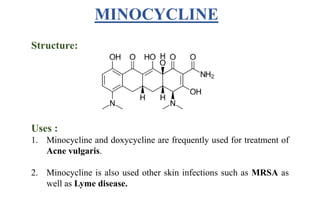
Structure:
Uses :
1. Minocycline and doxycycline are frequently used for treatment of
Acne vulgaris.
2. Minocycline is also used other skin infections such as MRSA as
well as Lyme disease.
MINOCYCLINE
MECHANISM OF ACTION
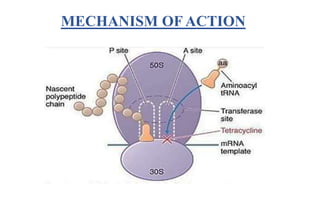
• Tetracyclines inhibit protein synthesis by binding to the bacterial
ribosome involved in the translation (protein synthesis) process and
shows bacteriostatic activity.
• They bind to 30s ribosomes and inhibit the protein synthesis.
•
• The 70s bacterial ribosomes partial is made of 30s and 50s subunits.
• the 50s subunits combines with the 30s subunit mRNA complex and
binds to t-RNA for building the protein chain.
• t-RNA congaing two binding site a. P-site (peptidyl site) b. A-site
(acceptor aminoacyl site).
• Tetracyclines reversible bind to the 30s subunit at the A-site prevent
attachment of the aminoacyl tRNA, terminating the translation process.
MECHANISM OF ACTION
TETRACYCLINES USES
• Tetracyclines are broad spectrum antibiotics use to treat
various types of infection.
• To treat eye infections
• Tetracyclines are low cost alternative antibiotics
• Recently Tetracyclines are used to treat cancer patients
• To treat respiratory infections, ear, intestine and sinus
• To treat Gonorrhoea
• Tetracyclines are not used to treat viral infections.
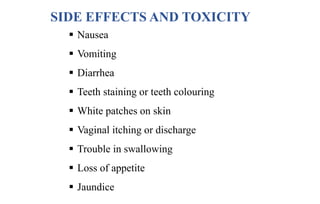
SIDE EFFECTS AND TOXICITY
 Nausea
 Vomiting
 Diarrhea
 Teeth staining or teeth colouring
 White patches on skin
 Vaginal itching or discharge
 Trouble in swallowing
 Loss of appetite
 Jaundice
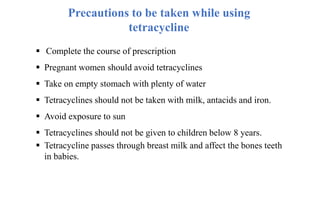
Precautions to be taken while using
tetracycline
 Complete the course of prescription
 Pregnant women should avoid tetracyclines
 Take on empty stomach with plenty of water
 Tetracyclines should not be taken with milk, antacids and iron.
 Avoid exposure to sun
 Tetracyclines should not be given to children below 8 years.
 Tetracycline passes through breast milk and affect the bones teeth
in babies.

Tetracyclines.pptx

  • 1.
    Mahendra G S NGSMInstitute of Pharmaceutical Sciences TETRACYCLINES
  • 2.
    TETRACYCLINES • Tetracyclines areobtained napthacene derivatives which are bacteriostatic and broad spectrum antibiotics rhat kills various types of infections caused by both gram +ve and gram -ve microorganism. • TETRA = four , CYCLINES = cyclic compounds • Tetracyclines have been introduced 50 years ago as broad spectrum antibiotics. • They are biosynthesized from CH3COOH and C3H7COOH units in the microorganisms. • They are active against both gram +ve and gram –ve bacteria. • Tetracyclines are available for oral route and parentral route.
  • 3.
  • 4.
    • Tetracyclines containingless than or more than four rings are inactive. • Conversion of amide groups at 2nd position decreases the activity. • Keto-enol tautomerism between C2 and C3 very important for biological activity. • Modification of –OH group at 3rd position leads to no activity. • Dehydration of 5a position leads to no activity. • Epimerisation of 4th position shows no activity . • Substitution at 5th position gives hydrophilic nature of the drug. • Dimethyl amino group at 4th position shows good activity.
  • 5.
    • =CH2 groupat 6th position increases antibacterial activity. • Elimination of –OH group at 6th position increases lipophilicity. Eg: Doxycycline • Electron donating group or electron withdrawing group at 7th position increases antibacterial activity. • D ring should be always aromatic. Change in D ring leads to biological inactivation. • Addition of any amino group substitution at 9th position leads to new class of antibiotics • Tetracycline ring is most important for antibacterial activity.
  • 6.
    CLASSIFICATION OF TETRACYCLINE Aaccordingto duration of action: 1.Long acting tetracyclines (12-16 hrs) Doxycycline, Minocycline, Meclocycline 2. Intermediate acting tetracyclines (8-12 hrs) Demeclocycline, Methacycline 3. Short acting tetracyclines (6-8/hrs) tetracyclin, chlortetracycline. Tetracyclines are obtained from various species of streptomyces bacteria by fermentation technology.
  • 7.
    General Structure ofTetracycline Name Of The Drug R1 R2 R3 R4 Tetracycline H OH CH3 H Chlortetracycline Cl OH CH3 H Oxytetracycline H OH CH3 OH Micocyclin N(CH3)2 H H H Doxycyclin H CH3 H OH
  • 8.
    CHLORTETRACYCLINE Structure: Uses : 1. Chlortetracyclineis commonly used to treat conjunctivitis in cats. 2. Chlortetracycline may increase the neuromuscular blocking activities of atracurium basilate.
  • 9.
    Structure: Uses : 1. Itis used in prophylaxis against malaria. 2. It is used in the treatment of anthrax and leptospirosis DOXYCYCLINE
  • 10.
    Structure: Uses : 1. Minocyclineand doxycycline are frequently used for treatment of Acne vulgaris. 2. Minocycline is also used other skin infections such as MRSA as well as Lyme disease. MINOCYCLINE
  • 11.
    MECHANISM OF ACTION •Tetracyclines inhibit protein synthesis by binding to the bacterial ribosome involved in the translation (protein synthesis) process and shows bacteriostatic activity. • They bind to 30s ribosomes and inhibit the protein synthesis. • • The 70s bacterial ribosomes partial is made of 30s and 50s subunits. • the 50s subunits combines with the 30s subunit mRNA complex and binds to t-RNA for building the protein chain. • t-RNA congaing two binding site a. P-site (peptidyl site) b. A-site (acceptor aminoacyl site). • Tetracyclines reversible bind to the 30s subunit at the A-site prevent attachment of the aminoacyl tRNA, terminating the translation process.
  • 12.
  • 13.
    TETRACYCLINES USES • Tetracyclinesare broad spectrum antibiotics use to treat various types of infection. • To treat eye infections • Tetracyclines are low cost alternative antibiotics • Recently Tetracyclines are used to treat cancer patients • To treat respiratory infections, ear, intestine and sinus • To treat Gonorrhoea • Tetracyclines are not used to treat viral infections.
  • 14.
    SIDE EFFECTS ANDTOXICITY  Nausea  Vomiting  Diarrhea  Teeth staining or teeth colouring  White patches on skin  Vaginal itching or discharge  Trouble in swallowing  Loss of appetite  Jaundice
  • 15.
    Precautions to betaken while using tetracycline  Complete the course of prescription  Pregnant women should avoid tetracyclines  Take on empty stomach with plenty of water  Tetracyclines should not be taken with milk, antacids and iron.  Avoid exposure to sun  Tetracyclines should not be given to children below 8 years.  Tetracycline passes through breast milk and affect the bones teeth in babies.