DNA
-Vishakha
DNA is a polymer. The monomer units of DNA are nucleotides, and the polymer is
known as a "polynucleotide."
First discovered by James D. Watson and Francis Crick, the structure of DNA of
all species comprises two helical chains each coiled round the same axis, and each
with a pitch of 34 Angstroms' (3.4 nanometers) and a radius of
10 Angstroms (1.0 nanometers).
Each nucleotide consists of a 5-carbon sugar (deoxyribose), a nitrogen containing
base attached to the sugar, and a phosphate group.
A nucleobase linked to a sugar is called a nucleoside
(A nucleoside is one of the four DNA bases covalently attached to the C1'
position of a sugar)
and a base linked to a sugar and one or more phosphate groups is called a
nucleotide (A nucleotide is a nucleoside with one or more phosphate groups
covalently attached to the 3'- and/or 5'-hydroxyl group(s).).
There are four different types of nucleotides found in DNA, differing only in the
nitrogenous base.
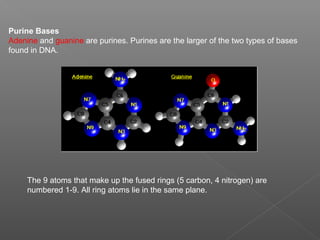
Purine Bases
Adenine and guanine are purines. Purines are the larger of the two types of bases
found in DNA.
The 9 atoms that make up the fused rings (5 carbon, 4 nitrogen) are
numbered 1-9. All ring atoms lie in the same plane.
Pyrimidine Bases
Cytosine and thymine are pyrimidines.
The 6 stoms (4 carbon, 2 nitrogen) are numbered 1-6. Like purines, all pyrimidine
ring atoms lie in the same plane.
Deoxyribose Sugar
The deoxyribose sugar of the DNA backbone has 5 carbons and 3 oxygens.
The carbon atoms are numbered 1', 2', 3', 4', and 5' to distinguish from the
numbering of the atoms of the purine and pyrmidine rings. The hydroxyl groups
on the 5'- and 3'- carbons link to the phosphate groups to form the DNA
backbone.
Deoxyribose lacks an hydroxyl group at the 2'-position when compared to
ribose, the sugar component of RNA.
DNA Backbone
The DNA backbone is a polymer with an
alternating sugar-phosphate sequence.
The deoxyribose sugars are joined at both
the 3'-hydroxyl and 5'-hydroxyl groups to
phosphate groups in ester links, also
known as "phosphodiester" bonds.
DNA Double Helix
DNA is a normally double stranded macromolecule. Two polynucleotide chains, held
together by weak thermodynamic forces, form a DNA molecule.
Features of the DNA Double Helix
Two DNA strands form a helical spiral,
winding around a helix axis in a right-
handed spiral
The two polynucleotide chains run in
opposite directions
The sugar-phosphate backbones of the
two DNA strands wind around the helix axis
like the railing of a sprial staircase
The bases of the individual nucleotides
are on the inside of the helix, stacked on
top of each other like the steps of a spiral
staircase.
Base Pairs
Within the DNA double helix, A forms 2 hydrogen bonds with T on the opposite
strand, and G forms 3 hyrdorgen bonds with C on the opposite strand.
DNA with high GC-content is
more stable due to intra-
strand base stacking
interactions
In the canonical Watson-Crick DNA base pairing, adenine (A) forms a base pair
with thymine (T) and guanine (G) forms a base pair with cytosine (C).
In RNA, thymine is replaced by uracil (U).
Alternate hydrogen bonding patterns, such as the wobble base pair and
Hoogsteen base pair, also occur—in particular, in RNA—giving rise to complex
and functional tertiary structures.
A Hoogsteen base pair is a variation of base-pairing in nucleic acids such as the
A•T pair.
In this manner, two nucleobases on each strand can be held together by hydrogen
bonds in the major groove.
A Hoogsteen base pair applies the N7 position of the purine base (as a hydrogen
bond acceptor) and C6 amino group (as a donor), which bind the Watson-Crick
(N3–N4) face of the pyrimidine base.
The angle between the two glycosylic bonds (ca. 80° in the A• T pair) is larger and
the C1′–C1′ distance (ca. 860 pm or 8.6 Å) is smaller than in the regular
geometry.
In some cases, called reversed Hoogsteen base pairs, one base is rotated 180°
with respect to the other.
The majority of nucleotide bases in DNA
link together with Watson-Crick pairing.
However, there are a few that link together
with Hoogsteen pairing. It has been
thought for quite some time that Hoogsteen
pairing only occurs in DNA when it is either
damaged or bound to some other molecule
(like a protein or a drug).
•dA-dT and dG-dC base pairs are the
same length, and occupy the same space
within a DNA double helix. Therefore the
DNA molecule has a uniform diameter.
•dA-dT and dG-dC base pairs can occur in
any order within DNA molecules
Geometry attribute: A-form B-form Z-form
Helix sense right-handed right-handed left-handed
Repeating unit 1 bp 1 bp 2 bp
Rotation/bp 33.6° 35.9° 60°/2
Mean bp/turn 11 10.5 12
Inclination of bp to axis +19° −1.2° −9°
Rise/bp along axis 2.4 Å (0.24 nm) 3.4 Å (0.34 nm) 3.7 Å (0.37 nm)
Rise/turn of helix 24.6 Å (2.46 nm) 33.2 Å (3.32 nm) 45.6 Å (4.56 nm)
Mean propeller twist +18° +16° 0°
Glycosyl angle anti
anti pyrimidine: anti,
purine: syn
Sugar pucker C3'-endo C2'-endo
C: C2'-endo,
G: C2'-exo
Diameter 23 Å (2.3 nm) 20 Å (2.0 nm) 18 Å (1.8 nm)

Dna

  • 1.
  • 2.
    DNA is apolymer. The monomer units of DNA are nucleotides, and the polymer is known as a "polynucleotide." First discovered by James D. Watson and Francis Crick, the structure of DNA of all species comprises two helical chains each coiled round the same axis, and each with a pitch of 34 Angstroms' (3.4 nanometers) and a radius of 10 Angstroms (1.0 nanometers). Each nucleotide consists of a 5-carbon sugar (deoxyribose), a nitrogen containing base attached to the sugar, and a phosphate group. A nucleobase linked to a sugar is called a nucleoside (A nucleoside is one of the four DNA bases covalently attached to the C1' position of a sugar) and a base linked to a sugar and one or more phosphate groups is called a nucleotide (A nucleotide is a nucleoside with one or more phosphate groups covalently attached to the 3'- and/or 5'-hydroxyl group(s).). There are four different types of nucleotides found in DNA, differing only in the nitrogenous base.
  • 3.
    Purine Bases Adenine andguanine are purines. Purines are the larger of the two types of bases found in DNA. The 9 atoms that make up the fused rings (5 carbon, 4 nitrogen) are numbered 1-9. All ring atoms lie in the same plane.
  • 4.
    Pyrimidine Bases Cytosine andthymine are pyrimidines. The 6 stoms (4 carbon, 2 nitrogen) are numbered 1-6. Like purines, all pyrimidine ring atoms lie in the same plane.
  • 5.
    Deoxyribose Sugar The deoxyribosesugar of the DNA backbone has 5 carbons and 3 oxygens. The carbon atoms are numbered 1', 2', 3', 4', and 5' to distinguish from the numbering of the atoms of the purine and pyrmidine rings. The hydroxyl groups on the 5'- and 3'- carbons link to the phosphate groups to form the DNA backbone. Deoxyribose lacks an hydroxyl group at the 2'-position when compared to ribose, the sugar component of RNA.
  • 6.
    DNA Backbone The DNAbackbone is a polymer with an alternating sugar-phosphate sequence. The deoxyribose sugars are joined at both the 3'-hydroxyl and 5'-hydroxyl groups to phosphate groups in ester links, also known as "phosphodiester" bonds.
  • 7.
    DNA Double Helix DNAis a normally double stranded macromolecule. Two polynucleotide chains, held together by weak thermodynamic forces, form a DNA molecule. Features of the DNA Double Helix Two DNA strands form a helical spiral, winding around a helix axis in a right- handed spiral The two polynucleotide chains run in opposite directions The sugar-phosphate backbones of the two DNA strands wind around the helix axis like the railing of a sprial staircase The bases of the individual nucleotides are on the inside of the helix, stacked on top of each other like the steps of a spiral staircase.
  • 8.
    Base Pairs Within theDNA double helix, A forms 2 hydrogen bonds with T on the opposite strand, and G forms 3 hyrdorgen bonds with C on the opposite strand. DNA with high GC-content is more stable due to intra- strand base stacking interactions
  • 9.
    In the canonicalWatson-Crick DNA base pairing, adenine (A) forms a base pair with thymine (T) and guanine (G) forms a base pair with cytosine (C). In RNA, thymine is replaced by uracil (U). Alternate hydrogen bonding patterns, such as the wobble base pair and Hoogsteen base pair, also occur—in particular, in RNA—giving rise to complex and functional tertiary structures. A Hoogsteen base pair is a variation of base-pairing in nucleic acids such as the A•T pair. In this manner, two nucleobases on each strand can be held together by hydrogen bonds in the major groove. A Hoogsteen base pair applies the N7 position of the purine base (as a hydrogen bond acceptor) and C6 amino group (as a donor), which bind the Watson-Crick (N3–N4) face of the pyrimidine base. The angle between the two glycosylic bonds (ca. 80° in the A• T pair) is larger and the C1′–C1′ distance (ca. 860 pm or 8.6 Å) is smaller than in the regular geometry. In some cases, called reversed Hoogsteen base pairs, one base is rotated 180° with respect to the other.
  • 10.
    The majority ofnucleotide bases in DNA link together with Watson-Crick pairing. However, there are a few that link together with Hoogsteen pairing. It has been thought for quite some time that Hoogsteen pairing only occurs in DNA when it is either damaged or bound to some other molecule (like a protein or a drug).
  • 11.
    •dA-dT and dG-dCbase pairs are the same length, and occupy the same space within a DNA double helix. Therefore the DNA molecule has a uniform diameter. •dA-dT and dG-dC base pairs can occur in any order within DNA molecules
  • 17.
    Geometry attribute: A-formB-form Z-form Helix sense right-handed right-handed left-handed Repeating unit 1 bp 1 bp 2 bp Rotation/bp 33.6° 35.9° 60°/2 Mean bp/turn 11 10.5 12 Inclination of bp to axis +19° −1.2° −9° Rise/bp along axis 2.4 Å (0.24 nm) 3.4 Å (0.34 nm) 3.7 Å (0.37 nm) Rise/turn of helix 24.6 Å (2.46 nm) 33.2 Å (3.32 nm) 45.6 Å (4.56 nm) Mean propeller twist +18° +16° 0° Glycosyl angle anti anti pyrimidine: anti, purine: syn Sugar pucker C3'-endo C2'-endo C: C2'-endo, G: C2'-exo Diameter 23 Å (2.3 nm) 20 Å (2.0 nm) 18 Å (1.8 nm)