PNEUMOCOCCUS *DIPLOCOCCUS PNEUMONIAE *STREPTOCOCCUS PNEUMONIAE
G+,lanceolate diplococcus Formly classified as Diplococcus pneumoniae Reclassified to streptococcus pneumoniae-genetic relation with strept. Differs from strpt in- 1.morphology 2.bile solubility 3.optachin sensitivity 4.sp.polysach.capsule
First noticed –pasteur &Sternberg Realtion betwn pneumococci &pneumonia –Frankel &Weichsalbaum Morphology Small-1 micron –slightly elongatd—one end broad ,other pointd,flame shaped /lanceolate shaped. Occurs in pairs-with broad ends in apposition long axis of the coccus parellel to the line joining the two cocci in a pair.CAPSULATED-capsule enclosing each pair.
Capsules—bst seen in materials taken bst from exudates-may b lost onb repeatd cultivation NONMOTILE,NONSPORING In culture typical morph—not apparent—cocci r more rounded tending to occur in short chains Staind with Anilline dyes---G+ Capsule-clear halo –inidan ink
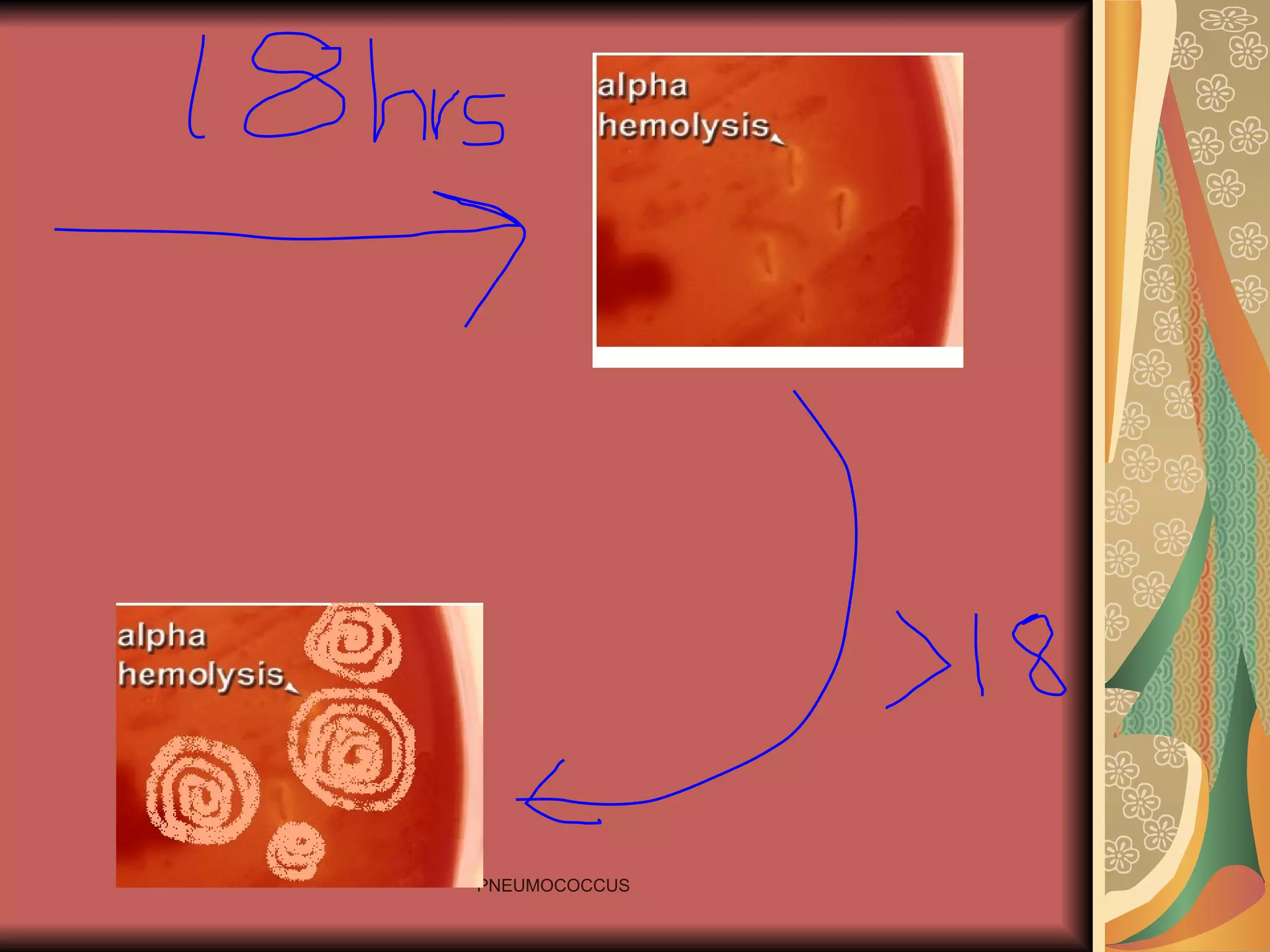
Cultural chr. Grow only in enriched media.—aerobes+fac.anero.Temp-37C---PH 7.8—growth is improcved by 5-10%Co2 Blood agar-inc-18 hrscolonies-small,dome shaped,glistening,with an area of green discolouration(alpha hemolysis) Resemble colonies of str. Viridans— Furthr inc—colonies become flat—with raised edges and central umbonation---so concentric rings r seen on the surface whn viewd frm above—”Draughtsman/Carrom Coin appearance” Sm strains that dvlp abundnt capsular material(3 &7)---form large mucoid colonies
 
Under anerobic condition---colonies in blood agar –sorrondd by zone of beta hemolysis due to—O2 labile hemolysin O Liquid media(gluc broth)-growth occurs as uniform turbidity Cocci readily undergoes autolysis in cultures due to activity of intracellular enzymes.,enhancd by bile salts,Na lauryl suphate,and other surface active antigens Heat killd cultures do not undergo autolysis
Biochemical reactions Fermnt---acid Ferm.-testd in HISS’s serum water/srum agar slopes.inulin f-+(diff strp.) -bile soluble— 1ml culture+drops of 10% sodium deoxycholate=lysis overn8 Loopful of deoxycholate—lysis in few min Bile/Bile salts--+ts---amidase---cleavs the bond between alanine &muramic acidin the peptidoglycan.---lysis of organism---soluble Tst at nuetral PH using deoxycholate &youn culture C-….O-
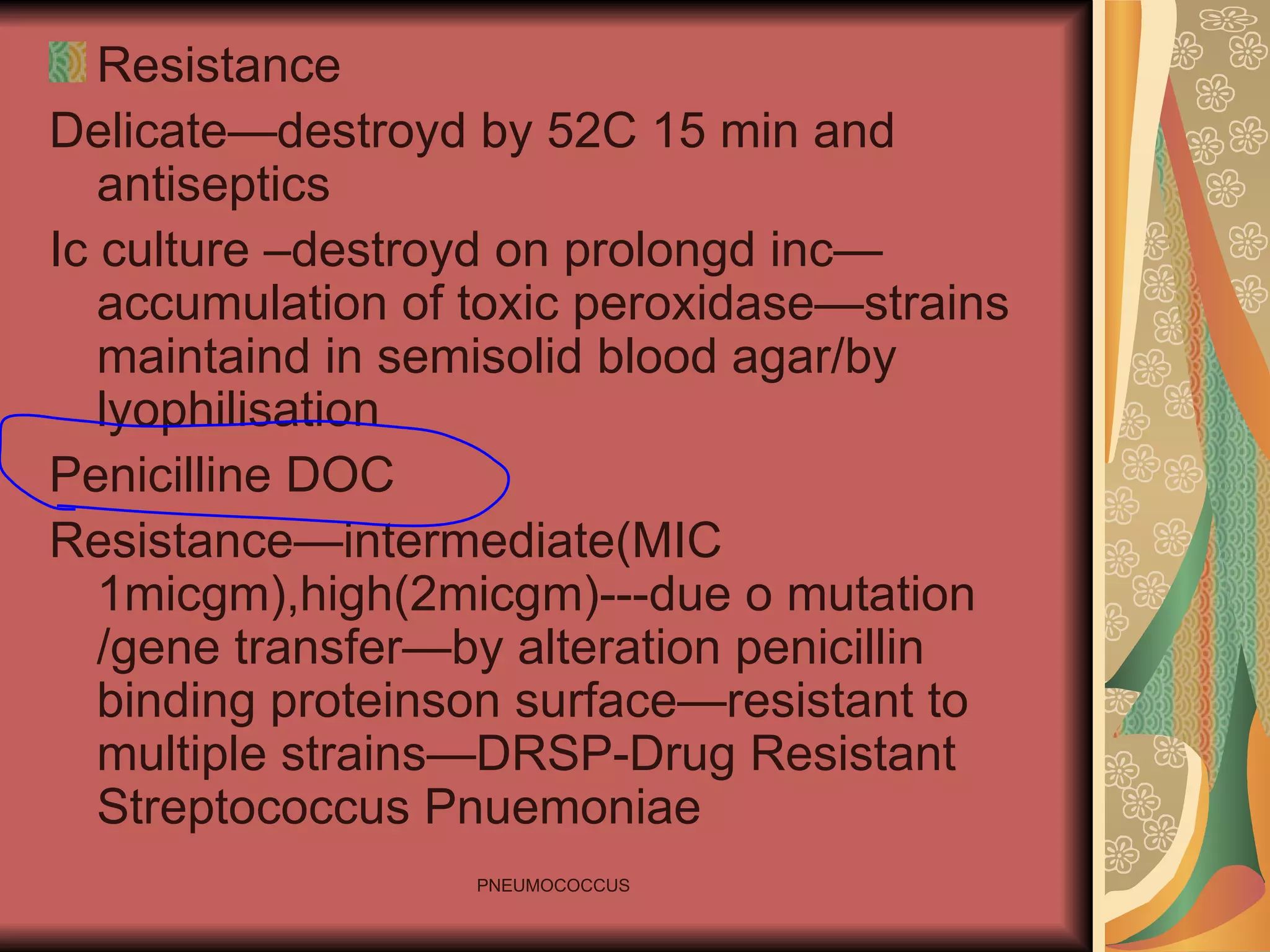
Resistance Delicate—destroyd by 52C 15 min and antiseptics Ic culture –destroyd on prolongd inc—accumulation of toxic peroxidase—strains maintaind in semisolid blood agar/by lyophilisation Penicilline DOC Resistance—intermediate(MIC 1micgm),high(2micgm)---due o mutation /gene transfer—by alteration penicillin binding proteinson surface—resistant to multiple strains—DRSP-Drug Resistant Streptococcus Pnuemoniae
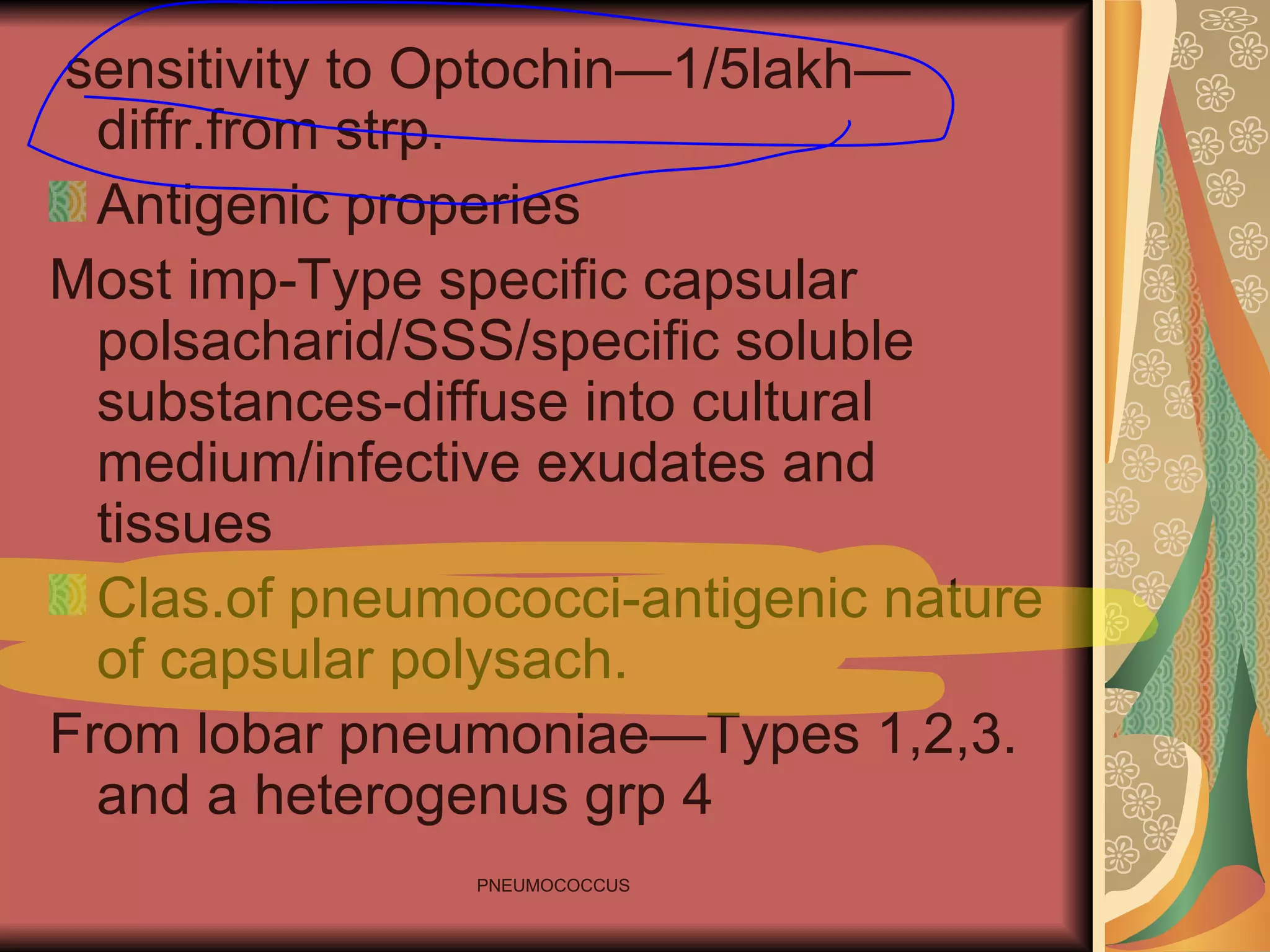
sensitivity to Optochin—1/5lakh—diffr.from strp. Antigenic properies Most imp-Type specific capsular polsacharid/SSS/specific soluble substances-diffuse into cultural medium/infective exudates and tissues Clas.of pneumococci-antigenic nature of capsular polysach. From lobar pneumoniae—Types 1,2,3. and a heterogenus grp 4
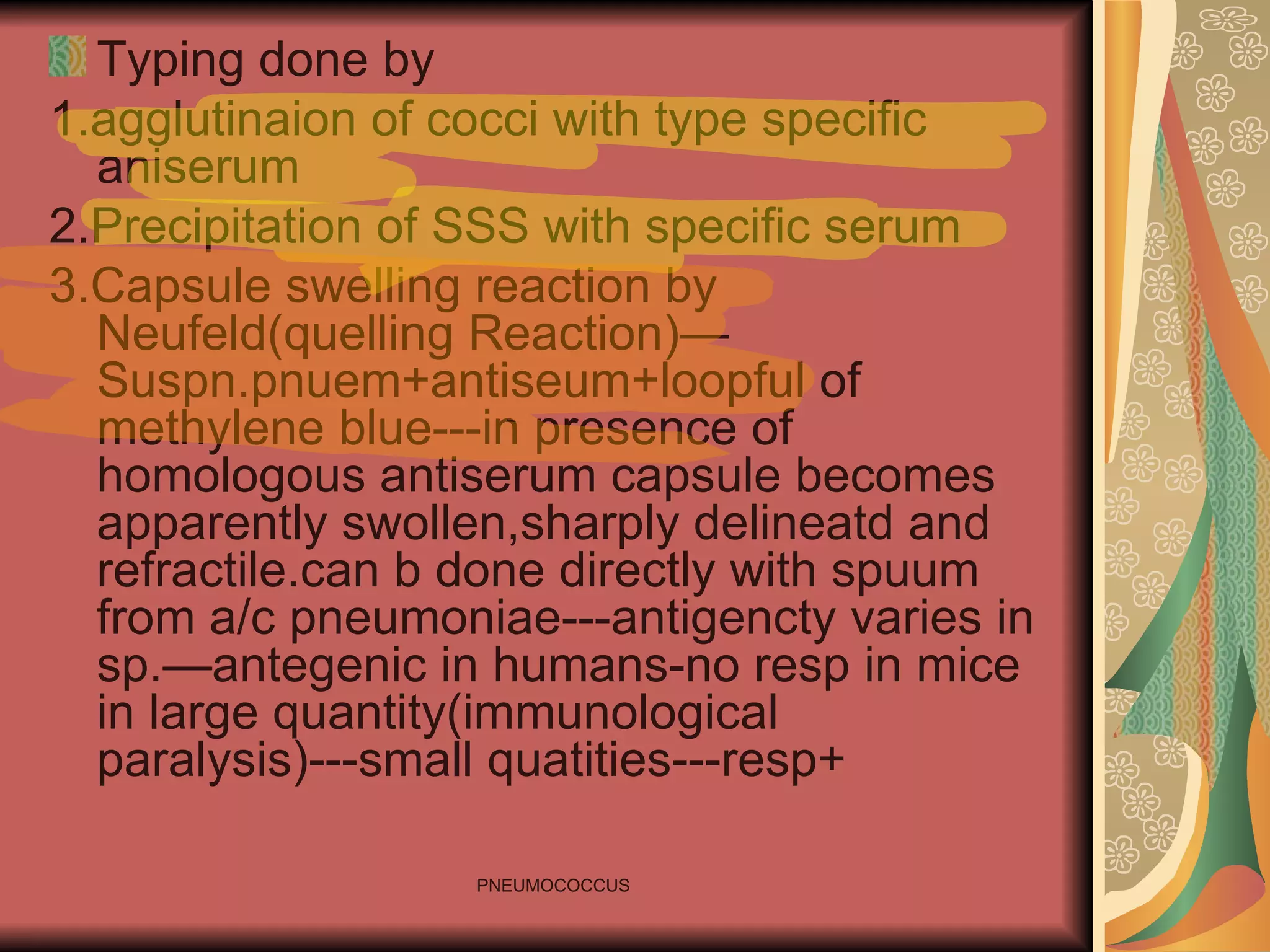
Typing done by 1.agglutinaion of cocci with type specific aniserum 2.Precipitation of SSS with specific serum 3.Capsule swelling reaction by Neufeld(quelling Reaction)—Suspn.pnuem+antiseum+loopful of methylene blue---in presence of homologous antiserum capsule becomes apparently swollen,sharply delineatd and refractile.can b done directly with spuum from a/c pneumoniae---antigencty varies in sp.—antegenic in humans-no resp in mice in large quantity(immunological paralysis)---small quatities---resp+
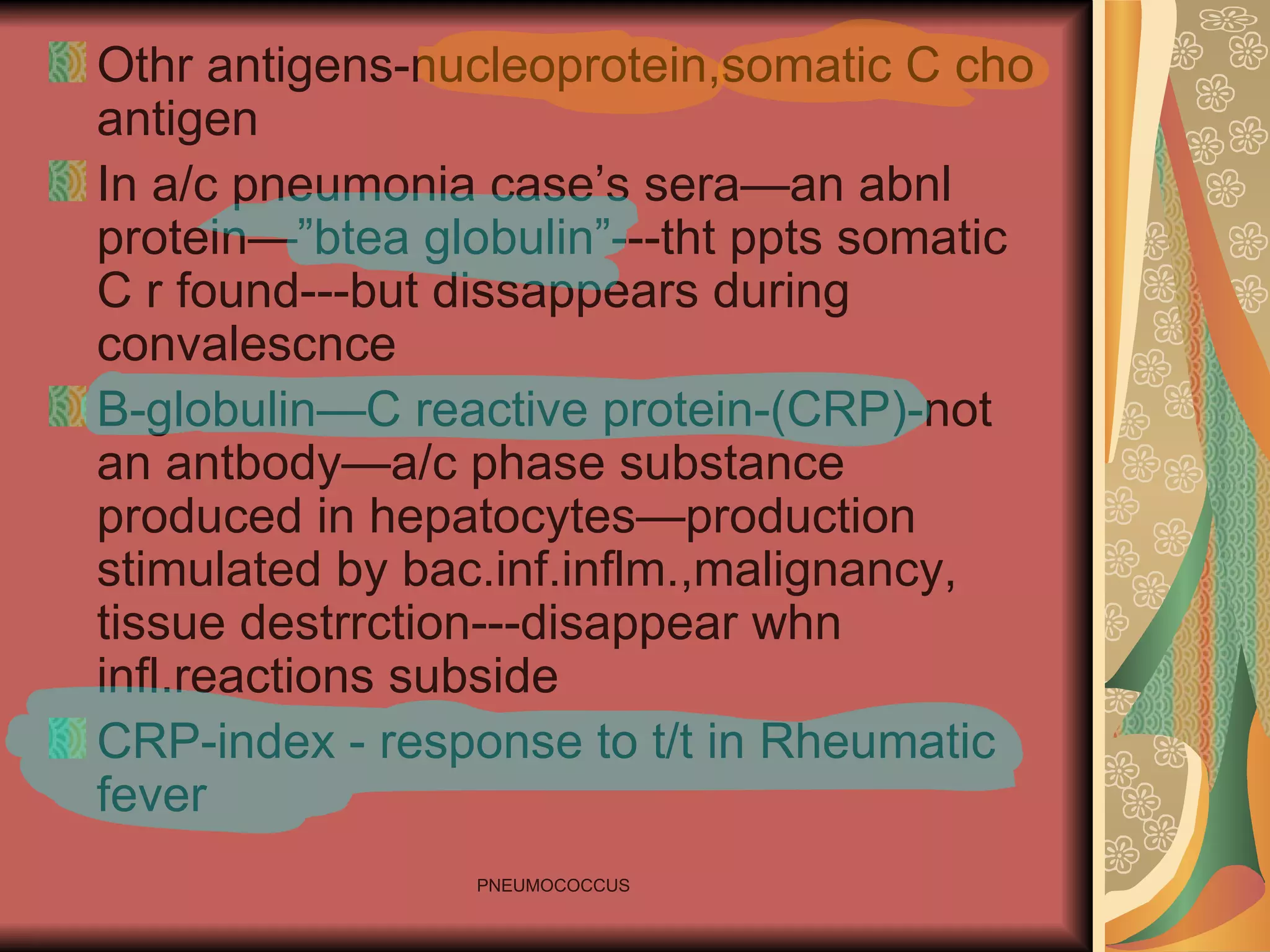
Othr antigens-nucleoprotein,somatic C cho antigen In a/c pneumonia case’s sera—an abnl protein—”btea globulin”---tht ppts somatic C r found---but dissappears during convalescnce B-globulin—C reactive protein-(CRP)-not an antbody—a/c phase substance produced in hepatocytes—production stimulated by bac.inf.inflm.,malignancy, tissue destrrction---disappear whn infl.reactions subside CRP-index - response to t/t in Rheumatic fever
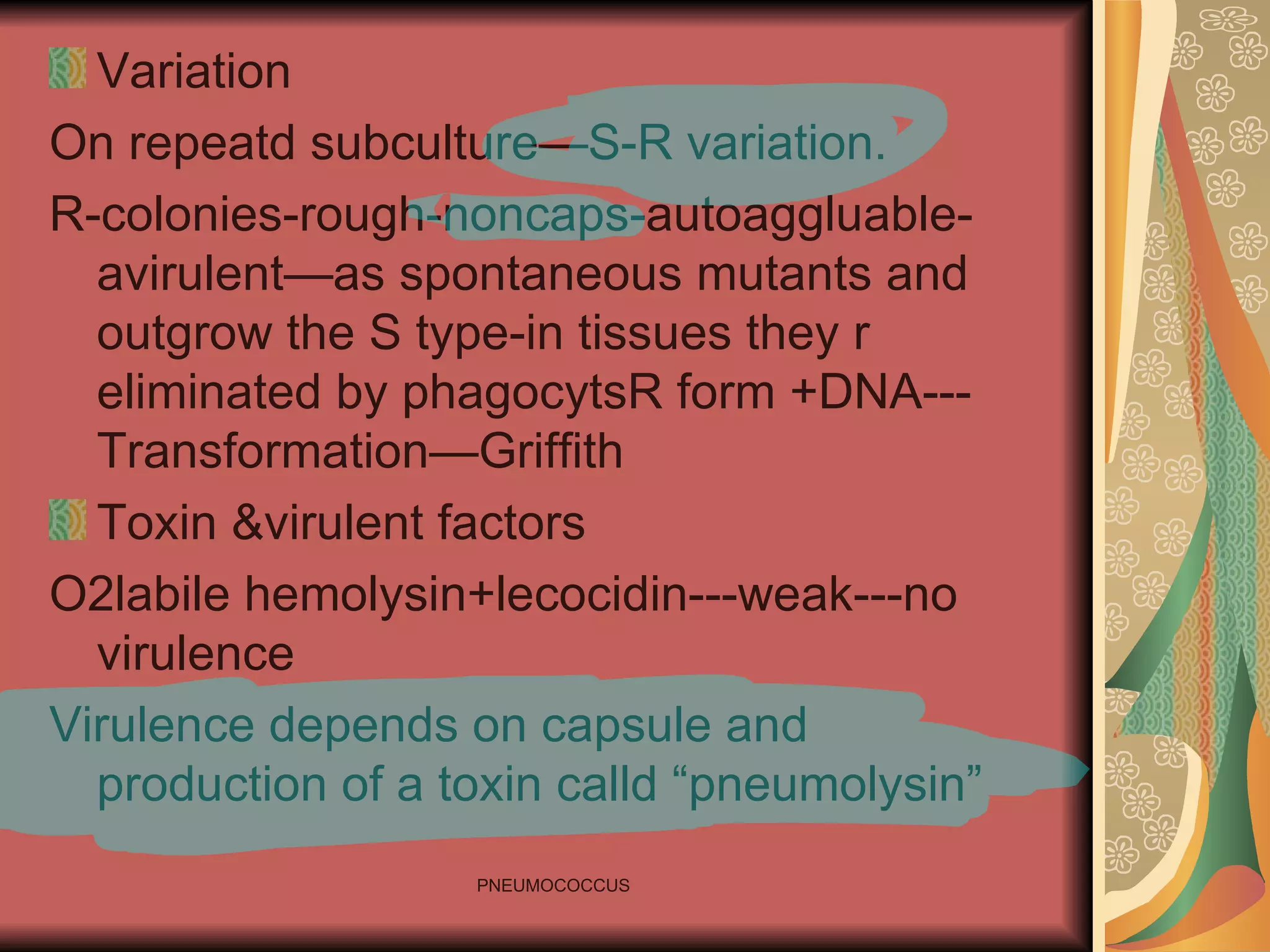
Variation On repeatd subculture—S-R variation. R-colonies-rough-noncaps-autoaggluable-avirulent—as spontaneous mutants and outgrow the S type-in tissues they r eliminated by phagocytsR form +DNA---Transformation—Griffith Toxin &virulent factors O2labile hemolysin+lecocidin---weak---no virulence Virulence depends on capsule and production of a toxin calld “pneumolysin”
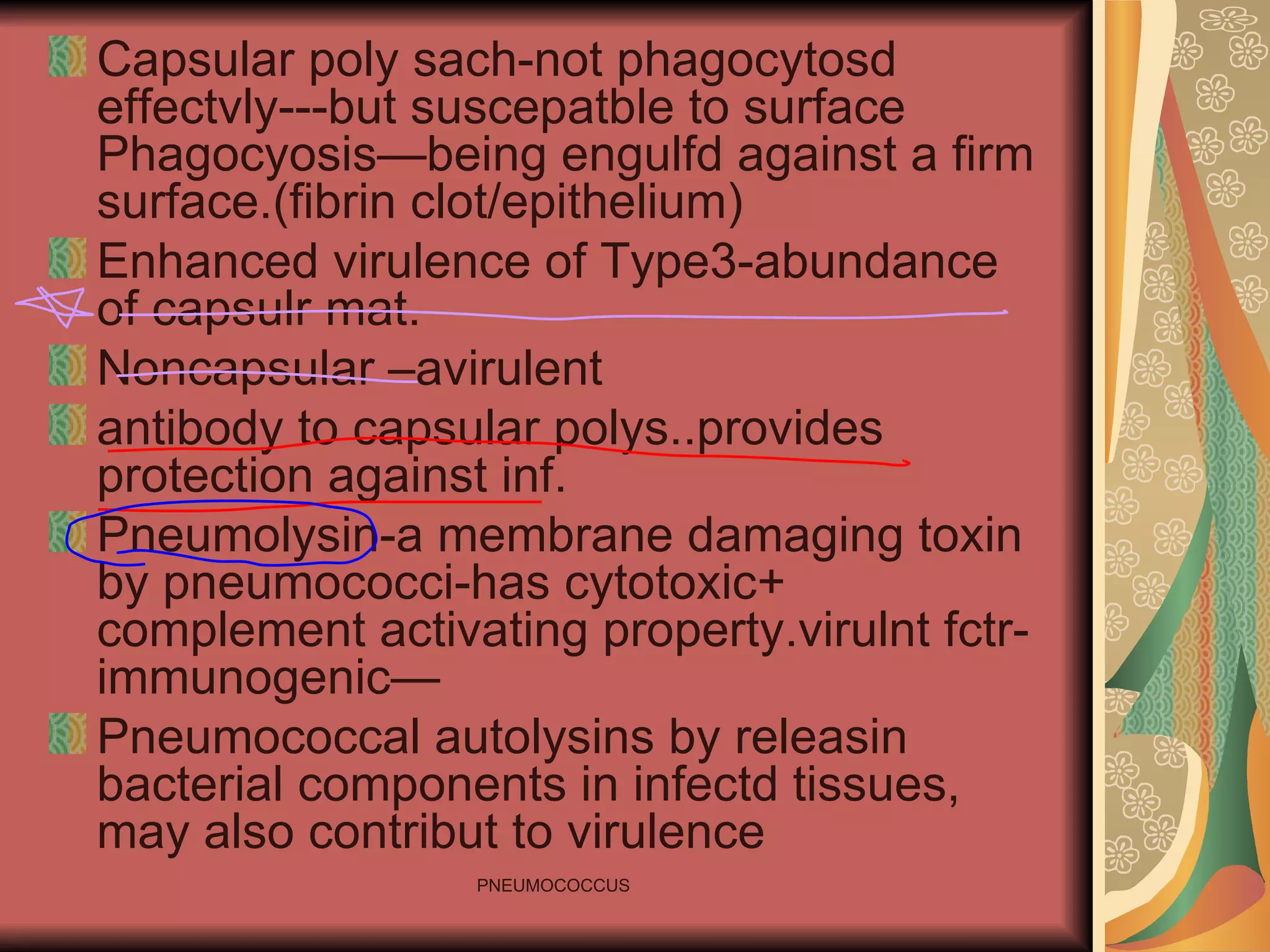
Capsular poly sach-not phagocytosd effectvly---but suscepatble to surface Phagocyosis—being engulfd against a firm surface.(fibrin clot/epithelium) Enhanced virulence of Type3-abundance of capsulr mat. Noncapsular –avirulent antibody to capsular polys..provides protection against inf. Pneumolysin-a membrane damaging toxin by pneumococci-has cytotoxic+ complement activating property.virulnt fctr-immunogenic— Pneumococcal autolysins by releasin bacterial components in infectd tissues, may also contribut to virulence
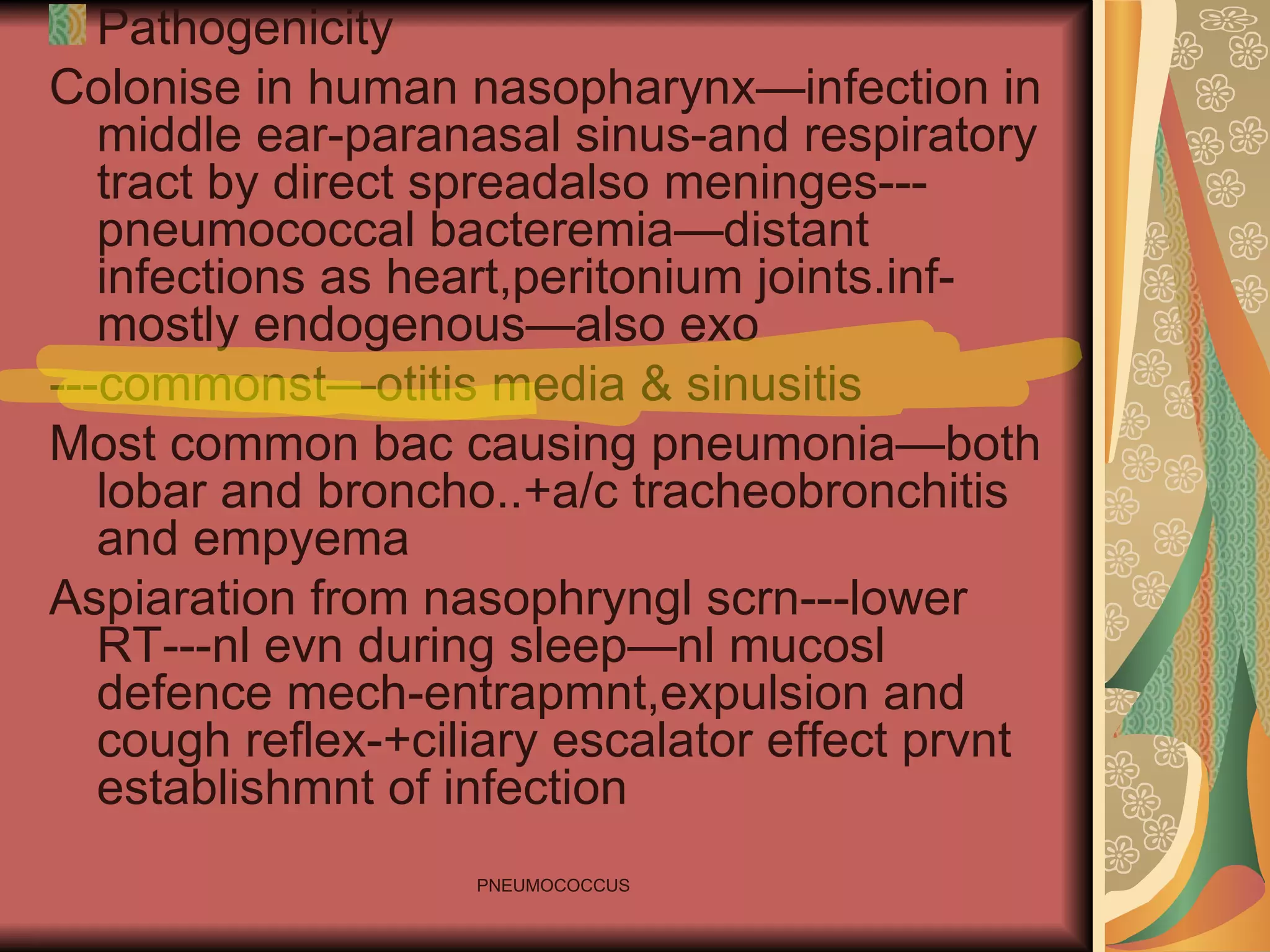
Pathogenicity Colonise in human nasopharynx—infection in middle ear-paranasal sinus-and respiratory tract by direct spreadalso meninges---pneumococcal bacteremia—distant infections as heart,peritonium joints.inf-mostly endogenous—also exo ---commonst—otitis media & sinusitis Most common bac causing pneumonia—both lobar and broncho..+a/c tracheobronchitis and empyema Aspiaration from nasophryngl scrn---lower RT---nl evn during sleep—nl mucosl defence mech-entrapmnt,expulsion and cough reflex-+ciliary escalator effect prvnt establishmnt of infection
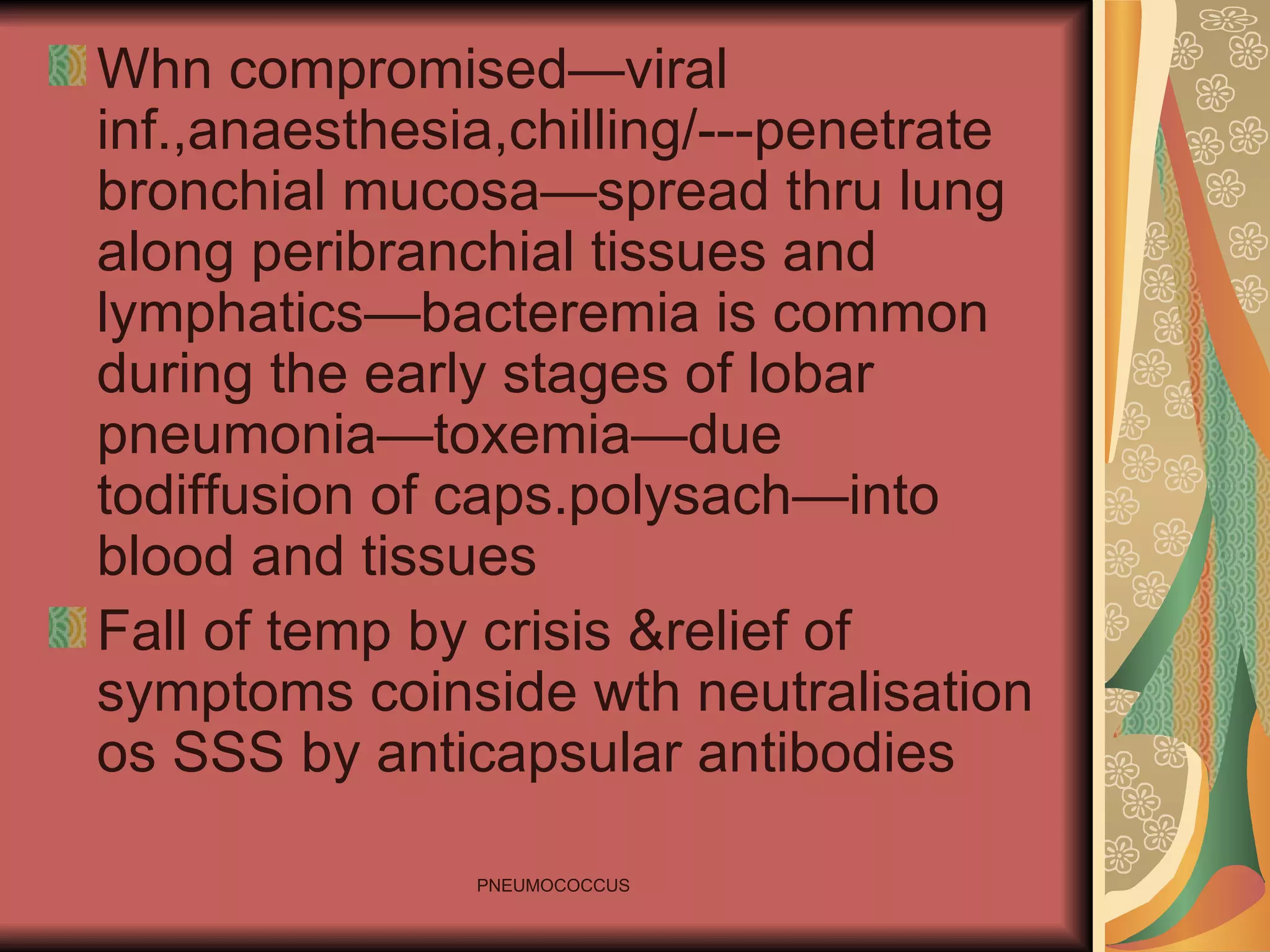
Whn compromised—viral inf.,anaesthesia,chilling/---penetrate bronchial mucosa—spread thru lung along peribranchial tissues and lymphatics—bacteremia is common during the early stages of lobar pneumonia—toxemia—due todiffusion of caps.polysach—into blood and tissues Fall of temp by crisis &relief of symptoms coinside wth neutralisation os SSS by anticapsular antibodies
50% fatality is due to pneumococcal bactermia Bronchopneumonia –always secondary inf.—caused by any serotype of pneumococcus—due to primarly damaged epi+increasd bronchial secrn----termilnla evnt in agd and debilitatad ones ---exacerbated by c/c bronchitis-also haemophilus influenzaeass. Wth this codition Meningitis –most serius of pneumococcal inf.---secondry to pneumonia,otits media,..in all ages…with antibiotics—fatality rate 25%
Other suppurative lesions Empyema,pericarditis otitis medis,sinusitis,conjunctivits,,, Epidemiology  Respiratory tract of carriers.-source—Ds-only whn host’s resistance lowerd+viral inf./pulmon.congestion/stress/malnutrition/immunodefficincy/alcoholism *splenectomy and sickle cell ds.---predispose to it
Lab dg a/c phase of lobar pneumonia—Rusty sputum—pneumococci in large no. with hardly any othr kind of bacteria,G+inoc-Blood ag.over n8 -37C,5-10%Co2---laryngal swabs can b used Scanty-intraperitoneal inoculation into mice --+--dies in 1-3 days Isolation of pneumococci frm blood indicates bad prognosis a/c otits media-pneum-fluid of inner ear..---meningitis---CSF—and culture---if negetive---do Demonstration of SSS in CSF by ppting with atisera Capsular polysach—demon-blood,urine,CSF—by counter immuno electrophoresi---antibodies can b demonstratd by agglutination pptn,mouse protection test,bactericidal test eith whole blood
Prophylaxis Polyvalent polysach vaccine for 23 most prevelnt serotypes -80-90% protection T/t Parenteral penicilline Serious-amoxycillin Third gen cephalosporin Vancomycin-life threatning illness

Pneumococcus

  • 1.
    PNEUMOCOCCUS *DIPLOCOCCUS PNEUMONIAE*STREPTOCOCCUS PNEUMONIAE
  • 2.
    G+,lanceolate diplococcus Formlyclassified as Diplococcus pneumoniae Reclassified to streptococcus pneumoniae-genetic relation with strept. Differs from strpt in- 1.morphology 2.bile solubility 3.optachin sensitivity 4.sp.polysach.capsule
  • 3.
    First noticed –pasteur&Sternberg Realtion betwn pneumococci &pneumonia –Frankel &Weichsalbaum Morphology Small-1 micron –slightly elongatd—one end broad ,other pointd,flame shaped /lanceolate shaped. Occurs in pairs-with broad ends in apposition long axis of the coccus parellel to the line joining the two cocci in a pair.CAPSULATED-capsule enclosing each pair.
  • 4.
    Capsules—bst seen inmaterials taken bst from exudates-may b lost onb repeatd cultivation NONMOTILE,NONSPORING In culture typical morph—not apparent—cocci r more rounded tending to occur in short chains Staind with Anilline dyes---G+ Capsule-clear halo –inidan ink
  • 5.
    Cultural chr. Growonly in enriched media.—aerobes+fac.anero.Temp-37C---PH 7.8—growth is improcved by 5-10%Co2 Blood agar-inc-18 hrscolonies-small,dome shaped,glistening,with an area of green discolouration(alpha hemolysis) Resemble colonies of str. Viridans— Furthr inc—colonies become flat—with raised edges and central umbonation---so concentric rings r seen on the surface whn viewd frm above—”Draughtsman/Carrom Coin appearance” Sm strains that dvlp abundnt capsular material(3 &7)---form large mucoid colonies
  • 6.
  • 7.
    Under anerobic condition---coloniesin blood agar –sorrondd by zone of beta hemolysis due to—O2 labile hemolysin O Liquid media(gluc broth)-growth occurs as uniform turbidity Cocci readily undergoes autolysis in cultures due to activity of intracellular enzymes.,enhancd by bile salts,Na lauryl suphate,and other surface active antigens Heat killd cultures do not undergo autolysis
  • 8.
    Biochemical reactions Fermnt---acidFerm.-testd in HISS’s serum water/srum agar slopes.inulin f-+(diff strp.) -bile soluble— 1ml culture+drops of 10% sodium deoxycholate=lysis overn8 Loopful of deoxycholate—lysis in few min Bile/Bile salts--+ts---amidase---cleavs the bond between alanine &muramic acidin the peptidoglycan.---lysis of organism---soluble Tst at nuetral PH using deoxycholate &youn culture C-….O-
  • 9.
    Resistance Delicate—destroyd by52C 15 min and antiseptics Ic culture –destroyd on prolongd inc—accumulation of toxic peroxidase—strains maintaind in semisolid blood agar/by lyophilisation Penicilline DOC Resistance—intermediate(MIC 1micgm),high(2micgm)---due o mutation /gene transfer—by alteration penicillin binding proteinson surface—resistant to multiple strains—DRSP-Drug Resistant Streptococcus Pnuemoniae
  • 10.
    sensitivity to Optochin—1/5lakh—diffr.fromstrp. Antigenic properies Most imp-Type specific capsular polsacharid/SSS/specific soluble substances-diffuse into cultural medium/infective exudates and tissues Clas.of pneumococci-antigenic nature of capsular polysach. From lobar pneumoniae—Types 1,2,3. and a heterogenus grp 4
  • 11.
    Typing done by1.agglutinaion of cocci with type specific aniserum 2.Precipitation of SSS with specific serum 3.Capsule swelling reaction by Neufeld(quelling Reaction)—Suspn.pnuem+antiseum+loopful of methylene blue---in presence of homologous antiserum capsule becomes apparently swollen,sharply delineatd and refractile.can b done directly with spuum from a/c pneumoniae---antigencty varies in sp.—antegenic in humans-no resp in mice in large quantity(immunological paralysis)---small quatities---resp+
  • 12.
    Othr antigens-nucleoprotein,somatic Ccho antigen In a/c pneumonia case’s sera—an abnl protein—”btea globulin”---tht ppts somatic C r found---but dissappears during convalescnce B-globulin—C reactive protein-(CRP)-not an antbody—a/c phase substance produced in hepatocytes—production stimulated by bac.inf.inflm.,malignancy, tissue destrrction---disappear whn infl.reactions subside CRP-index - response to t/t in Rheumatic fever
  • 13.
    Variation On repeatdsubculture—S-R variation. R-colonies-rough-noncaps-autoaggluable-avirulent—as spontaneous mutants and outgrow the S type-in tissues they r eliminated by phagocytsR form +DNA---Transformation—Griffith Toxin &virulent factors O2labile hemolysin+lecocidin---weak---no virulence Virulence depends on capsule and production of a toxin calld “pneumolysin”
  • 14.
    Capsular poly sach-notphagocytosd effectvly---but suscepatble to surface Phagocyosis—being engulfd against a firm surface.(fibrin clot/epithelium) Enhanced virulence of Type3-abundance of capsulr mat. Noncapsular –avirulent antibody to capsular polys..provides protection against inf. Pneumolysin-a membrane damaging toxin by pneumococci-has cytotoxic+ complement activating property.virulnt fctr-immunogenic— Pneumococcal autolysins by releasin bacterial components in infectd tissues, may also contribut to virulence
  • 15.
    Pathogenicity Colonise inhuman nasopharynx—infection in middle ear-paranasal sinus-and respiratory tract by direct spreadalso meninges---pneumococcal bacteremia—distant infections as heart,peritonium joints.inf-mostly endogenous—also exo ---commonst—otitis media & sinusitis Most common bac causing pneumonia—both lobar and broncho..+a/c tracheobronchitis and empyema Aspiaration from nasophryngl scrn---lower RT---nl evn during sleep—nl mucosl defence mech-entrapmnt,expulsion and cough reflex-+ciliary escalator effect prvnt establishmnt of infection
  • 16.
    Whn compromised—viral inf.,anaesthesia,chilling/---penetratebronchial mucosa—spread thru lung along peribranchial tissues and lymphatics—bacteremia is common during the early stages of lobar pneumonia—toxemia—due todiffusion of caps.polysach—into blood and tissues Fall of temp by crisis &relief of symptoms coinside wth neutralisation os SSS by anticapsular antibodies
  • 17.
    50% fatality isdue to pneumococcal bactermia Bronchopneumonia –always secondary inf.—caused by any serotype of pneumococcus—due to primarly damaged epi+increasd bronchial secrn----termilnla evnt in agd and debilitatad ones ---exacerbated by c/c bronchitis-also haemophilus influenzaeass. Wth this codition Meningitis –most serius of pneumococcal inf.---secondry to pneumonia,otits media,..in all ages…with antibiotics—fatality rate 25%
  • 18.
    Other suppurative lesionsEmpyema,pericarditis otitis medis,sinusitis,conjunctivits,,, Epidemiology Respiratory tract of carriers.-source—Ds-only whn host’s resistance lowerd+viral inf./pulmon.congestion/stress/malnutrition/immunodefficincy/alcoholism *splenectomy and sickle cell ds.---predispose to it
  • 19.
    Lab dg a/cphase of lobar pneumonia—Rusty sputum—pneumococci in large no. with hardly any othr kind of bacteria,G+inoc-Blood ag.over n8 -37C,5-10%Co2---laryngal swabs can b used Scanty-intraperitoneal inoculation into mice --+--dies in 1-3 days Isolation of pneumococci frm blood indicates bad prognosis a/c otits media-pneum-fluid of inner ear..---meningitis---CSF—and culture---if negetive---do Demonstration of SSS in CSF by ppting with atisera Capsular polysach—demon-blood,urine,CSF—by counter immuno electrophoresi---antibodies can b demonstratd by agglutination pptn,mouse protection test,bactericidal test eith whole blood
  • 20.
    Prophylaxis Polyvalent polysachvaccine for 23 most prevelnt serotypes -80-90% protection T/t Parenteral penicilline Serious-amoxycillin Third gen cephalosporin Vancomycin-life threatning illness