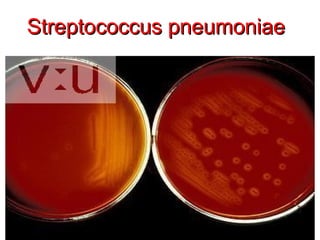
Streptococcus pneumoniae
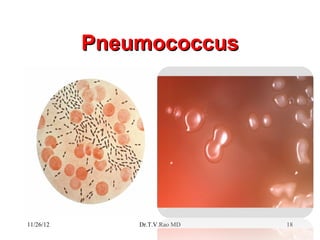
       pneumococcus
           Dr.T.V.Rao MD


11/26/12      Dr.T.V.Rao MD   1
Scientific Classification
  Kingdom: Bacteria / Phylum: Firmicutes /
  Class: Diplococci / Order: Lactobacillales /
  Family: Streptococcaceae /
  Genus: Streptococcus
Binomial name:
Streptococcus pneumoniae
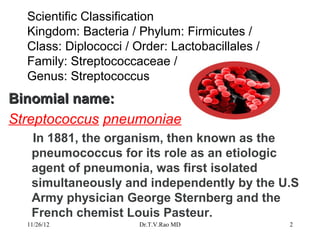
   In 1881, the organism, then known as the
   pneumococcus for its role as an etiologic
   agent of pneumonia, was first isolated
   simultaneously and independently by the U.S
   Army physician George Sternberg and the
   French chemist Louis Pasteur.
  11/26/12             Dr.T.V.Rao MD             2
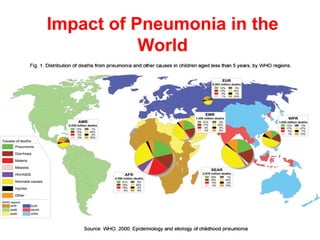
Impact of Pneumonia in the
                  World


11/26/12         Dr.T.V.Rao MD      3
Streptococcus pneumoniae
      5-40% normal inhabitants of upper respiratory tract; 40-
       70% of humans are natural carriers; 60% of all bacterial
       pneumonia
      Types of Pneumococci
  •        Types 1- 8: adults
  •        Types 6,14,19,23: children
      Predisposing factors:
  1.       Viral & other respiratory tract infections
  2.       Alcohol or drug intoxication
  3.       Abnormal circulatory dynamics
  4.       Other mechanisms: malnutrition, general debility, sickle
           cell anemia, hyposplenism, nephrosis or complement
   11/26/12
           deficiency          Dr.T.V.Rao MD                  4
Streptococcus pneumoniae
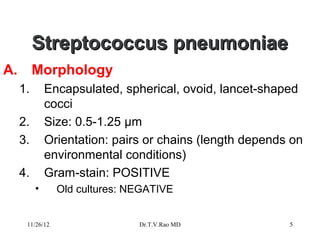
A. Morphology
 1.       Encapsulated, spherical, ovoid, lancet-shaped
          cocci
 2.       Size: 0.5-1.25 μm
 3.       Orientation: pairs or chains (length depends on
          environmental conditions)
 4.       Gram-stain: POSITIVE
      •      Old cultures: NEGATIVE


  11/26/12                  Dr.T.V.Rao MD             5
Streptococcus pneumoniae
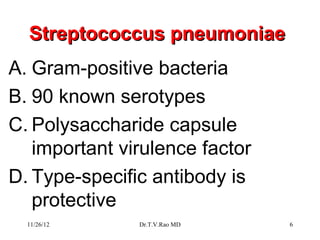
A. Gram-positive bacteria
B. 90 known serotypes
C. Polysaccharide capsule
   important virulence factor
D. Type-specific antibody is
   protective
  11/26/12     Dr.T.V.Rao MD    6
Streptococcus pneumoniae
 A. Morphology
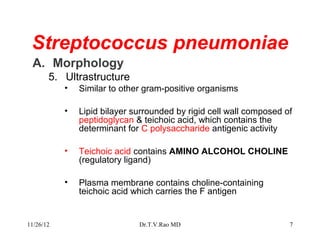
       5. Ultrastructure
           •   Similar to other gram-positive organisms

           •   Lipid bilayer surrounded by rigid cell wall composed of
               peptidoglycan & teichoic acid, which contains the
               determinant for C polysaccharide antigenic activity

           •   Teichoic acid contains AMINO ALCOHOL CHOLINE
               (regulatory ligand)

           •   Plasma membrane contains choline-containing
               teichoic acid which carries the F antigen


11/26/12                      Dr.T.V.Rao MD                          7
Streptococcus pneumoniae
B.        Physiology
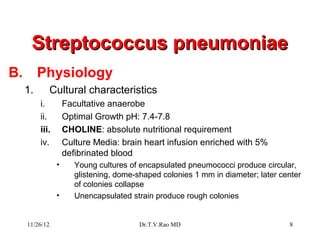
     1.      Cultural characteristics
          i.         Facultative anaerobe
          ii.        Optimal Growth pH: 7.4-7.8
          iii.       CHOLINE: absolute nutritional requirement
          iv.        Culture Media: brain heart infusion enriched with 5%
                     defibrinated blood
                 •      Young cultures of encapsulated pneumococci produce circular,
                        glistening, dome-shaped colonies 1 mm in diameter; later center
                        of colonies collapse
                 •      Unencapsulated strain produce rough colonies


     11/26/12                             Dr.T.V.Rao MD                            8
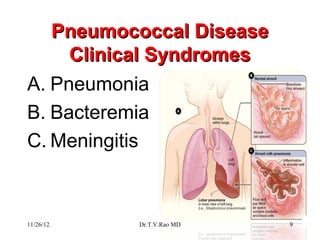
Pneumococcal Disease
     Clinical Syndromes
A. Pneumonia
B. Bacteremia
C. Meningitis


11/26/12   Dr.T.V.Rao MD   9
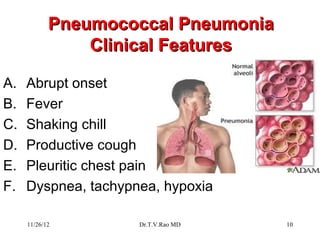
Pneumococcal Pneumonia
                Clinical Features
A.   Abrupt onset
B.   Fever
C.   Shaking chill
D.   Productive cough
E.   Pleuritic chest pain
F.   Dyspnea, tachypnea, hypoxia

     11/26/12        Dr.T.V.Rao MD   10
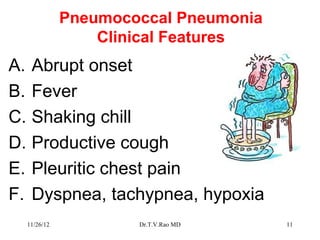
Pneumococcal Pneumonia
                    Clinical Features
A.    Abrupt onset
B.    Fever
C.    Shaking chill
D.    Productive cough
E.    Pleuritic chest pain
F.    Dyspnea, tachypnea, hypoxia
     11/26/12           Dr.T.V.Rao MD    11
Pneumococcal Disease in Children
A. Bacteremia without known site of
   infection most common clinical
   presentation
B. S. pneumoniae leading cause of
   bacterial meningitis among children
   <5 years of age
C. Common cause of acute otitis media

  11/26/12       Dr.T.V.Rao MD       12
Streptococcus pneumoniae
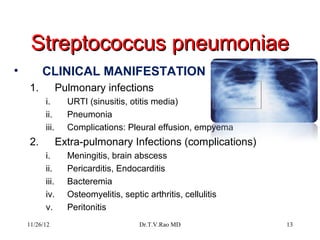
•        CLINICAL MANIFESTATION
    1.           Pulmonary infections
          i.       URTI (sinusitis, otitis media)
          ii.      Pneumonia
          iii.     Complications: Pleural effusion, empyema
    2.           Extra-pulmonary Infections (complications)
          i.       Meningitis, brain abscess
          ii.      Pericarditis, Endocarditis
          iii.     Bacteremia
          iv.      Osteomyelitis, septic arthritis, cellulitis
          v.       Peritonitis
    11/26/12                           Dr.T.V.Rao MD             13
Pneumococcal Disease
                Epidemiology
A. Reservoir         Human carriers

B. Transmission      Respiratory
                     "Autoinoculation“

A. Temporal pattern Winter and early spring

B. Communicability    Unknown
                      Probably as long as
                      organism in respiratory
   11/26/12          Dr.T.V.Rao MD              14
                      secretions
Children at Increased Risk of Invasive
         Pneumococcal Disease
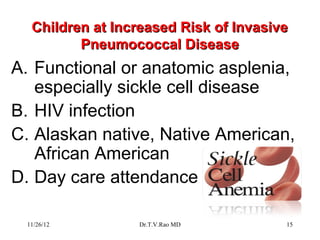
A. Functional or anatomic asplenia,
   especially sickle cell disease
B. HIV infection
C. Alaskan native, Native American,
   African American
D. Day care attendance

 11/26/12        Dr.T.V.Rao MD         15
Pneumococcal Disease Outbreaks
A. Outbreaks uncommon
B. Generally occur crowded
   environments (jails, nursing
   homes)
C. Persons with invasive disease
   often have underlying illness
D. May have high fatality rate
11/26/12     Dr.T.V.Rao MD     16
Streptococcus pneumoniae


11/26/12   Dr.T.V.Rao MD   17
Pneumococcus


11/26/12       Dr.T.V.Rao MD   18
Streptococcus pneumoniae
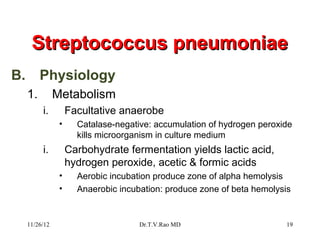
B.        Physiology
     1.         Metabolism
          i.         Facultative anaerobe
                 •     Catalase-negative: accumulation of hydrogen peroxide
                       kills microorganism in culture medium
          i.         Carbohydrate fermentation yields lactic acid,
                     hydrogen peroxide, acetic & formic acids
                 •     Aerobic incubation produce zone of alpha hemolysis
                 •     Anaerobic incubation: produce zone of beta hemolysis


     11/26/12                         Dr.T.V.Rao MD                       19
Streptococcus pneumoniae
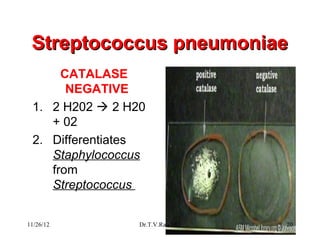
      CATALASE
       NEGATIVE
 1. 2 H202  2 H20
    + 02
 2. Differentiates
    Staphylococcus
    from
    Streptococcus


11/26/12         Dr.T.V.Rao MD   20
Streptococcus pneumoniae
                        B.     Physiology
3.         Laboratory Identification
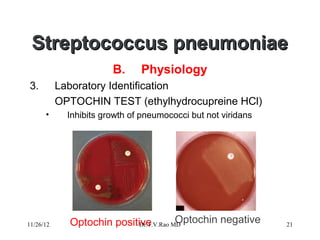
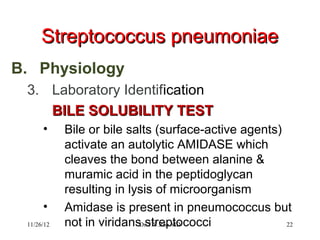
           OPTOCHIN TEST (ethylhydrocupreine HCl)
      •      Inhibits growth of pneumococci but not viridans


11/26/12     Optochin positive          Optochin negative
                            Dr.T.V.Rao MD                      21
Streptococcus pneumoniae
B. Physiology
 3. Laboratory Identification
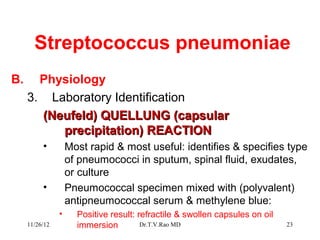
    BILE SOLUBILITY TEST
      •     Bile or bile salts (surface-active agents)
            activate an autolytic AMIDASE which
            cleaves the bond between alanine &
            muramic acid in the peptidoglycan
            resulting in lysis of microorganism
      •     Amidase is present in pneumococcus but
 11/26/12   not in viridansDr.T.V.Rao MD
                             streptococci              22
Streptococcus pneumoniae
B.     Physiology
     3. Laboratory Identification
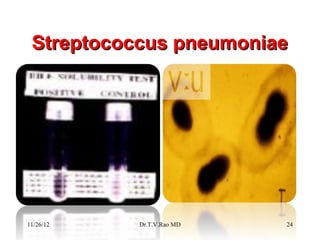
       (Neufeld) QUELLUNG (capsular
          precipitation) REACTION
          •         Most rapid & most useful: identifies & specifies type
                    of pneumococci in sputum, spinal fluid, exudates,
                    or culture
          •         Pneumococcal specimen mixed with (polyvalent)
                    antipneumococcal serum & methylene blue:
                •     Positive result: refractile & swollen capsules on oil
     11/26/12         immersion         Dr.T.V.Rao MD                         23
Streptococcus pneumoniae


11/26/12   Dr.T.V.Rao MD   24
Streptococcus pneumoniae
B. Physiology
  3. Laboratory Identification
     ANIMAL INOCULATION
           •   Fatal infection within 16-48 hours
               to mice injected intraperitoneally
               with sputum infected with
               pneumococci
11/26/12   •   For experimental purposes
                         Dr.T.V.Rao MD            25
Streptococcus pneumoniae
C. Antigenic Structure
     1. Capsular antigens
           i.   Forms hydrophilic gels on the surface
                of microorganisms
           ii. Antigenicity produces immunity
           iii. Basis for separation of serotypes
           iv. Cross-reactions with other bacteria
                due to common polysaccharide N-
11/26/12        acetyl-D glucosamine
                           Dr.T.V.Rao MD             26
Streptococcus pneumoniae
C.        Antigenic Structure
     2.        Somatic antigens
          i.        C polysaccharide (species-specific)
          •         Major cell wall structural component
                •     Teichoic acid polymer with phosphocholine (major
                      antigenic determinant), galactosamine, glucose,
                      phosphate, ribitol & trideoxydiaminohexose
                •     Phosphocholine responsible for agglutination of
                      pneumococci
          •         C polysaccharide binds with C reactive protein to
                    activate complement-mediated phagocytosis
     11/26/12                        Dr.T.V.Rao MD                       27
Streptococcus pneumoniae

C. Antigenic Structure
     2. Somatic antigens
           i.       F or FORSSMANN Antigen
                •    Lipoteichoic acid consisting of C
                     polysaccharide covalently linked to
                     lipids
                •    Inhibits N-acetyl-L-alanine amidase

11/26/12
           ii. M proteinDr.T.V.Rao MD                  28
Streptococcus pneumoniae
D.         Determinants of Pathogenicity
      1.        Polysaccharide Capsule (91 types)
           •      antiphagocytic capability by inhibiting C3b opsonization
                  of the bacterial cells
      1.        Choline binding protein A/Pneumococcal surface
                protein A (CbpA/PspA) - Adhesins
           •      Attachment to mucosal surface by attaching with N-
                  acetyl-galactose
      1.        Enzymes
           a)     Neuraminidase: cleaves terminal N-acetylneuraminic
                  acid to invade nasopharynx
           b)     Proteases: degrades IgG, IgM & secretory IgA
11/26/12                        Dr.T.V.Rao MD                          29
Streptococcus pneumoniae
D.     Determinants of Pathogenicity
     1. Toxins
          a)         Pneumolysin O (Ply)
                 •     A 53-kDa protein that is cytolytic to eukaryotic cells that
                       have cholesterol as a component of their cell membranes
                       particularly the respiratory epithelium; also activates
                       complement
          a)         Autolysin (LytA)
                 •     Causes lysis of pneumococci in the presence of surface-
                       active agents or antimicrobials that inhibit cell wall
                       synthesis
                 •     Release toxic proteases
     4.         Cell wall components
                 •     Teichoic acid & peptidoglycan beneath the capsular
     11/26/12                         Dr.T.V.Rao MD                     30
                       polysaccharide
Streptococcus pneumoniae
D.      Determinants of Pathogenicity
     6.   Hydrogen peroxide –
           •      causes damage to host cells (can cause apoptosis in
                  neuronal cells during meningitis) and has bactericidal
                  effects against competing bacteria (Haemophilus
                  influenzae, Neisseria meningitidis, Staphylococcus
                  aureus)
     6.        Pili –
           •      hair-like structures that extend from the surface
           •      contributes to colonization of upper respiratory tract
                  and increase the formation of large amounts of TNF by
                  the immune system during sepsis, raising the
                  possibility of septic shock
11/26/12                          Dr.T.V.Rao MD                            31
Streptococcus pneumoniae
E.         Laboratory Diagnosis
     1.        Direct examination of Sputum
           •     Gram-stain (PRESUMPTIVE DIAGNOSIS)
     1.        Culture
           •     Appearance of α-hemolytic colonies that are
                 bile soluble & optochin sensitive & positive
                 Quellung reaction: (if typing sera is available
                 - simplest, most rapid & accurate)


11/26/12                      Dr.T.V.Rao MD                    32
Streptococcus pneumoniae
E. Laboratory Diagnosis
  3. Serologic Diagnosis
        i. Detection of pneumococcal
           antibodies
            • radioimmunoassay
        i. Detection of capsular
           polysaccharide
 11/26/12             Dr.T.V.Rao MD          33
            • counterimmunoelectrophoresis
Streptococcus pneumoniae
•         MANAGEMENT
     –         CHEMOTHERAPY:
           •    Based on sensitivity teating
           •    DOC: IM PCN G (uncomplicated pneumonia) OR oral
                PCN V (milder URTI)
           •    PCN-allergic alternatives: cephalosporin or erythromycin
                (pneumonia),chloramphenicol (meningitis), quinolones


     –         PREVENTIVE:
           •    Pneumococcal conjugate vaccine for high-risk cases


    11/26/12                     Dr.T.V.Rao MD                        34
Pneumococcal Vaccines
A. 1977 14-valent polysaccharide
        vaccine licensed
B. 1983 23-valent polysaccharide
        vaccine licensed
C. 2000 7-valent polysaccharide
        conjugate vaccine licensed
 11/26/12     Dr.T.V.Rao MD     35
Pneumococcal Polysaccharide Vaccine

A. Purified capsular polysaccharide
   antigen from 23 types of
   pneumococcus
B. Account for 88% of bacteremic
   pneumococcal disease
C. Cross-react with types causing
   additional 8% of disease
  11/26/12      Dr.T.V.Rao MD     36
Pneumococcal Conjugate Vaccine

A. Polysaccharide conjugated to
   nontoxic diphtheria toxin (7
   serotypes)
B. Vaccine serotypes account for 86%
   of bacteremia and 83% of
   meningitis among children <6
   years
  11/26/12     Dr.T.V.Rao MD     37
Pneumococcal Polysaccharide Vaccine
 A. Purified pneumococcal
    polysaccharide (23 types)
 B. Not effective in children <2 years
 C. 60%-70% against invasive
    disease
 D. Less effective in preventing
    pneumococcal pneumonia
 11/26/12       Dr.T.V.Rao MD       38
Pneumococcal Polysaccharide Vaccine
           Recommendations
A. Adults >65 years of age
B. Persons >2 years with
  1. chronic illness
  2. anatomic or functional asplenia
  3. immunocompromised (disease,
     chemotherapy, steroids)
  4. HIV infection
  5. environments or settings with increased
     risk
   11/26/12         Dr.T.V.Rao MD          39
Pneumococcal Conjugate
                    Vaccine
A. Routine vaccination of children age
   <24 months and children 24-59
   months with high risk medical
   conditions
B. Doses at 2, 4, 6, months, booster
   dose at 12-15 month
C. Unvaccinated children >7 months
   require fewer doses
  11/26/12           Dr.T.V.Rao MD    40
Pneumococcal Polysaccharide Vaccine
                Revaccination

A. Routine revaccination of immuno-
   competent persons is not
   recommended
B. Revaccination recommended for
   persons age >2 years at highest
   risk of serious pneumococcal
   infection
C. Single revaccination dose >5 years
   after first dose
 11/26/12           Dr.T.V.Rao MD           41
Pneumococcal Polysaccharide Vaccine
           Candidates for Revaccination

A. Persons >2 years of age with:
  1. Functional or anatomic asplenia
  2. Immunosuppression
  3. Transplant
  4. Chronic renal failure
  5. Nephrotic syndrome
B. Persons vaccinated at <65 years of
  11/26/12           Dr.T.V.Rao MD           42
   age
The currently licensed vaccine

A. The polyvalent polysaccharide
         vaccine contains per dose (0.5 ml) 25
         micrograms of purified capsular
         polysaccharide from each of the 23
         capsular types of S. pneumoniae that
         together account for most cases
         (90%) of serious pneumococcal
         disease in Western industrialized
11/26/12
         countries..   Dr.T.V.Rao MD          43
Effectiveness of Current Vaccine
The currently licensed pneumococcal
polysaccharide vaccine has been shown to
protect adults and children under two years of
age against invasive pneumococcal infection,
and its use is recommended for adults and
children at high risk of pneumococcal disease.
Such groups include splenectomised patients
and persons with chronic organ failure or
sickle-cell disease, and the elderly population
  11/26/12          Dr.T.V.Rao MD           44
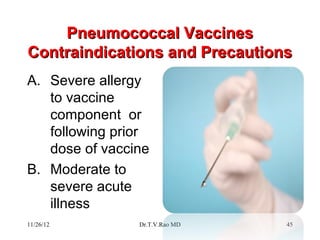
Pneumococcal Vaccines
Contraindications and Precautions
A. Severe allergy
   to vaccine
   component or
   following prior
   dose of vaccine
B. Moderate to
   severe acute
   illness
11/26/12        Dr.T.V.Rao MD   45
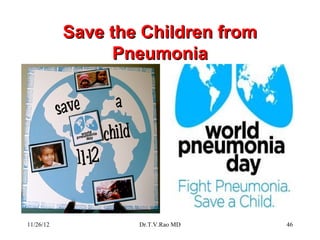
Save the Children from
                 Pneumonia


11/26/12           Dr.T.V.Rao MD    46
Programme Created by Dr.T.V.Rao
  MD for Medical Students in the
        Developing World
              Email
           doctortvrao@gmail.com


11/26/12          Dr.T.V.Rao MD    47

Streptococcus pneumoniae

  • 1.
    Streptococcus pneumoniae pneumococcus Dr.T.V.Rao MD 11/26/12 Dr.T.V.Rao MD 1
  • 2.
    Scientific Classification Kingdom: Bacteria / Phylum: Firmicutes / Class: Diplococci / Order: Lactobacillales / Family: Streptococcaceae / Genus: Streptococcus Binomial name: Streptococcus pneumoniae In 1881, the organism, then known as the pneumococcus for its role as an etiologic agent of pneumonia, was first isolated simultaneously and independently by the U.S Army physician George Sternberg and the French chemist Louis Pasteur. 11/26/12 Dr.T.V.Rao MD 2
  • 3.
    Impact of Pneumoniain the World 11/26/12 Dr.T.V.Rao MD 3
  • 4.
    Streptococcus pneumoniae  5-40% normal inhabitants of upper respiratory tract; 40- 70% of humans are natural carriers; 60% of all bacterial pneumonia  Types of Pneumococci • Types 1- 8: adults • Types 6,14,19,23: children  Predisposing factors: 1. Viral & other respiratory tract infections 2. Alcohol or drug intoxication 3. Abnormal circulatory dynamics 4. Other mechanisms: malnutrition, general debility, sickle cell anemia, hyposplenism, nephrosis or complement 11/26/12 deficiency Dr.T.V.Rao MD 4
  • 5.
    Streptococcus pneumoniae A. Morphology 1. Encapsulated, spherical, ovoid, lancet-shaped cocci 2. Size: 0.5-1.25 μm 3. Orientation: pairs or chains (length depends on environmental conditions) 4. Gram-stain: POSITIVE • Old cultures: NEGATIVE 11/26/12 Dr.T.V.Rao MD 5
  • 6.
    Streptococcus pneumoniae A. Gram-positivebacteria B. 90 known serotypes C. Polysaccharide capsule important virulence factor D. Type-specific antibody is protective 11/26/12 Dr.T.V.Rao MD 6
  • 7.
    Streptococcus pneumoniae A.Morphology 5. Ultrastructure • Similar to other gram-positive organisms • Lipid bilayer surrounded by rigid cell wall composed of peptidoglycan & teichoic acid, which contains the determinant for C polysaccharide antigenic activity • Teichoic acid contains AMINO ALCOHOL CHOLINE (regulatory ligand) • Plasma membrane contains choline-containing teichoic acid which carries the F antigen 11/26/12 Dr.T.V.Rao MD 7
  • 8.
    Streptococcus pneumoniae B. Physiology 1. Cultural characteristics i. Facultative anaerobe ii. Optimal Growth pH: 7.4-7.8 iii. CHOLINE: absolute nutritional requirement iv. Culture Media: brain heart infusion enriched with 5% defibrinated blood • Young cultures of encapsulated pneumococci produce circular, glistening, dome-shaped colonies 1 mm in diameter; later center of colonies collapse • Unencapsulated strain produce rough colonies 11/26/12 Dr.T.V.Rao MD 8
  • 9.
    Pneumococcal Disease Clinical Syndromes A. Pneumonia B. Bacteremia C. Meningitis 11/26/12 Dr.T.V.Rao MD 9
  • 10.
    Pneumococcal Pneumonia Clinical Features A. Abrupt onset B. Fever C. Shaking chill D. Productive cough E. Pleuritic chest pain F. Dyspnea, tachypnea, hypoxia 11/26/12 Dr.T.V.Rao MD 10
  • 11.
    Pneumococcal Pneumonia Clinical Features A. Abrupt onset B. Fever C. Shaking chill D. Productive cough E. Pleuritic chest pain F. Dyspnea, tachypnea, hypoxia 11/26/12 Dr.T.V.Rao MD 11
  • 12.
    Pneumococcal Disease inChildren A. Bacteremia without known site of infection most common clinical presentation B. S. pneumoniae leading cause of bacterial meningitis among children <5 years of age C. Common cause of acute otitis media 11/26/12 Dr.T.V.Rao MD 12
  • 13.
    Streptococcus pneumoniae • CLINICAL MANIFESTATION 1. Pulmonary infections i. URTI (sinusitis, otitis media) ii. Pneumonia iii. Complications: Pleural effusion, empyema 2. Extra-pulmonary Infections (complications) i. Meningitis, brain abscess ii. Pericarditis, Endocarditis iii. Bacteremia iv. Osteomyelitis, septic arthritis, cellulitis v. Peritonitis 11/26/12 Dr.T.V.Rao MD 13
  • 14.
    Pneumococcal Disease Epidemiology A. Reservoir Human carriers B. Transmission Respiratory "Autoinoculation“ A. Temporal pattern Winter and early spring B. Communicability Unknown Probably as long as organism in respiratory 11/26/12 Dr.T.V.Rao MD 14 secretions
  • 15.
    Children at IncreasedRisk of Invasive Pneumococcal Disease A. Functional or anatomic asplenia, especially sickle cell disease B. HIV infection C. Alaskan native, Native American, African American D. Day care attendance 11/26/12 Dr.T.V.Rao MD 15
  • 16.
    Pneumococcal Disease Outbreaks A.Outbreaks uncommon B. Generally occur crowded environments (jails, nursing homes) C. Persons with invasive disease often have underlying illness D. May have high fatality rate 11/26/12 Dr.T.V.Rao MD 16
  • 17.
  • 18.
    Pneumococcus 11/26/12 Dr.T.V.Rao MD 18
  • 19.
    Streptococcus pneumoniae B. Physiology 1. Metabolism i. Facultative anaerobe • Catalase-negative: accumulation of hydrogen peroxide kills microorganism in culture medium i. Carbohydrate fermentation yields lactic acid, hydrogen peroxide, acetic & formic acids • Aerobic incubation produce zone of alpha hemolysis • Anaerobic incubation: produce zone of beta hemolysis 11/26/12 Dr.T.V.Rao MD 19
  • 20.
    Streptococcus pneumoniae CATALASE NEGATIVE 1. 2 H202  2 H20 + 02 2. Differentiates Staphylococcus from Streptococcus 11/26/12 Dr.T.V.Rao MD 20
  • 21.
    Streptococcus pneumoniae B. Physiology 3. Laboratory Identification OPTOCHIN TEST (ethylhydrocupreine HCl) • Inhibits growth of pneumococci but not viridans 11/26/12 Optochin positive Optochin negative Dr.T.V.Rao MD 21
  • 22.
    Streptococcus pneumoniae B. Physiology 3. Laboratory Identification BILE SOLUBILITY TEST • Bile or bile salts (surface-active agents) activate an autolytic AMIDASE which cleaves the bond between alanine & muramic acid in the peptidoglycan resulting in lysis of microorganism • Amidase is present in pneumococcus but 11/26/12 not in viridansDr.T.V.Rao MD streptococci 22
  • 23.
    Streptococcus pneumoniae B. Physiology 3. Laboratory Identification (Neufeld) QUELLUNG (capsular precipitation) REACTION • Most rapid & most useful: identifies & specifies type of pneumococci in sputum, spinal fluid, exudates, or culture • Pneumococcal specimen mixed with (polyvalent) antipneumococcal serum & methylene blue: • Positive result: refractile & swollen capsules on oil 11/26/12 immersion Dr.T.V.Rao MD 23
  • 24.
  • 25.
    Streptococcus pneumoniae B. Physiology 3. Laboratory Identification ANIMAL INOCULATION • Fatal infection within 16-48 hours to mice injected intraperitoneally with sputum infected with pneumococci 11/26/12 • For experimental purposes Dr.T.V.Rao MD 25
  • 26.
    Streptococcus pneumoniae C. AntigenicStructure 1. Capsular antigens i. Forms hydrophilic gels on the surface of microorganisms ii. Antigenicity produces immunity iii. Basis for separation of serotypes iv. Cross-reactions with other bacteria due to common polysaccharide N- 11/26/12 acetyl-D glucosamine Dr.T.V.Rao MD 26
  • 27.
    Streptococcus pneumoniae C. Antigenic Structure 2. Somatic antigens i. C polysaccharide (species-specific) • Major cell wall structural component • Teichoic acid polymer with phosphocholine (major antigenic determinant), galactosamine, glucose, phosphate, ribitol & trideoxydiaminohexose • Phosphocholine responsible for agglutination of pneumococci • C polysaccharide binds with C reactive protein to activate complement-mediated phagocytosis 11/26/12 Dr.T.V.Rao MD 27
  • 28.
    Streptococcus pneumoniae C. AntigenicStructure 2. Somatic antigens i. F or FORSSMANN Antigen • Lipoteichoic acid consisting of C polysaccharide covalently linked to lipids • Inhibits N-acetyl-L-alanine amidase 11/26/12 ii. M proteinDr.T.V.Rao MD 28
  • 29.
    Streptococcus pneumoniae D. Determinants of Pathogenicity 1. Polysaccharide Capsule (91 types) • antiphagocytic capability by inhibiting C3b opsonization of the bacterial cells 1. Choline binding protein A/Pneumococcal surface protein A (CbpA/PspA) - Adhesins • Attachment to mucosal surface by attaching with N- acetyl-galactose 1. Enzymes a) Neuraminidase: cleaves terminal N-acetylneuraminic acid to invade nasopharynx b) Proteases: degrades IgG, IgM & secretory IgA 11/26/12 Dr.T.V.Rao MD 29
  • 30.
    Streptococcus pneumoniae D. Determinants of Pathogenicity 1. Toxins a) Pneumolysin O (Ply) • A 53-kDa protein that is cytolytic to eukaryotic cells that have cholesterol as a component of their cell membranes particularly the respiratory epithelium; also activates complement a) Autolysin (LytA) • Causes lysis of pneumococci in the presence of surface- active agents or antimicrobials that inhibit cell wall synthesis • Release toxic proteases 4. Cell wall components • Teichoic acid & peptidoglycan beneath the capsular 11/26/12 Dr.T.V.Rao MD 30 polysaccharide
  • 31.
    Streptococcus pneumoniae D. Determinants of Pathogenicity 6. Hydrogen peroxide – • causes damage to host cells (can cause apoptosis in neuronal cells during meningitis) and has bactericidal effects against competing bacteria (Haemophilus influenzae, Neisseria meningitidis, Staphylococcus aureus) 6. Pili – • hair-like structures that extend from the surface • contributes to colonization of upper respiratory tract and increase the formation of large amounts of TNF by the immune system during sepsis, raising the possibility of septic shock 11/26/12 Dr.T.V.Rao MD 31
  • 32.
    Streptococcus pneumoniae E. Laboratory Diagnosis 1. Direct examination of Sputum • Gram-stain (PRESUMPTIVE DIAGNOSIS) 1. Culture • Appearance of α-hemolytic colonies that are bile soluble & optochin sensitive & positive Quellung reaction: (if typing sera is available - simplest, most rapid & accurate) 11/26/12 Dr.T.V.Rao MD 32
  • 33.
    Streptococcus pneumoniae E. LaboratoryDiagnosis 3. Serologic Diagnosis i. Detection of pneumococcal antibodies • radioimmunoassay i. Detection of capsular polysaccharide 11/26/12 Dr.T.V.Rao MD 33 • counterimmunoelectrophoresis
  • 34.
    Streptococcus pneumoniae • MANAGEMENT – CHEMOTHERAPY: • Based on sensitivity teating • DOC: IM PCN G (uncomplicated pneumonia) OR oral PCN V (milder URTI) • PCN-allergic alternatives: cephalosporin or erythromycin (pneumonia),chloramphenicol (meningitis), quinolones – PREVENTIVE: • Pneumococcal conjugate vaccine for high-risk cases 11/26/12 Dr.T.V.Rao MD 34
  • 35.
    Pneumococcal Vaccines A. 197714-valent polysaccharide vaccine licensed B. 1983 23-valent polysaccharide vaccine licensed C. 2000 7-valent polysaccharide conjugate vaccine licensed 11/26/12 Dr.T.V.Rao MD 35
  • 36.
    Pneumococcal Polysaccharide Vaccine A.Purified capsular polysaccharide antigen from 23 types of pneumococcus B. Account for 88% of bacteremic pneumococcal disease C. Cross-react with types causing additional 8% of disease 11/26/12 Dr.T.V.Rao MD 36
  • 37.
    Pneumococcal Conjugate Vaccine A.Polysaccharide conjugated to nontoxic diphtheria toxin (7 serotypes) B. Vaccine serotypes account for 86% of bacteremia and 83% of meningitis among children <6 years 11/26/12 Dr.T.V.Rao MD 37
  • 38.
    Pneumococcal Polysaccharide Vaccine A. Purified pneumococcal polysaccharide (23 types) B. Not effective in children <2 years C. 60%-70% against invasive disease D. Less effective in preventing pneumococcal pneumonia 11/26/12 Dr.T.V.Rao MD 38
  • 39.
    Pneumococcal Polysaccharide Vaccine Recommendations A. Adults >65 years of age B. Persons >2 years with 1. chronic illness 2. anatomic or functional asplenia 3. immunocompromised (disease, chemotherapy, steroids) 4. HIV infection 5. environments or settings with increased risk 11/26/12 Dr.T.V.Rao MD 39
  • 40.
    Pneumococcal Conjugate Vaccine A. Routine vaccination of children age <24 months and children 24-59 months with high risk medical conditions B. Doses at 2, 4, 6, months, booster dose at 12-15 month C. Unvaccinated children >7 months require fewer doses 11/26/12 Dr.T.V.Rao MD 40
  • 41.
    Pneumococcal Polysaccharide Vaccine Revaccination A. Routine revaccination of immuno- competent persons is not recommended B. Revaccination recommended for persons age >2 years at highest risk of serious pneumococcal infection C. Single revaccination dose >5 years after first dose 11/26/12 Dr.T.V.Rao MD 41
  • 42.
    Pneumococcal Polysaccharide Vaccine Candidates for Revaccination A. Persons >2 years of age with: 1. Functional or anatomic asplenia 2. Immunosuppression 3. Transplant 4. Chronic renal failure 5. Nephrotic syndrome B. Persons vaccinated at <65 years of 11/26/12 Dr.T.V.Rao MD 42 age
  • 43.
    The currently licensedvaccine A. The polyvalent polysaccharide vaccine contains per dose (0.5 ml) 25 micrograms of purified capsular polysaccharide from each of the 23 capsular types of S. pneumoniae that together account for most cases (90%) of serious pneumococcal disease in Western industrialized 11/26/12 countries.. Dr.T.V.Rao MD 43
  • 44.
    Effectiveness of CurrentVaccine The currently licensed pneumococcal polysaccharide vaccine has been shown to protect adults and children under two years of age against invasive pneumococcal infection, and its use is recommended for adults and children at high risk of pneumococcal disease. Such groups include splenectomised patients and persons with chronic organ failure or sickle-cell disease, and the elderly population 11/26/12 Dr.T.V.Rao MD 44
  • 45.
    Pneumococcal Vaccines Contraindications andPrecautions A. Severe allergy to vaccine component or following prior dose of vaccine B. Moderate to severe acute illness 11/26/12 Dr.T.V.Rao MD 45
  • 46.
    Save the Childrenfrom Pneumonia 11/26/12 Dr.T.V.Rao MD 46
  • 47.
    Programme Created byDr.T.V.Rao MD for Medical Students in the Developing World Email doctortvrao@gmail.com 11/26/12 Dr.T.V.Rao MD 47