CULTURE MEDIA
HITEN SHANKER NAVANI
III B.Sc MICROBIOLOGY
CONTENTS
 DEFINITION
 HISTORY
 GENERAL REQUIREMENTS OF MICROBES
 MEDIA CONSTITUENTS
 MEDIA INGREDIENTS
 ENVIRONMENTAL CONDITIONS IN CULTURE MEDIA
 AGAR
 CLASSIFICATION OF MEDIA
 TYPES OF CULTURE MEDIA
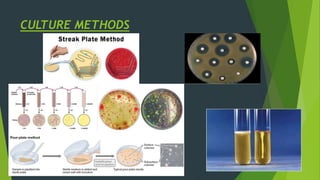
 CULTURE METHODS
 QUALITY CONTROL
DEFINITION
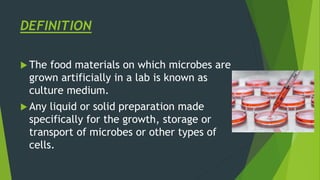
 The food materials on which microbes are
grown artificially in a lab is known as
culture medium.
 Any liquid or solid preparation made
specifically for the growth, storage or
transport of microbes or other types of
cells.
HISTORY
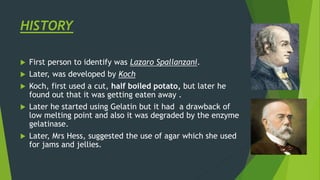
 First person to identify was Lazaro Spallanzani.
 Later, was developed by Koch
 Koch, first used a cut, half boiled potato, but later he
found out that it was getting eaten away .
 Later he started using Gelatin but it had a drawback of
low melting point and also it was degraded by the enzyme
gelatinase.
 Later, Mrs Hess, suggested the use of agar which she used
for jams and jellies.

GENERAL REQUIREMENTS
 Proper nutrients must be available.
 Oxygen or other gases must be available, as required.
 Moisture is necessary.
 The medium must have an appropriate pH.
 Proper temperature relations must prevail.
 The medium must be free of interfering bioburden.
 Contamination must be prevented.
GENERAL REQUIREMENTS
A satisfactory microbiological culture medium must contain
available sources of:
• Carbon
• Nitrogen
• Inorganic phosphate and sulfur
• Trace metals
• Water
• Vitamins
MEDIA
INGREDIENTS
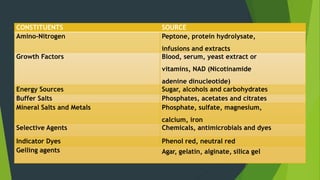
CONSTITUENTS SOURCE
Amino-Nitrogen Peptone, protein hydrolysate,
infusions and extracts
Growth Factors Blood, serum, yeast extract or
vitamins, NAD (Nicotinamide
adenine dinucleotide)
Energy Sources Sugar, alcohols and carbohydrates
Buffer Salts Phosphates, acetates and citrates
Mineral Salts and Metals Phosphate, sulfate, magnesium,
calcium, iron
Selective Agents Chemicals, antimicrobials and dyes
Indicator Dyes Phenol red, neutral red
Gelling agents Agar, gelatin, alginate, silica gel
Additional Points
 Purified water is recommended for use in the preparation
of culture media.
 Chromogens & Fluorogens are substrates incorporated
into culture media to allow organism differentiation and
identification.
 When these substrates are degraded by specific enzymes,
they release differently colored or fluorescent compounds
 Antimicrobial Agents are used in media to inhibit the
growth of bacteria, yeasts and fungi.
ENVIRONMENTAL CONDITIONS IN CULTURE
MEDIA
1. ATMOSPHERE
 Microbes that we grow can be Obligate or Facultative aerobes,
Microaerophilic, Obligate or Facultative anaerobes.
 Anaerobic conditions for growth of microorganisms are obtained in a
number of ways:
 Addition of small amounts of agar to liquid media
 Displacement of the air by hydrogen or nitrogen
 Absorption of the oxygen by chemicals
 Inoculation into the deep layers of solid media or under a layer of oil in
liquid media
2. WATER CONDITIONS
3. PROTECTIVE AGENTS AND GROWTH FACTORS
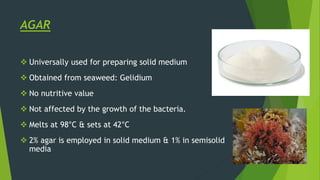
AGAR
 Universally used for preparing solid medium
 Obtained from seaweed: Gelidium
 No nutritive value
 Not affected by the growth of the bacteria.
 Melts at 98°C & sets at 42°C
 2% agar is employed in solid medium & 1% in semisolid
media
CLASSIFICATION OF MEDIA
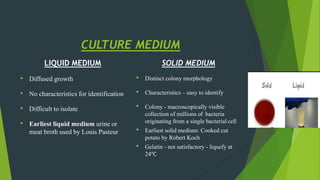
CULTURE MEDIUM
LIQUID MEDIUM
• Diffused growth
• No characteristics for identification
• Difficult to isolate
• Earliest liquid medium urine or
meat broth used by Louis Pasteur
SOLID MEDIUM
• Distinct colony morphology
• Characteristics – easy to identify
• Colony - macroscopically visible
collection of millions of bacteria
originating from a single bacterial cell
• Earliest solid medium: Cooked cut
potato by Robert Koch
• Gelatin - not satisfactory - liquefy at
24℃
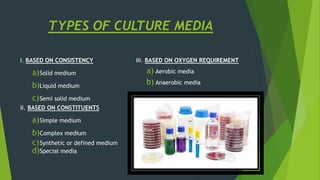
TYPES OF CULTURE MEDIA
I. BASED ON CONSISTENCY
a)Solid medium
b)Liquid medium
c)Semi solid medium
II. BASED ON CONSTITUENTS
a)Simple medium
b)Complex medium
c)Synthetic or defined medium
d)Special media
III. BASED ON OXYGEN REQUIREMENT
a) Aerobic media
b) Anaerobic media
SPECIAL MEDIA
 Enriched media
 Enrichment media
 Selective media
 Indicator media
 Differential media
 Sugar media
 Transport media
 Anaerobic Media
 Assay Media
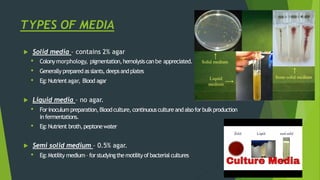
TYPES OF MEDIA
 Solid media – contains 2% agar
• Colonymorphology, pigmentation,hemolysiscanbe appreciated.
• Generallypreparedasslants,deepsandplates
• Eg:Nutrientagar, Blood agar
 Liquid media – no agar.
• Forinoculumpreparation,Bloodculture,continuouscultureandalsoforbulkproduction
infermentations.
• Eg:Nutrient broth,peptonewater
 Semi solid medium – 0.5% agar.
• Eg:Motility medium–forstudyingthemotilityofbacterialcultures
SIMPLE MEDIUM / BASAL MEDIUM
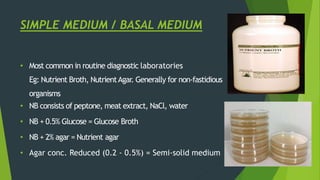
• Most common in routine diagnostic laboratories
Eg: Nutrient Broth, NutrientAgar. Generally for non-fastidious
organisms
• NB consists of peptone, meat extract, NaCl, water
• NB + 0.5% Glucose = Glucose Broth
• NB + 2% agar = Nutrient agar
• Agar conc. Reduced (0.2 - 0.5%) = Semi-solid medium
COMPLEX MEDIA
 Media other than basal media
 They have added complex ingredients such as
yeast extract or casein hydrolysate, which consist
of a mixture of many chemical species in unknown
proportions
 Eg. Yeast Extract, Caesin hydrolysate, Corn Steep
liquor, etc.
SYNTHETHIC OR DEFINED MEDIUM
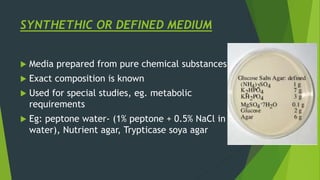
 Media prepared from pure chemical substances
 Exact composition is known
 Used for special studies, eg. metabolic
requirements
 Eg: peptone water- (1% peptone + 0.5% NaCl in
water), Nutrient agar, Trypticase soya agar
SPECIAL MEDIA
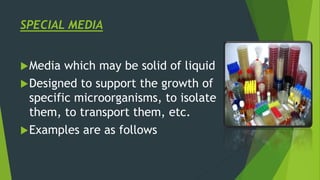
Media which may be solid of liquid
Designed to support the growth of
specific microorganisms, to isolate
them, to transport them, etc.
Examples are as follows
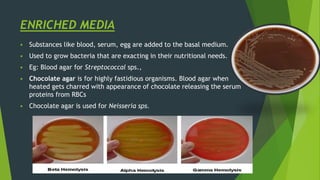
ENRICHED MEDIA
 Substances like blood, serum, egg are added to the basal medium.
 Used to grow bacteria that are exacting in their nutritional needs.
 Eg: Blood agar for Streptococcal sps.,
 Chocolate agar is for highly fastidious organisms. Blood agar when
heated gets charred with appearance of chocolate releasing the serum
proteins from RBCs
 Chocolate agar is used for Neisseria sps.
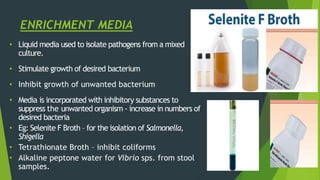
ENRICHMENT MEDIA
• Liquid media used to isolate pathogens from a mixed
culture.
• Stimulate growth of desired bacterium
• Inhibit growth of unwanted bacterium
• Media is incorporated with inhibitory substances to
suppress the unwanted organism - increase in numbers of
desired bacteria
• Eg: Selenite F Broth – for the isolation of Salmonella,
Shigella
• Tetrathionate Broth – inhibit coliforms
• Alkaline peptone water for Vibrio sps. from stool
samples.
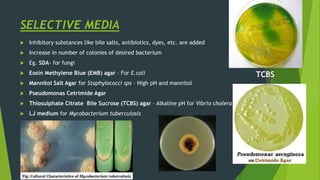
SELECTIVE MEDIA
 Inhibitory substances like bile salts, antibiotics, dyes, etc. are added
 Increase in number of colonies of desired bacterium
 Eg. SDA- for fungi
 Eosin Methylene Blue (EMB) agar – For E.coli
 Mannitol Salt Agar for Staphylococci sps – High pH and mannitol
 Pseudomonas Cetrimide Agar
 Thiosulphate Citrate Bile Sucrose (TCBS) agar – Alkaline pH for Vibrio cholera
 LJ medium for Mycobacterium tuberculosis
TCBS
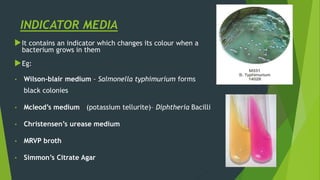
INDICATOR MEDIA
It contains an indicator which changes its colour when a
bacterium grows in them
Eg:
• Wilson-blair medium – Salmonella typhimurium forms
black colonies
• Mcleod’s medium (potassium tellurite)– Diphtheria Bacilli
• Christensen’s urease medium
• MRVP broth
• Simmon’s Citrate Agar
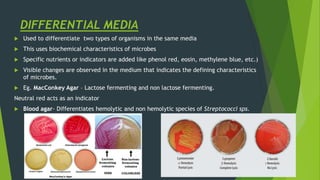
DIFFERENTIAL MEDIA
 Used to differentiate two types of organisms in the same media
 This uses biochemical characteristics of microbes
 Specific nutrients or indicators are added like phenol red, eosin, methylene blue, etc.)
 Visible changes are observed in the medium that indicates the defining characteristics
of microbes.
 Eg. MacConkey Agar – Lactose fermenting and non lactose fermenting.
Neutral red acts as an indicator
 Blood agar- Differentiates hemolytic and non hemolytic species of Streptococci sps.
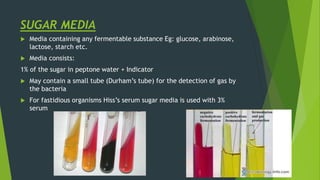
SUGAR MEDIA
 Media containing any fermentable substance Eg: glucose, arabinose,
lactose, starch etc.
 Media consists:
1% of the sugar in peptone water + Indicator
 May contain a small tube (Durham’s tube) for the detection of gas by
the bacteria
 For fastidious organisms Hiss’s serum sugar media is used with 3%
serum
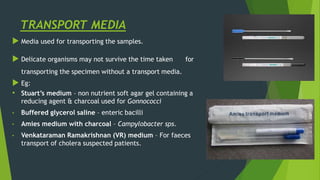
TRANSPORT MEDIA
 Media used for transporting the samples.
 Delicate organisms may not survive the time taken for
transporting the specimen without a transport media.
 Eg:
• Stuart’s medium – non nutrient soft agar gel containing a
reducing agent & charcoal used for Gonnococci
• Buffered glycerol saline – enteric bacilli
• Amies medium with charcoal – Campylobacter sps.
• Venkataraman Ramakrishnan (VR) medium – For faeces
transport of cholera suspected patients.
ANAEROBIC MEDIA
 This media is used to grow anaerobic microorgansims
 Eg.
 Robertson’s cooked meat broth
 Thioglycolate Medium THIOGLYCOLATE
MEDIUM
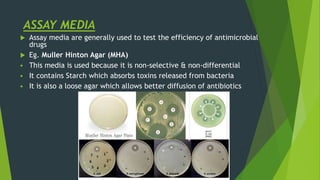
ASSAY MEDIA
 Assay media are generally used to test the efficiency of antimicrobial
drugs
 Eg. Muller Hinton Agar (MHA)
 This media is used because it is non-selective & non-differential
 It contains Starch which absorbs toxins released from bacteria
 It is also a loose agar which allows better diffusion of antibiotics
CULTURE METHODS
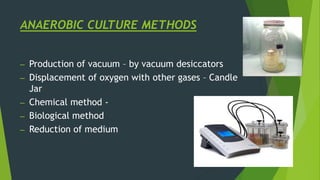
ANAEROBIC CULTURE METHODS
– Production of vacuum – by vacuum desiccators
– Displacement of oxygen with other gases – Candle
Jar
– Chemical method -
– Biological method
– Reduction of medium
QUALITY CONTROL OF MEDIA
 It is a routine check in microbiology laboratory
 This check insures the proper detection of proper
performance which may because of a poor and
deteriorated of stock of chemicals, laboratory
errors, improper maintenance of pH, etc.
 The following are to be taken care while
preparation of medium
QUALITY CONTROL OF MEDIA
 Quality control must be supervised by senior staff member
and deficiencies or contamination revealed during the
checks
 Specific indicators should be used to ensure the
correctness of sterilization cycle
 Sterilized media should be poured only into previously
sterilized plates only in laminar air flow
 Proper maintenance of Laminar air flow should be done
before and after the procedure
QUALITY CONTROL OF MEDIA
 Liquid media should be dispersed in tubes and then
sterilized
 Quality control must be seen of the additives like sugar,
serum proteins, enzymes, etc.
 All prepared media should be incubated for 24 hours prior
to the inoculation
 All aseptic techniques should be followed strictly like
sterilizing the loop, opening and closing the plates and
flasks
QUALITY CONTROL OF MEDIA
 Microbiology labs should be frequently fumigated using
potassium permanganate and formaldehye
 Decontamination of used stuff should be done properly
 Glasswares should be handled properly
 The skill of a person plays an important role in quality
control
THANK YOU

Culture media & Quality Control

  • 1.
    CULTURE MEDIA HITEN SHANKERNAVANI III B.Sc MICROBIOLOGY
  • 2.
    CONTENTS  DEFINITION  HISTORY GENERAL REQUIREMENTS OF MICROBES  MEDIA CONSTITUENTS  MEDIA INGREDIENTS  ENVIRONMENTAL CONDITIONS IN CULTURE MEDIA  AGAR  CLASSIFICATION OF MEDIA  TYPES OF CULTURE MEDIA  CULTURE METHODS  QUALITY CONTROL
  • 3.
    DEFINITION  The foodmaterials on which microbes are grown artificially in a lab is known as culture medium.  Any liquid or solid preparation made specifically for the growth, storage or transport of microbes or other types of cells.
  • 4.
    HISTORY  First personto identify was Lazaro Spallanzani.  Later, was developed by Koch  Koch, first used a cut, half boiled potato, but later he found out that it was getting eaten away .  Later he started using Gelatin but it had a drawback of low melting point and also it was degraded by the enzyme gelatinase.  Later, Mrs Hess, suggested the use of agar which she used for jams and jellies.
  • 5.
    GENERAL REQUIREMENTS  Propernutrients must be available.  Oxygen or other gases must be available, as required.  Moisture is necessary.  The medium must have an appropriate pH.  Proper temperature relations must prevail.  The medium must be free of interfering bioburden.  Contamination must be prevented.
  • 6.
    GENERAL REQUIREMENTS A satisfactorymicrobiological culture medium must contain available sources of: • Carbon • Nitrogen • Inorganic phosphate and sulfur • Trace metals • Water • Vitamins
  • 7.
  • 8.
    CONSTITUENTS SOURCE Amino-Nitrogen Peptone,protein hydrolysate, infusions and extracts Growth Factors Blood, serum, yeast extract or vitamins, NAD (Nicotinamide adenine dinucleotide) Energy Sources Sugar, alcohols and carbohydrates Buffer Salts Phosphates, acetates and citrates Mineral Salts and Metals Phosphate, sulfate, magnesium, calcium, iron Selective Agents Chemicals, antimicrobials and dyes Indicator Dyes Phenol red, neutral red Gelling agents Agar, gelatin, alginate, silica gel
  • 9.
    Additional Points  Purifiedwater is recommended for use in the preparation of culture media.  Chromogens & Fluorogens are substrates incorporated into culture media to allow organism differentiation and identification.  When these substrates are degraded by specific enzymes, they release differently colored or fluorescent compounds  Antimicrobial Agents are used in media to inhibit the growth of bacteria, yeasts and fungi.
  • 10.
    ENVIRONMENTAL CONDITIONS INCULTURE MEDIA 1. ATMOSPHERE  Microbes that we grow can be Obligate or Facultative aerobes, Microaerophilic, Obligate or Facultative anaerobes.  Anaerobic conditions for growth of microorganisms are obtained in a number of ways:  Addition of small amounts of agar to liquid media  Displacement of the air by hydrogen or nitrogen  Absorption of the oxygen by chemicals  Inoculation into the deep layers of solid media or under a layer of oil in liquid media 2. WATER CONDITIONS 3. PROTECTIVE AGENTS AND GROWTH FACTORS
  • 11.
    AGAR  Universally usedfor preparing solid medium  Obtained from seaweed: Gelidium  No nutritive value  Not affected by the growth of the bacteria.  Melts at 98°C & sets at 42°C  2% agar is employed in solid medium & 1% in semisolid media
  • 12.
  • 13.
    CULTURE MEDIUM LIQUID MEDIUM •Diffused growth • No characteristics for identification • Difficult to isolate • Earliest liquid medium urine or meat broth used by Louis Pasteur SOLID MEDIUM • Distinct colony morphology • Characteristics – easy to identify • Colony - macroscopically visible collection of millions of bacteria originating from a single bacterial cell • Earliest solid medium: Cooked cut potato by Robert Koch • Gelatin - not satisfactory - liquefy at 24℃
  • 14.
    TYPES OF CULTUREMEDIA I. BASED ON CONSISTENCY a)Solid medium b)Liquid medium c)Semi solid medium II. BASED ON CONSTITUENTS a)Simple medium b)Complex medium c)Synthetic or defined medium d)Special media III. BASED ON OXYGEN REQUIREMENT a) Aerobic media b) Anaerobic media
  • 15.
    SPECIAL MEDIA  Enrichedmedia  Enrichment media  Selective media  Indicator media  Differential media  Sugar media  Transport media  Anaerobic Media  Assay Media
  • 16.
    TYPES OF MEDIA Solid media – contains 2% agar • Colonymorphology, pigmentation,hemolysiscanbe appreciated. • Generallypreparedasslants,deepsandplates • Eg:Nutrientagar, Blood agar  Liquid media – no agar. • Forinoculumpreparation,Bloodculture,continuouscultureandalsoforbulkproduction infermentations. • Eg:Nutrient broth,peptonewater  Semi solid medium – 0.5% agar. • Eg:Motility medium–forstudyingthemotilityofbacterialcultures
  • 17.
    SIMPLE MEDIUM /BASAL MEDIUM • Most common in routine diagnostic laboratories Eg: Nutrient Broth, NutrientAgar. Generally for non-fastidious organisms • NB consists of peptone, meat extract, NaCl, water • NB + 0.5% Glucose = Glucose Broth • NB + 2% agar = Nutrient agar • Agar conc. Reduced (0.2 - 0.5%) = Semi-solid medium
  • 18.
    COMPLEX MEDIA  Mediaother than basal media  They have added complex ingredients such as yeast extract or casein hydrolysate, which consist of a mixture of many chemical species in unknown proportions  Eg. Yeast Extract, Caesin hydrolysate, Corn Steep liquor, etc.
  • 19.
    SYNTHETHIC OR DEFINEDMEDIUM  Media prepared from pure chemical substances  Exact composition is known  Used for special studies, eg. metabolic requirements  Eg: peptone water- (1% peptone + 0.5% NaCl in water), Nutrient agar, Trypticase soya agar
  • 20.
    SPECIAL MEDIA Media whichmay be solid of liquid Designed to support the growth of specific microorganisms, to isolate them, to transport them, etc. Examples are as follows
  • 21.
    ENRICHED MEDIA  Substanceslike blood, serum, egg are added to the basal medium.  Used to grow bacteria that are exacting in their nutritional needs.  Eg: Blood agar for Streptococcal sps.,  Chocolate agar is for highly fastidious organisms. Blood agar when heated gets charred with appearance of chocolate releasing the serum proteins from RBCs  Chocolate agar is used for Neisseria sps.
  • 22.
    ENRICHMENT MEDIA • Liquidmedia used to isolate pathogens from a mixed culture. • Stimulate growth of desired bacterium • Inhibit growth of unwanted bacterium • Media is incorporated with inhibitory substances to suppress the unwanted organism - increase in numbers of desired bacteria • Eg: Selenite F Broth – for the isolation of Salmonella, Shigella • Tetrathionate Broth – inhibit coliforms • Alkaline peptone water for Vibrio sps. from stool samples.
  • 23.
    SELECTIVE MEDIA  Inhibitorysubstances like bile salts, antibiotics, dyes, etc. are added  Increase in number of colonies of desired bacterium  Eg. SDA- for fungi  Eosin Methylene Blue (EMB) agar – For E.coli  Mannitol Salt Agar for Staphylococci sps – High pH and mannitol  Pseudomonas Cetrimide Agar  Thiosulphate Citrate Bile Sucrose (TCBS) agar – Alkaline pH for Vibrio cholera  LJ medium for Mycobacterium tuberculosis TCBS
  • 24.
    INDICATOR MEDIA It containsan indicator which changes its colour when a bacterium grows in them Eg: • Wilson-blair medium – Salmonella typhimurium forms black colonies • Mcleod’s medium (potassium tellurite)– Diphtheria Bacilli • Christensen’s urease medium • MRVP broth • Simmon’s Citrate Agar
  • 25.
    DIFFERENTIAL MEDIA  Usedto differentiate two types of organisms in the same media  This uses biochemical characteristics of microbes  Specific nutrients or indicators are added like phenol red, eosin, methylene blue, etc.)  Visible changes are observed in the medium that indicates the defining characteristics of microbes.  Eg. MacConkey Agar – Lactose fermenting and non lactose fermenting. Neutral red acts as an indicator  Blood agar- Differentiates hemolytic and non hemolytic species of Streptococci sps.
  • 26.
    SUGAR MEDIA  Mediacontaining any fermentable substance Eg: glucose, arabinose, lactose, starch etc.  Media consists: 1% of the sugar in peptone water + Indicator  May contain a small tube (Durham’s tube) for the detection of gas by the bacteria  For fastidious organisms Hiss’s serum sugar media is used with 3% serum
  • 27.
    TRANSPORT MEDIA  Mediaused for transporting the samples.  Delicate organisms may not survive the time taken for transporting the specimen without a transport media.  Eg: • Stuart’s medium – non nutrient soft agar gel containing a reducing agent & charcoal used for Gonnococci • Buffered glycerol saline – enteric bacilli • Amies medium with charcoal – Campylobacter sps. • Venkataraman Ramakrishnan (VR) medium – For faeces transport of cholera suspected patients.
  • 28.
    ANAEROBIC MEDIA  Thismedia is used to grow anaerobic microorgansims  Eg.  Robertson’s cooked meat broth  Thioglycolate Medium THIOGLYCOLATE MEDIUM
  • 29.
    ASSAY MEDIA  Assaymedia are generally used to test the efficiency of antimicrobial drugs  Eg. Muller Hinton Agar (MHA)  This media is used because it is non-selective & non-differential  It contains Starch which absorbs toxins released from bacteria  It is also a loose agar which allows better diffusion of antibiotics
  • 30.
  • 31.
    ANAEROBIC CULTURE METHODS –Production of vacuum – by vacuum desiccators – Displacement of oxygen with other gases – Candle Jar – Chemical method - – Biological method – Reduction of medium
  • 32.
    QUALITY CONTROL OFMEDIA  It is a routine check in microbiology laboratory  This check insures the proper detection of proper performance which may because of a poor and deteriorated of stock of chemicals, laboratory errors, improper maintenance of pH, etc.  The following are to be taken care while preparation of medium
  • 33.
    QUALITY CONTROL OFMEDIA  Quality control must be supervised by senior staff member and deficiencies or contamination revealed during the checks  Specific indicators should be used to ensure the correctness of sterilization cycle  Sterilized media should be poured only into previously sterilized plates only in laminar air flow  Proper maintenance of Laminar air flow should be done before and after the procedure
  • 34.
    QUALITY CONTROL OFMEDIA  Liquid media should be dispersed in tubes and then sterilized  Quality control must be seen of the additives like sugar, serum proteins, enzymes, etc.  All prepared media should be incubated for 24 hours prior to the inoculation  All aseptic techniques should be followed strictly like sterilizing the loop, opening and closing the plates and flasks
  • 35.
    QUALITY CONTROL OFMEDIA  Microbiology labs should be frequently fumigated using potassium permanganate and formaldehye  Decontamination of used stuff should be done properly  Glasswares should be handled properly  The skill of a person plays an important role in quality control
  • 36.