PLASMODIUM

WWW.RCVEts.Com
Plasmodium
•
•

> 100 species
Both animals and humans

1.

P. vivax  Benign Tertian Malaria

(humans)

2.

P. ovale  Benign Tertian Malaria

(humans)

3.

P. malariae  Benign Quartan Malaria

(humans/chimpanzees)

4.

P. falciparum  Malignant Tertian Malaria (humans)
Plasmodia
Geographical Distribution
• P. vivax and P. falciparum  more common
P. ovale  rarest of the 4 species
• > 200 million people worldwide
> 1 million deaths per year
Most common lethal infectious disease
Geographical Distribution
• Tropical & subtropical areas
esp. Asia, Africa, Central and South America
Certain regions in SE Asia, S. America, E.
Africa  Chloroquine Resistant strains of P.
falciparum
HABITAT
• Female Anopheles  sexual cycle
• Liver & RBCs of man  asexual cycle
RBC Age Variable:
 P. vivax  youngest erythrocytes
 P. malariae  oldest erythrocytes
 P. falciparum  RBCs of every age
Anopheles, Culex and Aedes aegyptii
MORPHOLOGY
•

Peripheral blood stained with Leishman’s stain

1.

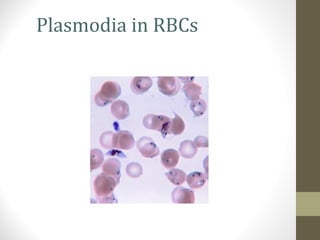
Small Trophozoites (Ring forms):
Infected RBC  at first ring form

a)
b)
c)

Dot/rod shaped nucleus (red)
Peripheral rim of cytoplasm (blue)
Central clear vacuole like area (not stained)
Different species have different rings
MORPHOLOGY
2.

Large Trophozoite:

•
•

Ring form  Large trophozoite
Fine grains of pigment Hematin

3.

Schizont:

Large trophozoite  schizont  N/C fragments merozoites

4.

Gametocytes:

•
•
•

Male and female distinguishable
Fully grown  rounded  occupies most of RBC
P. falciparum  sausage shaped  crescent in RBC
Plasmodia in RBCs
LIFE CYCLE
• HOST:

Definitive Host  Female anopheles (sexual cycle)
Intermediate Host  Man (asexual cycle)
• VECTOR:

Female Anopheles
LIFE CYCLE
• Sexual cycle initiated in Humans  Gametocytes
(gametogony in RBCs)  mosquitoes 
fusion of M/F gametes  oocyst  many
sporozoites (sporogony)
• Sexual cycle  Sporogony (sporozoites)
• Asexual cycle  Schizogony (schizonts)
Detailed Life Cycle
Oocysts in Mosquito
PATHOGENESIS
• Usual Incubation periods:
Vivax : 14 days
Malariae: 28 days
Falciparum: 11 days

• Transmission:
Mosquito bite
I/V drug abuse
Blood transfusion
Transplacental (congenital)
FEVER, ANEMIA, SPLENOMEGALY
PATHOGENESIS
• Malarial Relapses:
• P. vivax  2 years
• Para-erythrocytic stage  liver parenchyma 
dormant but viable
• Resistance lowered  released and activated 
complete erythrocytic cycle
• Not in P. falciparum as no para-erythrocytic stage
• Transmission other than mosquito bites no relapses
Natural Protection
• Sickle cell trait (heterozygous)
• Duffy blood group antigen –ve (homozygous
recessive) (P.vivax)
• G6PD deficiency
• Premunition:

• Partial immunity
• Humoral antibodies  block merozoites from
invading RBCs
• Low level of parasitemia low grade symptoms
PATHOGENESIS
•

Commonly Involved Organs:

1.
2.
3.
4.

Changes in Blood
Spleen
Liver
Bone Marrow
Signs and Symptoms
•
•
•
•
•
•
•
•
•
•
•

Abrupt fever, chills and rigors
Headache
Initially may be continuous then periodic
Upto 41ºC or 106 ºF
Nausea, vomiting, abdominal pain, anorexia, distaste of mouth
Drenching sweats afterwards
Well between febrile episodes
Splenomegaly
1/3 hepatomegaly
Anemia
Falciparum fatal bcz of brain and kidney damage
Laboratory Diagnosis
1.

Blood Exam:

a. Microscopic Exam:
•
•
•
•
•

Take blood during pyrexia
Not after even single dose of anti-malarials
Thick and thin smears made, dried and stained
Thick smear  presence of organisms
Thin smear  identification of species
Laboratory Diagnosis
• Thin Smear:

•
•
•
•
•
•

Single drop of blood
Spread to allow single cell layer
Leishman’s stain
Oil immersion lens
Ring shaped trophozoites in RBCs
P. falciparum gametocyte banana, sausage or crescent
shaped
• Other species gametocytes are spherical
• > 5 % RBCs infected  Dx of P. falciparum
Laboratory Diagnosis
• Thick Smear:

•
•
•
•
•

3-5 drops on slide allowed to dry
Several cell layers thick
Field’s stain or Giemsa stain
Oil immersion lens
Stain removes Hb from RBCs
Thin and Thick Smear
Laboratory Diagnosis
1.

Blood Exam:

b. TLC and DLC:
•
•

TLC low  leucopenia
In fever may be high
Monocytosis containing pigments
Laboratory Diagnosis
2. Biopsy:
•

BM and liver biopsies in difficult cases

3. Therapeutic Test:
•

Anti-malarials given  if fever subsides  Dx made

4. Serological Tests:
•
•
•
•

Fluorescent antibody testing
Complement fixation test
Flocculation test
Hemagglutination test
Treatment
 Falciparum easily treated before
complications as no relapses and no paraerythrocytic stage
 Chloroquine is treatment of choice for
sensitive strains of plasmodia (merozoites)
 Primaquine (Hypnozoites)
 Mefloquine or quinine and doxycycline
(chloroquine resistant strains of falciparum)
 Atovaquone and proguanil (Malarone) (CR
falciparum)
Prevention
Chemoprophylaxis
Mosquito netting
Window screens
Mosquito repellants
Protective clothing
Special care during night time
DDT or kerosene oil spray over pools of
water
 Drainage of stagnant water
 No vaccine presently available







Www.RCVetS.com

Plasmodium

  • 1.
  • 2.
    Plasmodium • • > 100 species Bothanimals and humans 1. P. vivax  Benign Tertian Malaria (humans) 2. P. ovale  Benign Tertian Malaria (humans) 3. P. malariae  Benign Quartan Malaria (humans/chimpanzees) 4. P. falciparum  Malignant Tertian Malaria (humans)
  • 3.
  • 4.
    Geographical Distribution • P.vivax and P. falciparum  more common P. ovale  rarest of the 4 species • > 200 million people worldwide > 1 million deaths per year Most common lethal infectious disease
  • 5.
    Geographical Distribution • Tropical& subtropical areas esp. Asia, Africa, Central and South America Certain regions in SE Asia, S. America, E. Africa  Chloroquine Resistant strains of P. falciparum
  • 7.
    HABITAT • Female Anopheles sexual cycle • Liver & RBCs of man  asexual cycle RBC Age Variable:  P. vivax  youngest erythrocytes  P. malariae  oldest erythrocytes  P. falciparum  RBCs of every age
  • 8.
    Anopheles, Culex andAedes aegyptii
  • 10.
    MORPHOLOGY • Peripheral blood stainedwith Leishman’s stain 1. Small Trophozoites (Ring forms): Infected RBC  at first ring form a) b) c) Dot/rod shaped nucleus (red) Peripheral rim of cytoplasm (blue) Central clear vacuole like area (not stained) Different species have different rings
  • 11.
    MORPHOLOGY 2. Large Trophozoite: • • Ring form Large trophozoite Fine grains of pigment Hematin 3. Schizont: Large trophozoite  schizont  N/C fragments merozoites 4. Gametocytes: • • • Male and female distinguishable Fully grown  rounded  occupies most of RBC P. falciparum  sausage shaped  crescent in RBC
  • 12.
  • 14.
    LIFE CYCLE • HOST: DefinitiveHost  Female anopheles (sexual cycle) Intermediate Host  Man (asexual cycle) • VECTOR: Female Anopheles
  • 15.
    LIFE CYCLE • Sexualcycle initiated in Humans  Gametocytes (gametogony in RBCs)  mosquitoes  fusion of M/F gametes  oocyst  many sporozoites (sporogony) • Sexual cycle  Sporogony (sporozoites) • Asexual cycle  Schizogony (schizonts)
  • 16.
  • 17.
  • 19.
    PATHOGENESIS • Usual Incubationperiods: Vivax : 14 days Malariae: 28 days Falciparum: 11 days • Transmission: Mosquito bite I/V drug abuse Blood transfusion Transplacental (congenital) FEVER, ANEMIA, SPLENOMEGALY
  • 20.
    PATHOGENESIS • Malarial Relapses: •P. vivax  2 years • Para-erythrocytic stage  liver parenchyma  dormant but viable • Resistance lowered  released and activated  complete erythrocytic cycle • Not in P. falciparum as no para-erythrocytic stage • Transmission other than mosquito bites no relapses
  • 21.
    Natural Protection • Sicklecell trait (heterozygous) • Duffy blood group antigen –ve (homozygous recessive) (P.vivax) • G6PD deficiency • Premunition: • Partial immunity • Humoral antibodies  block merozoites from invading RBCs • Low level of parasitemia low grade symptoms
  • 22.
  • 23.
    Signs and Symptoms • • • • • • • • • • • Abruptfever, chills and rigors Headache Initially may be continuous then periodic Upto 41ºC or 106 ºF Nausea, vomiting, abdominal pain, anorexia, distaste of mouth Drenching sweats afterwards Well between febrile episodes Splenomegaly 1/3 hepatomegaly Anemia Falciparum fatal bcz of brain and kidney damage
  • 25.
    Laboratory Diagnosis 1. Blood Exam: a.Microscopic Exam: • • • • • Take blood during pyrexia Not after even single dose of anti-malarials Thick and thin smears made, dried and stained Thick smear  presence of organisms Thin smear  identification of species
  • 26.
    Laboratory Diagnosis • ThinSmear: • • • • • • Single drop of blood Spread to allow single cell layer Leishman’s stain Oil immersion lens Ring shaped trophozoites in RBCs P. falciparum gametocyte banana, sausage or crescent shaped • Other species gametocytes are spherical • > 5 % RBCs infected  Dx of P. falciparum
  • 27.
    Laboratory Diagnosis • ThickSmear: • • • • • 3-5 drops on slide allowed to dry Several cell layers thick Field’s stain or Giemsa stain Oil immersion lens Stain removes Hb from RBCs
  • 28.
  • 29.
    Laboratory Diagnosis 1. Blood Exam: b.TLC and DLC: • • TLC low  leucopenia In fever may be high Monocytosis containing pigments
  • 30.
    Laboratory Diagnosis 2. Biopsy: • BMand liver biopsies in difficult cases 3. Therapeutic Test: • Anti-malarials given  if fever subsides  Dx made 4. Serological Tests: • • • • Fluorescent antibody testing Complement fixation test Flocculation test Hemagglutination test
  • 31.
    Treatment  Falciparum easilytreated before complications as no relapses and no paraerythrocytic stage  Chloroquine is treatment of choice for sensitive strains of plasmodia (merozoites)  Primaquine (Hypnozoites)  Mefloquine or quinine and doxycycline (chloroquine resistant strains of falciparum)  Atovaquone and proguanil (Malarone) (CR falciparum)
  • 32.
    Prevention Chemoprophylaxis Mosquito netting Window screens Mosquitorepellants Protective clothing Special care during night time DDT or kerosene oil spray over pools of water  Drainage of stagnant water  No vaccine presently available       
  • 33.