
Gopisankar

 Periodic desquamation of the endometrium
 The external hallmark of the menstrual cycle
 Just before menses the endometrium is infiltrated
with leucocytes
 Prostaglandins are maximal in the endometrium just
before menses
 Prostaglandins  constriction of the spiral arterioles
ischemia & desquamation
Followed by arteriolar relaxation, bleeding & tissue
breakdown
MENSTRUATION

 What is the mean duration of the MC?
Mean 28 days (only 15% of ♀)
Range 21-35
 What is the average duration of menses?
3-8 days
 What is the normal estimated blood loss?
Approximately 80 ml
 When does ovulation occur?
Usually day 14
NORMAL MENSTRUAL CYCLE

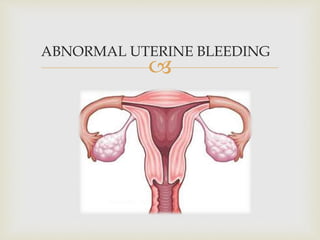
ABNORMAL UTERINE BLEEDING

Painful menstruation of sufficient magnitude so as to
incapacitate day to day activities
Types:
 Primary
 Secondary
DYSMENORRHOEA

CAUSES
1. Psychosomatic factor
2. Abnormal anatomical and functional aspect of
uterus
3. Role of vasopressin
4. Role of prostaglandins
5. Others
PRIMARY DYSMENORRHOEA

 General measures
 Drugs
Prostaglandin Synthetase inhibitor
Oral Contraceptive pills
 Surgery
Cervical dilatation
Bilateral block of pelvic plexus
Pre sacral neurectomy
TREATMENT

 Pain occurring in the presence of pelvic pathology
 Treatment aims at the cause rather than the symptom
SECONDARY DYSMENORRHOEA

 PMS is a psychoneuro endocrine disorder of
unknown etiology, often noticed just prior to
menstruation
PREMENSTRUAL SYNDROME

 Alteration in the level of estrogen and
progesterone
 Neuro endocrine factors
 Psychological and psychosocial factors
 others
PATHOPHYSIOLOGY

 Non pharmacological  Life style modification
 Non Hormonal
 Hormonal
TREATMENT

 Antidepressants or Tranquillizers
 Pyridoxine 100 mg BD
 Diuretics  Frusemide 20 mg OD *5 days
 Alprazolam 0.25 mg BD
 SSRI  Fluoxetine 20 mg
NON HORMONAL
 OCP  continued for 3 – 6 cycles
 Progesteron  Dydrogesterone 10 mg OD/BD from
fifth day of cycle *20 days
 Levonorgestrel IUS
 Bromocriptine 2.5 mg OD
 Suppression of ovarian cycle
 Danazol 200 mg OD
 GnRH analogues - Goserelin
HORMONAL

Research studies
1. Primary dysmenorrhea and physical activity.
 Department of Obstetrics and Gynecology, St.
Luke's-Roosevelt Hospital Center, New York, NY,
USA.(2012)
 Abstract
It has been widely claimed that exercise is beneficial
to dysmenorrhea, yet solid evidence is lacking. Studies
investigating this relationship have been reviewed for
this paper. Most showed improved symptomatology
with exercise.

2. Efficacy of vitamin B-6 in the treatment of
premenstrual syndrome
American college of Obstetrics and
gynaecology,USA,2012
 Result
Suggest that doses of vitamin B-6 up to 100
mg/day are likely to be of benefit in treating
premenstrual symptoms and premenstrual depression.

 Write about Post menopausal symptoms and submit
on or before 9th of April.
Assignment


Manstrual cycle

  • 1.
  • 2.
      Periodic desquamationof the endometrium  The external hallmark of the menstrual cycle  Just before menses the endometrium is infiltrated with leucocytes  Prostaglandins are maximal in the endometrium just before menses  Prostaglandins  constriction of the spiral arterioles ischemia & desquamation Followed by arteriolar relaxation, bleeding & tissue breakdown MENSTRUATION
  • 3.
      What isthe mean duration of the MC? Mean 28 days (only 15% of ♀) Range 21-35  What is the average duration of menses? 3-8 days  What is the normal estimated blood loss? Approximately 80 ml  When does ovulation occur? Usually day 14 NORMAL MENSTRUAL CYCLE
  • 4.
  • 5.
     Painful menstruation ofsufficient magnitude so as to incapacitate day to day activities Types:  Primary  Secondary DYSMENORRHOEA
  • 6.
     CAUSES 1. Psychosomatic factor 2.Abnormal anatomical and functional aspect of uterus 3. Role of vasopressin 4. Role of prostaglandins 5. Others PRIMARY DYSMENORRHOEA
  • 7.
      General measures Drugs Prostaglandin Synthetase inhibitor Oral Contraceptive pills  Surgery Cervical dilatation Bilateral block of pelvic plexus Pre sacral neurectomy TREATMENT
  • 8.
      Pain occurringin the presence of pelvic pathology  Treatment aims at the cause rather than the symptom SECONDARY DYSMENORRHOEA
  • 9.
      PMS isa psychoneuro endocrine disorder of unknown etiology, often noticed just prior to menstruation PREMENSTRUAL SYNDROME
  • 10.
      Alteration inthe level of estrogen and progesterone  Neuro endocrine factors  Psychological and psychosocial factors  others PATHOPHYSIOLOGY
  • 11.
      Non pharmacological Life style modification  Non Hormonal  Hormonal TREATMENT
  • 12.
      Antidepressants orTranquillizers  Pyridoxine 100 mg BD  Diuretics  Frusemide 20 mg OD *5 days  Alprazolam 0.25 mg BD  SSRI  Fluoxetine 20 mg NON HORMONAL
  • 13.
     OCP continued for 3 – 6 cycles  Progesteron  Dydrogesterone 10 mg OD/BD from fifth day of cycle *20 days  Levonorgestrel IUS  Bromocriptine 2.5 mg OD  Suppression of ovarian cycle  Danazol 200 mg OD  GnRH analogues - Goserelin HORMONAL
  • 15.
     Research studies 1. Primarydysmenorrhea and physical activity.  Department of Obstetrics and Gynecology, St. Luke's-Roosevelt Hospital Center, New York, NY, USA.(2012)  Abstract It has been widely claimed that exercise is beneficial to dysmenorrhea, yet solid evidence is lacking. Studies investigating this relationship have been reviewed for this paper. Most showed improved symptomatology with exercise.
  • 16.
     2. Efficacy ofvitamin B-6 in the treatment of premenstrual syndrome American college of Obstetrics and gynaecology,USA,2012  Result Suggest that doses of vitamin B-6 up to 100 mg/day are likely to be of benefit in treating premenstrual symptoms and premenstrual depression.
  • 17.
      Write aboutPost menopausal symptoms and submit on or before 9th of April. Assignment
  • 18.