Mrs. Jincy Ealias
M.Sc. (N)
Asst. Professor
Mr. Binu Babu
MBA, M.Sc. (N)
Asst. Professor
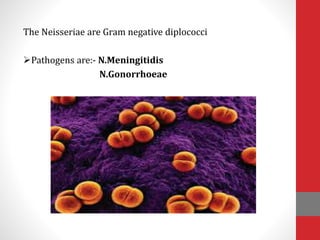
The Neisseriae are Gram negative diplococci
Pathogens are:- N.Meningitidis
N.Gonorrhoeae
Neisseria Meningitidis
General characteristics
• Gram-negative, bean-shaped, diplococci
• Do not possess flagella or spores
• Capsulated and possess pili.
• Strict parasites, do not survive long outside of the
host
• Aerobic
• Oxidative metabolism
• Produce catalase and oxidase
• Pathogenic species require enriched complex
media and CO2
Morphology
• Gram-negative, bean-shaped, diplococci
• Do not possess flagella or spores.
• Capsulated and possess pili.
• 0.8 x 0.6 µm in diameter.
Cultural characteristics
• Can grow in blood agar, Chocolate agar.
• Growth is improved by addition of blood or serum.
• Growth is also improved by incubation in the
presence of 2- 8 % CO2
• Growth temperature is 36-39⁰C and pH ranges of 6-8.
• Colonies are 1-2 mm in diameter, convex, grey and
transparent. No hemolysis in blood agar.
Biochemical properties
• Oxidase-positive; i.e., they possess the
enzyme cytochrome and produce
oxidase.
• N.Meningitidis is maltose fermenter.
• N.Meningitidis produces no beta
lactamases.
It has three important virulence factors:
1. Polysaccharride capsule. It is antiphagocytic
in nature.
2. The endotoxin of N. Meningitidis is a
lipopolysaccharide (LPS). It induces septic
shock by causing release of cytokines.
3. IgA protease. It cleaves the IgA antibodies
present in respiratory mucosa.
Pathogenesis
• Humans are the only natural hosts
• The organisms are transmitted by airborne
droplets
• Colonize the nasopharynx and become transient
flora of the upper respiratory tract.
• From the nasopharynx, the organism can enter the
bloodstream and spread to meninges and grow in
the cerebrospinal fluid.
Diseases
• N. Meningitidis is the most common cause of
meningitis in persons between the ages of 2 and
18 years.
• Outbreaks of meningitis are most common in
winter and early spring, and favored by close
contact between individuals.
1. Meningitis
2. Meningococcemia (multiplication of bacteria in
the blood stream)
Laboratory diagnosis
• It is frequently isolated from samples such as
blood, CSF.
• Different methods for laboratory diagnosis
are:
Gram staining
Culture
Oxidase test
Fermentation tests
Latex agglutination test
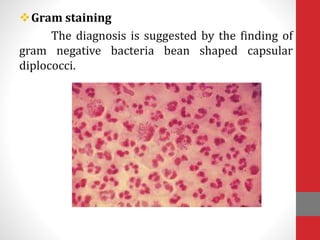
Gram staining
The diagnosis is suggested by the finding of
gram negative bacteria bean shaped capsular
diplococci.
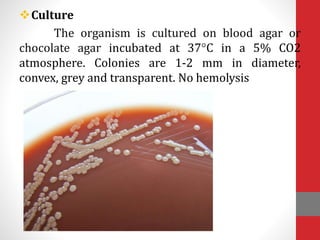
Culture
The organism is cultured on blood agar or
chocolate agar incubated at 37°C in a 5% CO2
atmosphere. Colonies are 1-2 mm in diameter,
convex, grey and transparent. No hemolysis
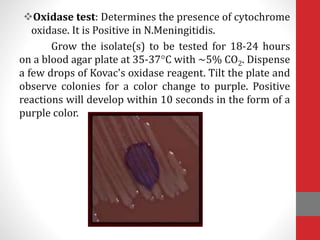
Oxidase test: Determines the presence of cytochrome
oxidase. It is Positive in N.Meningitidis.
Grow the isolate(s) to be tested for 18-24 hours
on a blood agar plate at 35-37°C with ~5% CO2. Dispense
a few drops of Kovac's oxidase reagent. Tilt the plate and
observe colonies for a color change to purple. Positive
reactions will develop within 10 seconds in the form of a
purple color.
Manitol fermentation: N. Meningitidis ferment
manitol.
Maltose fermentation: N. Meningitidis ferment
maltose.
Latex agglutination test, which detects capsular
polysaccharide in the spinal fluid.
Treatment and Prevention
• Penicillin G or sulphonamides are the drugs of
choice.
• Cholramphenicol or third generation
cephalosporin such as cefotaxime or
ceftriaxone are recommended for patients
who are allergic to penicillin.
• Meningococcal vaccine, is available which
contains the capsular polysaccharide.
Neisseria Gonorrhoeae
• N. Gonorrhoeae causes gonorrhea, neonatal
conjunctivitis (ophthalmia neonatorum) and
pelvic inflammatory disease (PID).
Morphology
• Oval shaped
• Gram negative diplococci
• Size is 0.6 to 0.8 µm.
• Occurs in pair
• Non motile
• Capsulated and have pilli
Cultural characteristics
• Can grow in enriched media such as chocolate
agar.
• Growth is also improved by incubation in the
presence of 5- 10% CO2
• Growth temperature is 37⁰C and no growth if
the temperature is less than 25⁰C or more
than 38.5⁰C
• pH ranges of 7.2-7.6.
Biochemical properties
The virulence factors are.
1. Pili: Most important virulence factors.
Piliated gonococci are usually virulent, whereas
non piliated strains are avirulent.
2. Two virulence factors in the cell wall
a) Lipooligosaccharride (LOS) (a modified form of
endotoxin). Endotoxin of gonococci is weaker than
that of meningococci.
b) Outer membrane proteins(OMP) : OMP cause
attachment of bacteria to epithelial cells of the
urethra, rectum, cervix, pharynx, or conjunctiva, like
pilli.
3. IgA protease
• The main host defenses against gonococci are
antibodies (IgA and IgG), complement, and
neutrophils.
• IgA protease degrades one of these antibodies.
Other biochemical properties are;
• They ferment glucose
• They are oxidase positive
Pathogenesis
• Humans are only reservoir, not part of normal
flora.
• Causes disease only in humans.
• Transmitted sexually both in males and
females.
• N. gonorrhea causes following infections.
1. Gonorrhea
2. Neonatal conjunctivitis (ophthalmia
neonatorum)
3. Pelvic inflammatory disease (PID).
Laboratory diagnosis
• It is frequently isolated from samples such
as blood, urethral discharge in men,
cervical discharge in females.
• Different methods for laboratory diagnosis
are:
Gram staining
Culture
Oxidase test
Fermentation tests
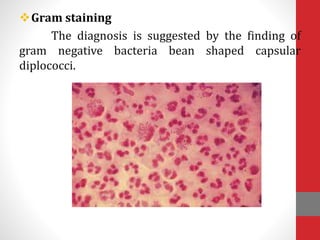
Gram staining
The diagnosis is suggested by the finding of
gram negative bacteria bean shaped capsular
diplococci.
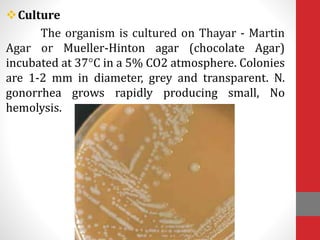
Culture
The organism is cultured on Thayar - Martin
Agar or Mueller-Hinton agar (chocolate Agar)
incubated at 37°C in a 5% CO2 atmosphere. Colonies
are 1-2 mm in diameter, grey and transparent. N.
gonorrhea grows rapidly producing small, No
hemolysis.
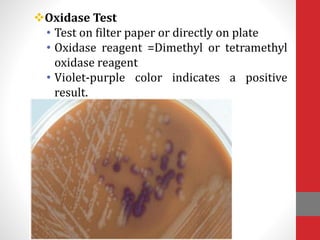
Oxidase Test
• Test on filter paper or directly on plate
• Oxidase reagent =Dimethyl or tetramethyl
oxidase reagent
• Violet-purple color indicates a positive
result.
Manitol fermentation: N. Gonorrhea ferment manitol.
Maltose fermentation: N. Gonorrhea do not ferment
maltose.
Treatment and Prevention
Treatment
• Penicillin
• Tetracycline if beta-lactamase positive
strain. Can also use cephalosporins and
flouroquinolones.
Prevention
• The prevention of gonorrhea involves the
use of safety measures and the immediate
treatment of symptomatic patients and their
contacts.
Neisseria

Neisseria

  • 1.
    Mrs. Jincy Ealias M.Sc.(N) Asst. Professor Mr. Binu Babu MBA, M.Sc. (N) Asst. Professor
  • 2.
    The Neisseriae areGram negative diplococci Pathogens are:- N.Meningitidis N.Gonorrhoeae
  • 3.
    Neisseria Meningitidis General characteristics •Gram-negative, bean-shaped, diplococci • Do not possess flagella or spores • Capsulated and possess pili. • Strict parasites, do not survive long outside of the host • Aerobic • Oxidative metabolism • Produce catalase and oxidase • Pathogenic species require enriched complex media and CO2
  • 4.
    Morphology • Gram-negative, bean-shaped,diplococci • Do not possess flagella or spores. • Capsulated and possess pili. • 0.8 x 0.6 µm in diameter. Cultural characteristics • Can grow in blood agar, Chocolate agar. • Growth is improved by addition of blood or serum. • Growth is also improved by incubation in the presence of 2- 8 % CO2 • Growth temperature is 36-39⁰C and pH ranges of 6-8. • Colonies are 1-2 mm in diameter, convex, grey and transparent. No hemolysis in blood agar.
  • 5.
    Biochemical properties • Oxidase-positive;i.e., they possess the enzyme cytochrome and produce oxidase. • N.Meningitidis is maltose fermenter. • N.Meningitidis produces no beta lactamases.
  • 6.
    It has threeimportant virulence factors: 1. Polysaccharride capsule. It is antiphagocytic in nature. 2. The endotoxin of N. Meningitidis is a lipopolysaccharide (LPS). It induces septic shock by causing release of cytokines. 3. IgA protease. It cleaves the IgA antibodies present in respiratory mucosa.
  • 7.
    Pathogenesis • Humans arethe only natural hosts • The organisms are transmitted by airborne droplets • Colonize the nasopharynx and become transient flora of the upper respiratory tract. • From the nasopharynx, the organism can enter the bloodstream and spread to meninges and grow in the cerebrospinal fluid.
  • 8.
    Diseases • N. Meningitidisis the most common cause of meningitis in persons between the ages of 2 and 18 years. • Outbreaks of meningitis are most common in winter and early spring, and favored by close contact between individuals. 1. Meningitis 2. Meningococcemia (multiplication of bacteria in the blood stream)
  • 9.
    Laboratory diagnosis • Itis frequently isolated from samples such as blood, CSF. • Different methods for laboratory diagnosis are: Gram staining Culture Oxidase test Fermentation tests Latex agglutination test
  • 10.
    Gram staining The diagnosisis suggested by the finding of gram negative bacteria bean shaped capsular diplococci.
  • 11.
    Culture The organism iscultured on blood agar or chocolate agar incubated at 37°C in a 5% CO2 atmosphere. Colonies are 1-2 mm in diameter, convex, grey and transparent. No hemolysis
  • 12.
    Oxidase test: Determinesthe presence of cytochrome oxidase. It is Positive in N.Meningitidis. Grow the isolate(s) to be tested for 18-24 hours on a blood agar plate at 35-37°C with ~5% CO2. Dispense a few drops of Kovac's oxidase reagent. Tilt the plate and observe colonies for a color change to purple. Positive reactions will develop within 10 seconds in the form of a purple color.
  • 13.
    Manitol fermentation: N.Meningitidis ferment manitol. Maltose fermentation: N. Meningitidis ferment maltose. Latex agglutination test, which detects capsular polysaccharide in the spinal fluid.
  • 14.
    Treatment and Prevention •Penicillin G or sulphonamides are the drugs of choice. • Cholramphenicol or third generation cephalosporin such as cefotaxime or ceftriaxone are recommended for patients who are allergic to penicillin. • Meningococcal vaccine, is available which contains the capsular polysaccharide.
  • 15.
    Neisseria Gonorrhoeae • N.Gonorrhoeae causes gonorrhea, neonatal conjunctivitis (ophthalmia neonatorum) and pelvic inflammatory disease (PID). Morphology • Oval shaped • Gram negative diplococci • Size is 0.6 to 0.8 µm. • Occurs in pair • Non motile • Capsulated and have pilli
  • 16.
    Cultural characteristics • Cangrow in enriched media such as chocolate agar. • Growth is also improved by incubation in the presence of 5- 10% CO2 • Growth temperature is 37⁰C and no growth if the temperature is less than 25⁰C or more than 38.5⁰C • pH ranges of 7.2-7.6.
  • 17.
    Biochemical properties The virulencefactors are. 1. Pili: Most important virulence factors. Piliated gonococci are usually virulent, whereas non piliated strains are avirulent. 2. Two virulence factors in the cell wall a) Lipooligosaccharride (LOS) (a modified form of endotoxin). Endotoxin of gonococci is weaker than that of meningococci. b) Outer membrane proteins(OMP) : OMP cause attachment of bacteria to epithelial cells of the urethra, rectum, cervix, pharynx, or conjunctiva, like pilli.
  • 18.
    3. IgA protease •The main host defenses against gonococci are antibodies (IgA and IgG), complement, and neutrophils. • IgA protease degrades one of these antibodies. Other biochemical properties are; • They ferment glucose • They are oxidase positive
  • 19.
    Pathogenesis • Humans areonly reservoir, not part of normal flora. • Causes disease only in humans. • Transmitted sexually both in males and females. • N. gonorrhea causes following infections. 1. Gonorrhea 2. Neonatal conjunctivitis (ophthalmia neonatorum) 3. Pelvic inflammatory disease (PID).
  • 20.
    Laboratory diagnosis • Itis frequently isolated from samples such as blood, urethral discharge in men, cervical discharge in females. • Different methods for laboratory diagnosis are: Gram staining Culture Oxidase test Fermentation tests
  • 21.
    Gram staining The diagnosisis suggested by the finding of gram negative bacteria bean shaped capsular diplococci.
  • 22.
    Culture The organism iscultured on Thayar - Martin Agar or Mueller-Hinton agar (chocolate Agar) incubated at 37°C in a 5% CO2 atmosphere. Colonies are 1-2 mm in diameter, grey and transparent. N. gonorrhea grows rapidly producing small, No hemolysis.
  • 23.
    Oxidase Test • Teston filter paper or directly on plate • Oxidase reagent =Dimethyl or tetramethyl oxidase reagent • Violet-purple color indicates a positive result.
  • 24.
    Manitol fermentation: N.Gonorrhea ferment manitol. Maltose fermentation: N. Gonorrhea do not ferment maltose.
  • 25.
    Treatment and Prevention Treatment •Penicillin • Tetracycline if beta-lactamase positive strain. Can also use cephalosporins and flouroquinolones. Prevention • The prevention of gonorrhea involves the use of safety measures and the immediate treatment of symptomatic patients and their contacts.