Fintech at the
Crossroads:
Regulatory
Divergence and
Technological
Convergence
in 2026
Executive Summary
Fintech is entering 2026 at a pivotal moment of both
convergence and divergence. Emerging technologies such
as agentic AI, stablecoins, and embedded finance are
advancing alongside increasingly fragmented global
regulation. Fintech at the Crossroads examines ten
fintech subsectors that present new opportunities
for innovators and institutions navigating this
evolving landscape. The paper explores why each
subsector matters and how organizations can
turn compliance into competitive advantage
while shaping the next generation of financial
experiences users now expect.
The more things change, the more they stay
the same—or do they? On the one hand, a
wave of enabling technologies, new
challenges, and shifting attitudes is
reshaping the way companies and
individuals all over the world are
making, investing, spending, and
moving their money. On the other
hand, sharply divergent paths toward
regulation, consumer rights, and
more suggest that this wave will hit
different shores in different ways.
This Finovate white paper, Fintech
at the Crossroads: Regulatory
Divergence and Technological
Convergence in 2026, will examine
the major fintech trends that are
impacting financial services
decision-makers and
entrepreneurs worldwide. We
are especially interested in how
the challenges of 2025 will turn
into the opportunities of 2026,
and what fintech companies are
doing to turn these
opportunities into real-world
solutions for banks, credit
unions, their customers, and
members.
Credits:
Julie Muhn, Finovate Senior Research Analyst
David Penn, Finovate Research Analyst
https://Finovate.com
@FINOVATE
© 2025 Finovate
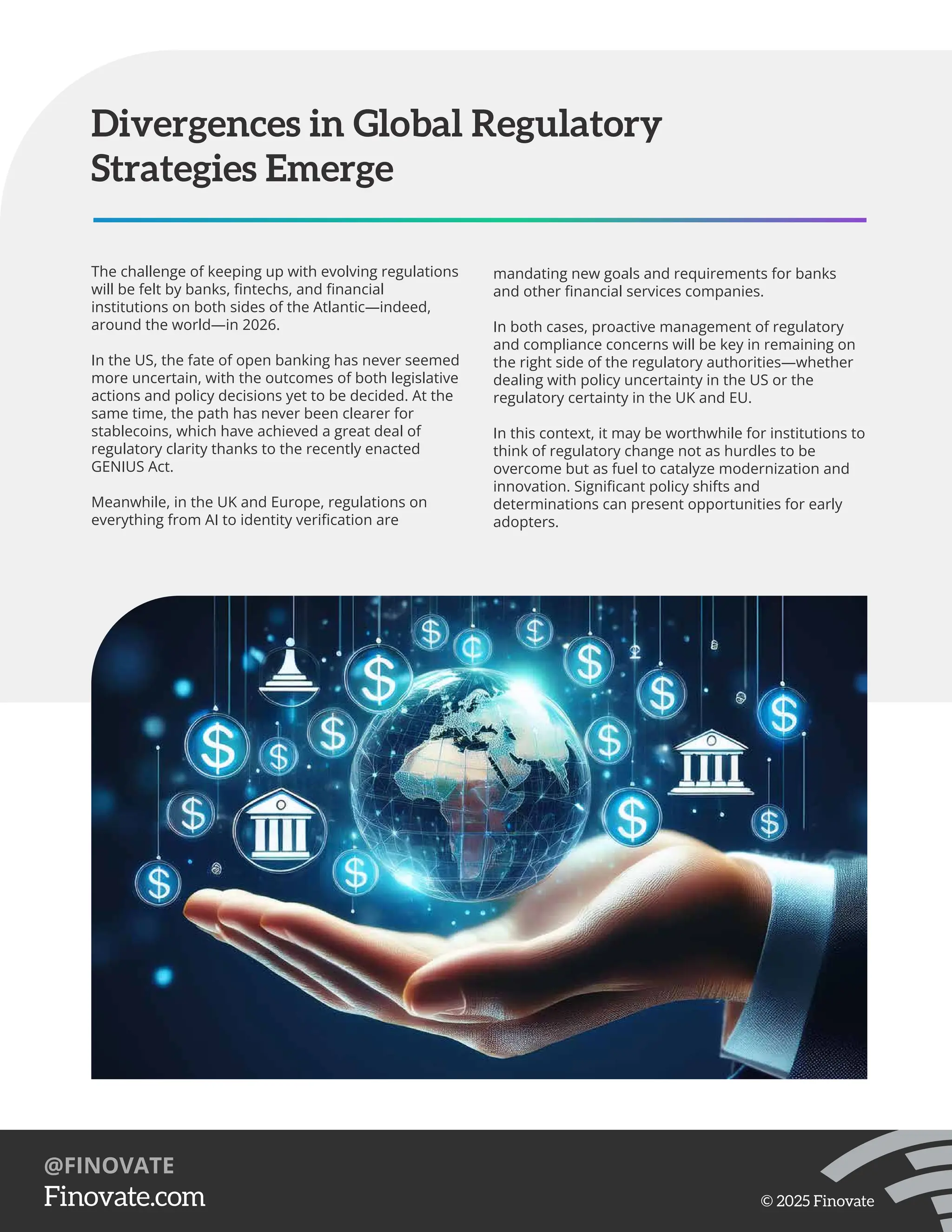
The challenge of keeping up with evolving regulations
will be felt by banks, fintechs, and financial
institutions on both sides of the Atlantic—indeed,
around the world—in 2026.
In the US, the fate of open banking has never seemed
more uncertain, with the outcomes of both legislative
actions and policy decisions yet to be decided. At the
same time, the path has never been clearer for
stablecoins, which have achieved a great deal of
regulatory clarity thanks to the recently enacted
GENIUS Act.
Meanwhile, in the UK and Europe, regulations on
everything from AI to identity verification are
Divergences in Global Regulatory
Strategies Emerge
mandating new goals and requirements for banks
and other financial services companies.
In both cases, proactive management of regulatory
and compliance concerns will be key in remaining on
the right side of the regulatory authorities—whether
dealing with policy uncertainty in the US or the
regulatory certainty in the UK and EU.
In this context, it may be worthwhile for institutions to
think of regulatory change not as hurdles to be
overcome but as fuel to catalyze modernization and
innovation. Significant policy shifts and
determinations can present opportunities for early
adopters.
https://Finovate.com
@FINOVATE
© 2025 Finovate
As previously discussed, the fate of open banking
in the US is very much in question. Most recently,
in October, a judge blocked enforcement of the
CFPB’s open banking rule pending
reconsideration.
That said, open banking-related compliance
deadlines are coming into effect in 2026. These
regulations impact primarily the largest banks
and will require them to meet new standards
regarding data access, technical implementation,
consumer authorization, privacy standards, and
more. How well these big banks meet these
challenges will help others in the
industry—community financial institutions,
fintechs—identify the most significant pain points
and implementation difficulties. More
importantly, it will help determine what
technology solutions can be deployed to address
them, from API development to security
architecture to staff training and compliance
monitoring.
In contrast, open banking is on much surer
footing in Europe. Heading into 2026, the next
round of regulations on data access will bring
customer experience enhancements, a better
framework for international transactions, and
improved security and fraud prevention
measures. Nevertheless, as in the US, identifying
best practices for efficient compliance with these
requirements will be valuable.
Open Banking and
Open Finance in a
Post-1033 World
https://Finovate.com
@FINOVATE
© 2025 Finovate
2025 saw most embedded finance innovations
focused on pilot integrations and merchant-led credit
or payment features. Next year, expect more
companies to move beyond lending- and
payment-based embedded functionality to include
full-stack banking, insurance, and investment services
offered as built-in solutions rather than add-ons.
The key to making embedded finance work will be the
seamless nature of the customer experience, requiring
an artful alignment of design and engineering. Timing
and location in the customer journey will also be
important in delivering the right experience at the
right time.
Embedded Finance Expands Beyond
Payments
Additionally, both trust and transparency will be
paramount; just because a process is embedded
doesn’t mean that customers should be blind to what
is happening with their data or their money.
While considerable attention is being paid to
innovations on the consumer side, we should watch
for greater penetration by embedded finance on the
B2B side of the market. Working capital solutions
embedded in procurement workflows and payments
solutions offered to accounting and invoice platforms
focused on small and medium-sized businesses are
just a few examples.
https://Finovate.com
@FINOVATE
© 2025 Finovate
Wealthtech 2.0: Beyond
Robo-Advisors
It’s been a decade since wealthtech first stepped into the
spotlight as the darling of fintech. Backed by advances in big
data and algorithmic modeling, roboadvisors exploded in
popularity, and helped popularize the phrase “high tech, high
touch.” After a period of consolidation, roboadvisors are still
thriving, but a new era of wealthtech is on the horizon.
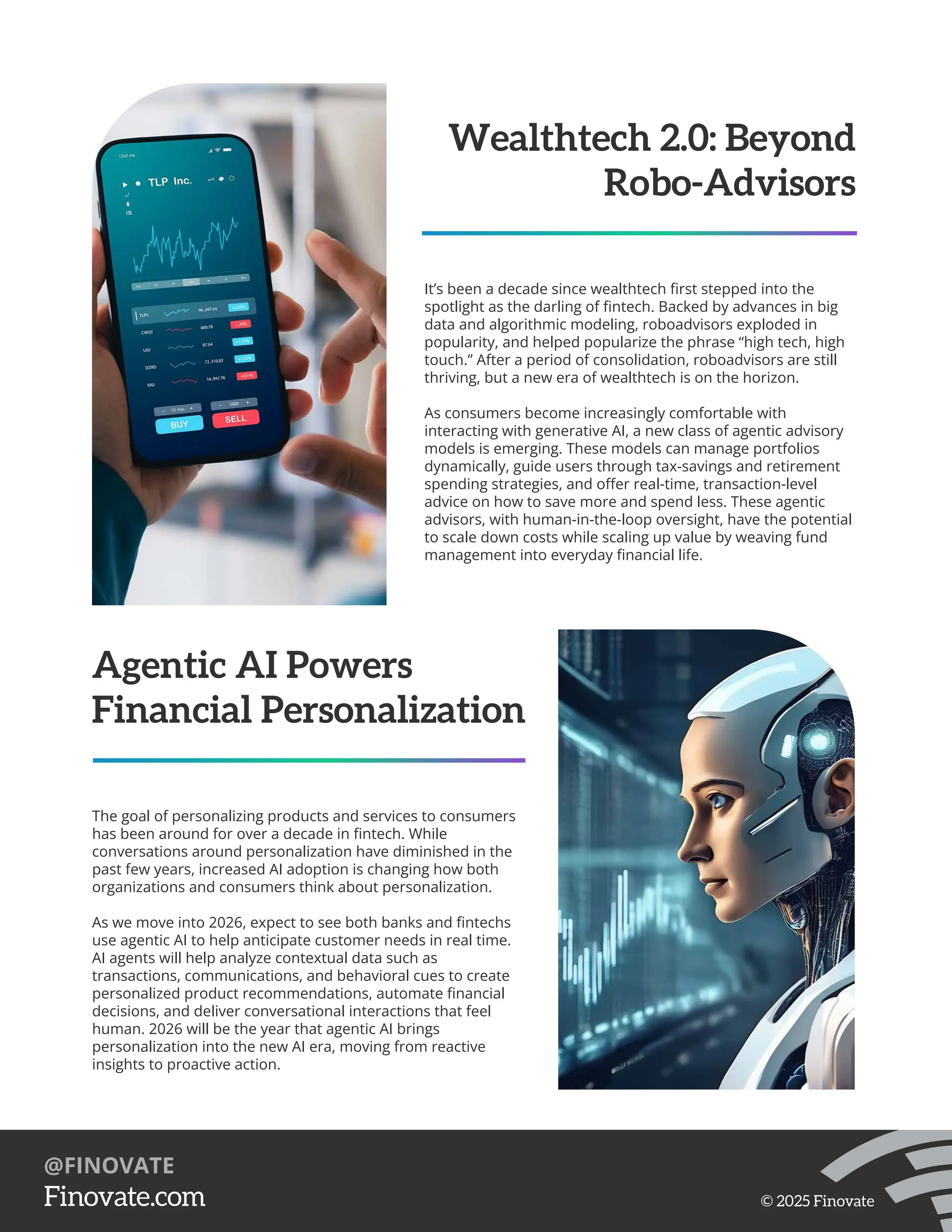
As consumers become increasingly comfortable with
interacting with generative AI, a new class of agentic advisory
models is emerging. These models can manage portfolios
dynamically, guide users through tax-savings and retirement
spending strategies, and offer real-time, transaction-level
advice on how to save more and spend less. These agentic
advisors, with human-in-the-loop oversight, have the potential
to scale down costs while scaling up value by weaving fund
management into everyday financial life.
Agentic AI Powers
Financial Personalization
The goal of personalizing products and services to consumers
has been around for over a decade in fintech. While
conversations around personalization have diminished in the
past few years, increased AI adoption is changing how both
organizations and consumers think about personalization.
As we move into 2026, expect to see both banks and fintechs
use agentic AI to help anticipate customer needs in real time.
AI agents will help analyze contextual data such as
transactions, communications, and behavioral cues to create
personalized product recommendations, automate financial
decisions, and deliver conversational interactions that feel
human. 2026 will be the year that agentic AI brings
personalization into the new AI era, moving from reactive
insights to proactive action.
https://Finovate.com
@FINOVATE
© 2025 Finovate
Agentic AI Fuels the
Next Era of Commerce
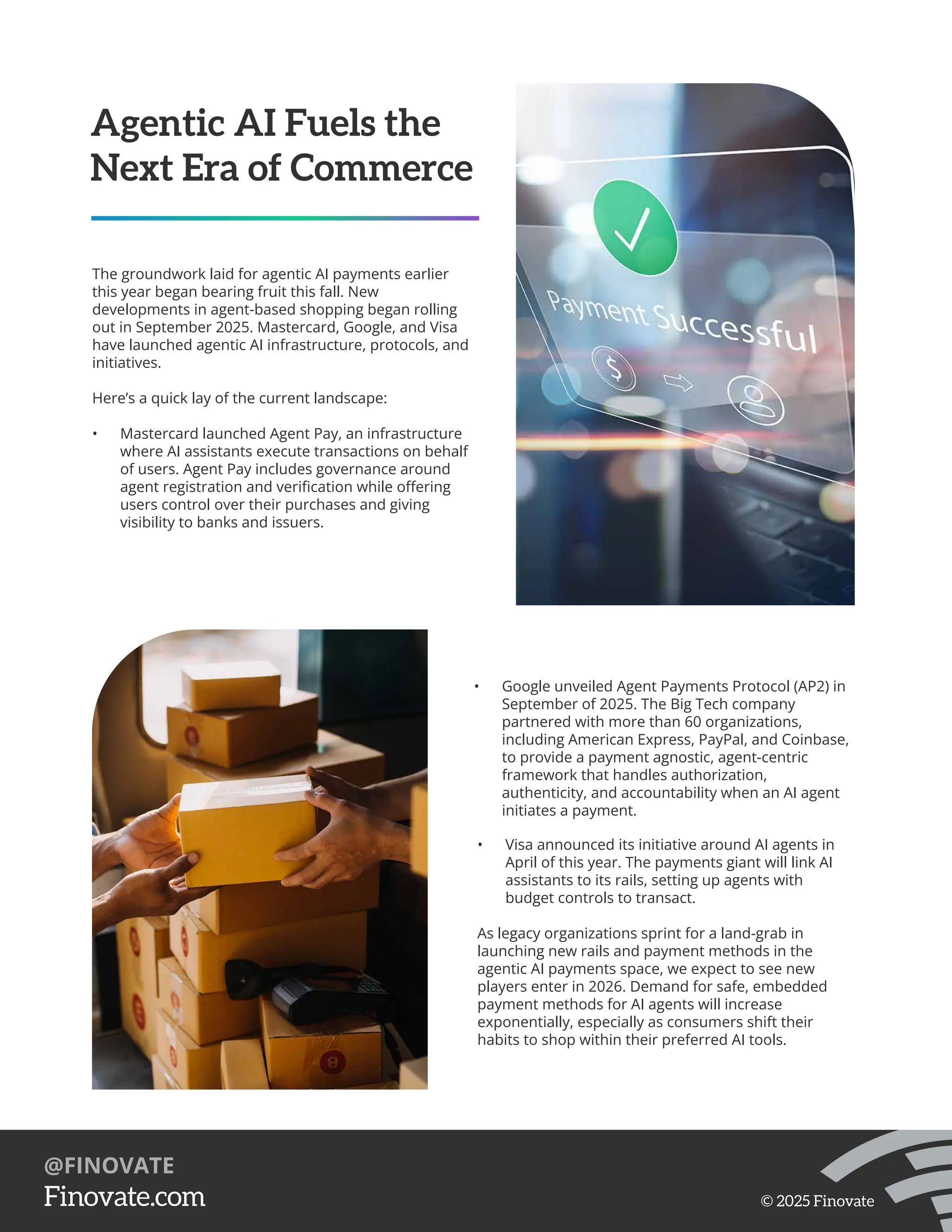
The groundwork laid for agentic AI payments earlier
this year began bearing fruit this fall. New
developments in agent-based shopping began rolling
out in September 2025. Mastercard, Google, and Visa
have launched agentic AI infrastructure, protocols, and
initiatives.
Here’s a quick lay of the current landscape:
• Mastercard launched Agent Pay, an infrastructure
where AI assistants execute transactions on behalf
of users. Agent Pay includes governance around
agent registration and verification while offering
users control over their purchases and giving
visibility to banks and issuers.
• Google unveiled Agent Payments Protocol (AP2) in
September of 2025. The Big Tech company
partnered with more than 60 organizations,
including American Express, PayPal, and Coinbase,
to provide a payment agnostic, agent-centric
framework that handles authorization,
authenticity, and accountability when an AI agent
initiates a payment.
• Visa announced its initiative around AI agents in
April of this year. The payments giant will link AI
assistants to its rails, setting up agents with
budget controls to transact.
As legacy organizations sprint for a land-grab in
launching new rails and payment methods in the
agentic AI payments space, we expect to see new
players enter in 2026. Demand for safe, embedded
payment methods for AI agents will increase
exponentially, especially as consumers shift their
habits to shop within their preferred AI tools.
https://Finovate.com
@FINOVATE
© 2025 Finovate
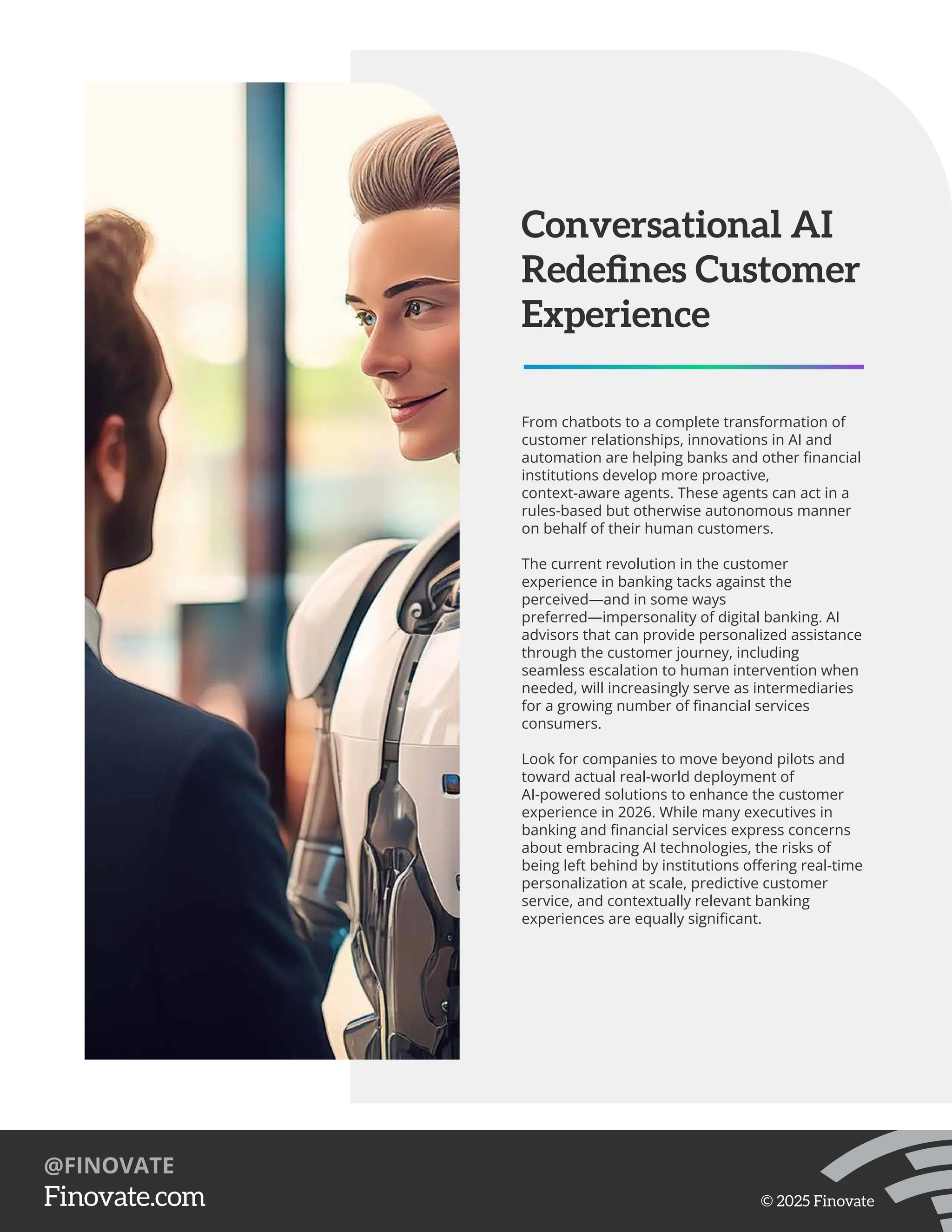
From chatbots to a complete transformation of
customer relationships, innovations in AI and
automation are helping banks and other financial
institutions develop more proactive,
context-aware agents. These agents can act in a
rules-based but otherwise autonomous manner
on behalf of their human customers.
The current revolution in the customer
experience in banking tacks against the
perceived—and in some ways
preferred—impersonality of digital banking. AI
advisors that can provide personalized assistance
through the customer journey, including
seamless escalation to human intervention when
needed, will increasingly serve as intermediaries
for a growing number of financial services
consumers.
Look for companies to move beyond pilots and
toward actual real-world deployment of
AI-powered solutions to enhance the customer
experience in 2026. While many executives in
banking and financial services express concerns
about embracing AI technologies, the risks of
being left behind by institutions offering real-time
personalization at scale, predictive customer
service, and contextually relevant banking
experiences are equally significant.
Conversational AI
Redefines Customer
Experience
https://Finovate.com
@FINOVATE
© 2025 Finovate
Stablecoins Drive Payment
Interoperability
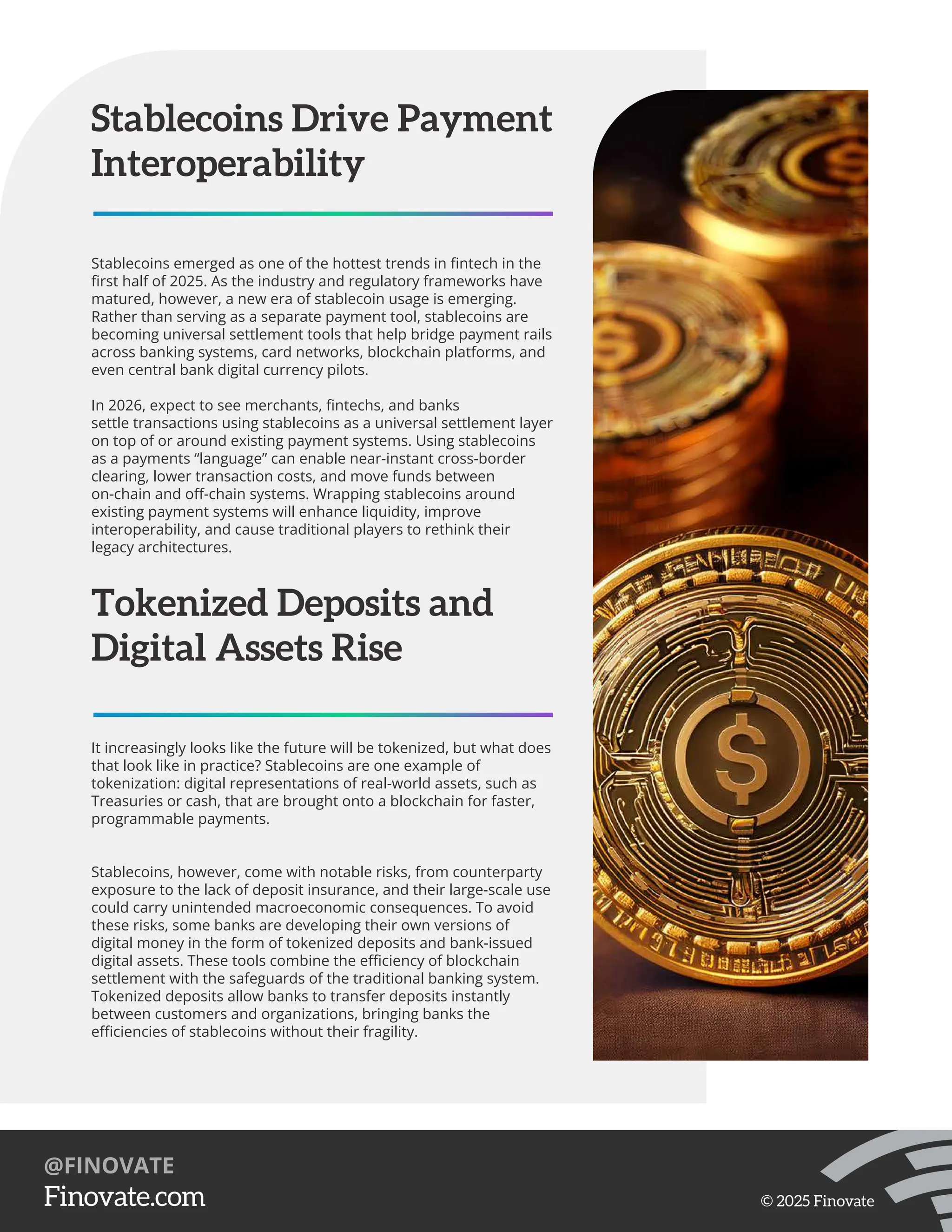
Stablecoins emerged as one of the hottest trends in fintech in the
first half of 2025. As the industry and regulatory frameworks have
matured, however, a new era of stablecoin usage is emerging.
Rather than serving as a separate payment tool, stablecoins are
becoming universal settlement tools that help bridge payment rails
across banking systems, card networks, blockchain platforms, and
even central bank digital currency pilots.
In 2026, expect to see merchants, fintechs, and banks
settle transactions using stablecoins as a universal settlement layer
on top of or around existing payment systems. Using stablecoins
as a payments “language” can enable near-instant cross-border
clearing, lower transaction costs, and move funds between
on-chain and off-chain systems. Wrapping stablecoins around
existing payment systems will enhance liquidity, improve
interoperability, and cause traditional players to rethink their
legacy architectures.
Tokenized Deposits and
Digital Assets Rise
It increasingly looks like the future will be tokenized, but what does
that look like in practice? Stablecoins are one example of
tokenization: digital representations of real-world assets, such as
Treasuries or cash, that are brought onto a blockchain for faster,
programmable payments.
Stablecoins, however, come with notable risks, from counterparty
exposure to the lack of deposit insurance, and their large-scale use
could carry unintended macroeconomic consequences. To avoid
these risks, some banks are developing their own versions of
digital money in the form of tokenized deposits and bank-issued
digital assets. These tools combine the efficiency of blockchain
settlement with the safeguards of the traditional banking system.
Tokenized deposits allow banks to transfer deposits instantly
between customers and organizations, bringing banks the
efficiencies of stablecoins without their fragility.
https://Finovate.com
@FINOVATE
© 2025 Finovate
Banks and financial services companies remain
among the top targets for fraud, with only the
healthcare sector experiencing greater dollar losses
from fraud. Many of the top threats to financial
services firms and their customers that were
prevalent in 2025—AI-powered phishing attacks,
synthetic identity fraud, and ransomware—are likely
to continue as challenges in 2026. There is also
evidence of a growing form of fraud—first-party
fraud—in which the criminal and the customer are
one and the same. Threats like these are a reminder
that not every evolution of financial crime will be
exclusively technologically driven.
New Fraud Threats Bring New
Challenges
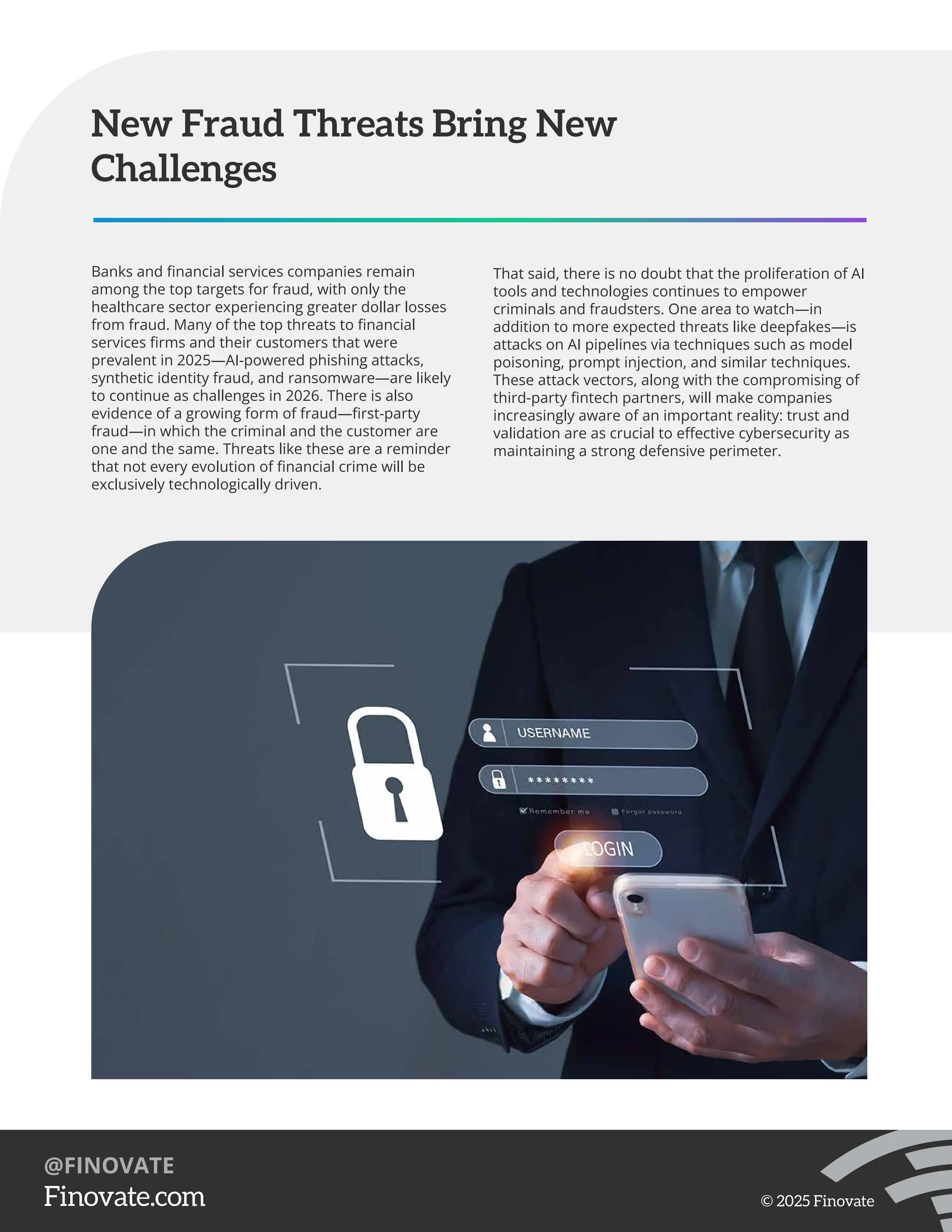
That said, there is no doubt that the proliferation of AI
tools and technologies continues to empower
criminals and fraudsters. One area to watch—in
addition to more expected threats like deepfakes—is
attacks on AI pipelines via techniques such as model
poisoning, prompt injection, and similar techniques.
These attack vectors, along with the compromising of
third-party fintech partners, will make companies
increasingly aware of an important reality: trust and
validation are as crucial to effective cybersecurity as
maintaining a strong defensive perimeter.
https://Finovate.com
@FINOVATE
© 2025 Finovate
Conclusion:
AI, Digital Assets, and the
Future of Fintech
The 2026 financial services landscape will be
characterized by agentic AI, digital assets like
stablecoins, and significantly divergent regulatory
environments. Agentic AI is transforming commerce,
wealth management, customer service, and more
through proactive, personalized experiences that
anticipate rather than react to user needs.
Stablecoins and tokenized deposits are closing
the gap between decentralized and traditional
finance. Embedded finance is making it
increasingly possible—and profitable—for
non-financial companies to expand into
payments, investing, lending, and more.
Regulatory environments vary
significantly, with the US demonstrating
clarity in some areas while facing
uncertainty in others. Meanwhile, in
places like Europe—and even Asia and
MENA—more progressive regulators
have provided greater clarity on the
rules of the road. This is compelling
institutions—and the fintech
innovators seeking to serve them—to
scramble to keep up.
The defining shift moving into 2026
is the transition from reactive and
fragmented systems toward
proactive and integrated
experiences. Firms that
successfully balance innovation
with compliance, AI advancement
with customer security and trust,
and who view regulatory
frameworks as empowering
rather than obstructing, stand to
gain the most from these
emerging trends.
https://Finovate.com
@FINOVATE
© 2025 Finovate
Join us at FinovateEurope 2026 and
FinovateSpring 2026
As the fintech industry navigates the crossroads of regulatory divergence and
technological convergence, staying ahead of the curve has never been more critical.
FinovateEurope (Feb 10-11 2026, London) and FinovateSpring (May 5-7 2026, San
Diego) are your opportunities to connect with the brightest minds, cutting-edge
innovators, and industry leaders shaping the future of financial services.
At these premier events, you’ll gain firsthand insights into the trends
explored in this white paper, including agentic AI, embedded finance,
stablecoins, and tokenized deposits. Discover how fintech companies are
turning challenges into opportunities, leveraging compliance as a
competitive advantage, and redefining customer experiences with
groundbreaking technologies.
Why attend?
• Exclusive demos: Witness live demonstrations of the latest
fintech solutions that are transforming the industry.
• Expert panels: Engage with thought leaders and
regulators as they discuss the implications of global
regulatory divergence and technological advancements.
• Networking opportunities: Build connections with
fintech innovators, financial institutions, investors,
and technology providers from around the world.
• Actionable insights: Learn how to position your
organization for success in 2026 and beyond.
https://bit.ly/4nyYKBK
https://bit.ly/4hGlwGl
Finovate report on the outlook for Fintechin 2026

  • 1.
    Fintech at the Crossroads: Regulatory Divergenceand Technological Convergence in 2026
  • 2.
    Executive Summary Fintech isentering 2026 at a pivotal moment of both convergence and divergence. Emerging technologies such as agentic AI, stablecoins, and embedded finance are advancing alongside increasingly fragmented global regulation. Fintech at the Crossroads examines ten fintech subsectors that present new opportunities for innovators and institutions navigating this evolving landscape. The paper explores why each subsector matters and how organizations can turn compliance into competitive advantage while shaping the next generation of financial experiences users now expect. The more things change, the more they stay the same—or do they? On the one hand, a wave of enabling technologies, new challenges, and shifting attitudes is reshaping the way companies and individuals all over the world are making, investing, spending, and moving their money. On the other hand, sharply divergent paths toward regulation, consumer rights, and more suggest that this wave will hit different shores in different ways. This Finovate white paper, Fintech at the Crossroads: Regulatory Divergence and Technological Convergence in 2026, will examine the major fintech trends that are impacting financial services decision-makers and entrepreneurs worldwide. We are especially interested in how the challenges of 2025 will turn into the opportunities of 2026, and what fintech companies are doing to turn these opportunities into real-world solutions for banks, credit unions, their customers, and members. Credits: Julie Muhn, Finovate Senior Research Analyst David Penn, Finovate Research Analyst https://Finovate.com @FINOVATE © 2025 Finovate
  • 3.
    The challenge ofkeeping up with evolving regulations will be felt by banks, fintechs, and financial institutions on both sides of the Atlantic—indeed, around the world—in 2026. In the US, the fate of open banking has never seemed more uncertain, with the outcomes of both legislative actions and policy decisions yet to be decided. At the same time, the path has never been clearer for stablecoins, which have achieved a great deal of regulatory clarity thanks to the recently enacted GENIUS Act. Meanwhile, in the UK and Europe, regulations on everything from AI to identity verification are Divergences in Global Regulatory Strategies Emerge mandating new goals and requirements for banks and other financial services companies. In both cases, proactive management of regulatory and compliance concerns will be key in remaining on the right side of the regulatory authorities—whether dealing with policy uncertainty in the US or the regulatory certainty in the UK and EU. In this context, it may be worthwhile for institutions to think of regulatory change not as hurdles to be overcome but as fuel to catalyze modernization and innovation. Significant policy shifts and determinations can present opportunities for early adopters. https://Finovate.com @FINOVATE © 2025 Finovate
  • 4.
    As previously discussed,the fate of open banking in the US is very much in question. Most recently, in October, a judge blocked enforcement of the CFPB’s open banking rule pending reconsideration. That said, open banking-related compliance deadlines are coming into effect in 2026. These regulations impact primarily the largest banks and will require them to meet new standards regarding data access, technical implementation, consumer authorization, privacy standards, and more. How well these big banks meet these challenges will help others in the industry—community financial institutions, fintechs—identify the most significant pain points and implementation difficulties. More importantly, it will help determine what technology solutions can be deployed to address them, from API development to security architecture to staff training and compliance monitoring. In contrast, open banking is on much surer footing in Europe. Heading into 2026, the next round of regulations on data access will bring customer experience enhancements, a better framework for international transactions, and improved security and fraud prevention measures. Nevertheless, as in the US, identifying best practices for efficient compliance with these requirements will be valuable. Open Banking and Open Finance in a Post-1033 World https://Finovate.com @FINOVATE © 2025 Finovate
  • 5.
    2025 saw mostembedded finance innovations focused on pilot integrations and merchant-led credit or payment features. Next year, expect more companies to move beyond lending- and payment-based embedded functionality to include full-stack banking, insurance, and investment services offered as built-in solutions rather than add-ons. The key to making embedded finance work will be the seamless nature of the customer experience, requiring an artful alignment of design and engineering. Timing and location in the customer journey will also be important in delivering the right experience at the right time. Embedded Finance Expands Beyond Payments Additionally, both trust and transparency will be paramount; just because a process is embedded doesn’t mean that customers should be blind to what is happening with their data or their money. While considerable attention is being paid to innovations on the consumer side, we should watch for greater penetration by embedded finance on the B2B side of the market. Working capital solutions embedded in procurement workflows and payments solutions offered to accounting and invoice platforms focused on small and medium-sized businesses are just a few examples. https://Finovate.com @FINOVATE © 2025 Finovate
  • 6.
    Wealthtech 2.0: Beyond Robo-Advisors It’sbeen a decade since wealthtech first stepped into the spotlight as the darling of fintech. Backed by advances in big data and algorithmic modeling, roboadvisors exploded in popularity, and helped popularize the phrase “high tech, high touch.” After a period of consolidation, roboadvisors are still thriving, but a new era of wealthtech is on the horizon. As consumers become increasingly comfortable with interacting with generative AI, a new class of agentic advisory models is emerging. These models can manage portfolios dynamically, guide users through tax-savings and retirement spending strategies, and offer real-time, transaction-level advice on how to save more and spend less. These agentic advisors, with human-in-the-loop oversight, have the potential to scale down costs while scaling up value by weaving fund management into everyday financial life. Agentic AI Powers Financial Personalization The goal of personalizing products and services to consumers has been around for over a decade in fintech. While conversations around personalization have diminished in the past few years, increased AI adoption is changing how both organizations and consumers think about personalization. As we move into 2026, expect to see both banks and fintechs use agentic AI to help anticipate customer needs in real time. AI agents will help analyze contextual data such as transactions, communications, and behavioral cues to create personalized product recommendations, automate financial decisions, and deliver conversational interactions that feel human. 2026 will be the year that agentic AI brings personalization into the new AI era, moving from reactive insights to proactive action. https://Finovate.com @FINOVATE © 2025 Finovate
  • 7.
    Agentic AI Fuelsthe Next Era of Commerce The groundwork laid for agentic AI payments earlier this year began bearing fruit this fall. New developments in agent-based shopping began rolling out in September 2025. Mastercard, Google, and Visa have launched agentic AI infrastructure, protocols, and initiatives. Here’s a quick lay of the current landscape: • Mastercard launched Agent Pay, an infrastructure where AI assistants execute transactions on behalf of users. Agent Pay includes governance around agent registration and verification while offering users control over their purchases and giving visibility to banks and issuers. • Google unveiled Agent Payments Protocol (AP2) in September of 2025. The Big Tech company partnered with more than 60 organizations, including American Express, PayPal, and Coinbase, to provide a payment agnostic, agent-centric framework that handles authorization, authenticity, and accountability when an AI agent initiates a payment. • Visa announced its initiative around AI agents in April of this year. The payments giant will link AI assistants to its rails, setting up agents with budget controls to transact. As legacy organizations sprint for a land-grab in launching new rails and payment methods in the agentic AI payments space, we expect to see new players enter in 2026. Demand for safe, embedded payment methods for AI agents will increase exponentially, especially as consumers shift their habits to shop within their preferred AI tools. https://Finovate.com @FINOVATE © 2025 Finovate
  • 8.
    From chatbots toa complete transformation of customer relationships, innovations in AI and automation are helping banks and other financial institutions develop more proactive, context-aware agents. These agents can act in a rules-based but otherwise autonomous manner on behalf of their human customers. The current revolution in the customer experience in banking tacks against the perceived—and in some ways preferred—impersonality of digital banking. AI advisors that can provide personalized assistance through the customer journey, including seamless escalation to human intervention when needed, will increasingly serve as intermediaries for a growing number of financial services consumers. Look for companies to move beyond pilots and toward actual real-world deployment of AI-powered solutions to enhance the customer experience in 2026. While many executives in banking and financial services express concerns about embracing AI technologies, the risks of being left behind by institutions offering real-time personalization at scale, predictive customer service, and contextually relevant banking experiences are equally significant. Conversational AI Redefines Customer Experience https://Finovate.com @FINOVATE © 2025 Finovate
  • 9.
    Stablecoins Drive Payment Interoperability Stablecoinsemerged as one of the hottest trends in fintech in the first half of 2025. As the industry and regulatory frameworks have matured, however, a new era of stablecoin usage is emerging. Rather than serving as a separate payment tool, stablecoins are becoming universal settlement tools that help bridge payment rails across banking systems, card networks, blockchain platforms, and even central bank digital currency pilots. In 2026, expect to see merchants, fintechs, and banks settle transactions using stablecoins as a universal settlement layer on top of or around existing payment systems. Using stablecoins as a payments “language” can enable near-instant cross-border clearing, lower transaction costs, and move funds between on-chain and off-chain systems. Wrapping stablecoins around existing payment systems will enhance liquidity, improve interoperability, and cause traditional players to rethink their legacy architectures. Tokenized Deposits and Digital Assets Rise It increasingly looks like the future will be tokenized, but what does that look like in practice? Stablecoins are one example of tokenization: digital representations of real-world assets, such as Treasuries or cash, that are brought onto a blockchain for faster, programmable payments. Stablecoins, however, come with notable risks, from counterparty exposure to the lack of deposit insurance, and their large-scale use could carry unintended macroeconomic consequences. To avoid these risks, some banks are developing their own versions of digital money in the form of tokenized deposits and bank-issued digital assets. These tools combine the efficiency of blockchain settlement with the safeguards of the traditional banking system. Tokenized deposits allow banks to transfer deposits instantly between customers and organizations, bringing banks the efficiencies of stablecoins without their fragility. https://Finovate.com @FINOVATE © 2025 Finovate
  • 10.
    Banks and financialservices companies remain among the top targets for fraud, with only the healthcare sector experiencing greater dollar losses from fraud. Many of the top threats to financial services firms and their customers that were prevalent in 2025—AI-powered phishing attacks, synthetic identity fraud, and ransomware—are likely to continue as challenges in 2026. There is also evidence of a growing form of fraud—first-party fraud—in which the criminal and the customer are one and the same. Threats like these are a reminder that not every evolution of financial crime will be exclusively technologically driven. New Fraud Threats Bring New Challenges That said, there is no doubt that the proliferation of AI tools and technologies continues to empower criminals and fraudsters. One area to watch—in addition to more expected threats like deepfakes—is attacks on AI pipelines via techniques such as model poisoning, prompt injection, and similar techniques. These attack vectors, along with the compromising of third-party fintech partners, will make companies increasingly aware of an important reality: trust and validation are as crucial to effective cybersecurity as maintaining a strong defensive perimeter. https://Finovate.com @FINOVATE © 2025 Finovate
  • 11.
    Conclusion: AI, Digital Assets,and the Future of Fintech The 2026 financial services landscape will be characterized by agentic AI, digital assets like stablecoins, and significantly divergent regulatory environments. Agentic AI is transforming commerce, wealth management, customer service, and more through proactive, personalized experiences that anticipate rather than react to user needs. Stablecoins and tokenized deposits are closing the gap between decentralized and traditional finance. Embedded finance is making it increasingly possible—and profitable—for non-financial companies to expand into payments, investing, lending, and more. Regulatory environments vary significantly, with the US demonstrating clarity in some areas while facing uncertainty in others. Meanwhile, in places like Europe—and even Asia and MENA—more progressive regulators have provided greater clarity on the rules of the road. This is compelling institutions—and the fintech innovators seeking to serve them—to scramble to keep up. The defining shift moving into 2026 is the transition from reactive and fragmented systems toward proactive and integrated experiences. Firms that successfully balance innovation with compliance, AI advancement with customer security and trust, and who view regulatory frameworks as empowering rather than obstructing, stand to gain the most from these emerging trends. https://Finovate.com @FINOVATE © 2025 Finovate
  • 12.
    Join us atFinovateEurope 2026 and FinovateSpring 2026 As the fintech industry navigates the crossroads of regulatory divergence and technological convergence, staying ahead of the curve has never been more critical. FinovateEurope (Feb 10-11 2026, London) and FinovateSpring (May 5-7 2026, San Diego) are your opportunities to connect with the brightest minds, cutting-edge innovators, and industry leaders shaping the future of financial services. At these premier events, you’ll gain firsthand insights into the trends explored in this white paper, including agentic AI, embedded finance, stablecoins, and tokenized deposits. Discover how fintech companies are turning challenges into opportunities, leveraging compliance as a competitive advantage, and redefining customer experiences with groundbreaking technologies. Why attend? • Exclusive demos: Witness live demonstrations of the latest fintech solutions that are transforming the industry. • Expert panels: Engage with thought leaders and regulators as they discuss the implications of global regulatory divergence and technological advancements. • Networking opportunities: Build connections with fintech innovators, financial institutions, investors, and technology providers from around the world. • Actionable insights: Learn how to position your organization for success in 2026 and beyond. https://bit.ly/4nyYKBK https://bit.ly/4hGlwGl