Campylobacter
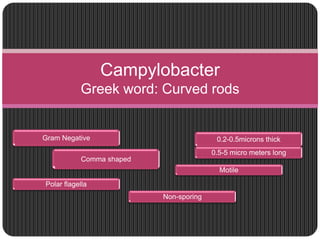
Greek word: Curved rods
Gram Negative 0.2-0.5microns thick
0.5-5 micro meters long
Motile
Non-sporing
Comma shaped
Polar flagella
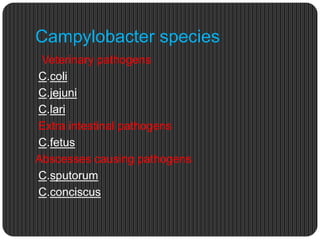
Campylobacter species
Veterinary pathogens
C.coli
C.jejuni
C.lari
Extra intestinal pathogens
C.fetus
Abscesses causing pathogens
C.sputorum
C.conciscus
Survival of Campylobacter
 They are Microaerophilic.
 Can survive in 5% oxygen.
 They are thermophilic.
 Can take a 450c .
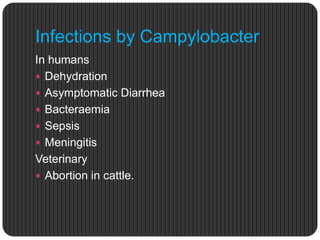
Infections by Campylobacter
In humans
 Dehydration
 Asymptomatic Diarrhea
 Bacteraemia
 Sepsis
 Meningitis
Veterinary
 Abortion in cattle.
Sources of infection
 Its a zoonotic infection meaning it spreads by the
animal to humans.
 It is present in animal and birds’ intestinal micro
flora.
 Found in water.
 It is self limited and organisms are shed after the
patients recovery by faeco-oral route.
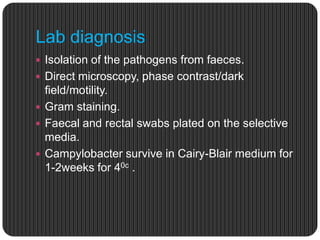
Lab diagnosis
 Isolation of the pathogens from faeces.
 Direct microscopy, phase contrast/dark
field/motility.
 Gram staining.
 Faecal and rectal swabs plated on the selective
media.
 Campylobacter survive in Cairy-Blair medium for
1-2weeks for 40c .
Medically important species
 Campylobacter jejuni is a harmful pathogen.
 Clinical disease common in children.
 Stools of the patient contain leucocytes and
blood.
 Incubation period-1-7days.
 Illness starts with fever, abdominal pain, and
watery diarrhoea.
 Invasive pathogen may involve Mesenteric lymph
nodes and cause bacteraemia.
Preventive measures.
 Cleanliness and hygiene is the most important
facto for preventive any disease.
 The formite should be cleaned.
 The faeco-oral secretion of the patient should be
disposed properly to avoid an epidemic.
 In hospitals special care should be taken to avoid
any contamination.

Campylobacter

  • 1.
    Campylobacter Greek word: Curvedrods Gram Negative 0.2-0.5microns thick 0.5-5 micro meters long Motile Non-sporing Comma shaped Polar flagella
  • 2.
    Campylobacter species Veterinary pathogens C.coli C.jejuni C.lari Extraintestinal pathogens C.fetus Abscesses causing pathogens C.sputorum C.conciscus
  • 3.
    Survival of Campylobacter They are Microaerophilic.  Can survive in 5% oxygen.  They are thermophilic.  Can take a 450c .
  • 4.
    Infections by Campylobacter Inhumans  Dehydration  Asymptomatic Diarrhea  Bacteraemia  Sepsis  Meningitis Veterinary  Abortion in cattle.
  • 5.
    Sources of infection Its a zoonotic infection meaning it spreads by the animal to humans.  It is present in animal and birds’ intestinal micro flora.  Found in water.  It is self limited and organisms are shed after the patients recovery by faeco-oral route.
  • 6.
    Lab diagnosis  Isolationof the pathogens from faeces.  Direct microscopy, phase contrast/dark field/motility.  Gram staining.  Faecal and rectal swabs plated on the selective media.  Campylobacter survive in Cairy-Blair medium for 1-2weeks for 40c .
  • 7.
    Medically important species Campylobacter jejuni is a harmful pathogen.  Clinical disease common in children.  Stools of the patient contain leucocytes and blood.  Incubation period-1-7days.  Illness starts with fever, abdominal pain, and watery diarrhoea.  Invasive pathogen may involve Mesenteric lymph nodes and cause bacteraemia.
  • 8.
    Preventive measures.  Cleanlinessand hygiene is the most important facto for preventive any disease.  The formite should be cleaned.  The faeco-oral secretion of the patient should be disposed properly to avoid an epidemic.  In hospitals special care should be taken to avoid any contamination.