B.Sc. II
Botany
UNIT IV:
PLANT
ANATOMY
TYPES OF
TISSUE
DR. DILIP V. HANDE
ASSOCIATE
PROFESSOR
DEPT OF BOTANY
SHRI SHIVAJI
SCIENCE
COLLEGE
AMRAVATI
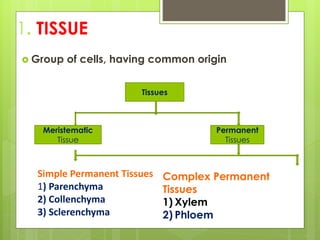
1. TISSUE
 Group of cells, having common origin
Tissues
Meristematic
Tissue
Permanent
Tissues
Simple Permanent Tissues
1) Parenchyma
2) Collenchyma
3) Sclerenchyma
Complex Permanent
Tissues
1) Xylem
2) Phloem
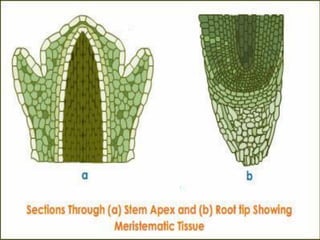
MERISTEMATIC TISSUES
 Cells have power of division
 A. Characteristics of
Meristematic Tissues
 Cells are thin walled
 Have abundant
cytoplasm
 Retain power of division
 No intracellular spaces
B. Classification of meristems :
 Based on position in plant body
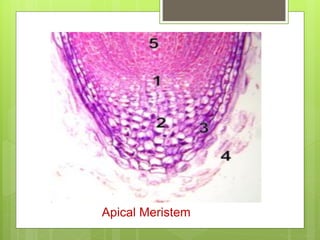
 (i) Apical meristems
 Occur at apices
 Differentiate into primary tissues
 Cause increase in length
 Axillary buds are present in axils of
leaves
Apical Meristem
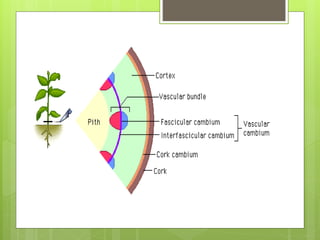
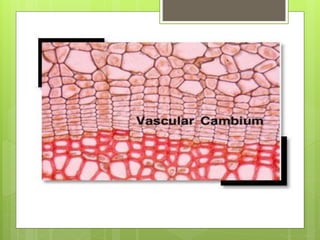
(ii) Lateral meristems :
Arranged parallel to the sides of organs
of plant
Cells produced by them differentiate
into secondary tissues
Cause increase in width of plant organ
e.g., Fascicular cambium & cork
cambium
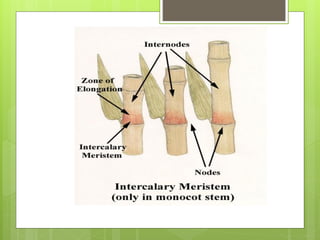
(iii) Intercalary meristems :
Meristems occur in between
mature/permanent tissues
Produce cells that form primary tissues
Cause increase in length
Occur at bases of internodes & leaf sheaths
of grasses & other monocots;
They regenerate parts removed by grazing
animals
Based on origin
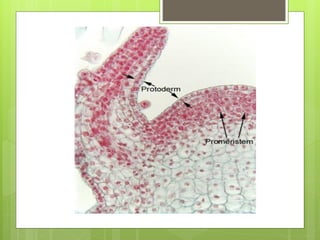
(i) Promeristems :
Group of meristematic cells in
embryo / seedlings
Give rise to primary meristems
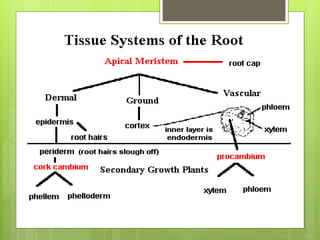
(ii) Primary meristems :
Formed from promeristems
Cells produced by them differentiate
into primary / secondary permanent
tissues
e.g., Apical meristems, fascicular
cambium & intercalary meristem
(iii) Secondary meristems :
Formed at a later stage in the life of
plant from permanent tissues by
process of dedifferentiation,
e.g., Cork cambium & inter-fascicular
cambium
3. PERMANENT TISSUES
Cells have lost power of division &
become structurally & functionally
specialized
Characteristics :
Undergone differentiation into specific types for a
particular function
2 types:
(i) Simple permanent tissues ( Tissue composed of
1 type of cell)
(ii)Complex permanent tissues ( Tissue is
composed of more than 1 type of cell)
B. Simple Permanent Tissues :
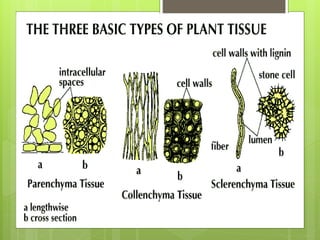
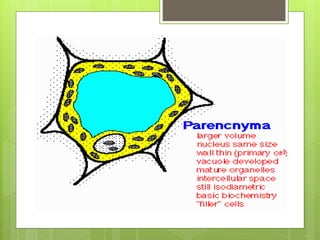
(i) Parenchyma
Cells are thin- walled
Retain capacity to divide at maturity
No intracellular spaces
Main function is storage
When parenchyma cells contain a number of
chloroplasts they are called chlorenchyma &
when they are arranged with regular system
of intercellular air spaces, they constitute
aerenchyma
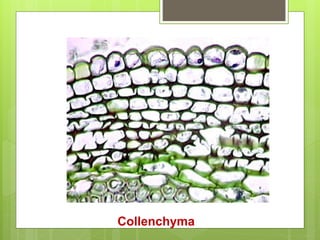
(ii) Collenchyma
Cells living at maturity
Cells are variously shaped
Cell wall is unevenly thickened
Occurs below epidermis of dicot stem
Cells may possess chloroplast
Provides strength & flexibility to
growing organs
Collenchyma
(iii) Sclerenchyma
Cells are dead at maturity
Cell wall is lignified evenly
Gives mechanical support to
organs
Has 2 types of cells :
(a)SCLEREIDS (STONE CELLS) :
Oval/spherical & have very thick walls with
narrow lumen
Occur in shells of nuts & in pulp of fruits & in
tea leaves
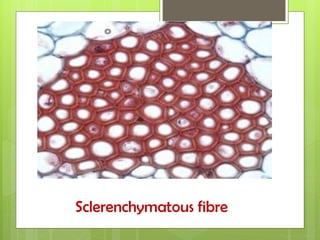
(b)FIBRES :Elongated & thick walled cells
Generally occur in groups Present in xylem
phloem & cortex & pericycle
Sclerenchymatous fibre
C. Complex Permanent Tissues :
(i)XYLEM :
Forms continuous channel
Concerned with transport of water & minerals
Provides mechanical support
Composed of treachery elements, xylem
parenchyma & xylem fibres
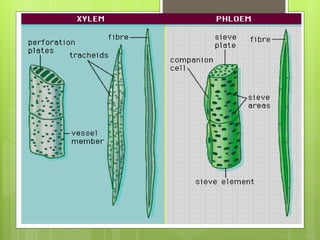
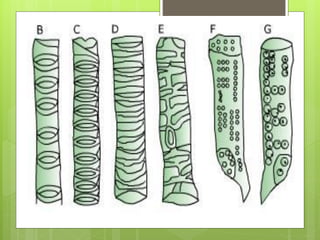
XYLEM VESSELS :
• Long cylindrical tubular structures
formed by many cells.
• End walls of vessel members have
either single large opening /
perforation / several small openings
• Have thick lignified walls
• Vessles are dead at maturity & found
in angiosperms only
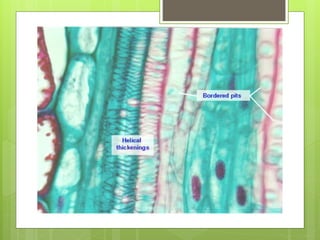
(b) XYLEM TRACHEIDS :
• Elongated cells
• Overlap one another at their slanting
ends
• Do not have perforation plates
• Have thick lignified walls
• Dead at maturity
c) XYLEM PARENCHYMA
• Thick/ thin walls of cellulose
• Only living components of xylem
• Involved in short distance transport
• Help in storage of sugars, starch,
lipids & tannins
(d) XYLEM FIBRES ( SCLERENCHYMA)
• Dead elements, Provide mechanical support
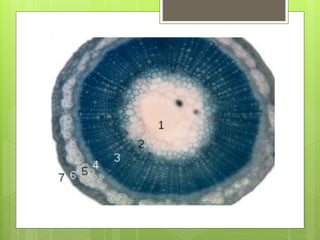
• Xylem formed in primary plant body by procambium is
called primary xylem
• 1st formed primary xylem is called protoxylem
• Later formed is called metaxylem
• In stems, protoxylem lies towards pith & metaxylem
towards periphery ; such an arrangement is called endarch
• In roots, protoxylem lies towards periphery & metaxylem
towards pith ; such an arrangement is called exarch
• Xylem constituents formed by fascicular cambium
constitute secondary xylem
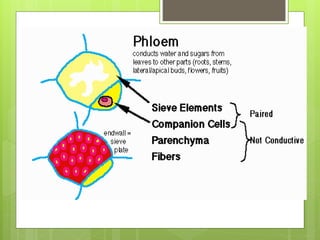
(ii) PHLOEM
 Concerned with transport of
organic substances
 Composed of sieve elements,
companion cells, phloem
parenchyma & phloem fibres
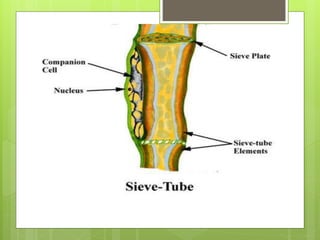
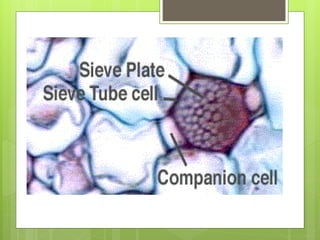
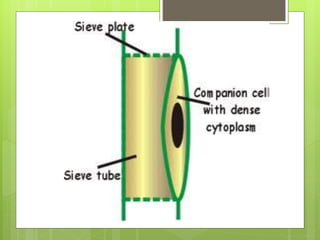
(a) SIEVE TUBES:
Formed by elongated sieve tube members
Cross walls have number of perforations
Mature sieve tube has peripheral cytoplasm
Functions are controlled by nucleus of
companion cells
Members are characteristically present in
angiosperms
(a) SIEVE CELLS :
Sieve areas are found to occur
throughout the end walls &
lateral walls
Cells are living, but lack nucleus
Found in lower vascular plants
(c) COMPANION CELLS:
Found in association with
sieve tube members
Sieve tube elements &
companion cells are
connected by pit fields
Help in maintaining the
pressure gradient
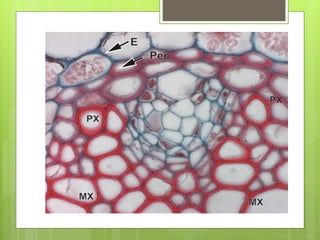
(d) PHLOEM PARENCHYMA :
Cells are elongated & cylindrical
Have dense cytoplasm &
prominent nucleus
Stores food materials & other s
substances
Absent in monocot plants
(e) PHLOEM FIBRES (BAST FIBRES) :
Found along with other elements of phloem
Elongated & thick walled cells
Dead at maturity
Absent in primary phloem
1st formed primary phloem is known as protophloem
Later formed is known as metaphloem
Elements formed by fascicular cambium constitute
secondary phloem
THANKS

Plant Anatomy types tissue

  • 1.
    B.Sc. II Botany UNIT IV: PLANT ANATOMY TYPESOF TISSUE DR. DILIP V. HANDE ASSOCIATE PROFESSOR DEPT OF BOTANY SHRI SHIVAJI SCIENCE COLLEGE AMRAVATI
  • 2.
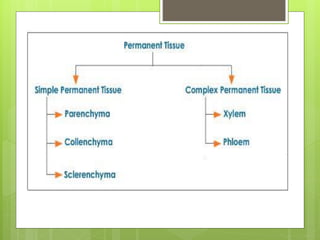
    1. TISSUE  Groupof cells, having common origin Tissues Meristematic Tissue Permanent Tissues Simple Permanent Tissues 1) Parenchyma 2) Collenchyma 3) Sclerenchyma Complex Permanent Tissues 1) Xylem 2) Phloem
  • 4.
    MERISTEMATIC TISSUES  Cellshave power of division  A. Characteristics of Meristematic Tissues  Cells are thin walled  Have abundant cytoplasm  Retain power of division  No intracellular spaces
  • 6.
    B. Classification ofmeristems :  Based on position in plant body  (i) Apical meristems  Occur at apices  Differentiate into primary tissues  Cause increase in length  Axillary buds are present in axils of leaves
  • 7.
  • 8.
    (ii) Lateral meristems: Arranged parallel to the sides of organs of plant Cells produced by them differentiate into secondary tissues Cause increase in width of plant organ e.g., Fascicular cambium & cork cambium
  • 10.
    (iii) Intercalary meristems: Meristems occur in between mature/permanent tissues Produce cells that form primary tissues Cause increase in length Occur at bases of internodes & leaf sheaths of grasses & other monocots; They regenerate parts removed by grazing animals
  • 12.
    Based on origin (i)Promeristems : Group of meristematic cells in embryo / seedlings Give rise to primary meristems
  • 14.
    (ii) Primary meristems: Formed from promeristems Cells produced by them differentiate into primary / secondary permanent tissues e.g., Apical meristems, fascicular cambium & intercalary meristem
  • 16.
    (iii) Secondary meristems: Formed at a later stage in the life of plant from permanent tissues by process of dedifferentiation, e.g., Cork cambium & inter-fascicular cambium
  • 18.
    3. PERMANENT TISSUES Cellshave lost power of division & become structurally & functionally specialized Characteristics : Undergone differentiation into specific types for a particular function 2 types: (i) Simple permanent tissues ( Tissue composed of 1 type of cell) (ii)Complex permanent tissues ( Tissue is composed of more than 1 type of cell)
  • 20.
    B. Simple PermanentTissues : (i) Parenchyma Cells are thin- walled Retain capacity to divide at maturity No intracellular spaces Main function is storage When parenchyma cells contain a number of chloroplasts they are called chlorenchyma & when they are arranged with regular system of intercellular air spaces, they constitute aerenchyma
  • 22.
    (ii) Collenchyma Cells livingat maturity Cells are variously shaped Cell wall is unevenly thickened Occurs below epidermis of dicot stem Cells may possess chloroplast Provides strength & flexibility to growing organs
  • 23.
  • 24.
    (iii) Sclerenchyma Cells aredead at maturity Cell wall is lignified evenly Gives mechanical support to organs Has 2 types of cells : (a)SCLEREIDS (STONE CELLS) : Oval/spherical & have very thick walls with narrow lumen Occur in shells of nuts & in pulp of fruits & in tea leaves (b)FIBRES :Elongated & thick walled cells Generally occur in groups Present in xylem phloem & cortex & pericycle
  • 25.
  • 26.
    C. Complex PermanentTissues : (i)XYLEM : Forms continuous channel Concerned with transport of water & minerals Provides mechanical support Composed of treachery elements, xylem parenchyma & xylem fibres
  • 27.
    XYLEM VESSELS : •Long cylindrical tubular structures formed by many cells. • End walls of vessel members have either single large opening / perforation / several small openings • Have thick lignified walls • Vessles are dead at maturity & found in angiosperms only
  • 29.
    (b) XYLEM TRACHEIDS: • Elongated cells • Overlap one another at their slanting ends • Do not have perforation plates • Have thick lignified walls • Dead at maturity
  • 30.
    c) XYLEM PARENCHYMA •Thick/ thin walls of cellulose • Only living components of xylem • Involved in short distance transport • Help in storage of sugars, starch, lipids & tannins
  • 32.
    (d) XYLEM FIBRES( SCLERENCHYMA) • Dead elements, Provide mechanical support • Xylem formed in primary plant body by procambium is called primary xylem • 1st formed primary xylem is called protoxylem • Later formed is called metaxylem • In stems, protoxylem lies towards pith & metaxylem towards periphery ; such an arrangement is called endarch • In roots, protoxylem lies towards periphery & metaxylem towards pith ; such an arrangement is called exarch • Xylem constituents formed by fascicular cambium constitute secondary xylem
  • 34.
    (ii) PHLOEM  Concernedwith transport of organic substances  Composed of sieve elements, companion cells, phloem parenchyma & phloem fibres
  • 36.
    (a) SIEVE TUBES: Formedby elongated sieve tube members Cross walls have number of perforations Mature sieve tube has peripheral cytoplasm Functions are controlled by nucleus of companion cells Members are characteristically present in angiosperms
  • 38.
    (a) SIEVE CELLS: Sieve areas are found to occur throughout the end walls & lateral walls Cells are living, but lack nucleus Found in lower vascular plants
  • 40.
    (c) COMPANION CELLS: Foundin association with sieve tube members Sieve tube elements & companion cells are connected by pit fields Help in maintaining the pressure gradient
  • 42.
    (d) PHLOEM PARENCHYMA: Cells are elongated & cylindrical Have dense cytoplasm & prominent nucleus Stores food materials & other s substances Absent in monocot plants
  • 44.
    (e) PHLOEM FIBRES(BAST FIBRES) : Found along with other elements of phloem Elongated & thick walled cells Dead at maturity Absent in primary phloem 1st formed primary phloem is known as protophloem Later formed is known as metaphloem Elements formed by fascicular cambium constitute secondary phloem
  • 46.